
Puck, 1877-10-10 · page 4 of 16
Puck — October 10, 1877 — page 4: what you’re looking at
What you’re looking at
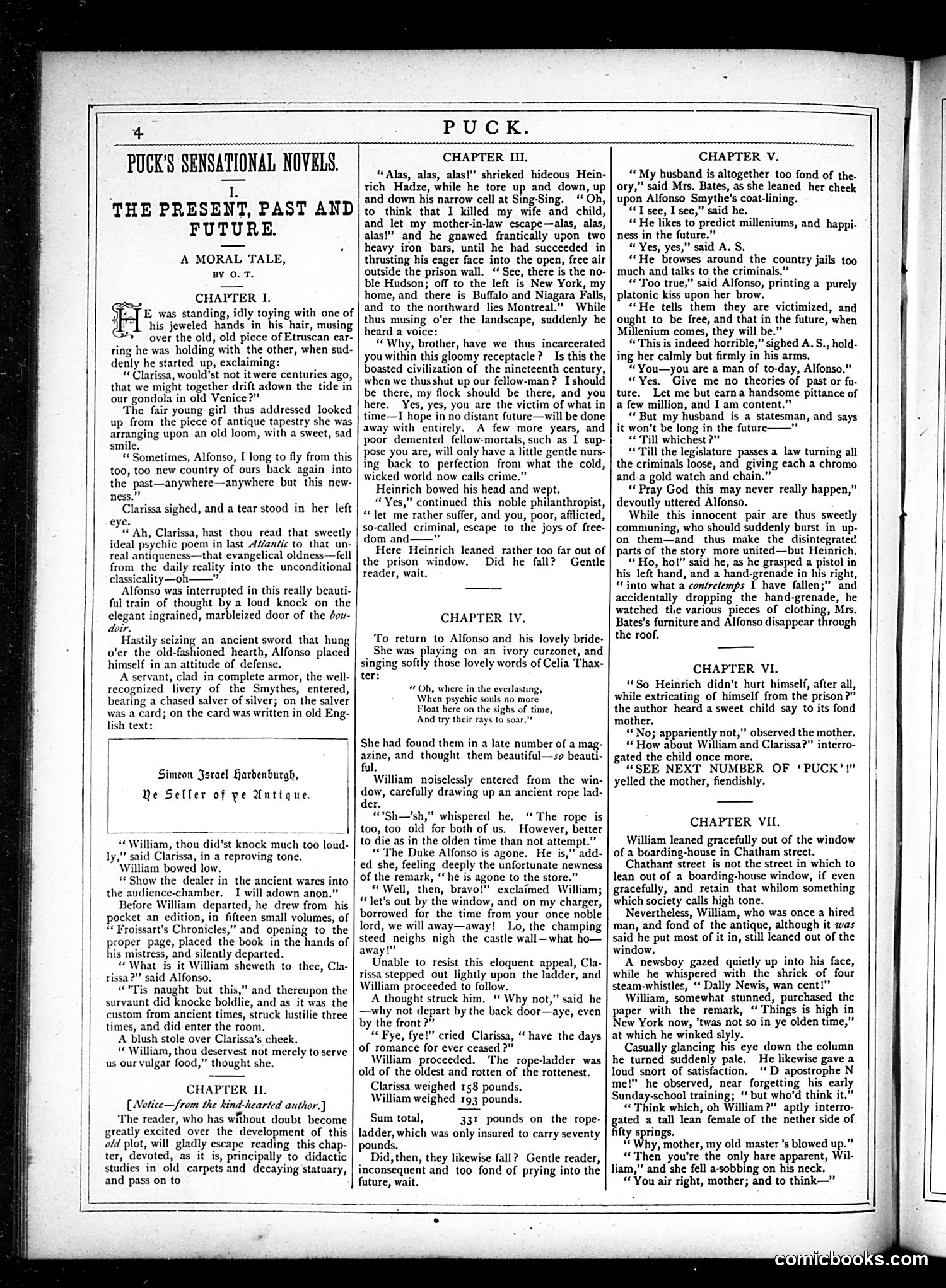
This page from Puck magazine contains the opening chapters of a serialized satirical novella titled "The Present, Past and Future: A Moral Tale" by O.D. (author unclear). Rather than political cartoons, this is **literary satire in prose form**. The story follows characters named Alonso, Clarissa, Heinrich Hudson, and William, depicting their moral failings and romantic entanglements. References to "Buffalo and Niagara Falls" and "New York" establish an American setting. The satire appears to mock 19th-century social pretensions, "civilization," and hypocrisy—common Puck themes. The narrative voice criticizes characters' self-deceptions and warns of consequences. However, **without seeing illustrations that may accompany this text, or knowing O.D.'s identity**, the specific satirical targets and contemporary references remain unclear from this page alone.
📄 Transcribed text from this page (OCR, searchable)
Machine-transcribed from the original scan — historical spelling and the odd misread are preserved.
4 PUCK. PUCK'S SENSATIONAL NOVELS. 1 THE PRESENT, PAST AND FUTURE. A MORAL TALE, BY 0. T. CHAPTER I. GET E was standing, idly toying with one of a. his jeweled hands in his hair, musing “>” over the old, old piece of Etruscan ear- ring he was holding with the other, when sud- denly he started up, exclaiming: “Clarissa, would’st not it were centuries ago, that we might together drift adown the tide in our gondola in old Venice?” The fair young girl thus addressed looked up from the piece of antique tapestry she was arranging upon an old loom, with a sweet, sad smile, “Sometimes, Alfonso, I long to fly from this too, too new country of ours back again into the past—anywhere—anywhere but this new- ness.” Clarissa sighed, and a tear stood in her left eye. “Ah, Clarissa, hast thou read that sweetly ideal psychic poem in last AVantic to that un- real antiqueness—that evangelical oldness—fell from the daily reality into the unconditional classicality—oh—” Alfonso was interrupted in this really beauti- ful train of thought by a loud knock on the elegant ingrained, marbleized door of the dou- doir, Hastily seizing an ancient sword that hung o’er the old-fashioned hearth, Alfonso placed himself in an attitude of defense. A servant, clad in complete armor, the well- recognized livery of the Smythes, entered, bearing a chased salver of silver; on the salver was a card; on the card was written in old Eng- lish text: | | Simeon Jsrael Harbenburgh, i | Ne Seller of ye Antique. | | 1 “William, thou did’st knock much too loud- 'y,” said Clarissa, in a reproving tone. William bowed low. “ Show the dealer in the ancient wares into the audience-chamber. I will adown anon.” Before William departed, he drew from his pocket an edition, in fifteen small volumes, of “ Froissart’s Chronicles,” and opening to the proper page, placed the book in the hands of his mistress, and silently departed. “What is it William sheweth to thee, Cla- rissa ?” said Alfonso. “'Tis naught but this,” and thereupon the survaunt did knocke boldlie, and as it was the custom from ancient times, struck lustilie three times, and did enter the room. A blush stole over Clarissa’s cheek. “ William, thou deservest not merely to serve us our vulgar food,” thought she. CHAPTER II. [Notice—from the kind-hearted author] ‘The reader, who has without doubt become greatly excited over the development of this old plot, will gladly escape reading this chap- ter, devoted, as it is, principally to didactic studies in old carpets and decaying statuary, and pass on to CHAPTER III. “Alas, alas, alas!” shrieked hideous Hein- tich Hadze, while he tore up and down, up and down his narrow cell at Sing-Sing. ‘Oh, to think that I killed my wife and child, and let my mother-in-law escape—alas, alas, alas!” and he gnawed frantically upon two heavy iron bars, until he had succeeded in thrusting his eager face into the open, free air outside the prison wall. ‘See, there is the no- ble Hudson; off to the left is New York, my home, and there is Buffalo and Niagara Falls, and to the northward lies Montreal.” While thus musing o’er the landscape, suddenly he heard a voice: “Why, brother, have we thus incarcerated you within this gloomy receptacle? Is this the boasted civilization of the nineteenth century, when we thus shut up our fellow-man? Ishould be there, my flock should be there, and you here. Yes, yes, you are the victim of what in time—I hope in no distant future—will be done away with entirely. A few more years, and poor demented fellow-mortals, such as I sup- pose you are, will only have a little gentle nurs- ing back to perfection from what the cold, wicked world now calls crime.” Heinrich bowed his head and wept. “Yes,” continued this noble philanthropist, “‘let_me rather suffer, and you, poor, afflicted, so-called criminal, escape to the joys of free- dom and. Here Heinrich leaned rather too far out of the prison window. Did he fall? Gentle reader, wait. CHAPTER IV, ‘To return to Alfonso and his lovely bride- She was playing on an ivory curzonet, and singing softly those lovely words of Celia Thax- ter: “Oh, where in the everlasting, When psychic souls no more Float here on the sighs of time, And try their rays to soar.”* She had found them in a late number of a mag- azine, and thought them beautiful—so beauti- ful. William_noiselessly entered from the win- dow, carefully drawing up an ancient rope lad- der. “Sh—'sh,” whispered he. ‘The rope is too, too old for both of us. However, better to die as in the olden time than not attempt.” “The Duke Alfonso is agone. He is,” add- ed she, feeling deeply the unfortunate newness of the remark, “he is agone to the store.” “Well, then, bravo!” exclaimed William; ‘let's out by the window, and on my charger, borrowed for the time from your once noble lord, we will away—away! Lo, the champing steed neighs nigh the castle wall—what ho— away!” Unable to resist this eloquent appeal, Cla- rissa stepped out lightly upon the ladder, and William proceeded to follow. A thought struck him. ‘ Why not,” said he —why not depart by the back door—aye, even by the front ?” “ Fye, fye!” cried Clarissa, “have the days of romance for ever ceased ?” William proceeded. The rope-ladder was old of the oldest and rotten of the rottenest. Clarissa weighed 158 pounds. William weighed 193 pounds. Sum total, 331 pounds on the rope- ladder, which was only insured to carry seventy pounds. Did, then, they likewise fall? Gentle reader, inconsequent and too fond of prying into the future, wait. CHAPTER V. “My husband is altogether too fond of the- ory,” said Mrs, Bates, as she leaned her cheek upon Alfonso Smythe’s coat-lining. “T see, I see,” said he. “He likes to predict milleniums, and happi- ness in the future.” “Yes, yes,” said A. S. “He browses around the country jails too much and talks to the criminals.” «Too true,” said Alfonso, printing a purely platonic kiss upon her brow. “He tells them they are victimized, and ought to be free, and that in the future, when Millenium comes, they will be.” “ This is indeed horrible,” sighed A. S., hold- ing her calmly but firmly in his arms. “You—you are a man of to-day, Alfonso.” “Yes, ‘Give me no theories of past or fu- ture. Let me but earna handsome pittance of a few million, and I am content.” ‘But my husband is a statesman, and says it won't be long in the future——" “Till whichest ?” “Till the legislature passes a law turning all the criminals loose, and giving each a chromo and.a gold watch and chain.’ “Pray God this may never really happen,” devoutly uttered Alfonso. While this innocent pair are thus sweetly communing, who should suddenly burst in up- on them—and thus make the disintegrated parts of the story more united—but Heinrich. “Ho, ho!” said he, as he grasped a pistol in his left hand, and a hand-grenade in his right, ‘into what a contretemps 1 have fallen;” and accidentally dropping the hand-grenade, he watched the various pieces of clothing, Mrs. Bates’s furniture and Alfonso disappear through the roof. CHAPTER VI. “So Heinrich didn’t hurt himself, after all, while extricating of himself from the prison?” the author heard a sweet child say to its fond mother. ‘No; appariently not,” observed the mother. “ How about William and Clarissa?” interro- gated the child once more. “SEE NEXT NUMBER OF ‘PUCK’!" yelled the mother, fiendishly. CHAPTER VII. William leaned gracefully out of the window of a boarding-house in Chatham street. Chathant street is not the street in which to lean out of a boarding-house window, if even gracefully, and retain that whilom something which society calls high tone. Nevertheless, William, who was once a hired man, and fond of the antique, although it was said he put most of it in, still leaned out of the window. A newsboy gazed quietly up into his face, while he whispered with the shrick of four steam-whistles, ‘ Dally Newis, wan cent!"" William, somewhat stunned, purchased the paper with the remark, “Things is high in New York now, ’twas not so in ye olden time,” at which he winked slyly. Casually glancing his eye down the column he turned suddenly pale. He likewise gave a loud snort of satisfaction. ‘“D apostrophe N me!” he observed, near forgetting his early Sunday-school training; ‘ but who'd think it.” “Think which, oh William?” aptly interro- gated a tall lean female of the nether side of fty springs. ‘Why, mother, my old master 's blowed up.”” “Then you're the only hare apparent, Wil- liam,” and she fell a-sobbing on his neck. “You air right, mother; and to think—”