
Puck, 1877-10-10 · page 10 of 16
Puck — October 10, 1877 — page 10: what you’re looking at
What you’re looking at
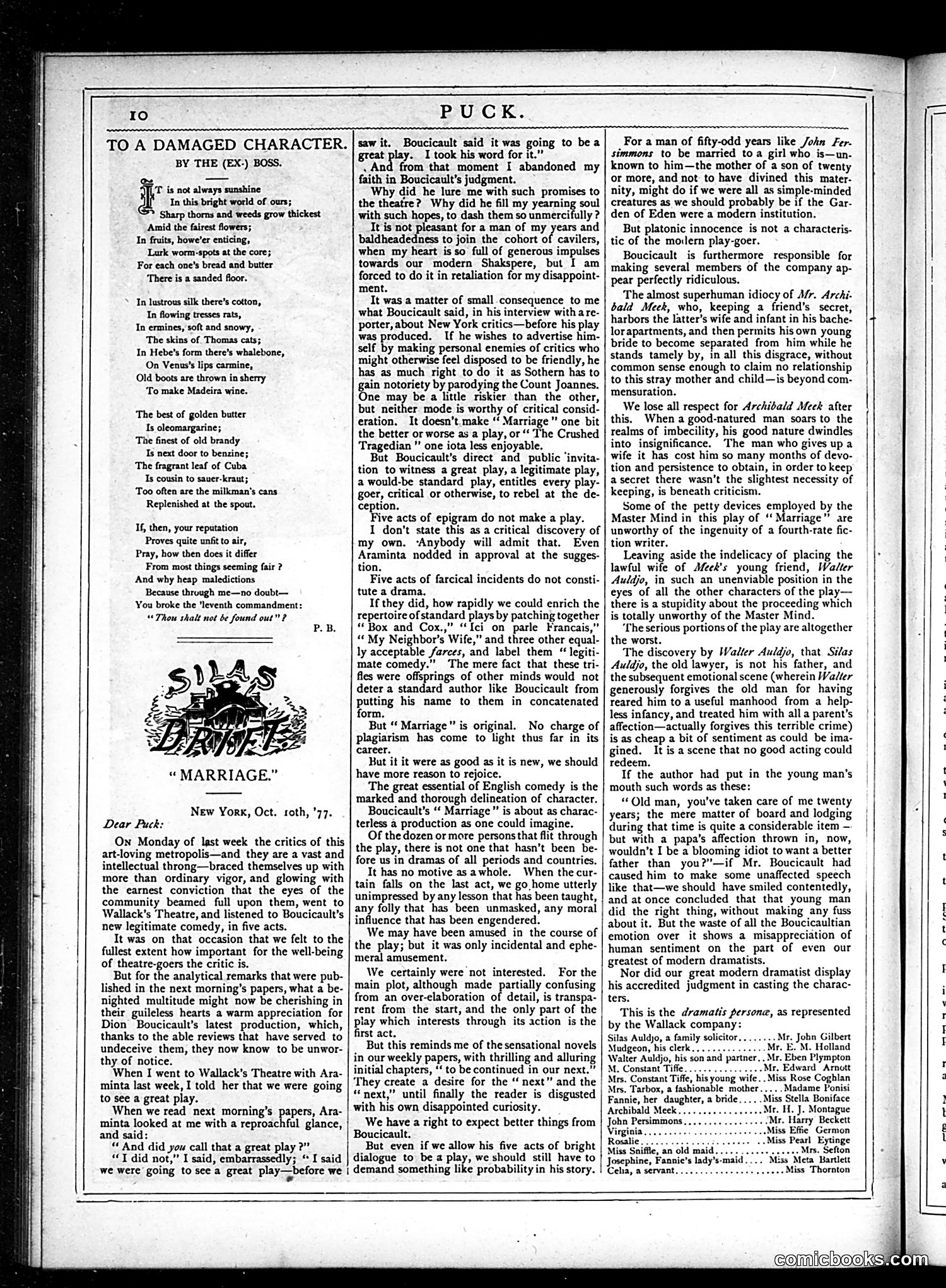
This page contains two articles critiquing theatrical productions. The main piece, titled "To a Damaged Character," attacks an unnamed play for its poor quality and lack of merit. The second article, "Marriage," reviews Wallack's Theatre production of a comedy, dated October 10, 1877. The critic praises English comedy's character development but finds this particular play lacking in both originality and substance. He argues the work contains "farcical incidents" rather than genuine drama, comparing it unfavorably to better-constructed plays. The reviewer expresses frustration that audiences are expected to accept mediocre theater, demanding that playwrights provide better storylines and character development. The tone is one of professional disappointment in contemporary dramatic standards.
📄 Transcribed text from this page (OCR, searchable)
Machine-transcribed from the original scan — historical spelling and the odd misread are preserved.
3 fo} PUCK. TO A DAMAGED CHARACTER. BY THE (EX-) BOSS. “T is not always sunshine In this bright world of ours; Sharp thorns and weeds grow thickest Amid the fairest flowers; In fruits, howe’er enticing, Lurk worm-spots at the core; For each one’s bread and butter ‘There is a sanded floor. In lustrous silk there’s cotton, In flowing tresses rats, In ermines, soft and snowy, The skins of Thomas cats; In Hebe’s form there’s whalebone, On Venus’s lips carmine, Old boots are thrown in sherry ‘To make Madeira wine. The best of golden butter Is oleomargarine; The finest of old brandy Is next door to benzine; The fragrant leaf of Cuba Is cousin to sauer-kraut; Too often are the milkman’s cans Replenished at the spout. If, then, your reputation Proves quite unfit to air, Pray, how then does it differ From most things seeming fair ? And why heap maledictions Because through me—no doubt— You broke the ‘leventh commandment: “Thou shalt not be found out" ? P.B. “MARRIAGE.” New York, Oct. roth, "77. Dear Puck: On Monday of last week the critics of this art-loving metropolis—and they are a vast and intellectual throng—braced themselves up with more than ordinary vigor, and glowing with the earnest conviction that the eyes of the community beamed full upon them, went to Wallack's Theatre, and listened to Boucicault’s new legitimate comedy, in five acts. It was on that occasion that we felt to the fullest extent how important for the well-being of theatre-goers the critic is. But for the analytical remarks that were pub- lished in the next morning’s papers, what a be- nighted multitude might now be cherishing in their guileless hearts a warm appreciation for Dion Boucicault’s latest production, which, thanks to the able reviews that have served to undeceive them, they now know to be unwor- thy of notice. When I went to Wallack’s Theatre with Ara- minta last week, I told her that we were going to see a great play. When we read next morning’s papers, Ara- minta looked at me with a reproachful glance, and said: “ And did you call that a great play?” “I did not,” I said, embarrassedly; ‘I said we were going to see a great play—before we | demand something Ii saw it. Boucicault said it was going to bea great pay. I took his word for it.”” An : from that moment I abandoned my faith in Boucicault’s judgment. Why did he lure me with such promises to the theatre? Why did he fill my yearning soul with such hopes, to dash them so unmercifully ? It is not pleasant for a man of my years and baldheadedaess to join the cohort of cavilers, when my heart is so full of generous impulses towards our modern Shakspere, but I am forced to do it in retaliation for my disappoint- ment. It was a matter of small consequence to me what Boucicault said, in his interview with are- porter, about New York critics—before his play was produced. If he wishes to advertise him- self by making personal enemies of critics who might otherwise feel disposed to be friendly, he has as much right to do it as Sothern has to ain notoriety by parodying the Count Joannes. ne may be a little riskier than the other, but neither mode is worthy of critical consid- eration. It doesn’t. make ‘‘ Marriage” one bit the better or worse as a play, or ‘‘ The Crushed ‘Tragedian " one iota less enjoyable. But Boucicault’s direct and public ‘invita- tion to witness a great play, a legitimate play, a would-be standard play, entitles every play- goer, critical or otherwise, to rebel at the de- ception. Five acts of epigram do not make a play. I don't state this as a critical discovery of my own. ‘Anybody will admit that. Even Araminta nodded in approval at the sugges- tion. Five acts of farcical incidents do not consti- tute a drama. If they did, how rapidly we could enrich the repertoire of standard plays by patching together “Box and Cox.,” “Ici on parle Francais,” “ My Neighbor's Wife,” and three other equal- ly acceptable farces, and label them “ legiti- mate comedy.” ‘The mere fact that these tri- fles were offsprings of other minds would not deter a standard author like Boucicault from putting his name to them in concatenated form. But “ Marriage” is original. No charge of plagiarism has come to light thus far in its career. But it it were as good as it is new, we should have more reason to rejoice. ‘The great essential of English comedy is the marked and thorough delineation of character. Boucicault’s ‘‘ Marriage” is about as charac- terless a production as one could imagine. Of the dozen or more personsthat flit through the play, there is not one that hasn't been be- fore us in dramas of all periods and countries. It has no motive as awhole. When the cur- tain falls on the last act, we go home utterly unimpressed by any lesson that has been taught, any folly that has been unmasked, any moral influence that has been engendered. We may have been amused in the course of the play; but it was only incidental and ephe- meral amusement. We certainly were not interested. For the main plot, although made partially confusing from an over-elaboration of detail, is transpa- rent from the start, and the only part of the play which interests through its action is the first act. But this reminds me of the sensational novels in our weekly papers, with thrilling and alluring initial chapters, ‘‘ to be continued in our next. They create a desire for the “ next” and the “next,” until finally the reader is disgusted with his own disappointed curiosity. We have a right to expect better things from Boucicault. But even if we allow his five acts of bright dialogue to be 2 play, we should still have to ¢ probability in his story. | For a man of fifty-odd years like John Fer. simmons to be married to a girl who is—un- known to him—the mother of a son of twenty or more, and not to have divined this mater- nity, might do if we were all as simple-minded creatures as we should probably be if the Gar- den of Eden were a modern institution. But platonic innocence is not a characteris- tic of the movlern play-goer. Boucicault is furthermore responsible for making several members of the company ap- pear perfectly ridiculous. The almost superhuman idiocy of Afr. Archi- bald Meck, who, keeping a friend's secret, harbors the latter's wife and infant in his bache- lorapartments, and then permits his own young bride to become separated from him while he stands tamely by, in all this disgrace, without common sense enough to claim no relationship to this stray mother and child—is beyond com- mensuration. We lose all respect for Archibald Meek after this. When a good-natured man soars to the realms of imbecility, his good nature dwindles into insignificance. ‘The man who gives up a wife it has cost him so many months of devo- tion and persistence to obtain, in order to keep a secret there wasn’t the slightest necessity of keeping, is beneath criticism. Some of the petty devices employed by the Master Mind in this play of “ Marriage” are unworthy of the ingenuity of a fourth-rate fic- tion writer. Leaving aside the indelicacy of placing the lawful wife of Afeek's young friend, Walter Auldjo, in such an unenviable position in the eyes of all the other characters of the play— there is a stupidity about the proceeding which is totally unworthy of the Master Mind. ‘Lhe serious portions of the play are altogether the worst. The discovery by Walter Auldjo, that Silas Auldjo, the old lawyer, is not his father, and the subsequent emotional scene (wherein Walter generously forgives the old man for having reared him to a useful manhood from a help- less infancy, and treated him with all a parent’s affection—actually forgives this terrible crime) is as cheap a bit of sentiment as could be ima- gined. It is a scene that no good acting could redeem. If the author had put in the young man’s mouth such words as these: “Old man, you've taken care of me twenty years; the mere matter of board and lodging during that time is quite a considerable item — but with a papa’s affection thrown in, now, wouldn’t I be a blooming idiot to want a better father than you?”—if Mr. Boucicault had caused him to make some unaffected speech like that—we should have smiled contentedly, and at once concluded that that young man did the right thing, without making any fuss about it. But the waste of all the Boucicaultian emotion over it shows a misappreciation of human sentiment on the part of even our greatest of modern dramatists. Nor did our great modern dramatist display his accredited judgment in casting the charac- ters. This is the dramatis persona, as represented by the Wallack company: Silas Auldjo, a family solicitor «. Mr. Jon Gilbert Mudgeon, his clerk .-Mr. Eo M. Holland Walter Auldjo, his son and partner. . Mr. Eben Plympton M. Constant Tiffe , Edward Arnott Mrs. Constant Tiffe, his young wife Mrs. Tarbox, a fashionable mother Fannie, her daughter, a bride Archibald Meek.. fon Persimmons , Madame Ponisi Miss Stella Boniface ir. H. J. Montague Harry Beckett Effie. Germon ‘Meta Bartlett josephine, Fanni Miss Thornton J Celia, a servant. . comichooksrete)