
Puck, 1877-10-10 · page 5 of 16
Puck — October 10, 1877 — page 5: what you’re looking at
What you’re looking at
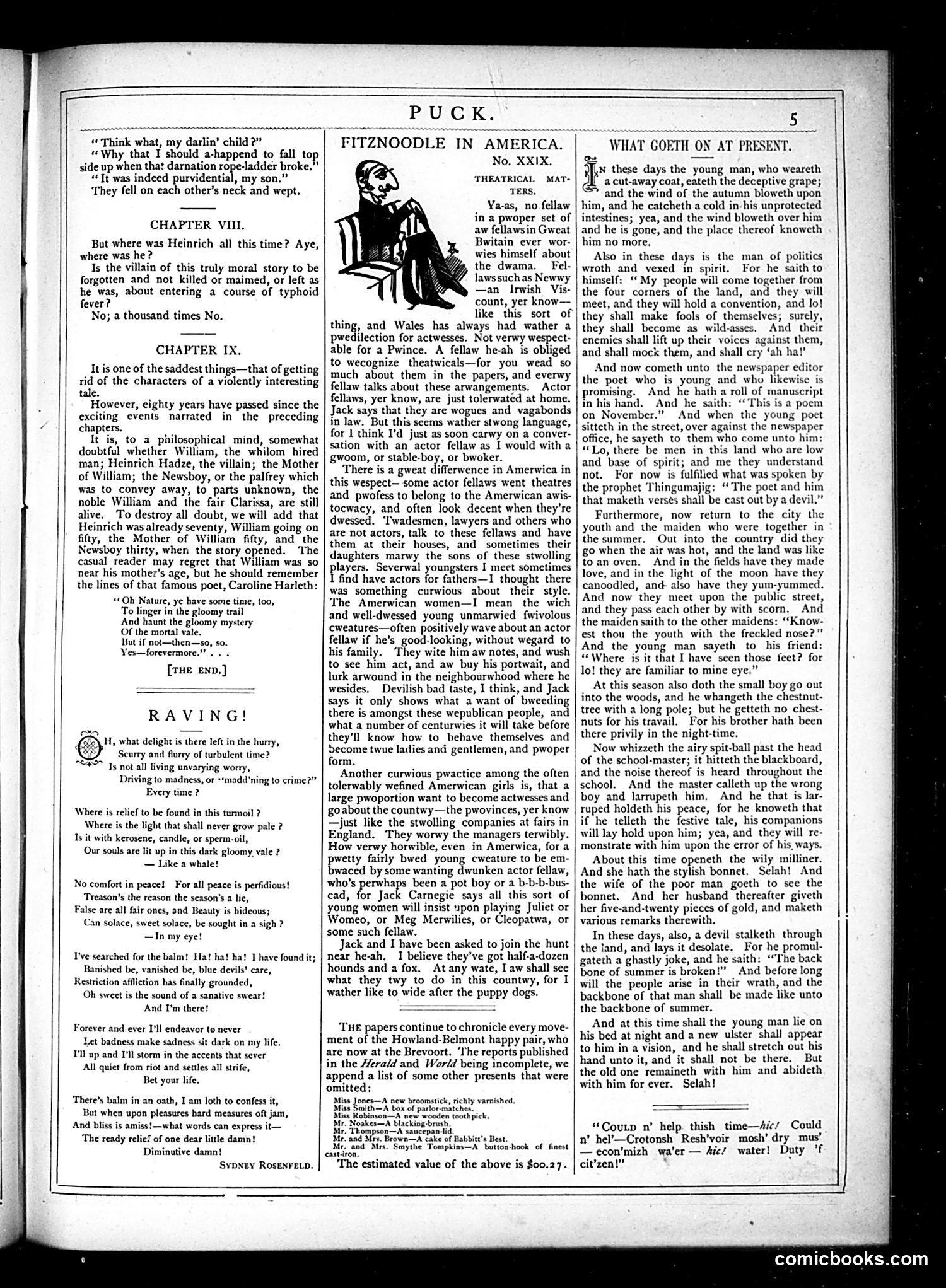
This page contains three distinct sections: **"Fitznoodle in America" (top):** A serialized story with illustration showing a theatrical Irish character. The text discusses Irish and Welsh actors in America, contrasting proper theatrical training with untrained performers who work in variety shows and traveling companies. **"What Goeth On At Present" (right column):** Social commentary on contemporary urban life—young men catching colds, political discourse, newspaper editors, and seasonal activities like chestnut-roasting. The tone is observational rather than explicitly satirical. **"Raving!" (bottom left):** A poem by Sydney Rosenfeld using romantic verse to explore themes of peace, relief, and emotional resolution, appearing unrelated to specific current events. The page mixes entertainment, social observation, and literary content typical of 1880s-90s Puck magazine.
📄 Transcribed text from this page (OCR, searchable)
Machine-transcribed from the original scan — historical spelling and the odd misread are preserved.
“Think what, my darlin’ child?” “Why that I should a-happend to fall top side up when that darnation rope-ladder broke.” “Tt was indeed purvidential, my son.” ‘They fell on each other’s neck and wept. CHAPT VII. But where was Heinrich all this time? Aye, where was he ? Is the villain of this truly moral story to be forgotten and not killed or maimed, or left as he was, about entering a course of typhoid fever? No; a thousand times No. CHAPTER IX. It is one of the saddest things—that of getting rid of the characters of a violently interesting tale, However, eighty years have passed since the exciting events narrated in the preceding chapters. It is, to a philosophical mind, somewhat doubtful whether William, the whilom hired man; Heinrich Hadze, the villain; the Mother of William; the Newsboy, or the palfrey which was to convey away, to parts unknown, the noble William and the fair Clarissa, are still alive. To destroy all doubt, we will add that Heinrich was already seventy, William going on fifty, the Mother of William fifty, and the Newsboy thirty, when the story opened. ‘The casual reader may regret that William was so near his mother’s age, but he should remember the lines of that famous poet, Caroline Harleth: “Oh Nature, ye have some time, too, To linger in the gloomy trail And haunt the gloomy mystery Of the mortal vale. But if not—then—so, so. Yes—forevermore.”” . . . (tHE Enp.] RAVING! GGaX": what delight is there left in the hurry, Scurry and flurry of turbulent time? "S42" Ts not all living unvarying worry, Driving to madness, or *‘madd’ning to crime?” Every time ? Where is relief to be found in this turmoil ? Where is the light that shall never grow pale ? Is it with kerosene, candle, or sperm-oil, Our souls are lit up in this dark gloomy, vale ? — Like a whale! No comfort in peace! For all peace is perfidious! Treason’s the reason the season's a lie, False are all fair ones, and Beauty is hideous; Can solace, sweet solace, be sought in a sigh ? —In my eye! I've searched for the balm! Ha! ha! ha! I have foundit; Banished be, vanished be, blue devils’ care, Restriction affliction has finally grounded, ‘Oh sweet is the sound of a sanative swear! And I'm there! Forever and ever I'll endeavor to never Let badness make sadness sit dark on my life. T'll up and I'll storm in the accents that sever All quiet from riot and settles all strife, Bet your life. There’s balm in an oath, I am loth to confess it, But when upon pleasures hard measures oft jam, And bliss is amiss!—what words can express it— ‘The ready relie? of one dear little damn! Diminutive damn! Sypvey Rosexretp. PUCK. FITZNOODLE IN AMERICA. No. XXIX. ‘THEATRICAL TERS. Ya-as, no fellaw in a pwoper set of aw fellawsin Gweat Bwitain ever wor- wies himself about the dwama._ Fel- lawssuch as Newwy —an Irwish Vis- count, yer know— like this sort of thing, and Wales has always had wather a Pwedilection for actwesses. Not verwy wespect- MAT- to wecognize theatwicals—for you wead so much about them in the papers, and everwy fellaw talks about these arwangements. Actor fellaws, yer know, are just tolerwated at home. Jack says that they are wogues and vagabonds in law. But this seems wather stwong language, for 1 think I’d just as soon carwy on a conver- sation with an actor fellaw as I would with a gwoom, or stable-boy, or bwoker. ‘There is a gweat ditferwence in Amerwica in this wespect— some actor fellaws went theatres and pwofess to belong to the Amerwican awis- tocwacy, and often look decent when they're dwessed. ‘I'wadesmen, lawyers and others who are not actors, talk to these fellaws and have them at their houses, and sometimes their daughters marwy the sons of these stwolling ps Severwal youngsters I meet sometimes find have actors for fathers—1 thought there was something curwious about their style. ‘The Amerwican women—I mean the wich and well-dwessed young unmarwied fwivolous cweatures—often positively wave about an actor fellaw if he’s good-looking, without wegard to his family. They wite him aw notes, and wush to see him act, and aw buy his portwait, and lurk arwound in the neighbourwhood where he wesides. Devilish bad taste, I think, and Jack says it only shows what a want of bweeding there is amongst these wepublican people, and what a number of centurwies it will take before they’ll know how to behave themselves and form. Another curwious pwactice among the often tolerwably wefined Amerwican girls is, that a large pwoportion want to become actwesses and go about the countwy—the pwovinces, yer know England. They worwy the managers terwibly. How verwy horwible, even in Amerwica, for a pwetty fairly bwed young cweature to be em- bwaced by some wanting dwunken actor fellaw, who's perwhaps been a pot boy or a b-b-b-bus- cad, for Jack Carnegie says all this sort of young women will insist upon playing Juliet or Womeo, or Meg Merwilies, or Cleopatwa, or some such fellaw. Jack and I have been asked to join the hunt near he-ah. I believe they’ve got half-a-dozen hounds and a fox. At any wate, I aw shall see what they twy to do in this countwy, for I wather like to wide after the puppy dogs. ‘THE papers continue to chronicle every move- ment of the Howland-Belmont happy pair, who are now at the Brevoort. ‘The reports published in the Hera/d and World being incomplete, we append a list of some other presents that were omitted: Miss Jones—A new broomstick, richly varnished. Smith—A box of parlor-matches. Mr. and Mrs. Smythe Tompkins—A button-hook of finest castiiron, The estimated value of the above is $00.27. able for a Pwince. A fellaw he-ah is obliged | Ddecome twue ladies and gentlemen, and pwoper | | of the school-master; it hitteth the blackboard, —just like the stwolling companies at fairs in | WHAT GOETH ON AT PRESEN ir these days the young man, who weareth a cut-away coat, eateth the deceptive grape; and the wind of the autumn bloweth upon him, and he catcheth a cold in-his unprotected intestines; yea, and the wind bloweth over him and he is gone, and the place thereof knoweth him no more, Also in these days is the man of politics wroth and vexed in spirit. For he saith to himself: “My people will come together from the four corners of the land, and they will meet, and they will hold a convention, and lo! they shall make fools of themselves; surely, they shall become as wild-asses. And _ their enemies shall lift up their voices against them, and shall mock them, and shall cry ‘ah ha!’ And now cometh unto the newspaper editor the poet who is young and who likewise is promising. And he hath a roll of manuscript in his hand. And he saith: “This isa poem on November.” And when the young poet sitteth in the street, over against the newspaper office, he sayeth to. them who come unto him: “Lo, there be men in this land who are low and base of spirit; and me they understand not. For now is fulfilied what was spoken by the prophet Thingumajig: “The poet and him that maketh verses shall be cast out by a devil.” Furthermore, now return to the city the youth and the maiden who were together in the summer. Out into the country did they go when the air was hot, and the land was like toan oven. And in the fields have they made love, and in the light of the moon have they canoodled, and- also have they yum-yummed. And now they meet upon the public street, and they pass each other by with scorn. And the maiden saith to the other maidens: “Know- est thou the youth with the freckled nose?” And the young man sayeth to his friend: “Where is it that I have seen those feet? for lo! they are familiar to mine eye.” At this season also doth the small boy go out into the woods, and he whangeth the chestnut- tree with a long pole; but he getteth no chest- nuts for his travail. For his brother hath been there privily in the night-time. Now whizzeth the airy spit-ball past the head < and the noise thereof is heard throughout the school. And the master calleth up the wrong boy and larrupeth him. And he that is lar- ruped holdeth his peace, for he knoweth that if he telleth the festive tale, his companions will lay hold upon him; yea, and they will re- monstrate with him upon the error of his, ways. About this time openeth the wily milliner. And she hath the stylish bonnet. Selah! And the wife of the poor man goeth to see the bonnet. And her husband thereafter giveth her five-and-twenty pieces of gold, and maketh various remarks therewith. In these days, also, a devil stalketh through the land, and lays it desolate. For he promul- gateth a ghastly joke, and he saith: “The back bone of summer is broken!” And before long will the people arise in their wrath, and the backbone of that man shall be made like unto the backbone of summer. And at this time shall the young man lie on his bed at night and a new ulster shall appear to him in a vision, and he shall stretch out his hand unto it, and it shall not be there. But the old one remaineth with him and abideth with him for ever. Selah! “Coutp n’ help. thish time—Aic/ Could n’ hel'—Crotonsh Resh’voir mosh’ dry mus’ —econ’mizh wa’er — hic! water! Duty ’f cit’zen!” ‘ comicbooks.com