
Puck, 1877-10-10 · page 11 of 16
Puck — October 10, 1877 — page 11: what you’re looking at
What you’re looking at
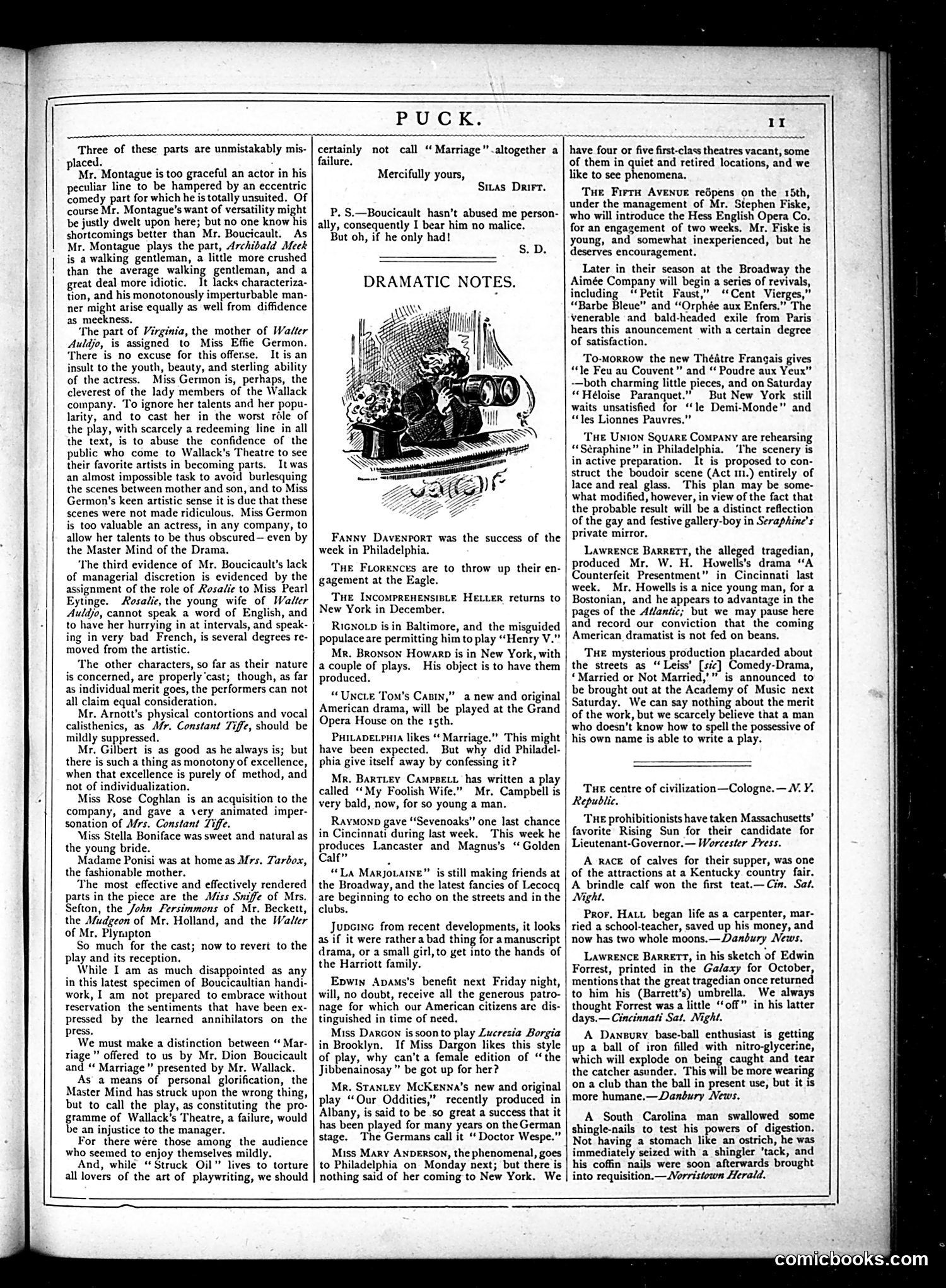
This page contains theatrical criticism and "Dramatic Notes" rather than political cartoons. The small illustration shows a theatrical mask and dramatic props, typical of Puck's arts coverage. The text critiques contemporary theater productions and performances. References include Miss Effie Germon's role in a revival, concerns about casting decisions for various plays, and reviews of productions like "A Constant Tiff" and works by Bouicault. The page discusses whether certain actresses are properly utilized and critiques theatrical management decisions. There's satire aimed at theatrical impresarios' choices and concerns about whether plays constitute genuine artistic merit or mere commercial ventures. The content reflects Puck's role as cultural critic, using humor to evaluate New York theater's quality and artistic integrity during this period.
📄 Transcribed text from this page (OCR, searchable)
Machine-transcribed from the original scan — historical spelling and the odd misread are preserved.
Three of these parts are unmistakably mis- placed. . cone Mr. Montague is too graceful an actor in his peculiar line to be hampered by an eccentric comedy part for which he is totally unsuited. Of course Mr. Montague's want of versatility might be justly dwelt upon here; but no one know his shortcomings better than Mr. Boucicault. As Mr. Montague plays the part, Archibald Meek is a walking gentleman, a little more crushed than the average walking gentleman, and a great deal more idiotic. It lacks characteriza- tion, and his monotonously imperturbable man- ner might arise equally as well from diffidence as _meekness. ‘The part of Virginia, the mother of Walter Auldjo, is assigned to Miss Effie Germon. ‘There is no excuse for this offerse. It is an insult to the youth, beauty, and sterling ability of the actress. Miss Germon is, perhaps, the cleverest of the lady members of the Wallack company. To ignore her talents and her popu- larity, and to cast her in the worst réle of the play, with scarcely a redeeming line in all the text, is to abuse the confidence of the public who come to Wallack's Theatre to see their favorite artists in becoming parts. It was an almost impossible task to avoid burlesquing the scenes between mother and son, and to Miss Germon's keen artistic sense it is due that these scenes were not made ridiculous. Miss Germon is too valuable an actress, in any company, to allow her talents to be thus obscured— even by the Master Mind of the Drama. ‘The third evidence of Mr. Boucicault’s lack of managerial discretion is evidenced by the assignment of the role of Rosa/i¢ to Miss Pearl Eytinge. Rosalie, the young wife of Walter Auldjo, cannot speak a word of English, and to have her hurrying in at intervals, and speak- ing in very bad’ French, is several degrees re- moved from the artistic. ‘The other characters, so far as their nature is concerned, are properly ‘cast; though, as far as individual merit goes, the performers can not all claim equal consideration. Mr. Arnott’s physical contortions and vocal calisthenics, as Ar. Constant Tiffe, should be mildly suppressed. Mr. Gilbert is as good as he always is; but there is such a thing as monotony of excellence, when that excellence is purely of method, and not of individualization. Miss Rose Coghlan is an acquisition to the company, and gave a very animated imper- sonation of Mrs. Constant Tiffe. Miss Stella Boniface was sweet and natural as the young bride. Madame Ponisi was at home as Mrs. Tarbox, the fashionable mother. The most effective and effectively rendered parts in the piece are the Afiss Sniffe of Mrs. Sefton, the John Fersimmons of Mr. Beckett, the Afudgeon of Mr. Holland, and the Walter of Mr. Plyrapton So much for the cast; now to revert to the play and its reception. While I am as much disappointed as any in this latest specimen of Boucicaultian handi- work, I am not prepared to embrace without reservation the sentiments that have been ex- pressed by the learned annihilators on the press. We must make a distinction between “ Mar- riage” offered to us by Mr. Dion Boucicault and “ Marriage” presented by Mr. Wallack. As a means of personal glorification, the Master Mind has struck upon the wrong thing, but to call the play, as constituting the pro- gramme of Wallack’s Theatre, a failure, would be an injustice to the manager. For there were those among the audience who seemed to enjoy themselves mildly. And, while ‘Struck Oil" lives to torture E all lovers of the art of playwriting, we should PUCK. Ir certainly not call “ Marriage" altogether a failure. Mercifully yours, Stas Drirt. P. S.—Boucicault hasn’t abused me person- ally, consequently I bear him no malice. But oh, if he only had! Ss. D. DRAMATIC NOTES. Fanny Davenport was the success of the week in Philadelphia. ‘THE FLorences are to throw up their en- gagement at the Eagle. Tue INCOMPREHENSIBLE HELLER returns to New York in December. RicNotp is in Baltimore, and the misguided populace are permitting him to play ‘Henry V.” Mr. Bronson Howarp is in New York, with a couple of plays. His object is to have them produced. “Uncie Tom's Canin,” a new and original | American drama, will be played at the Grand Opera House on the sth. PHILapetpuia likes “ Marriage.” This might have been expected. But why did Philadel- phia give itself away by confessing it? Mr. BartLey CAMPBELL has written a play called ‘My Foolish Wife.” Mr. Campbell is very bald, now, for so young a man. RayMonp gave “Sevenoaks” one last chance in Cincinnati during last week. This week he | produces Lancaster and Magnus’s ‘Golden Calf” “La MarjoLatne” is still making friends at the Broadway, and the latest fancies of Lecocq are beginning to echo on the streets and in the clubs. Jupcinc from recent developments, it looks as if it were rather a bad thing for amanuscript drama, or a small girl, to get into the hands of the Harriott family. Epwiy Apams’s benefit next Friday night, will, no doubt, receive all the generous patro- nage for which our American citizens are dis- tinguished in time of need. Miss Darcon is soonto play Lucresia Borgia in Brooklyn, If Miss Dargon likes this style of play, why can’t a female edition of ‘the Jibbenainosay” be got up for her? Mr. Stantey McKenna’s new and original play “Our Oddities,” recently produced in Albany, is said to be so great a success that it has been played for many years on theGerman stage. The Germans call it ‘‘ Doctor Wespe.” Miss Mary ANDERSON, the phenomenal, goes to Philadelphia on Monday next; but there is nothing said of her coming to New York. We have four or five first-class theatres vacant, some of them in quiet and retired locations, and we like to see phenomena. Tue Firrn Avenue redpens on the 15th, under the management of Mr. Stephen Fiske, who will introduce the Hess English Opera Co, for an engagement of two weeks. Mr. Fiske is young, and somewhat inexperienced, but he deserves encouragement. Later in their season at the Broadway the Aimée Company will begin a series of revivals, including ‘Petit Faust,” ‘Cent Vierges,” “Barbe Bleue” and “Orphée aux Enfers.” The venerable and bald-headed exile from Paris hears this anouncement with a certain degree of satisfaction. To-morrow the new Théatre Frangais gives “Je Feu au Couvent” and “ Poudre aux Yeux” -—both charming little pieces, and on Saturday “Heloise Paranquet.” But New York still waits unsatisfied for ‘le Demi-Monde” and “Jes Lionnes Pauvres.” ‘Tue Union Square Company are rehearsing “‘Séraphine” in Philadelphia. ‘Ihe scenery is in active preparation. It is proposed to con- struct the boudoir scene (Act m1.) entirely of lace and real glass. ‘This plan may be some- what modified, however, in view of the fact that the probable result will be a distinct reflection of the gay and festive gallery-boy in Seraphine's private mirror. Lawrence Barrett, the alleged tragedian, produced Mr. W. H. Howells’s drama “A Counterfeit Presentment” in Cincinnati last week. Mr. Howells is a nice young man, for a Bostonian, and he appears to advantage in the pages of the AlVantic; but we may pause here and record our conviction that the coming American dramatist is not fed on beans. Tue mysterious production placarded about the streets as “ Leiss’ [sic] Comedy-Drama, ‘Married or Not Married,’” is announced to be brought out at the Academy of Music next Saturday. We can say nothing about the merit of the work, but we scarcely believe that a man who doesn’t know how to spell the possessive of his own name is able to write a play. Tue centre of civilization—Cologne.—W. Y. Republic. THE prohibitionists have taken Massachusetts’ favorite Rising Sun for their candidate for Lieutenant-Governor.— Worcester Press. A race of calves for their supper, was one of the attractions at a Kentucky country fair. A brindle calf won the first teat.— Cin. Sat. Night. Pror. Hatt began life as a carpenter, mar- tied a school-teacher, saved up his money, and now has two whole moons.— Danbury News. Lawrence Barrett, in his sketch of Edwin Forrest, printed in the Galaxy for October, mentions that the great tragedian once returned to him his (Barrett's) umbrella. We always thought Forrest was a little ‘‘off” in his latter days.— Cincinnati Sat. Night. A Dansury base-ball enthusiast is getting up a ball of iron filled with nitro-glycerine, which will explode on being caught and tear the catcher asunder. This will be more wearing on a club than the ball in present use, but it is more humane.—Danbury News. A South Carolina man swallowed some shingle-nails to test his powers of digestion. Not having a stomach like an ostrich, he was immediately seized with a shingler ‘tack, and his coffin nails were soon afterwards brought into requisition.— Norristown Herald.