
Puck, 1877-10-10 · page 6 of 16
Puck — October 10, 1877 — page 6: what you’re looking at
What you’re looking at
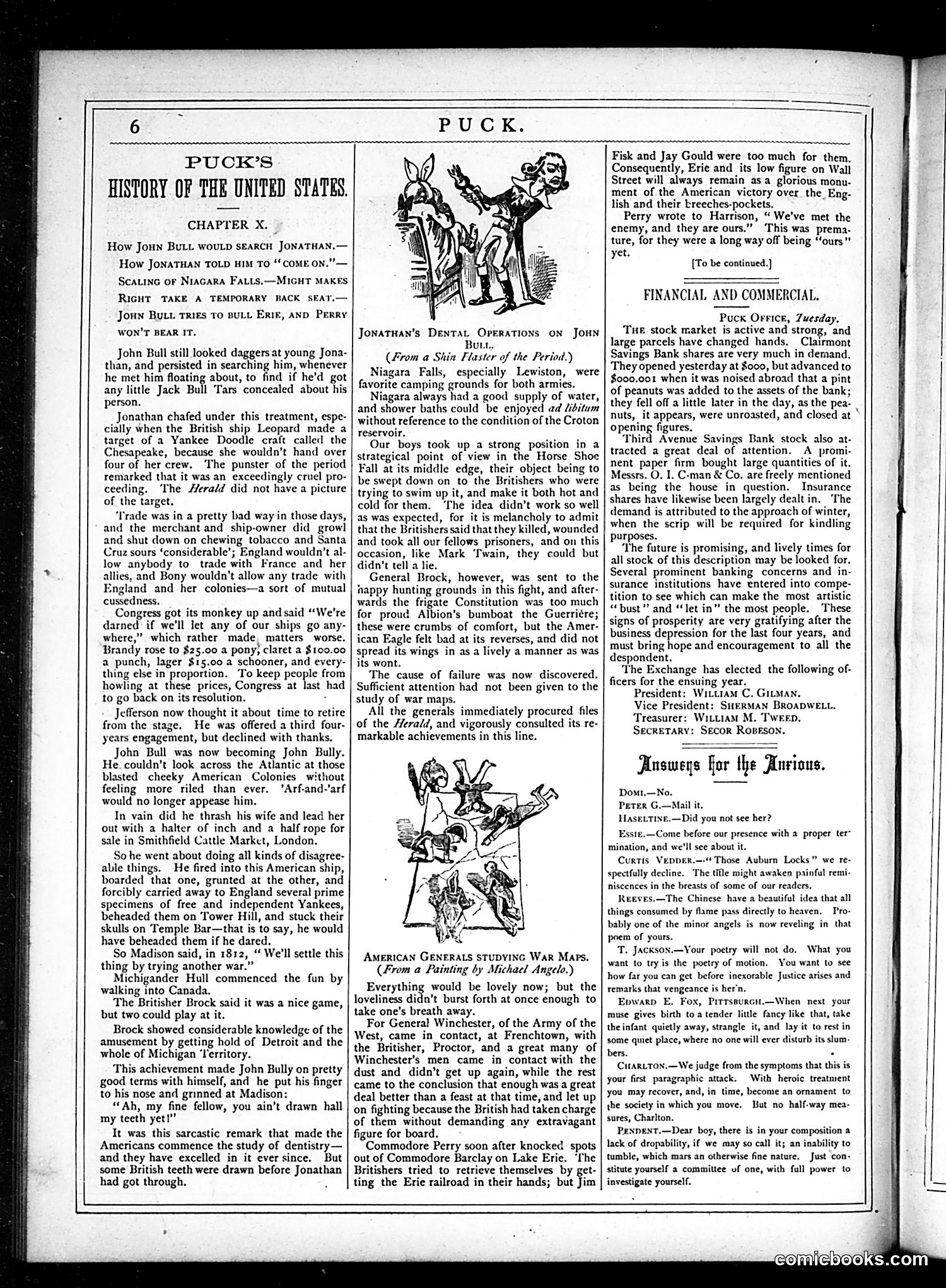
This page contains two distinct sections: a serialized history article about the United States (Chapter X, discussing early American conflicts and figures like John Bull and Jonathan) and an unrelated "Answers for the Anxious" advice column. The main cartoon visible shows **Jonathan's Dental Operations on John Bull**—a dental/medical scene depicting American and British relations. The image uses the personification of "John Bull" (Britain) and "Jonathan" (America) engaging in what appears to be a satirical treatment of diplomatic or commercial conflict, likely referencing trade disputes or military tensions of the era. The "Financial and Commercial" section discusses stock market activity and banking, while the advice column addresses social etiquette questions from readers. Without clearer dates or specific historical context visible on the page, the exact political moment remains somewhat unclear.
📄 Transcribed text from this page (OCR, searchable)
Machine-transcribed from the original scan — historical spelling and the odd misread are preserved.
PUCK’S HISTORY OF THE UNITED STATES. CHAPTER X. » How Joun Butt woutp search JONATHAN.— How JONATHAN TOLD HIM TO “COME ON.” — SCALING OF NIAGARA FaLts.—MIGHT MAKES RIGHT TAKE A TEMPORARY BACK SEAT.— Joun Butt Tries To BULL Erik, AND Perry WON'T BEAR IT. John Bull still looked daggers at young Jona- than, and persisted in searching him, whenever he met him floating about, to find if he’d got any little Jack Bull Tars concealed about his person. Jonathan chafed under this treatment, espe- cially when the British ship Leopard made a target of a Yankee Doodle craft called the Chesapeake, because she wouldn't hand over four of her crew. The punster of the period remarked that it was an exceedingly cruel pro- ceeding. The Herald did not have a picture of the target. ‘Trade was in a pretty bad way in those days, and the merchant and ship-owner did growl and shut down on chewing tobacco and Santa Cruz sours ‘considerable’; England wouldn't al- low anybody to trade with France and her allies, and Bony wouldn’t allow any trade with England and her colonies—a sort of mutual cussedness. Congress got its monkey up and said “We're darned: if we'll Jet any of our ships go any- where,” which rather made, matters worse. Brandy rose to $25.00 a pony, claret a $100.00 a punch, lager $15.00 a schooner, and every- thing else in proportion. ‘To keep people from howling at these prices, Congress at last had to go back on its resolution. 2 Jefferson now thought it about time to retire from the stage. He was offered a third four- years engagement, but declined with thanks, John Bull was now becoming John Bully. He. couldn't look across the Atlantic at those blasted cheeky American Colonies without feeling more riled than ever. 'Arf-and-'arf would no longer appease him. In vain did he thrash his wife and lead her out with a halter of inch and a half rope for sale in Smithfield Cattle Market, London. So he went about doing all kinds of disagree- able things. He fired into this American shi; boarded that one, grunted at the other, and forcibly carried away to England several prime specimens of free and independent Yankees, beheaded them on Tower Hill, and stuck their skulls on Temple Bar—that is to say, he would have beheaded them if he dared. So Madison said, in 1812, “ We'll settle this thing by trying another war.” Michigander Hull commenced the fun by walking into Canada. The Britisher Brock said it was a nice game, but two could play at it. Brock showed considerable knowledge of the amusement by getting hold of Detroit and the whole of Michigan ‘Territory. This achievement made John Bully on pretty good terms with himself, and he put his finger to his nose and grinned at Madison: “Ah, my fine fellow, you ain’t drawn hall my teeth yet!” It was this sarcastic remark that made the Americans commence the study of dentistry— and they have excelled in it ever since. But some British teeth were drawn before Jonathan had got through. Jonatuan’s Dentat Operations ON JOHN Butt, (From a Shin Flaster of the Period.) Niagara Falls, especially Lewiston, were favorite camping grounds for both armies. Niagara always had a good supply of water, and shower baths could be enjoyed ad dibitum without reference to the condition of the Croton reservoir. Our boys took up a strong position in a strategical point of view in the Horse Shoe Fall at its middle edge, their object being to be swept down on to the Britishers who were trying to swim up it, and make it both hot and cold for them. ‘The idea didn’t work so well as was expected, for it is melancholy to admit that the Britishers said that they killed, wounded and took all our fellows prisoners, and on this occasion, like Mark Twain, they could but didn’t tell a lie. General Brock, however, was sent to the happy hunting grounds in this fight, and after- wards the frigate Constitution was too much for proud Albion’s bumboat the Guerri¢re; these were crumbs of comfort, but the Amer- ican Eagle felt bad at its reverses, and did not spread its wings in as a lively a manner as was its wont. The cause of failure was now discovered. Sufficient attention had not been given to the study of war maps. All the generals immediately procured files of the Herald, and vigorously consulted its re- markable achievements in this line. AMERICAN GENERALS STUDYING WaR Maps. (From a Painting by Michael Angelo.) Everything would be lovely now; but the loveliness didn’t burst forth at once enough to take one’s breath away. For General Winchester, of the Army of the West, came in contact, at Frenchtown, with the Britisher, Proctor, and a great many of Winchester’s men came in contact with the dust and didn’t get up again, while the rest came to the conclusion that enough was a great deal better than a feast at that time, and let up on fighting because the British had taken charge of them without demanding any extravagant figure for board. ‘Commodore Perry soon after knocked. spots out of Commodore Barclay on Lake Erie. ‘The Britishers tried to retrieve themselves by get- ting the Erie railroad in their hands; but Jim Fisk and Jay Gould were too much for them. Consequently, Erie and its low figure on Wall Street will always remain as a glorious monu- ment of the American victory over the Eng- lish and their treeches-pockets. Perry wrote to Harrison, “ We've met the enemy, and they are ours.” This was prema- ture, for they were a long way off being “ours” yet. [To be continued.] FINANCIAL AND COMMERCIAL. Puck Orricr, Zuesday. Tue stock market is active and strong, and large parcels have changed hands. Clairmont Savings Bank shares are very much in demand. They opened yesterday at $000, but advanced to $000,001 when it was noised abroad that a pint of peanuts was added to the assets of the bank; they fell off a little later in the day, as the pea- nuts, it appears, were unroasted, and closed at * opening figures, ‘Third Avenue Savings Bank stock also at- tracted a great deal of attention. A promi- nent paper firm bought large quantities of it. Messrs. O. I. C-man & Co. are freely mentioned as being the house in question. Insurance shares have likewise been largely dealt in. ‘The demand is attributed to the approach of winter, when the scrip will be required for kindling purposes. ‘The future is promising, and lively times for all stock of this description may be looked for. Several prominent banking concerns and in- surance institutions have entered into compe- tition to see which can make the most artistic “bust” and “let in” the most people. These signs of prosperity are very gratifying after the business depression for the last four years, and must bring hope and encouragement to all the despondent. ‘The Exchange has elected the following of- ficers for the ensuing year. President: Witttam C. Ginan. Vice President: SHERMAN BROADWELL. Treasurer: WittiaM M. TWEED. Maseitixe.—Did you not see her? Essit.—Come before our presence with a proper ter” mination, and we'll see about it. Curtis Vepper.—- Those Auburn Locks” we re- spectfully decline. The tifle might awaken painful remi- niscences in the breasts of some of our readers. Reeves.—The Chinese have a beautiful idea that all things consumed by flame pass directly to heaven. Pro- bably one of the minor angels is now reveling in that poem of yours. T. Jacksox.—Your poetry will not do. What you want to try is the poetry of motion. You want to see how far you can get before inexorable Justice arises and remarks that vengeance is her'n. Epwarp E, Fox, Prrrsaurtt.—When next your muse gives birth toa tender little fancy like that, take the infant quietly away, strangle it, and lay it to rest in some quiet place, where no one will ever disturb its slum- bers. : CHARLTON.—We judge from the symptoms that this is your first paragraphic attack. With heroic treatment you may recover, and, in time, become an ornament to the society in which you move. But no half-way mea- sures, Charlton, PexpeNnt.—Dear boy, there is in your composition a lack of dropability, if we may so call it; an inability to tumble, which mars an otherwise fine nature. Just ‘con- stitute yourself a committee uf one, with full power to investigate yourself.