
Puck, 1877-10-10 · page 12 of 16
Puck — October 10, 1877 — page 12: what you’re looking at
What you’re looking at
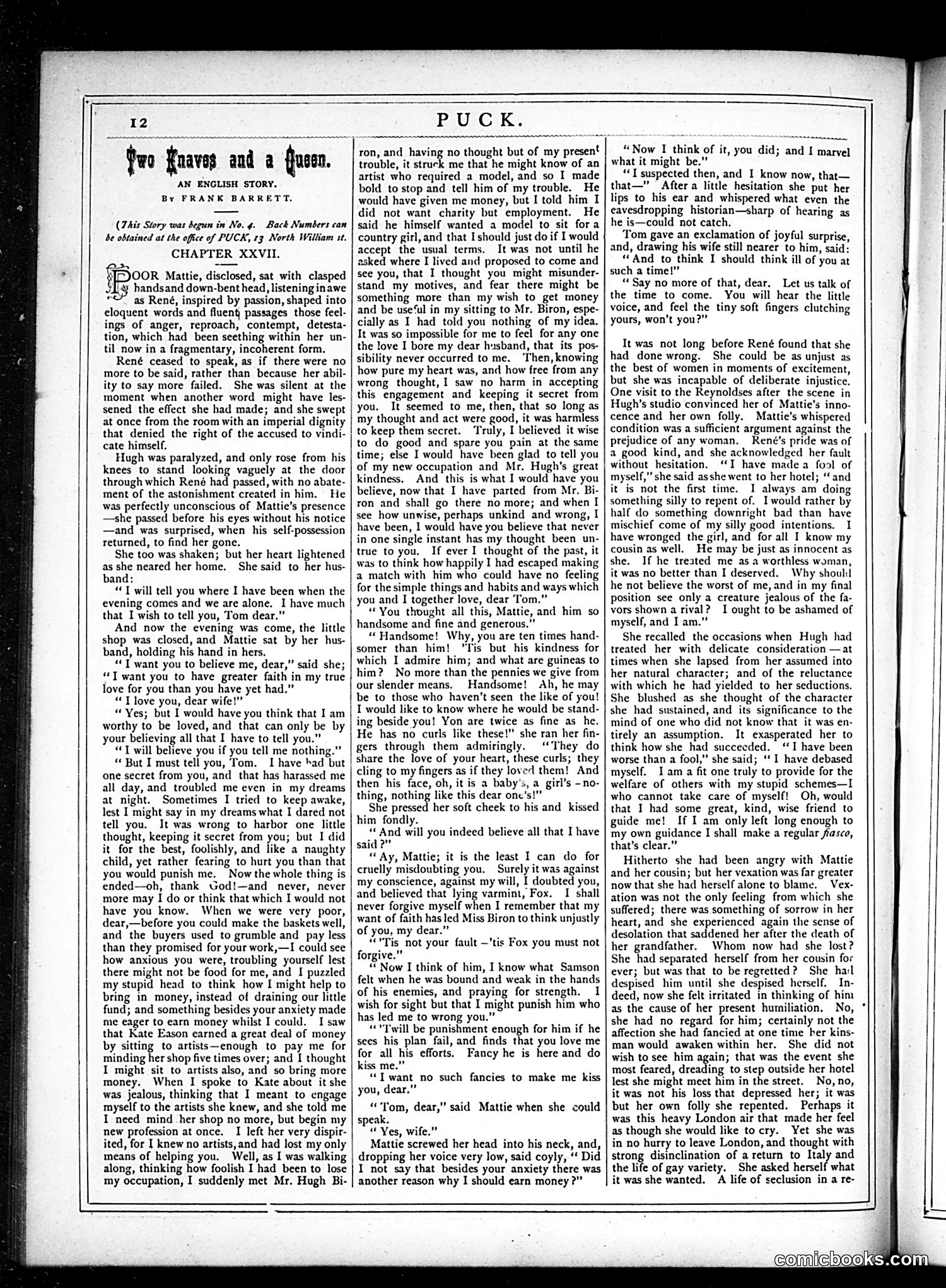
This page contains prose fiction rather than political satire or cartoons. It's Chapter XXVII of "Two Knaves and a Knave," an English story by Frank Barrett. The narrative depicts domestic drama involving characters named Tom, Mattie, Hugh, and René. The plot concerns marital tension, infidelity suspicions, and financial struggles—Tom fears his wife Mattie is attracted to the wealthy Mr. Hugh Biron. The text explores themes of jealousy, honor, and class anxiety common to Victorian melodrama. No political figures, cartoons, or satirical commentary are visible on this page. It appears to be serialized fiction published in *Puck* magazine, representing the publication's literary content rather than its characteristic satirical cartooning.
📄 Transcribed text from this page (OCR, searchable)
Machine-transcribed from the original scan — historical spelling and the odd misread are preserved.
12 Feo raves and a jue. * AN ENGLISH STORY. By FRANK BARRETT. (This Story was begun in No. 4. Back Numbers can be obtained at the office of PUCK, 13 North William st. CHAPTER XXVII. Poor Mattie, disclosed, sat with clasped oly handsand down-bent head, listening inawe “ as René, inspired by passion, shaped into eloquent words and fluent passages those feel- ings of anger, reproach, contempt, detesta- tion, which had been seething within her un- til now in a fragmentary, incoherent form. René ceased to speak, as if there were no more to be said, rather than because her abil- ity to say more failed. She was silent at the moment when another word might have les- sened the effect she had made; and she swept at once from the room with an imperial dignity that denied the right of the accused to vindi- cate himself, Hugh was paralyzed, and only rose from his knees to stand looking vaguely at the door through which René had passed, with no abate- ment of the astonishment created in him. He was perfectly unconscious of Mattie’s presence —-she passed before his eyes without his notice —and was surprised, when his self-possession returned, to find her gone. She too was shaken; but her heart lightened as she neared her home. She said to her hus- band: “Twill tell you where I have been when the evening comes and we are alone. I have much that I wish to tell you, Tom dear.” And now the evening was come, the little shop was closed, and Mattie sat by her hus- band, holding his hand in hers. “T want you to believe me, dear,” said she; “‘T want you to have greater faith in my true love for you than you have yet had.” “T love you, dear wife!” “ Yes; but I would have you think that I am worthy to be loved, and that can only be by your believing all that I have to tell you.” “1 will believe you if you tell me nothing.” “ But I must tell you, Tom, I have had but one secret from you, and that has harassed me all day, and troubled me even in my dreams at night. Sometimes I tried to keep awake, lest I might say in my dreams what I dared not tell you. It was wrong to harbor one little thought, keeping it secret from you; but I did it for the best, foolishly, and like a naughty child, yet rather fearing to hurt you than that you would punish me. Now the whole thing is ended—oh, thank God!—and_ never, never more may I do or think that which I would not have you know. When we were very poor, dear,—before you could make the baskets well, and ‘the buyers used to grumble and pay less than they promised for your work,—I could see how anxious you were, troubling yourself lest there might not be food for me, and I puzzled my stupid head to think how I might help to bring in money, instead of draining our little fund; and something besides your anxiety made me eager to earn money whilst I could. I saw that Kate Eason earned a great deal of money by sitting to artists—enough to pay me for minding her shop five times over; and I thought I might sit to artists also, and so bring more money. When I spoke to Kate about it she was jealous, thinking that I meant to engage myself to the artists she knew, and she told me I need mind her shop no more, but begin my new profession at once. I left her very dispir- ited, for I knew no artists, and had lost my only means of helping you. Well, as I was walking along, thinking how foolish I had been to lose my occupation, I suddenly met Mr. Hugh Bi- (i PUCK. ron, and having no thought but of my present trouble, it struck me that he might know of an artist who required a model, and so I made bold to stop and tell him of my trouble. He would have given me money, but I told him I did not want charity but employment. He said he himself wanted a model to sit fora country girl, and that I should just do if I would accept the usual terms. It was not until he asked where I lived and proposed to come and see you, that I thought you might misunder- stand my motives, and fear there might be something more than my wish to get money and be use‘ul in my sitting to Mr. Biron, espe- cially as I had told you nothing of my idea. It was so impossible for me to feel for any one the love I bore my dear husband, that its pos- sibility never occurred to me. ‘Then, knowing how pure my heart was, and how free from any wrong thought, I saw no harm in accepting this engagement and keeping it secret from you. It seemed to me, then, that so long as my thought and act were good, it was harmless to keep them secret. Truly, I believed it wise to do good and spare you pain at the same time; else I would have been glad to tell you of my new occupation and Mr. Hugh's great kindness. And this is what I would have you believe, now that I have parted from Mr. Bi- ron and shall go there no more; and when I see how unwise, perhaps unkind and wrong, I have been, 1 would have you believe that never in one single instant has my thought been un- true to you. If ever I thought of the past, it was to think how happily I had escaped making a match with him who could have no feeling for the simple things and habits and ways which you and I together love, dear Tom.” “You thought all this, Mattie, and him so handsome and fine and generous.” “Handsome! Why, you are ten times hand- somer than him! "Tis but his kindness for which I admire him; and what are guineas to him? No more than the pennies we give from our slender means. Handsome! Ah, he may be to those who haven't seen the like of you! I would like to know where he would be stand- ing beside you! Yon are twice as fine as he. He has no curls like these!” she ran her fin- gers through them admiringly. ‘They do share the love of your heart, these curls; they cling to my fingers as if they loved them! And then his face, oh, it is a baby’s, a girl’s -no- thing, nothing like this dear one’s!” She pressed her soft cheek to his and kissed him fondly. “And will you indeed believe all that I have said ?”” “Ay, Mattie; it is the least I can do for cruelly misdoubting you. Surely it was against my conscience, against my will, I doubted you, and believed that lying varmint, Fox. I shall never forgive myself when I remember that my want of faith has led Miss Biron to think unjustly of you, my dear.”” “Tis not your fault —'tis Fox you must not forgive.” “ Now I think of him, I know what Samson felt when he was bound and weak in the hands of his enemies, and praying for strength. I wish for sight but that I might punish him who me to wrong you.” will be punishment enough for him if he sees his plan fail, and finds that you love me for all his efforts. Fancy he is here and do kiss me.” “T want no such fancies to make me kiss you, dear.” “Tom, dear,” said Mattie when she could speak. “ Yes, wife Mattie screwed her head into his neck, and, dropping her voice very low, said coyly, “ Did I not say that besides your anxiety there was another reason why I should earn money ?” “Now I think of it, you did; and I marvel what it might be.”” “I suspected then, and I know now, that— that—” After a little hesitation she put her lips to his ear and whispered what even the eavesdropping historian—sharp of hearing as he is—could not catch. Tom gave an exclamation of joyful surprise, and, drawing his wife still nearer to him, said: “And to think I should think ill of you at such a time!”” “Say no more of that, dear. Let us talk of the time to come. You will hear the little voice, and feel the tiny soft fingers clutching yours, won’t you?” It was not long before René found that she had done wrong. She could be as unjust as the best of women in moments of excitement, but she was incapable of deliberate injustice, One visit to the Reynoldses after the scene in Hugh’s studio convinced her of Mattie’: cence and her own folly, Mattie’s w condition was a sufficient argument against the prejudice of any woman. René’s pride was of a good kind, and she acknowledged her fault without hesitation. “I have made a fool of myself,” she said as she went to her hotel; “and it is not the first time. I always am doing something silly to repent of. I would rather by half do something downright bad than have mischief come of my silly good intentions. I have wronged the girl, and for all I know my cousin as well. He may be just as innocent as she. If he treated me as a worthless woman, it was no better than I deserved. Why should he not believe the worst of me, and in my final position see only a creature jealous of the fa- vors shown a rival? I ought to be ashamed of myself, and I am.” She recalled the occasions when Hugh had treated her with delicate consideration —at times when she lapsed from her assumed into her natural character; and of the reluctance with which he had yielded to her seductions. She blushed as she thought of the character she had sustained, and its significance to the mind of one who did not know that it was en- tirely an assumption. It exasperated her to think how she had succeeded. ‘I have been worse than a fool,” she said; ‘(I have debased myself. I am a fit one truly to provide for the welfare of others with my stupid schemes—I who cannot take care of myself! Oh, would that I had some great, kind, wise friend to guide me! If I am only left long enough to my own guidance I shall make a regular fiasco, that’s clear.” Hitherto she had been angry with Mattie and her cousin; but her vexation was far greater now that she had herself alone to blame. Vex- ation was not the only feeling from which she suffered; there was something of sorrow in her heart, and she experienced again the sense of desolation that saddened her after the death of her grandfather. Whom now had she lost? She had separated herself from her cousin for ever; but was that to be regretted? She hal despised him until she despised herself. In- deed, now she felt irritated in thinking of him as the cause of her present humiliation. No, she had no regard for him; certainly not the affection she had fancied at one time her kins- man would awaken within her. She did not wish to see him again; that was the event she most feared, dreading to step outside her hotel lest she might mect him in the street. No, no, it was not his loss that depressed her; it was but her own folly she repented. Perhaps it was this heavy London air that made her feel as though she would like to cry. Yet she was in no hurry to leave London, and thought with strong disinclination of a return to Italy and the life of gay variety. She asked herself what it was she wanted. A life of seclusion in a re-