
A complete issue · 16 pages · 1877
Puck — September 12, 1877
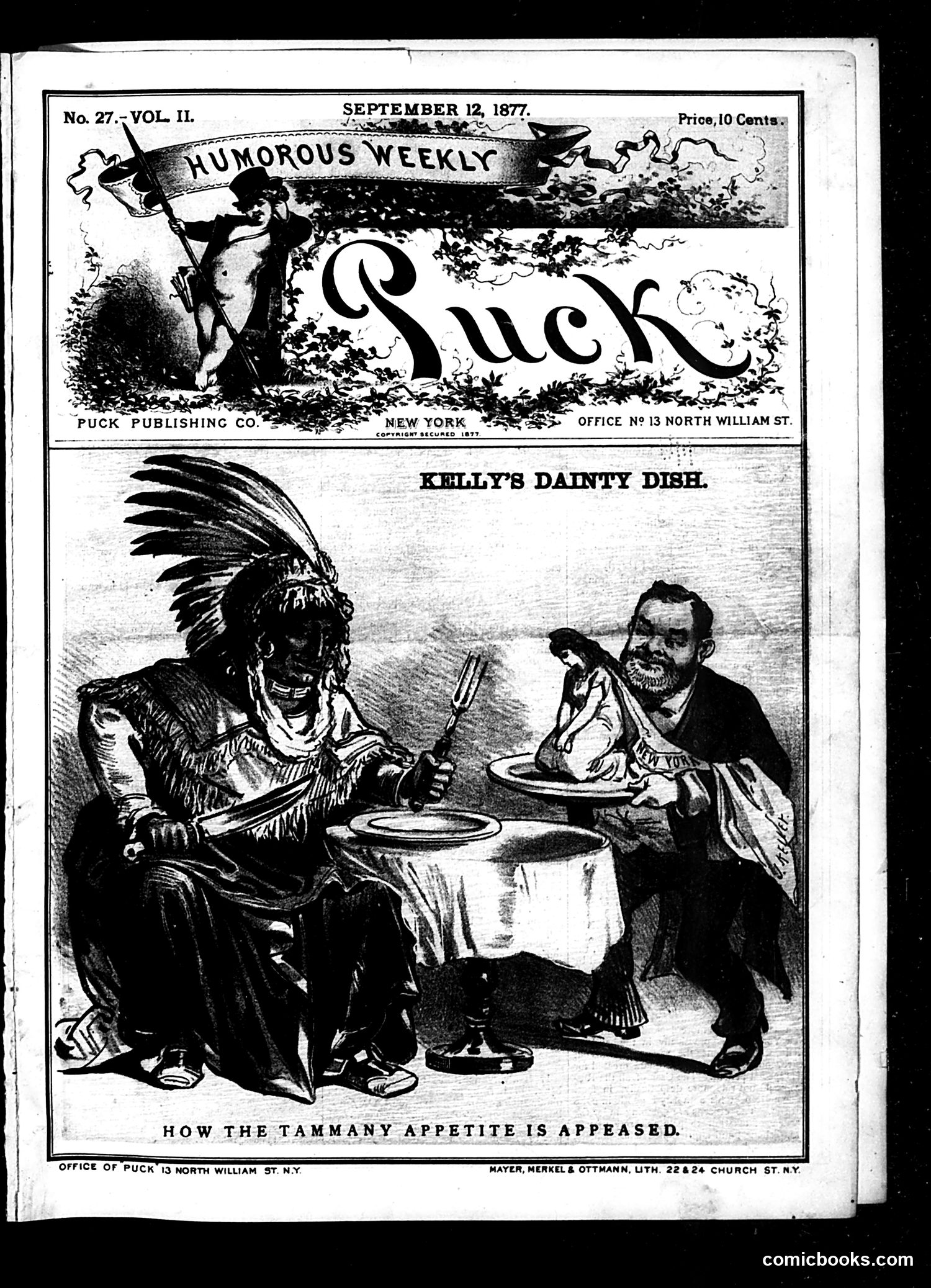
This cartoon satirizes what appears to be a political or social figure named Kelly. The illustration shows a Native American chief and a well-dressed white man sharing a meal from a large pot, with the caption "How the Tammany Appetite is Appeased." The reference to "Tammany" indicates this attacks Tammany Hall, New York's powerful Democratic political machine known for corruption and patronage. The "dainty dish" likely refers to illicit dealings or graft. The Native American imagery—a common 19th-century satirical device for depicting "savage" or corrupt behavior—suggests Kelly engages in crude, predatory politics. The shared meal implies collusion or backroom deals between political operators. Without additional context, the specific Kelly referenced remains unclear.
This page contains editorial content rather than political cartoons. The main pieces are: **"Puck" Editorial**: The editor celebrates the magazine's success and influence, appealing to readers' patriotism while criticizing "knaves" and "Tammany" (the corrupt Democratic political machine). The tone is self-congratulatory. **"Kelly's Dainty Dish"**: This satirizes Controller Kelly and Tammany Hall's corruption, suggesting Kelly distributes offices and farms to benefit himself while claiming to fight corruption. It's commentary on New York City machine politics. **"Mac Mahon's Sorrow"** and **"Cashiers and Cash"**: These appear to be brief satirical pieces on political and financial topics of the era. The page reflects Puck's role as a vehicle for attacking Democratic political corruption in Gilded Age New York.
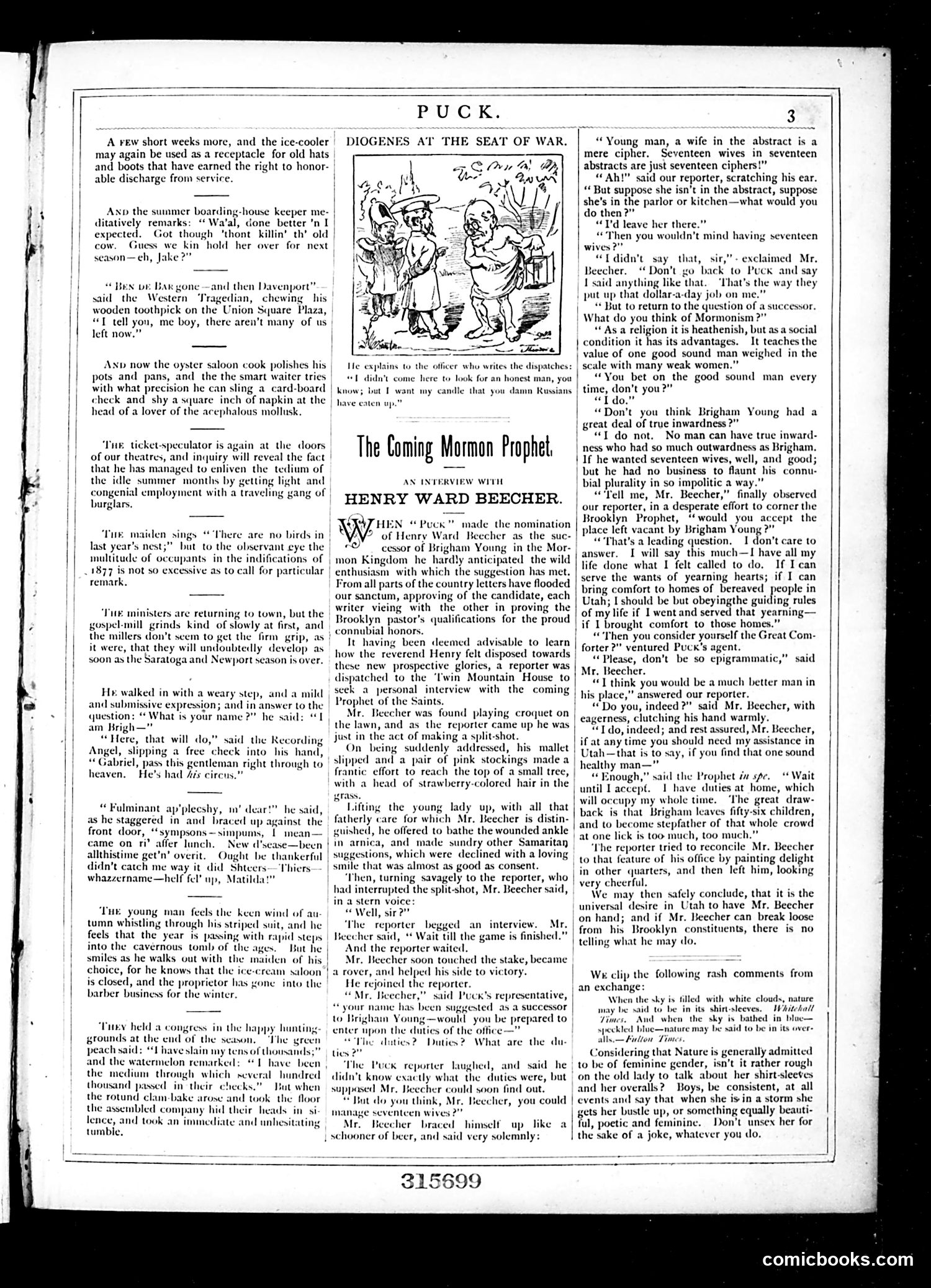
This page satirizes **Henry Ward Beecher**, a prominent Brooklyn preacher, through an interview titled "The Coming Mormon Prophet." The cartoon depicts Beecher as a potential Mormon leader, mocking his personal scandals (he faced adultery allegations) by suggesting his polygamous inclinations suit Mormon doctrine. The satire plays on Beecher's public prominence and moral authority contrasted with his private conduct. The piece questions whether someone with Beecher's reputation should lead a religious movement, using Mormonism's actual polygamy practices as the vehicle for ridicule. The accompanying illustration shows exaggerated caricatures typical of 19th-century Puck's visual style, emphasizing grotesque features for comedic effect.
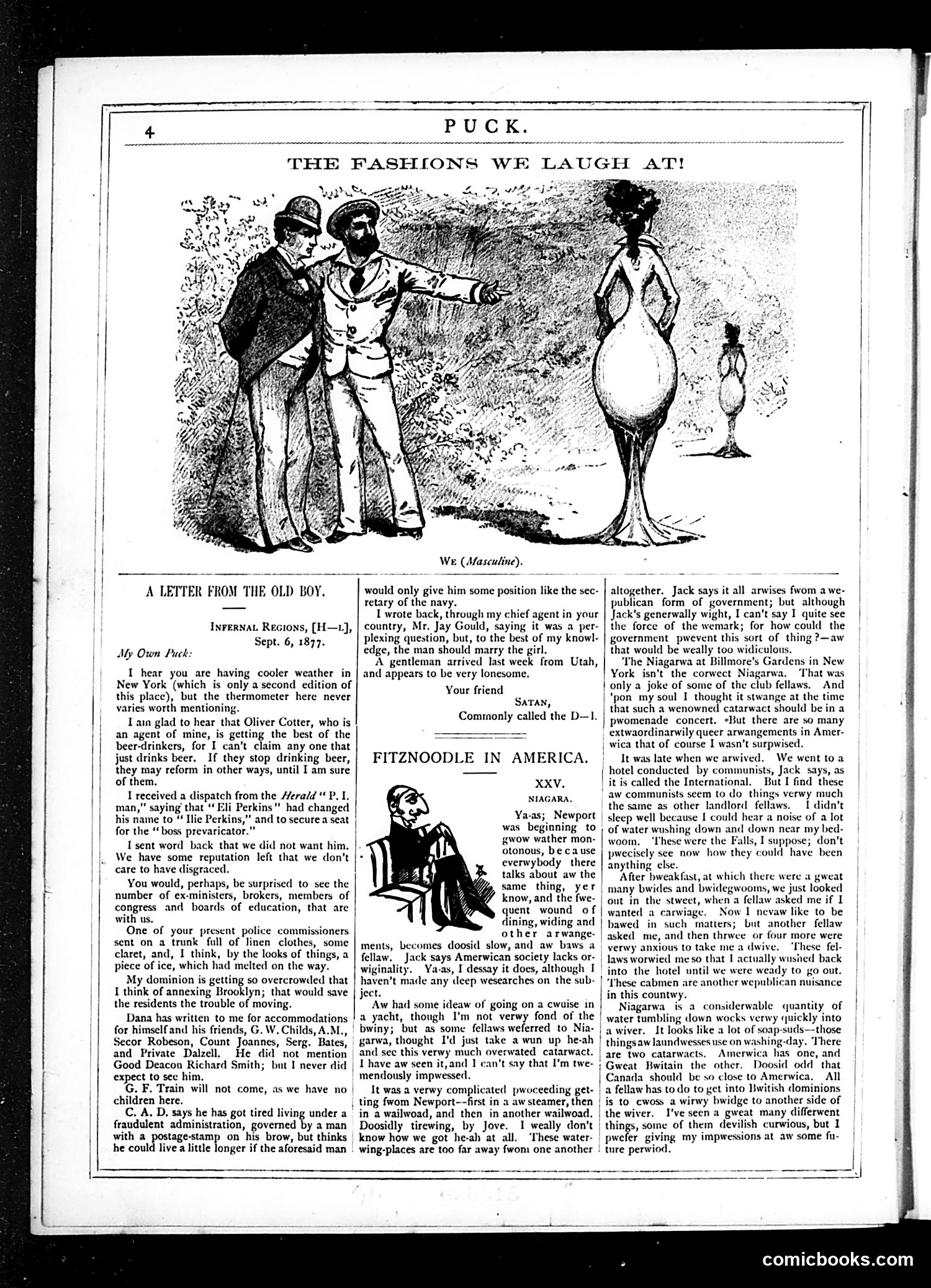
**Main Cartoon:** "The Fashions We Laugh At" depicts two well-dressed men examining a woman whose silhouette is exaggerated into an enormous, bulbous shape—likely satirizing the corset and bustle fashions of the 1870s. A smaller similarly-shaped figure appears in the background. The men's gestures suggest mockery of this extreme silhouette. **Articles Below:** Include "A Letter from the Old Boy" (social commentary on American life) and "Fitznoodle in America," continuing a satirical travel narrative. These mock both American customs and European perspectives on them. The page's central joke targets Victorian women's fashion—specifically the grotesque body shapes created by corsetry and bustles—presenting them as absurd and worthy of ridicule, a common Puck theme of the era.
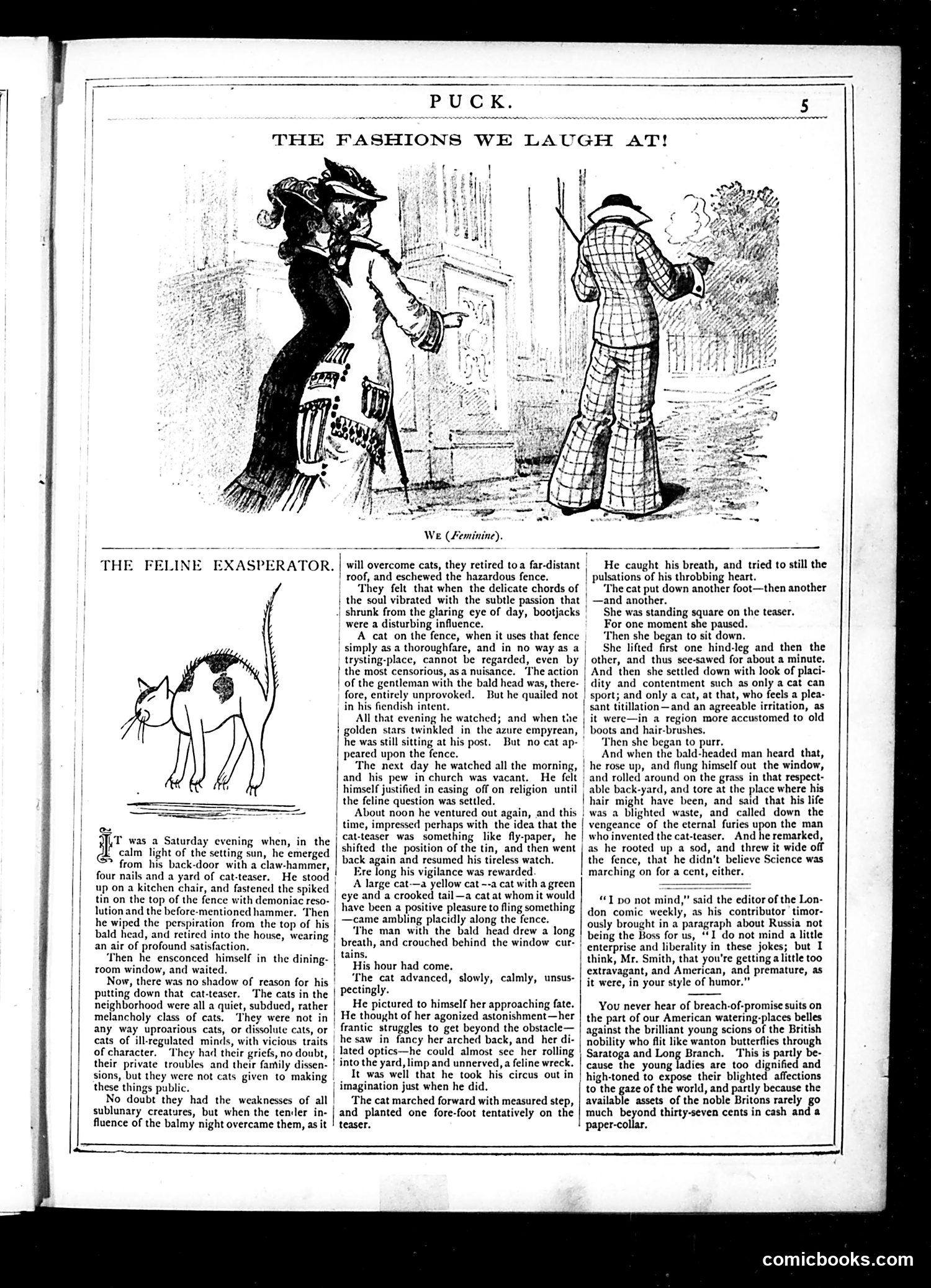
This page satirizes Victorian-era fashion through a humorous story about a cat on a fence. The top illustration shows two fashionably dressed women in elaborate period clothing, labeled "We (Feminine)." The main narrative follows a man whose cat disrupts his evening by fighting on a fence. The cat's nocturnal antics symbolize the absurdity of women's fashion—specifically how women tolerate discomfort and impracticality in pursuing style. The story mocks women's willingness to endure tight corsets, heavy fabrics, and restrictive clothing despite their obvious impracticality, comparing it to the cat's pointless, exhausting fence-climbing. The concluding editorial comment criticizes American society's excessive materialism and shallow fashion consciousness compared to European standards.
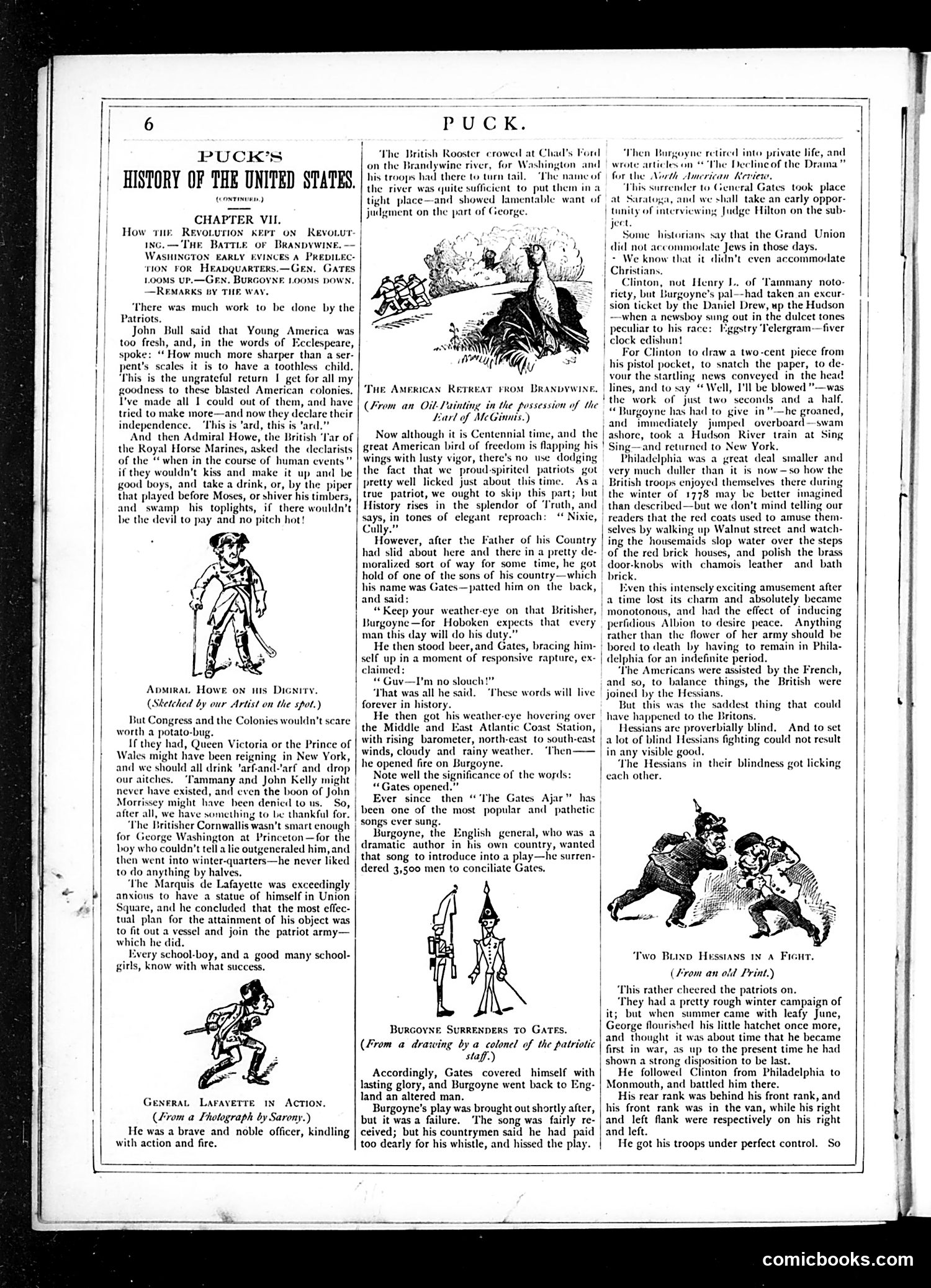
This page presents "Puck's History of the United States (Continued)," focusing on the Revolutionary War period. The illustrations satirize British military incompetence and American patriotic resolve. **Key Figures:** - **General Lafayette** and **General Howe** represent the opposing commanders - **General Burgoyne** appears in a cartoon labeled "Burgoyne Surrenders to Gates," mocking his defeat - **Two Blind Hessians in a Fight** depicts German mercenary soldiers hired by Britain **The Satire:** The cartoons mock British military failures and the hired German troops ("Hessians"), portraying them as incompetent or ridiculous. The text celebrates American patriotic resistance, contrasting noble revolutionary ideals against British blunders. The humor targets British command failures while celebrating American military success during the Revolutionary War.
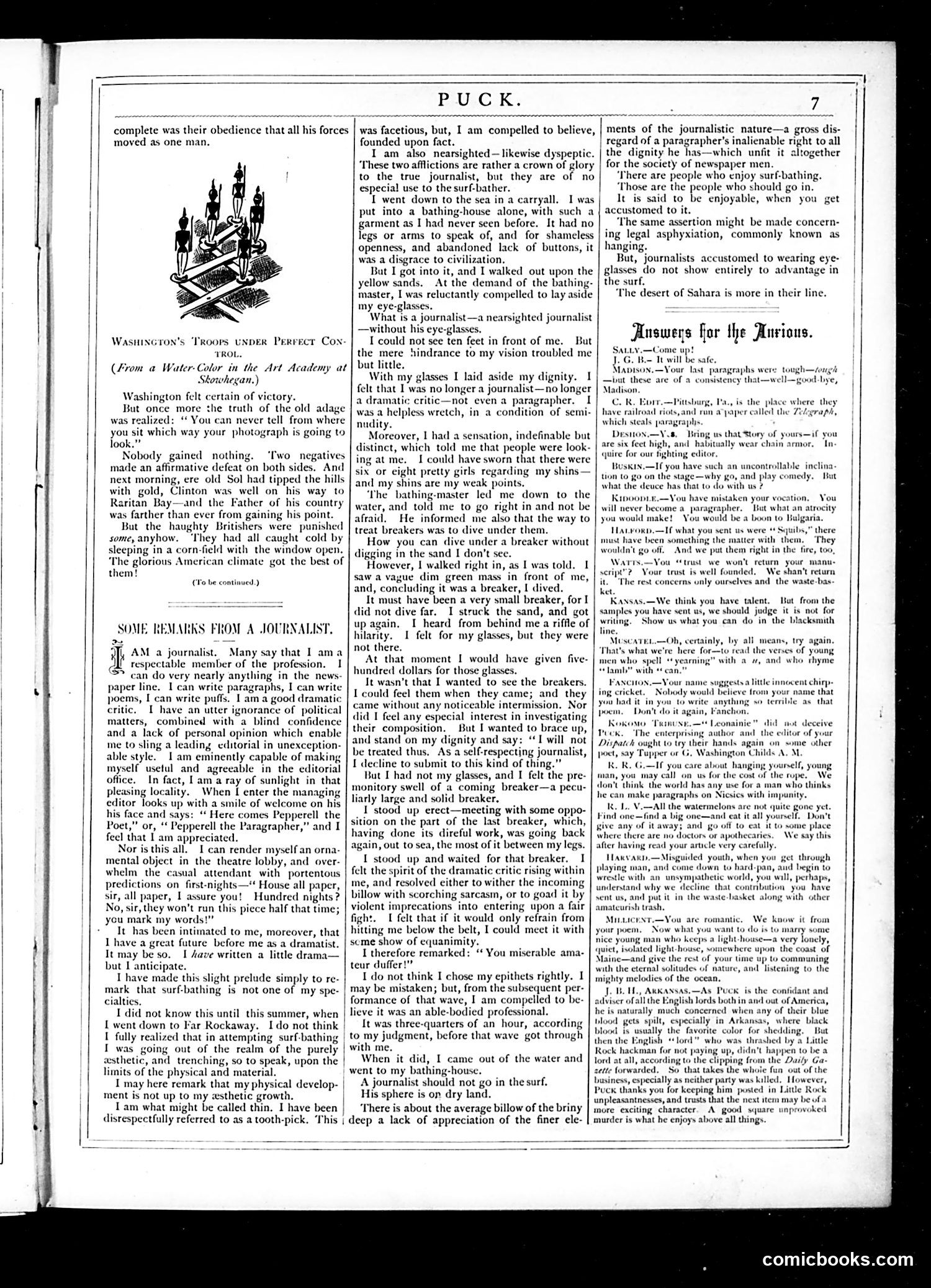
The cartoon depicts a castle or fortification with soldiers arranged in perfect formation. The caption references Washington and "perfect control," appearing to satirize military discipline or organization. The accompanying article, "Some Remarks from a Journalist," discusses the author's experience as a journalist with strong political opinions and lack of personal restraint. He describes attending a bathing incident where he lost his glasses, creating comic confusion—he couldn't see the "breakers" (waves) he'd come to observe. The satire contrasts the journalist's uncontrolled nature with the military's perfect order suggested in the cartoon. The piece critiques journalists' "utter ignorance of political matters" and inability to be objective, while the cartoon may reference Civil War military command (though the specific Washington reference remains unclear without more context).
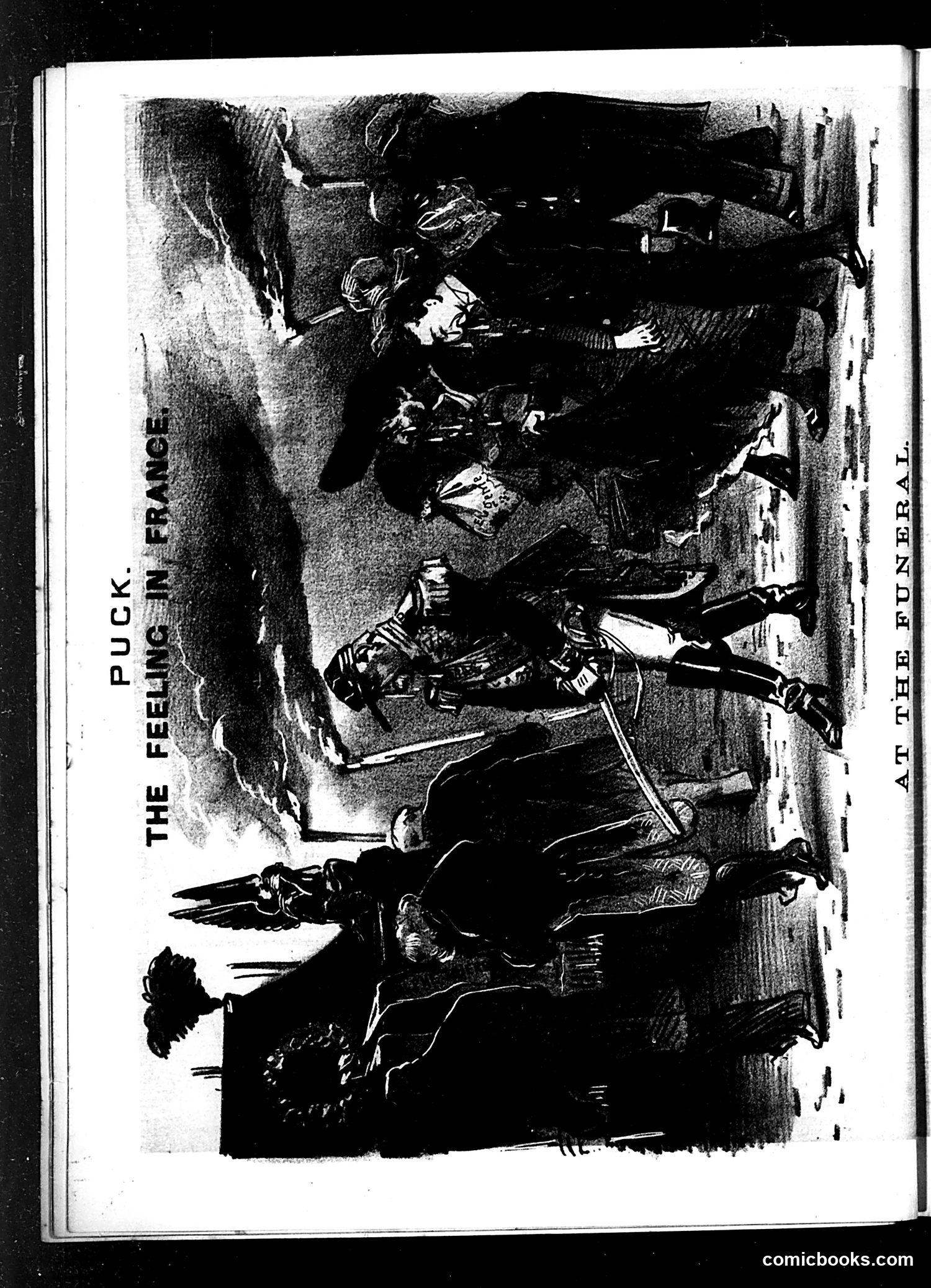
This Puck cartoon depicts French military and political figures responding to some international crisis or diplomatic situation. The image shows soldiers and officers in military dress gathered in what appears to be a tense or dramatic scene. The title "The Feeling in France" suggests it's commenting on French public opinion or official reaction to a contemporary event. Without a visible date, I cannot identify the specific historical moment referenced. However, given Puck's satirical nature, the cartoon likely mocks either French military posturing, political instability, or their response to a foreign policy matter. The dramatic composition and gathered figures suggest concern or agitation among French leadership. More context would be needed to determine the precise political reference.
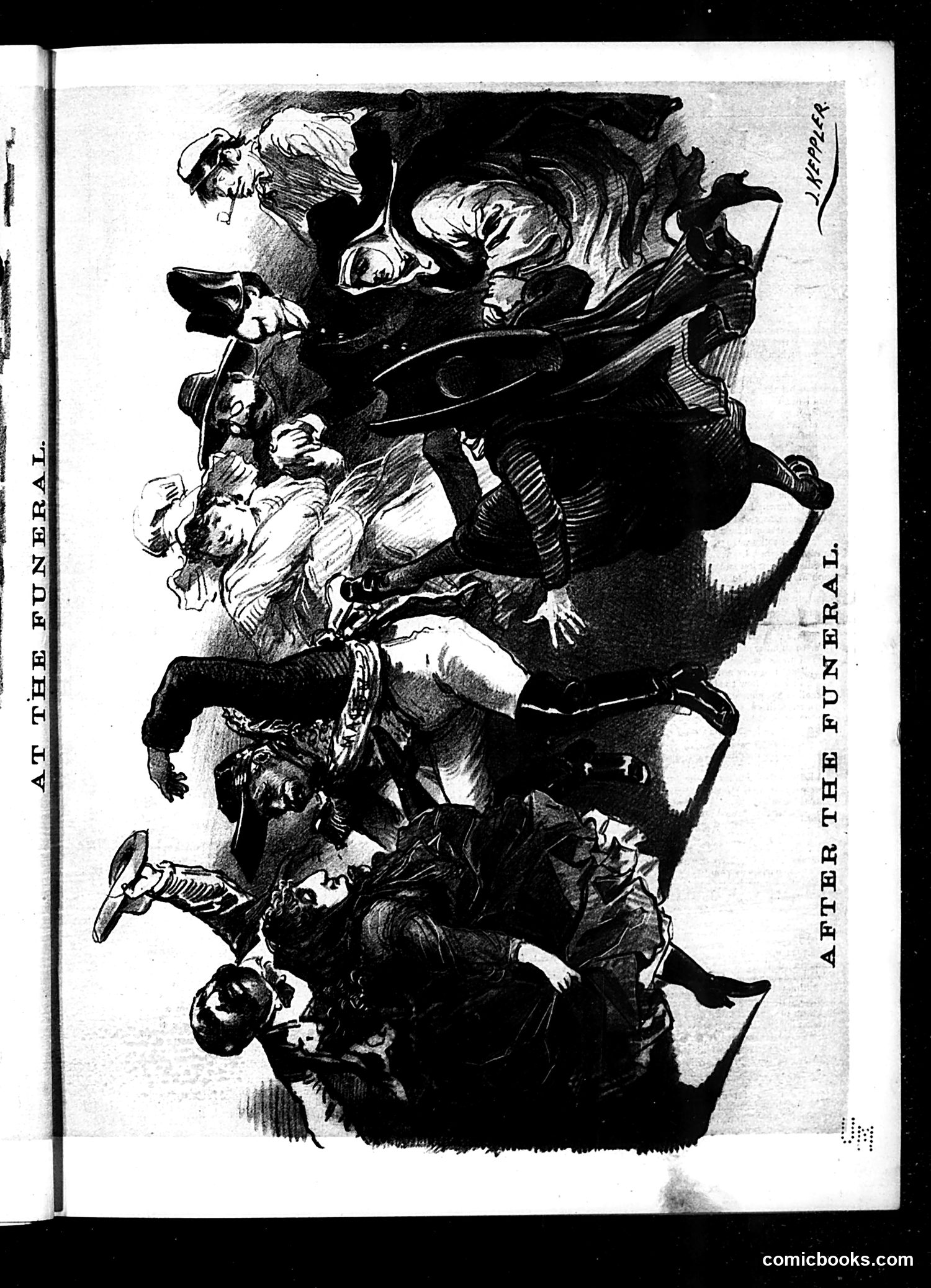
This Puck cartoon satirizes what appears to be a funeral scene with two panels showing contrasting behavior. The upper section depicts mourners at a funeral maintaining solemn, respectful demeanor. The lower section, labeled "After the Funeral," shows the same figures engaged in rowdy, undignified conduct—fighting, carousing, and behaving badly. The satire likely critiques hypocrisy: the contrast between people's public displays of respectability and grief versus their true, unrestrained character once the formal occasion ends. The figures appear to be wealthy or prominent individuals, suggested by their formal dress, making the commentary on class hypocrisy particularly pointed. This was a common Puck theme—exposing the gap between pretense and reality.
This page contains theater criticism and dramatic notes rather than political cartoons. The main content discusses Mr. Sothern's performance in "The Crushed Tragedian" at Park Theatre, praising his comedic talent while critiquing the play itself as burlesquely absurd. The small illustration at bottom right appears to be a scene from "The Dark City," another contemporary drama being reviewed. The "Dramatic Notes" section briefly mentions several theatrical productions and performers of the period, including references to plays at the Lyceum and Eagle Theatre. This is essentially a **theater review and entertainment gossip page** rather than political satire—typical content for Puck's lighter sections, which balanced its satirical political cartoons with cultural commentary.
This page contains theater and entertainment commentary rather than political cartoons. The left column discusses various theatrical productions and personalities of the era, including references to plays like "R-R-R-Romse!" and performers such as Celia Logan and Sara Jewett. The main illustrated content is titled "DRAWN!" and appears to be a poem or sketch about a lady's drawing room. Below that is "SOMETHING ON EARS," an essay discussing ears as human features and their representation in art and literature, with references to poets and Tennyson. The page functions primarily as cultural criticism and entertainment journalism rather than political satire. Without clearer visual elements or more specific historical references, the exact satirical targets remain unclear to a modern reader unfamiliar with 1880s theater culture.
This page contains **serialized fiction, not a political cartoon**. It's Chapter XXIII of "Two Knaves and a Queen," an English story by F.D.S. Parkes, appearing in Puck magazine. The narrative depicts a conversation between characters named René, Hugh, Mattie, and Kate Eason regarding portrait painting and artists' models. The dialogue reflects period attitudes about beauty, artistic integrity, and gender relations—Mattie defends herself against accusations of vanity while discussing professional modeling work. There is **no political satire visible** on this page. It's simply serialized literary content that Puck magazine published alongside its better-known satirical cartoons to fill space and attract readers interested in fiction as well as humor.
The main illustration, titled "Puck's Exchanges," appears to be a satirical commentary on frontier violence and Native American relations. The cartoon depicts what seems to be a confrontation scene, though the specific figures are difficult to identify clearly from the image quality. The text discusses Joseph's (likely Chief Joseph of the Nez Perce) conflict with the U.S. Government, criticizing American treatment of Native Americans and the military's conduct toward indigenous peoples, particularly regarding violence against women and children. The satire attacks the hypocrisy of "civilized and Christian men" who deny Native Americans basic rights while condemning them for defending their lands and families. The piece advocates for government accountability and fair treatment of indigenous peoples.
This page consists primarily of **text commentary and social satire**, not illustrated cartoons. The content includes multiple short pieces commenting on contemporary issues: - **Political observations** about American imagination and Western expansion - **Social commentary** on marriage customs in Greece versus America - **Anecdotes** mocking various figures, including references to President Hayes and debates about drinking habits - **Humorous takes** on military affairs, Russian soldiers, and American army conditions - **Personal gossip** about widows and fashion preferences The pieces appear to target **political hypocrisy**, **social pretension**, and **contemporary public figures**, though specific identities are often veiled through satirical reference rather than explicit naming. Without seeing accompanying illustrations, the full satirical impact is diminished, but the tone throughout is one of mocking social absurdity and political inconsistency.
This page is **primarily advertisements** with minimal satirical content. The main feature is **Puck's Illustrated Almanac**, a 160-page book edited by Leopold Schoence and Georg Asmus, illustrated by Joseph Keppler. The only visible narrative content appears to be a humorous anecdote about a man arriving in Richmond for a convention who encounters a boot-black at his hotel. The joke involves a dialogue about shininess and money, ending with a reference to an earthquake. The surrounding ads promote products including yeast, hats, wine, cigarettes, and printing inks—typical commercial fare for a late 19th-century American magazine. Without seeing the actual cartoon illustrations, specific political or social satire cannot be identified from this particular page.
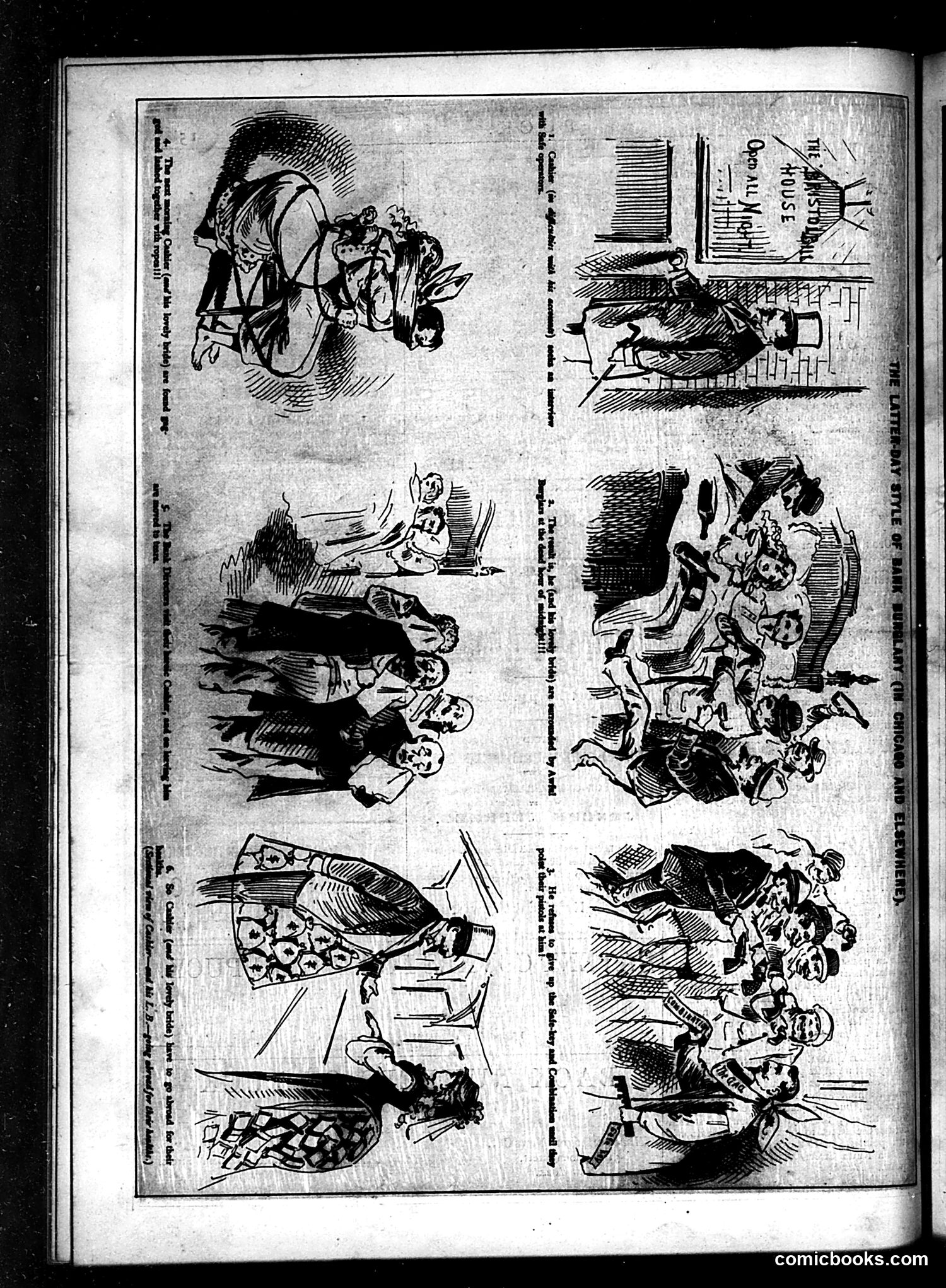
This page from *Puck* contains six satirical cartoon panels arranged in a grid. The OCR text is too degraded to read clearly, preventing precise identification of the specific political or social references. However, the visual content suggests commentary on late 19th or early 20th-century American life. The panels appear to depict various social scenes—possibly involving political figures, wealthy individuals, or class interactions—rendered in *Puck*'s characteristic exaggerated, caricatured style with heavy cross-hatching. Without legible text labels identifying the figures or clearly describing each scene's context, I cannot confidently explain which specific events, policies, or public figures are being satirized. The satirical intent is evident from the artistic treatment, but the particular jokes and references remain unclear from this image alone.