
Puck, 1877-09-12 · page 10 of 16
Puck — September 12, 1877 — page 10: what you’re looking at
What you’re looking at
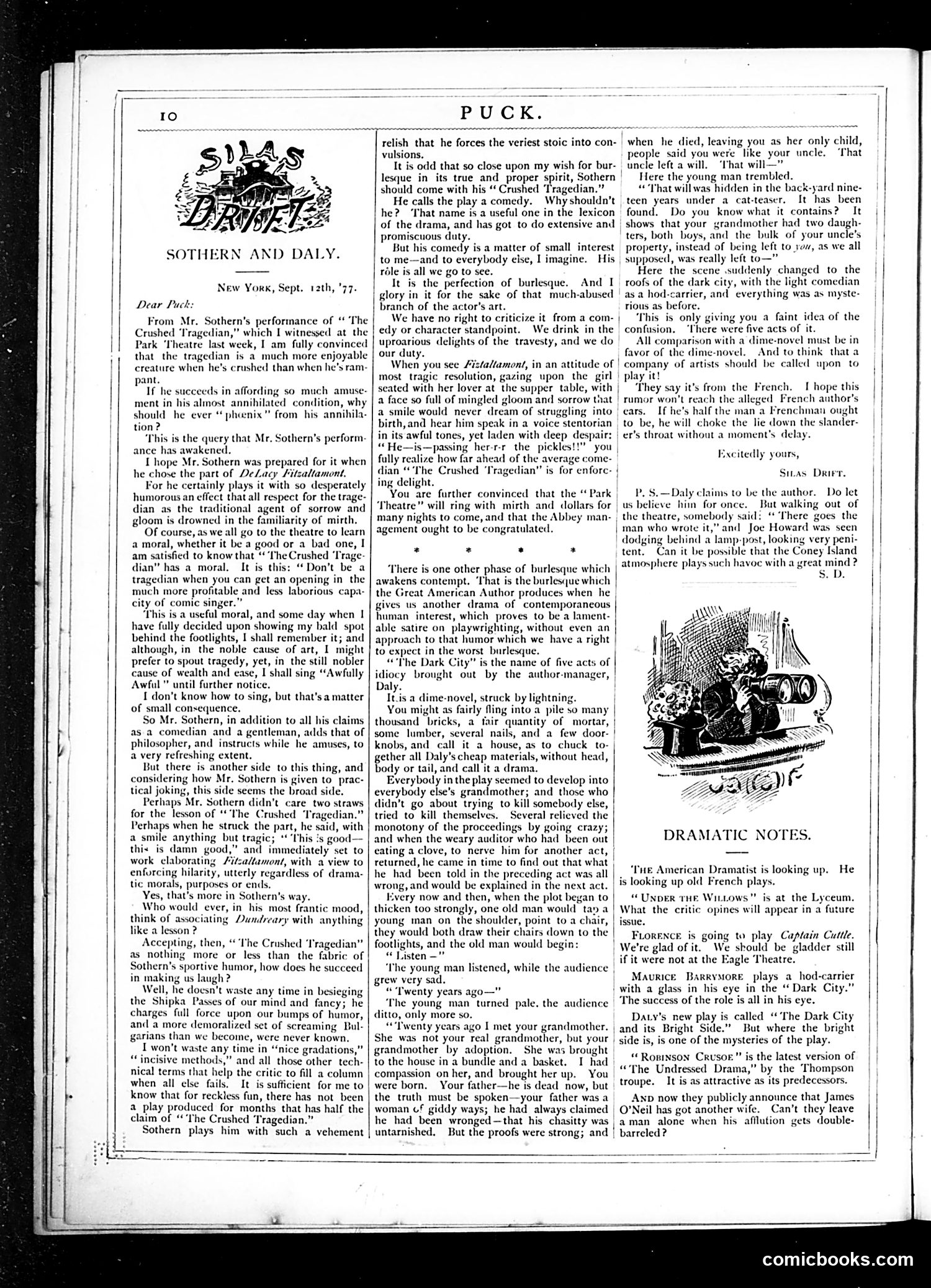
This page contains theater criticism and dramatic notes rather than political cartoons. The main content discusses Mr. Sothern's performance in "The Crushed Tragedian" at Park Theatre, praising his comedic talent while critiquing the play itself as burlesquely absurd. The small illustration at bottom right appears to be a scene from "The Dark City," another contemporary drama being reviewed. The "Dramatic Notes" section briefly mentions several theatrical productions and performers of the period, including references to plays at the Lyceum and Eagle Theatre. This is essentially a **theater review and entertainment gossip page** rather than political satire—typical content for Puck's lighter sections, which balanced its satirical political cartoons with cultural commentary.
📄 Transcribed text from this page (OCR, searchable)
Machine-transcribed from the original scan — historical spelling and the odd misread are preserved.
SOTHERN AND DALY. New York, Sept. 12th, '77. Dear Puc From Mr. Sothern’s performance of “ The Crushed ‘Tragedian,” which I witnessed at the Park ‘Theatre last week, I am fully convinced that the tragedian is a much more enjoyable creature when he’s crushed than when he's ram- pant. If he succeeds in affording so much amuse- ment in his almost annihilated condition, why should he ever “ phunix" from his annihila- tion? ‘This is the query that Mr. Sothern’s perform- ance has awakened. I hope Mr. Sothern was prepared for it when chose the part of DeLacy Fitzaltamont, For he certainly plays it with so desperately humorous an effect that all respect for the trage- dian as the traditional agent of sorrow and gloom is drowned in the familiarity of mirth, Of course, as we all go to the theatre to learn a moral, whether it be a good or a bad one, I am satisfied to know that “The Crushed ‘Trage- dian" has a moral. It is this: ‘Don't be a tragedian when you can get an opening in the much more profitable and less laborious capa- city of comic singer.” ‘This is a useful moral, and some day when 1 have fully decided upon showing my bald spot behind the footlights, I shall remember it; and although, in the noble cause of art, 1 might prefer to spout tragedy, yet, in the still nobler cause of wealth and ease, I shall sing ‘““Awfully Awful” until farther notice. I don’t know how to sing, but that's a matter of small consequence. So Mr. Sothern, in addition to all his claims as a comedian and a gentleman, adds that of philosopher, and instructs while he amuses, to a very refreshing extent. But there is another side to this thing, and considering how Mr. Sothern is given to. prac- tical joking, this side seems the broad side. Perhaps Mr. Sothern didn’t care two straws for the lesson of The Crushed ‘Tragedian.” Perhaps when he struck the part, he said, with a smile anything but tragic; * ‘This 's good— this is damn good,” and immediately set to work claborating Fitsa/amont, with a view to enforcing hilarity, utterly regardless of drama- tic morals, purposes or ends, Yes, that’s more in Sothern's way. Who would ever, in his most frantic mood, think of associating Dundreary with anything like a lesson ? . Accepting, then, “The Crushed ‘Tragedian” as nothing more or less than the fabric of Sothern’s sportive humor, how does he succeed in making us laugh ? Well, he doesn’t waste any time in besieging the Shipka Passes of our mind and fancy; he charges full force upon our bumps of humor, and a more demoralized set of screaming Bul- garians than we become, were never known, T won't waste any time in “nice gradations,” “incisive methods,” and all those other tech- nical terms that help the critic to fill a column when all clse fails. It is sufficient for me to know that for reckless fun, there has not been a play produced for months that has half the claim of ‘The Crushed Tragedian. Sothern plays him with such a vehement he relish that he forces the veriest stoic into con- vulsions, It is odd that so close upon my wish for bur- | lesque in its true and proper spirit, Sothern should come with his ‘‘ Crushed Tragedian,” He calls the play a comedy. Why shouldn't he? ‘That name is a useful one in the lexicon of the drama, and has got to do extensive and promiscuous duty. But his comedy is a matter of small interest to me—and to everybody else, I imagine. His rile is all we go to see. It is the perfection of burlesque. And I glory in it for the sake of that much-abused branch of the actor's art. We have no right to criticize it from a com- edy or character standpoint. We drink in the uproarious delights of the travesty, and we do our duty. When you see /izfa//amont, in an attitude of | most tragic resolution, gazing upon the girl seated with her lover at. the supper table, with a face so full of mingled gloom and sorrow that a smile would never dream of struggling into birth, and hear him speak in a voice stentorian in its awful tones, yet laden with deep despai “He—is—passing her-r-r the pickles!” you fully realize how far ahead of the ave! com dian “ ‘The Crushed ‘Tragedian" is for enfore- | ing delight. You are further convinced that the ark ‘Theatre” will ring with mirth and dollars for many nights to come, and that the Abbey man- agement ought to be congratulated. * * * * ‘There is one other phase of burlesque which awakens contempt. ‘That is the burlesque which the Great American Author produces when he gives us another drama of contemporancous human interest, which proves to be a lament- able satire on playwrighting, without even an approach to that humor which we have a right to expect in the worst burlesque, “The Dark City” is the name of five acts of idiocy brought out by the author-manager, Daly. It.is a dime-novel, struck by lightning. You might as fairly fling into a pile so many thousand bricks, a fair quantity of mortar, some lumber, several nails, and a few door- knobs, and call it a house, as to chuck to- gether all Daly’s cheap materials, without head, Body or tail, and call it a drama. Everybody in the play seemed to develop into everybody else's grandmother; and those who didn’t go about trying to kill somebody else, tried to kill themselves. Several relieved the monotony of the proceedings by going crazy; and when the weary auditor who had been out eating a clove, to nerve him for another act, returned, he came in time to find out that what he had been told in the preceding act was all wrong, and would be explained in the next act. Every now and then, when the plot began to thicken too strongly, one old man would tap a young man on the shoulder, point to a chair, | they would both draw their chairs down to the | footlights, and the old man would begin: « Listen — ‘The young man listened, while the audience grew very sad “Twenty years ago—” ‘The young man turned pale. the audience ditto, only more so. “Twenty years ago I met your grandmother. She was not your real grandmother, but your | grandmother by adoption. She was brought to the house in a bundle and a basket. I had compassion on her, and brought her up. You were born. Your father—he is dead now, but the truth must be spoken—your father was a woman of giddy ways; he had always claimed he had been wronged—that his chasitty was untarnished, But the proofs were strong; and when he died, leaving you as her only child, people said you were like your uncle. ‘That uncle left a will. ‘That will—” Here the young man trembled. “ That willwas hidden in the back-yard nine- teen years under a cat-teaser, It has been found. Do you know what it contains? It shows that your grandmother had two daugh: ters, both buys, and the bulk of your uncle property, instead of being left to you, as we all supposed, was really left to—”” Here the scene suddenly changed to the roofs of the dark city, with the light comedian as a hod-carrier, and everything was as myste- rious as before. ‘This is only giving you a faint idea of the confusion. ‘There were five acts of it. All comparison with a dime-novel must be in favor of the dime-novel. And to think that a company of artists should be called upon to play it! ‘They say it’s from the French. [hope this rumor won't reach the alleged French author's cars. If he’s half the man a Frenchman ought to be, he will choke the lie down the slander- er’s throat without a moment's delay. Excitedly yours, Stnas Drier. P. $.—Daly claims to be the author. Do let us believe him for once. But walking out of the theatre, somebody said: ‘There goes the man who wrote it,” and Joe Howard was seen dodging behind a lamp:post, looking very peni- tent. Can it be possible that the Coney Island atmosphere plays such havoc with a great mind ? S. D. DRAMATIC NOTES. ‘Te American Dramatist is looking up. He is looking up old French plays. “ UNDER THE WiLLows" is at the Lyceum. What the critic opines will appear in a future issue. Fiorence is going to play Captain Cuttle. We're glad of it. We should be gladder still if it were not at the Eagle Theatre. Maurice Barryore plays a_hod-carrier with a glass in his eye in the ‘ Dark City. The success of the role is all in his eye. Daty’s new play is called “ ‘The Dark City and its Bright Side.” But where the bright side is, is one of the mysteries of the play. “ Ropinson Crusoe” is the latest version of “The Undressed Drama,” by the ‘Thompson troupe. It is as attractive as its predecessors. Awp now they publicly announce that James O'Neil has got another wife. Can’t they leave aman alone when his afilution gets double- barreled? comicbooks.com