
Puck, 1877-09-12 · page 11 of 16
Puck — September 12, 1877 — page 11: what you’re looking at
What you’re looking at
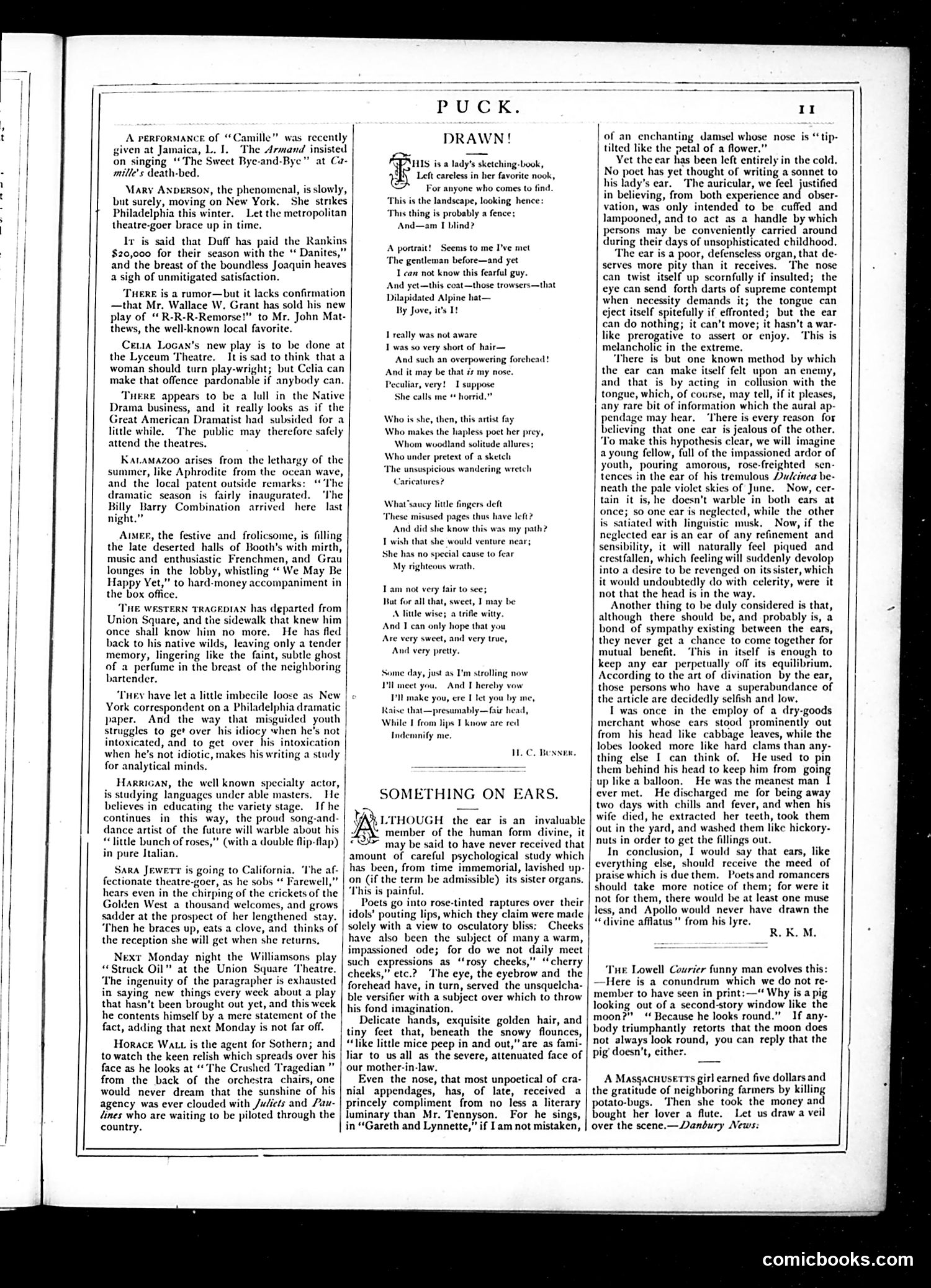
This page contains theater and entertainment commentary rather than political cartoons. The left column discusses various theatrical productions and personalities of the era, including references to plays like "R-R-R-Romse!" and performers such as Celia Logan and Sara Jewett. The main illustrated content is titled "DRAWN!" and appears to be a poem or sketch about a lady's drawing room. Below that is "SOMETHING ON EARS," an essay discussing ears as human features and their representation in art and literature, with references to poets and Tennyson. The page functions primarily as cultural criticism and entertainment journalism rather than political satire. Without clearer visual elements or more specific historical references, the exact satirical targets remain unclear to a modern reader unfamiliar with 1880s theater culture.
📄 Transcribed text from this page (OCR, searchable)
Machine-transcribed from the original scan — historical spelling and the odd misread are preserved.
A perrorMance of “Camille” was recently given at Jamaica, L. 1. The Armand insisted on singing “The Sweet Bye-and-Bye” at Ca- mille's death-bed. Mary ANDERSON, the phenomenal, is slowly, but surely, moving on New York. She strikes Philadelphia this winter. Let the metropolitan theatre-goer brace up in time. Ir is said that Duff has paid the Rankins $20,000 for their season with the ‘ Danites,” and the breast of the boundless Joaquin heaves a sigh of unmitigated satisfaction. ‘Tuere is a rumor—but it lacks confirmation —that Mr. Wallace W. Grant has sold his new play of “ R-R-R-Remorse!” to Mr. John Mat- thews, the well-known local favorite. Cetia Locan’s new play is to be done at the Lyceum Theatre. It is sad to think that a woman should turn play-wright; but Celia can make that offence pardonable if anybody can. ‘Tuere appears to be a lull in the Native Drama business, and it really looks as if the Great American Dramatist had subsided for a little while. ‘The public may therefore safely attend the theatres. Kat.amazoo arises from the lethargy of the summer, like Aphrodite from the ocean and the local patent outside remark: dramatic season is fairly inaugurated. Billy Barry Combination arrived here last night.” Aimer, the festive and frolicsome, is filling the late deserted halls of Booth’s with mirth, music and enthusiastic Frenchmen, and Grau lounges in the lobby, whistling “We May Be Happy Yet,” to hard-money accompaniment in the box offi ‘THE WESTERN TRAGEDIAN has departed from Union Square, and the sidewalk that knew him once shall know him no more. He has fled back to his native wilds, leaving only a tender memory, lingering like the faint, subtle ghost of a perfume in the breast of the neighboring bartender. ‘Tey have let a little imbecile loose as New | « York correspondent on a Philadelphia dramatic paper. And the way that misguided youth struggles to get over his idiocy when he’s not | intoxicated, and to get over his intoxication when he’s not idiotic, makes his writing a study for analytical minds. Harrican, the well known specialty actor, is studying languages under able masters. He | believes in educating the var ty stage. If he continues in this way, the proud song-and- Retnousn the ear is an_ invaluable dance artist of the future will warble about his “little bunch of roses,” (with a double flip-flap) in pure Italian. Sara Jewett is going to California fectionaie theatre-goer, as he sobs hears even in the chirping of the crickets of the Golden West a thousand welcomes, and grows | sadder at the prospect of her lengthened. stay. "Then he braces up, eats a clove, and thinks of the reception she will get when she returns, DRAWN! es is a lady's sketching-book, SH) Lett careless in her favorite nook, 7 For anyone who comes to find. This is the landscape, looking hence: ‘This thing is probably a fences And—am I blind? ‘A portrait! Seems to me I've met ‘The gentleman before—and yet I can not know this fearful guy. And yet—this coat—those trowsers—that Dilapidated Alpine hat— By Jove, it's I! I really was not aware I was so very short of ha And such an overpowering for And it may be that és my nose. Peculiar, very! I suppose She calls me horrid.” Who is she, then, this artist fay Who makes the hapless poet her prey, Whom woodland solitude allures; Who under pretext of a sketch ¢ unsuspicious wandering wretch Caricatures? What'saucy little fingers deft “These misused pages thus have left? And did she know this was my path? I wish that she would venture near; She has no special cause to fear My righteous wrath, Tam not very fair to see; Hut for all that, sweet, T may be AA little wise; a trifle witty. And T can only hope that you Are And very pretty. cry sweet, and very true, Some day, just ay I'm strolliny you, And T hereby vow ke you, ere I let you by me, ir he at— presumably While I from lips T know are red emnify me. H.C. Benen. SOMETHING ON EARS. member of the human form divine, it «© may be said to have never received that amount of careful psychological study which has been, from time immemorial, lavished up- on (if the term be admissible) its sister organs. ‘This is painful. Poets go into rose-tinted raptures over their idols’ pouting lips, which they claim were made solely with a view to osculatory bliss: Cheeks have also been the subject of many a warm, impassioned ode; for do we not daily mect Nexr Monday night the Williamsons play | {ivy expressions’ as “rosy checks,”” “cher “Struck Oil" at the Union Square Theatre. | Cheeks," etc? ‘The eye, the eyebrow and. the ‘The ingenuity of the paragrapher is exhausted in saying new things every weck about a play forehead have, in turn, served the unsquelcha- ble versifier with a subject over which to throw that hasn't been brought out yet, and this week | nis fond imagination. he contents himself by a mere statement of the fact, adding that next Monday is not far off. Delicate hands, exquisite golden hair, and tiny feet that, beneath the snowy flounces, Horace Watt is the agent for Sothern; and | ‘like little mice peep in and out," are as fami- to watch the keen relish which spreads over his | liar to us all as the severe, attenuated face of face as he looks at “The Crushed Tragedian " | our mother-in-law. from the back of the orchestra chairs, one Even the nose, that most unpoetical of cra- would never dream that the sunshine of his | nial appendages, has, of late, received a agency was ever clouded with Ju/iets and Pau-| princely compliment from no less a literary dines who are waiting to be piloted through the | luminary than Mr. Tennyson. country. For he sings, in “Gareth and Lynnette,” if Iam not mistaken, of an enchanting damsel whose nose is “ tip- tilted like the petal of a flower.” Yet the ear has been left entirely in the cold. No poet has yet thought of writing a sonnet to his lady’s ear. The auricular, we feel justified in believing, from both experience and obser- vation, was only intended to be cuffed and lampooned, and to act as a handle by which persons may be conveniently carried around during their days of unsophisticated childhood. The ear is a poor, defenseless organ, that de- | | serves more pity than it receives. The nose can twist itself up scornfully if insulted; the eye can send forth darts of supreme contempt | | when necessity demands it; the tongue can eject itself spitefully if effronted; but the ear can do nothing; it can’t move; it hasn’t a war- like prerogative to assert or enjoy. ‘This is melancholic in the extreme. ‘There is but one known method by which the ear can make itself felt upon an enemy, and that is by acting in collusion with the tongue, which, of course, may tell, if it pleases, any rare bit of information which the aural ap- pendage may hear. ‘There is every reason for believing that one ear is jealous of the ot! ‘To make this hypothesis clear, we will imagine a young fellow, full of the impassioned ardor of youth, pouring amorous, rose-freighted sen- tences in the ear of his tremulous Dudeinea bi neath the pale violet skies of June. Now, cer- tain it is, he doesn’t warble in both ears at once; so one ear is neglected, while the other is satiated with linguistic musk. Now, if the neglected ear is an ear of any refinement and sensibility, it will naturally feel piqued and crestfallen, which feeling will suddenly devolop into a desire to be revenged on its sister, which it would undoubtedly do with celerity, were it not that the head is in the way. Another thing to be duly considered is that, although there should be, and probably is, a bond of sympathy existing between the cars, they never get a chance to come together for mutual benefit. This in itself is enough to keep any ear perpetually off its equilibrium, According to the art of divination by the ear, those persons who have a superabundance of the article are decidedly selfish and low, I was once in the employ of a dry-goods merchant whose ears stood prominently out from his head like cabbage leaves, while the lobes looked more like hard clams than any- thing else I can think of. He used to pin them behind his head to keep him from going up like a balloon, He was the meanest man I ever met. He discharged me for being away two days with chills and fever, and when his wife died, he extracted her teeth, took them out in the yard, and washed them like hickory- nuts in order to get the fillings out. In conclusion, I would say that ears, like everything else, should receive the meed of praise which is due them. Poets and romancers should take more notice of them; for were it not for them, there would be at least one muse less, and Apollo would never have drawn the “divine afflatus” from his lyre. R. K. M. ‘Te Lowell Courier funny man evolves this: —Here is a conundrum which we do not re- member to have seen in print:— Why is a pig looking out of a second-story window like the moon?” “ Because he looks round.” If any- body triumphantly retorts that the moon does not always look round, you can reply that the pig’ doesn’t, either. A Massacuusetts girl earned five dollars and the gratitude of neighboring farmers by killing potato-bugs. ‘Then she took the money and bought her lover a flute. Let us draw a veil over the scene.—Danbury News: —— comicbooks.com