
Puck, 1877-09-12 · page 14 of 16
Puck — September 12, 1877 — page 14: what you’re looking at
What you’re looking at
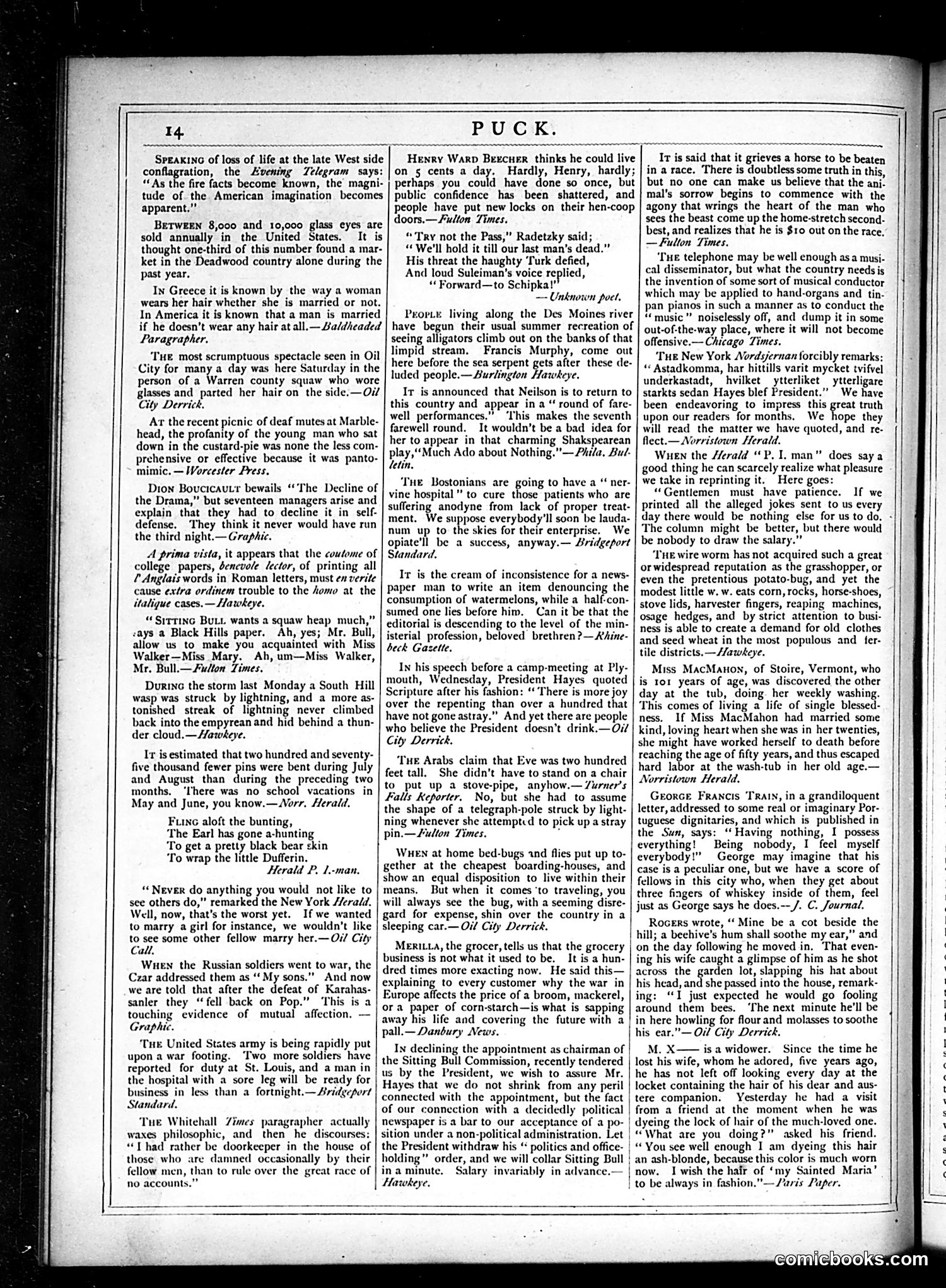
This page consists primarily of **text commentary and social satire**, not illustrated cartoons. The content includes multiple short pieces commenting on contemporary issues: - **Political observations** about American imagination and Western expansion - **Social commentary** on marriage customs in Greece versus America - **Anecdotes** mocking various figures, including references to President Hayes and debates about drinking habits - **Humorous takes** on military affairs, Russian soldiers, and American army conditions - **Personal gossip** about widows and fashion preferences The pieces appear to target **political hypocrisy**, **social pretension**, and **contemporary public figures**, though specific identities are often veiled through satirical reference rather than explicit naming. Without seeing accompanying illustrations, the full satirical impact is diminished, but the tone throughout is one of mocking social absurdity and political inconsistency.
📄 Transcribed text from this page (OCR, searchable)
Machine-transcribed from the original scan — historical spelling and the odd misread are preserved.
14 SPEAKING of loss of life at the late West side conflagration, the vening Telegram says: “As the fire facts become known, the’ magni- tude of the American imagination becomes apparent.” BETWEEN 8,000 and 10,000 glass eyes are sold annually in the United States. It is thought one-third of this number found a mar- ket in the Deadwood country alone during the past year. In Greece it is known by the way a woman wears her hair whether she is married or not. In America it is known that a man is married if he doesn’t wear any hair at all.—Baddheaded Paragrapher, ‘THE most scrumptuous spectacle seen in Oil City for many a day was here Saturday in the person of a Warren county squaw who wore glasses and parted her hair on the side,—Ow City Derrick. Ar the recent picnic of deaf mutes at Marble- head, the profanity of the young man who sat down in the custard-pie was none the less com- prehensive or effective because it was panto- mimic. — Worcester Press, Dion Boucicautr bewails “The Decline of the Drama,” but seventeen managers arise and explain that they had to decline it in self- defense. They think it never would have run the third night.— Graphic. A prima vista, it appears that the coulome of college papers, dencvole lector, of printing all ¢ Anglais words in Roman letters, must en verite cause extra ordinem trouble to the homo at the italique cases.— Hawkeye. “ Sittinc BuLt wants a squaw heap much,” says a Black Hills paper. Ah, yes; Mr. Bull, allow us to make you acquainted with Miss Walker—Miss Mary. Ah, um—Miss Walker, Mr. Bull.— Fulton Times, Durinc the storm last Monday a South Hill wasp was struck by lightning, and a more as- tonished streak of lightning never climbed back into the empyrean and hid behind a thun- der cloud.—Hatwkeye. Ir is estimated that two hundred and seventy- five thousand fewer pins were bent during July and August than during the preceding two months, ‘Ihere was no school vacations in May and June, you know.—Norr, Herald. Func aloft the bunting, ‘The Earl has gone a-hunting ‘To get a pretty black bear skin ‘To wrap the little Dufferin. Herald P. I.-man. “Never do anything you would not like to see others do,” remarked the New York /erald, Well, now, that's the worst yet. If we wanted to marry a girl for instance, we wouldn't like to see some other fellow marry her.—Oi/ City Call, Wuen the Russian soldiers went to war, the Czar addressed them as ‘‘ My sons.” And now we are told that after the defeat of Karahas- sanler they “fell back on Pop.” ‘T' is a ing evidence of mutual affection. — ‘THE United States army is being rapidly put upon a war footing. ‘Two more soldiers have reported for duty at St. Louis, and a man in the hospital with a sore leg will be ready for business in less than a fortnight.—Aridgeport Standard. Tue Whitehall Zimes paragrapher actually waxes philosophic, and then’ he discourses: “Thad rather be doorkeeper in the house of those who are damned occasionally by their fellow men, than to rule over the great race of no accounts.” PUCK. Henry Warp Beecuer thinks he could live on 5 cents a day. Hardly, Henry, hardly; perhaps you could have done so once, but public confidence has been shattered, and people have put new locks on their hen-coop doors.— Fulton Times. “ Try not the Pass,” Radetzky said; “We'll hold it till our last man’s dead.” His threat the haughty ‘Turk defied, And loud Suleiman’s voice replied, “‘ Forward—to Schipka!’ — Unknown poet. Prope ing along the Des Moines river have begun their usual summer recreation of seeing alligators climb out on the banks of that limpid stream, Francis Murphy, come out here before the sea serpent gets after these de- luded people.—Aurlington Hawkeye. Ir is announced that Neilson is to return to this country and appear in a “ round of fare- well performances.” ‘his makes the seventh farewell round. It wouldn’t be a bad idea for her to appear in that charming Shakspearean play,‘‘Much Ado about Nothing."—Pit/a, Bul- detin. ‘Tne Bostonians are going to have a “ ner- vine hospital” to cure those patients who are suffering anodyne from lack of proper treat- ment. We suppose everybody'll soon be lauda- num up to the skies for their enterprise. We opiate’ll be a success, anyway.— Bridgeport Standard. It is the cream of inconsistence for a news- Paper man to write an item denouncing the consumption of watermelons, while a half-con- sumed one lies before him. Can it be that the editorial is descending to the level of the min- isterial profession, beloved brethren?—Xdine- beck Gazelle. In his speech before a camp-meeting at Ply- mouth, Wednesday, President Hayes quoted Scripture after his fashion: “ There is more joy over the repenting than over a hundred that have not gone astray.” And yet there are people who believe the President doesn’t drink.—Oi/ City Derrick. ‘Tne Arabs claim that Eve was two hundred feet tall. She didn’t have to stand on a chair to put up a stove-pipe, anyhow.— Zurner’s Falls Keporter, No, but she had to assume the shape of a telegraph-pole struck by light- ning whenever she attemptcd to pick up a stray pin.—Fulton Times. . Wuen at home bed-bugs 1nd flies put up to- gether at the cheapest boarding-houses, and show an equal disposition to live within their means. But when it comes ‘to traveling, you will always see the bug, with a seeming disre- gard for expense, shin over the country in a sleeping car.— Oil City Derrick. MERILLA, the grocer, tells us that the grocery business is not what it used to be. It is a hun- dred times more exacting now. He said this— explaining to every customer why the war in Europe affects the price of a broom, mackerel, ora paper of corn-starch—is what is sapping away his life and covering the future with a pall.— Danbury News. In declining the appointment as chairman of | the Sitting Bull Commission, recently tendered us by the President, we wish to assure Mr. Hayes that we do not shrink from any peril connected with the appointment, but the fact of our connection with a decidedly political newspaper bar to our acceptance of a po- sition under a non-political administration. Let the President withdraw his “ politics and office- | ” order, and we will collar Sitting Bull Salary invariably in advance.- holdin; ina minute. Hawkeye. ~ ——————~ It is said that it grieves a horse to be beaten in a race. There is doubtless some truth in this, but no one can make us believe that the ani. mal’s sorrow begins to commence with the agony that wrings the heart of the man who sees the beast come up the home-stretch second- best, and realizes that he is $10 out on the race, —Fulton Times, ‘Tue telephone may be well enough asa musi- cal disseminator, but what the country needs is the invention of some sort of musical conductor which may be applied to hand-organs and tin- pan pianos in such a manner as to conduct the “music” noiselessly off, and dump it in some out-of-the-way place, where it will not become offensive.— Chicago Times. "Tue New York Nordsjernan forcibly remarks: “ Astadkomma, har hittills varit mycket tvifvel underkastadt, hvilket _ytterliket _ ytterligare starkts sedan Hayes blef President.” We have been endeavoring to impress this great truth upon our readers for months. We hope they will read the matter we have quoted, and re- flect.— Norristown Herald. Wuen the Hera/d “P. 1, man” does saya good thing he can scarcely realize what pleasure we take in reprinting it. Here goes: “Gentlemen must have patience. If we printed all the alleged jokes sent to us every day there would be nothing else for us to do. - The column might be better, but there would be nobody to draw the salary.”” ‘Tne wire worm has not acquired such a great or widespread reputation as the grasshopper, or even the pretentious potato-bug, and yet the modest little w. w. eats corn, rocks, horse-shoes, stove lids, harvester fingers, reaping machines, osage hedges, and by strict attention to busi- ness is able to create a demand for old clothes and seed wheat in the most populous and fer- tile districts. — Hawkeye. Miss MacManon, of Stoire, Vermont, who is tor years of age, was discovered the other day at the tub, doing. her weckly washing. This comes of living a life of single blessed- ness. If Miss MacMahon had married some kind, loving heart when she was in her twenties, she might have worked herself to death before reaching the age of fifty years, and thus escaped hard Tabor at the wash-tub in her old age.— Norristown Herald. Georce Francis Train, in a grandiloquent letter, addressed to some real or imaginary Por- tuguese dignitaries, and which is published in the Sun, says: “Having nothing, I possess everything! Being nobody, I feel myself everybody!” George may imagine that his case is a peculiar one, but we have a score of fellows in this city who, when they get about three fingers of whiskey inside of them, feel just as George says he does.--/. C. Journal. Roses wrote, “‘ Mine be a cot beside the | hill; a beehive’s hum shall soothe my ear,” and | on the day following he moved in, ‘That even- ing his wife caught a glimpse of him as he shot across the garden lot, slapping his hat about his head, and she passed into the house, remark- ing: “I just expected he would go fooling around them bees. ‘The next minute he'll be in here howling for flour and molasses to soothe his ear.”— Oil City Derrick, M. X—— isa widower. Since the time he lost his wife, whom he adored, five years ago, he has not left off looking every day at the locket containing the hair of his dear and aus- tere companion. Yesterday he had a visit from a friend at the moment when he was | dyeing the lock of hair of the much-loved one. ‘What are you doing?” asked his friend. “ You see well enough I am dyeing this hair | an ash-blonde, because this color is much worn | now. I wish the hafr of ‘my Sainted Maria’ | to be always in fashion."—/aris Paper.