
Puck, 1877-09-12 · page 7 of 16
Puck — September 12, 1877 — page 7: what you’re looking at
What you’re looking at
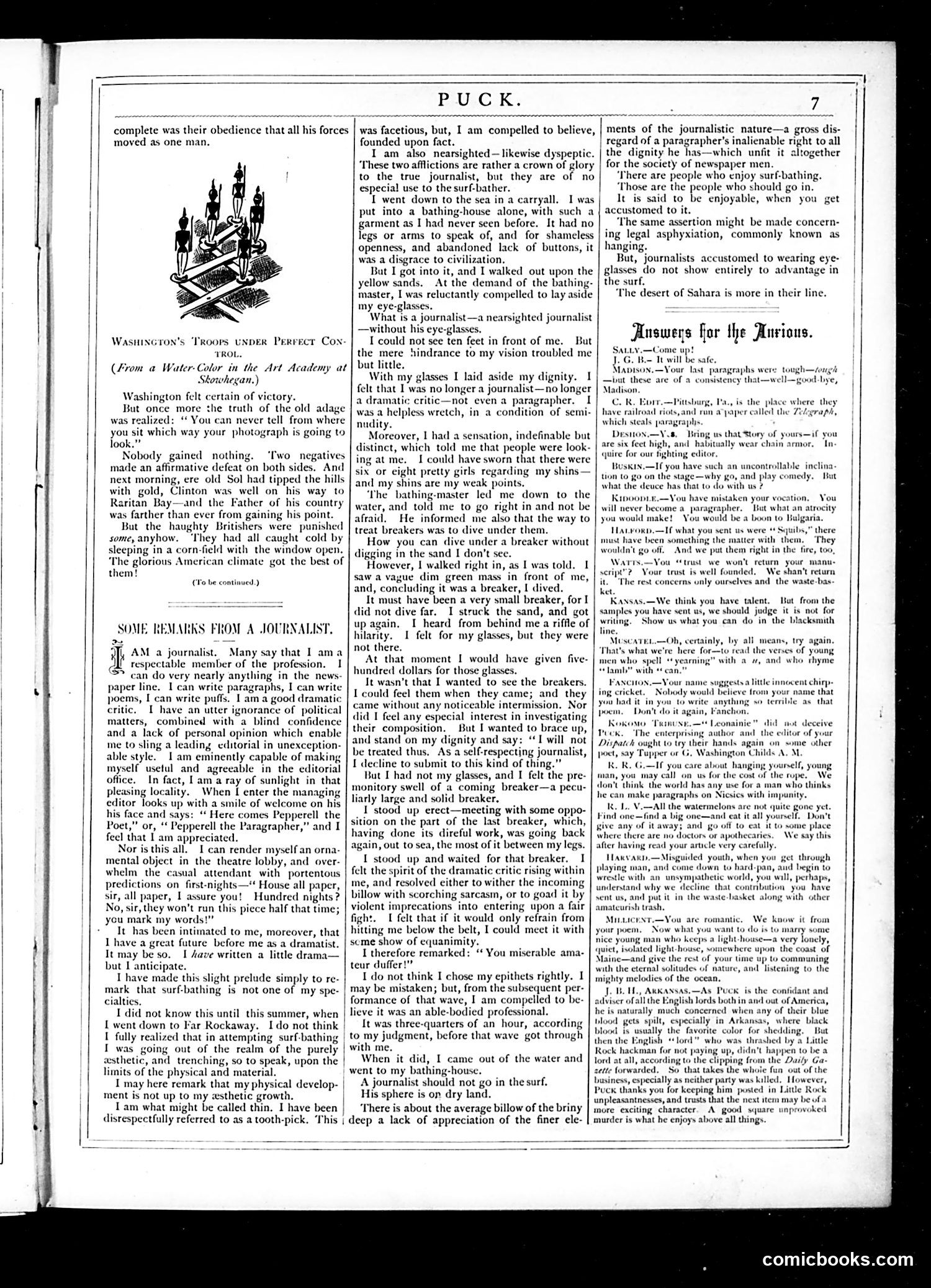
The cartoon depicts a castle or fortification with soldiers arranged in perfect formation. The caption references Washington and "perfect control," appearing to satirize military discipline or organization. The accompanying article, "Some Remarks from a Journalist," discusses the author's experience as a journalist with strong political opinions and lack of personal restraint. He describes attending a bathing incident where he lost his glasses, creating comic confusion—he couldn't see the "breakers" (waves) he'd come to observe. The satire contrasts the journalist's uncontrolled nature with the military's perfect order suggested in the cartoon. The piece critiques journalists' "utter ignorance of political matters" and inability to be objective, while the cartoon may reference Civil War military command (though the specific Washington reference remains unclear without more context).
📄 Transcribed text from this page (OCR, searchable)
Machine-transcribed from the original scan — historical spelling and the odd misread are preserved.
_ = a | | complete was their obedience that all his forces moved as one man. per Perrect Con- Wasnixcros's ‘Troops Uy TROL. (From a Water-Color in the Art Academy at Skowhegan.) Washington felt certain of victory. | But once more the truth of the old adage was realized: ‘ You can never tell from where you sit which way your photograph is going to look. Nobody gained nothing. ‘Two negatives made an affirmative defeat on both sides. And next morning, ere old Sol had tipped the hills with gold, Clinton was well on his way to Raritan Bay—and the Father of his country was farther than ever from gaining his point. But the haughty Britishers were punished some, anyhow. ‘They had all caught cold by sleeping in a corn-field with the window open. ‘The glorious American climate got the best of them! (To be continued.) SOME REMARKS FROM A JOURNALIST, bl ey AM a journalist. Many say that I ama respectable member of the profession. 1 can do very nearly anything in the news- paper line. I can write paragraphs, I can write poems, [ can write puffs. 1 ama good dramatic critic.” I have an utter ignorance of political matters, combined with a blind confidence and a lack of personal opinion which enable me to sling a leading editorial in unexception- able style. I am eminently capable of making myself usetul and agreeable in the editorial office. In fact, L am_a ray of sunlight in that pleasing locality. When I enter the managing editor looks up with a smile of welcome on his his face and says: “ Here comes Pepperell the Poet,” or, “« Pepperell the Paragrapher,” and I feel that I am appreciated. Nor is this all. I can render myself an orna- mental object in the theatre lobby, and over- whelm the casual attendant with portentous predictions on first-nights—* House all paper, sir, all paper, I assure you! Hundred nights ? No, sir, they won't run this piece half that time; you mark my words!” It_has been intimated to me, moreover, that I have a great future before me as a dramatist. It may be so. I Aave written a little drama— but I anticipat I have made this slight prelude simply to re- mark that surf-bathing is not one of my spe- cialties. I did not know this until this summer, when { went down to Far Rockaway. Ido not think I fully realized that in attempting surf-bathing I was going out of the realm of the purely sthet limits of the physical and material. I may here remark that my physical develop- ment is not up to my wsthetic growth, Tam what might be called thin. I have been , and trenching, so to speak, upon the | PUCK. 7 was facetious, but, I am compelled to believe, founded upon fact. I am also nearsighted —likewise dyspeptic. ‘These two afflictions are rather a crown of glory to the true journalist, but they are of no especial use to the surf-bather. I went down to the sea in a carryall, I was put into a bathing-house alone, with such a garment as I had never seen before. It had no legs or arms to speak of, and for shameless openness, and abandoned lack of buttons, it was a disgrace to civilization, But I got into it, and I walked out upon the yellow sands. At the demand of the bathing- master, I was reluctantly compelled to lay aside my eye-glasses. What is a journalist —a nearsighted journalist —without his eye-glas I could not see ten feet in front of me. But the mere hindrance to my vision troubled me but little, With my glasses I laid aside my dignity. 1 felt that I was no longer a journalist—no longer a dramatic critic—not even a paragrapher. I was a helpless wretch, in a condition of semi- nudity. Moreover, I had a sensation, indefinable but distinct, which told me that people were look- ing at me. I could have sworn that there were six or eight pretty girls regarding my shins— and my shins are my weak points. ‘The bathing-master led me down to the water, and told me to go right in and not be afraid, He informed me also that the way to treat breakers was to dive under them. How you can dive under a breaker without digging in the sand I don’t sec. However, 1 walked right in, as I was told. 1 saw a vague dim green mass in front of me, and, concluding it was a breaker, I dived. It must have been a very small breaker, for I did not dive far. I struck the sand, and got up again, I heard from behind me a riffle of hilarity. I felt for my glasses, but they were not there. At that moment I would have given five- hundred dollars for those glasses. It wasn’t that I wanted to see the breakers. I could feel them when they came; and they came without any noticeable intermission. Nor did I feel any especial interest in investigating their composition. But I wanted to brace up, and stand on my dignity and say: “I will not be treated thus, AS a self-respecting journalist, I decline to submit to this kind of thing.” But [ had not my glasses, and I felt the pre- monitory swell of a coming breaker—a pecu- liarly large and solid breaker. I stood up erect—meeting with some oppo- sition on the part of the last breaker, which, having done its direful work, was going back again, out to sea, the most of it between my le, I stood up and waited for that breaker. 1 felt the spirit of the dramatic critic rising within me, and resolved either to wither the incoming billow with scorching sarcasm, or to goad it by violent imprecations into entering upon a fair fight. I felt that if it would only refrain from hitting me below the belt, I could meet it with seme show of equanimity. I therefore remarked: ‘ You miserable ama- teur duffer!” I do not think I chose my epithets rightly. I may be mistaken; but, from the subsequent per- formance of that wave, I am compelled to be- lieve it was an able-bodied professional. It was three-quarters of an hour, according to my judgment, before that wave got through with me. | When it did, I came out of the water and went to my bathing-house, | A journalist should not go in the surf. His sphere is on dry land. ments of the journalistic nature—a gross dis- regard of a paragrapher’s inalienable right to all the dignity he has—which unfit it altogether | for the society of newspaper men. ‘There are people who enjoy surf-bathing. ‘Those are the people who should go in. It is said to be enjoyable, when you get accustomed to it. ‘The same assertion might be made concern- ing legal asphyxiation, commonly known as hanging. But, journalists accustomed to wearing eye- glasses do not show entirely to advantage in the surf. ‘The desert of Sahara is more in their line. Answers for the Anrious. LLY.—Come up B= It will be safe, Mapisox.—Your last paragraphs were rough but these are of a consistency that—well—good-hye, Madison. ‘C.K. El Pittsburg, Pa., is the place where they have railroad riots,and run a'paper called the Zel:graphy Is paragraphs. Bring us that Story of your which st Desiox.—Vss, f yo are six feet high, and habitually wear chain armor, “In quire for our fighting editor Busktn.—If you have such an uncontrollable inclina- ton to go on the stage—why go, and play ¢ But what the deuce has that to do with us? Kinoopn.,—You have mistaken your vocation, You But what an atrocity you would ‘a boon to Bulgaria. ILALYoRD.—If what you sent us were #* Squibs,” there must have been something the matter with th They wouldn't aff. And we put th ight in the fire, too, Warts.—You “trust we won't return your manu- script”? Your trust is well founded. We shan't return it. The rest concerns only ourselves and the waste-bas- ket Kaxsas.—We think you have talent, Mut from the samples you have sent us, we should judge it is not for writing. Show us what you can do in the blacksmith line. Museavet.—Oh, certainly That's what we're for men who spell. yearning’ by all means, try again, » read the verses of young with a a, and who thyme stya little innocent chirp» ‘obody would believe from your name that anything so terrible as that N ing cricket. you had it in you to write poem. Don't « Kokomo ‘Teinuxe.—« Leonainie™ did not deceive Tex. ‘The enterpri thor and the editor of your Dispatch ought to try their hands again on some other poet, say Tupper or G, Washington Childs A. M. K. R. G.—If you care about hanging yourself, young man, you may call on us for the cost of the rope. V don’t think the world has any use for a man who thinks he can make paragraphs on Niesics with impunity, V.—All the watermelons are not 4 find a big one—and eat it all yourself. give any of it away; and go off to eat it to some place Where there are no doctors oF ay We say this after having read your arucle very carefully. n you get through aries. Haxvann.—Misguided youth, w playing man, and come down to h wrestle with an unsympathetic world, you will, perhaps, understand why we decline that contnbution you have nd put it in the waste-hasket along with other sent us, amateurish trash, Mu. your poe Nt.—You are romantic. We know it frou Now what you want to do is to marry some —a very lonely, on the coast of » communing listening to the Maine—and give the rest of ys with the eternal solitudes of mighty melodies of the ocean, J. BL, AkKANSAS.—As Puck is the confidant and adviser ofall the English lords both in and out of America, he is naturally much concerned when any of their blue hlood gets spilt, especially in Arkansas, where black blood is usually the favorite color for shedding. But then the ish “lord” who was thrashed by a Little Rock hackman for not paying up, didn’t happen to be a lord at all, according to the clipping from the Daily Ga- sette forwarded, o that takes the whole out of the business, especially as neither party was killed. However, Puck thanks you for keeping him posted in Little Rock unpleasantnesses, and trusts that the next item may be of a | _ There is about the average billow of the briny disrespectfully referred to as a tooth-pick. This | deep a lack of appreciation of the finer ele- more exciting character. A good square unprovoked murder is what he enjoys above all things. comicbooks.com