
Puck, 1877-09-12 · page 12 of 16
Puck — September 12, 1877 — page 12: what you’re looking at
What you’re looking at
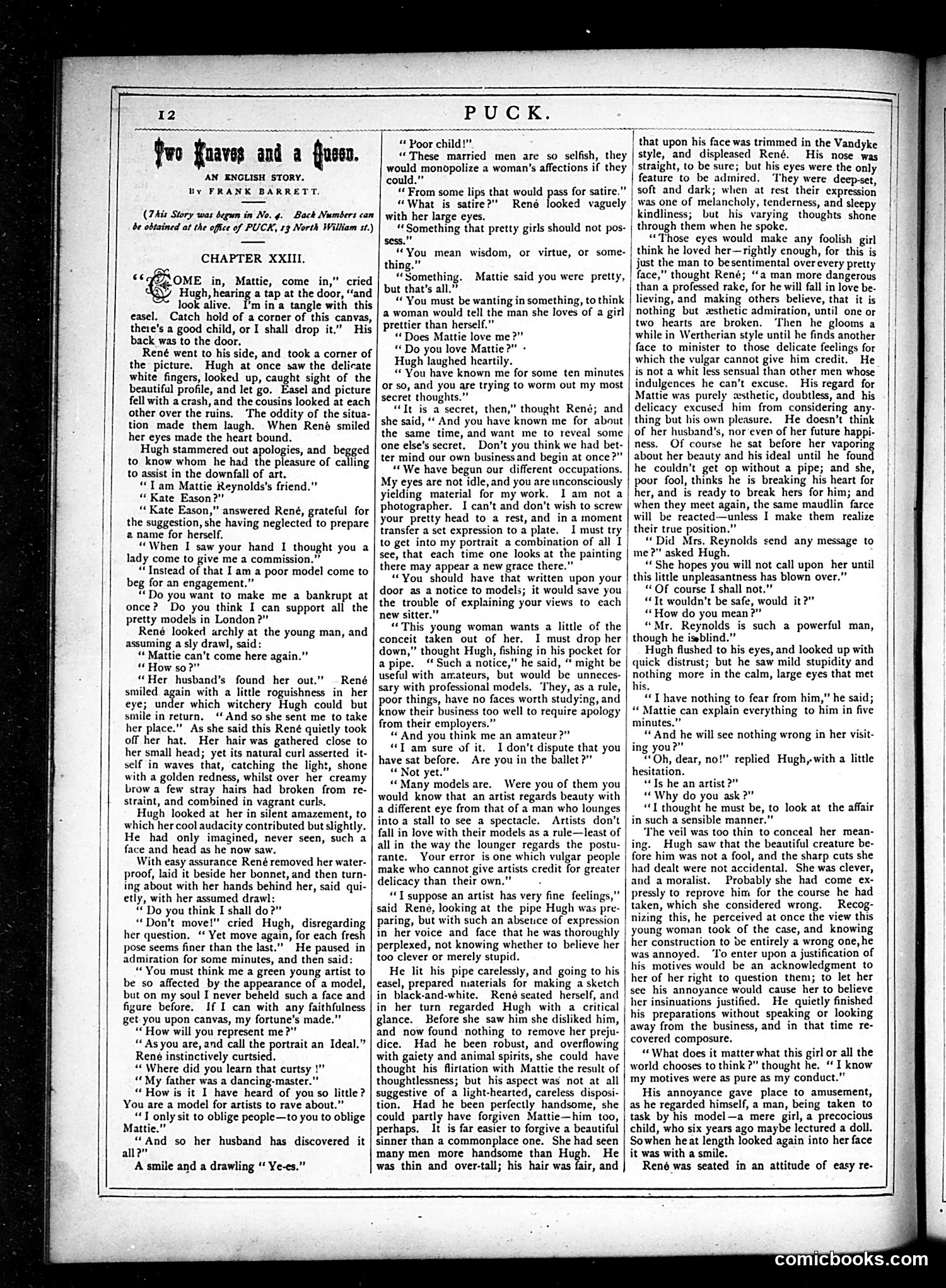
This page contains **serialized fiction, not a political cartoon**. It's Chapter XXIII of "Two Knaves and a Queen," an English story by F.D.S. Parkes, appearing in Puck magazine. The narrative depicts a conversation between characters named René, Hugh, Mattie, and Kate Eason regarding portrait painting and artists' models. The dialogue reflects period attitudes about beauty, artistic integrity, and gender relations—Mattie defends herself against accusations of vanity while discussing professional modeling work. There is **no political satire visible** on this page. It's simply serialized literary content that Puck magazine published alongside its better-known satirical cartoons to fill space and attract readers interested in fiction as well as humor.
📄 Transcribed text from this page (OCR, searchable)
Machine-transcribed from the original scan — historical spelling and the odd misread are preserved.
AN ENGLISH STORY. By FRANK BARRETT. (This Story was begun in No.4. Back Numbers can be obtained at the office of PUCK, 13 North William st.) CHAPTER XXIII. 6s ME in, Mattie, come in,” cried Hugh, hearing a tap at the door, “and look alive. I’m ina tangle with this easel. Catch hold of a corner of this canvas, there's a good child, or I shall drop it.” His back was to the door. René went to his side, and took a corner of the picture. Hugh at once saw the delicate white fingers, looked up, caught sight of the beautiful profile, and let go. Easel and picture fell with a crash, and the cousins looked at each other over the ruins. ‘The oddity of the situa- tion made them laugh. When René smiled her eyes made the heart bound. Hugh stammered out apologies, and begged to know whom he had the pleasure of calling to assist in the downfall of art. “Tam Mattie Reynolds's friend.” “ Kate Eason?” “Kate Eason,” answered René, grateful for the suggestion, she having neglected to prepare 2 name for herself. “When I saw your hand I thought you a lady come to give me a commission.” “Instead of that I am a poor model come to beg for an engagement.” “Do you want to make me a bankrupt at once? ‘Do you think I can support all the pretty models in London?” René looked archly at the young man, and assuming a sly drawl, said: “ Mattie can’t come here again.” “ How so?” “Her husband’s found her out.” smiled again with a little roguishness in her eye; under which witchery Hugh could but smile in return, ‘ And so she sent me to take her place.” As she said this René quietly took off her hat. Her hair was gathered close to her small head; yet its natural curl asserted it- self in waves that, catching the light, shone with a golden redness, whilst over her creamy brow a few stray hairs had broken from re- straint, and combined in vagrant curls. Hugh looked at her in silent amazement, to which her cool audacity contributed but slightly. He had only imagined, never seen, such a face and head as he now saw. With easy assurance René removed her water- proof, laid it beside her bonnet, and then turn- ing about with her hands behind her, said qui- etly, with her assumed drawl: “Do you think I shall do?” “Don't move!” cried Hugh, disregarding her question, “ Yet move again, for each fresh pose seems finer than the last.” He paused in admiration for some minutes, and then said: “You must think me a green young artist to be so affected by the appearance of a model, but on my soul I never beheld such a face and figure before. If I can with any faithfulness get you upon canvas, my fortune’s made.” “How will you represent me?” “As you are, and call the portrait an Ideal.” René instinctively curtsied. “« Where did you learn that curtsy !”” “My father was a dancing-master.” “ How is it I have heard of you so little? You are a model for artists to rave about.” “‘T only sit to oblige people—to you to oblige Mattie.” “And so her husband has discovered it all?” A smile and a drawling ‘ Ye-es.” “ Poor child!” “These married men are so selfish, they would monopolize a woman’s affections if they ‘From some lips that would pass for satire. “What is satire?” with her large eyes. “Something that pretty girls should not pos- René looked vaguely | Mattie said you were pretty, but that’s all.” “ You must be wanting in something, to think a woman would tell the man she loves of a girl prettier than herself.”” “Does Mattie love me?” “Do you love Mattie?” + Hugh laughed heartily. that upon his face was trimmed in the Vandyke style, and displeased René. His nose was straight, to be sure; but his eyes were the only feature to be admired, ‘They were deep-set, soft and dark; when at rest their expression was one of melancholy, tenderness, and sleepy kindliness; but his varying thoughts shone through them when he spoke. “Those eyes would make any foolish girl | You mean wisdom, or virtue, or some- | think he loved her—rightly enough, for this is just the man to besentimental overevery pretty face,” thought René; “a man more dangerous than a professed rake, for he will fall in love be- lieving, and making others believe, that it is nothing but xsthetic admiration, until one or two hearts are broken. ‘Then he glooms a while in Wertherian style until he finds another face to minister to those delicate feelings for which the vulgar cannot give him credit. He “You have known me for some ten minutes | is not a whit less sensual than other men whose or so, and you are trying to worm out my most | indulgences he can’t excuse. His regard for secret thoughts.”” Mattie was purely wsthetic, doubtless, and his “It is a secret, then,” thought René; and | delicacy excused him from considering any- she said, “ And you have known me for about | thing but his own pleasure. He doesn’t. think the same time, and want me to reveal some one else’s secret. Don’t you think we had bet- of her husband’s, nor even of her future happi- ness. Of course he sat before her vaporing ter mind our own business and begin at once?” | about her beauty and his ideal until he found “We have begun our different occupations. | he couldn't get on without a pipe; and she, My eyes are not idle, and you are unconsciously yielding material for my work. I am not a} poor fool, thinks he is breaking his heart for er, and is ready to break hers for him; and photographer. I can’t and don’t wish to screw | when they meet again, the same maudlin farce your pretty head to a rest, and ina moment | will be reacted—unless I make them realize transfer a set expression to a plate. I must try | their true position.” to get into my portrait a combination of all I) “Did Mrs. Reynolds send any message to see, that each time one looks at the painting | me?” asked Hugh. there may appear a new grace there.” “You should have that written upon your | this little unpleasantness has blown over.” door as a notice to models; it would save you the trouble of explaining your views to cach new sitter.”” “This young woman wants a little of the “She hopes you will not call upon her until “Of course I shall not.”” “Tt wouldn’t be safe, would it?” “How do you mean?” “Mr. Reynolds is such a powerful man, conceit taken out of her. I must drop her | though he iseblind.” down,” thought Hugh, fishing in his pocket for Hugh flushed to his eyes, and looked up with apipe. ‘Such a notice,” he said, “ might be | quick distrust; but he saw mild stupidity and useful with amateurs, but would be unneces- | nothing more in the calm, large eyes that met sary with professional models. ‘They, as a rule, | his. poor things, have no faces worth studying, and “T have nothing to fear from him,” he said; know their business too well to require apology | “ Mattie can explain everything to him in five from their employers.” | minutes.” “ And you think me an amateur?” | “And he will see nothing wrong in her visit- “T am sure of it. I don't dispute that you | ing you?” have sat before. Are you in the ballet?” “Not yet.” “Many models are. Were you of them you would know that an artist regards beauty with a different eye from that of a man who lounges “Oh, dear, no!” replied Hugh, with a little hesitation. “(Ts he an artist ?” “Why do you ask 2” “I thought he must be, to look at the affair into a stall to see a spectacle. Artists don’t | in such a sensible manner.” fall in love with their models as a rule—least of | ‘The veil was too thin to conceal her mean- all in the way the lounger regards the postu- | ing. Hugh saw that the beautiful creature be- rante. Your error is one which vulgar people | fore him was not a fool, and the sharp cuts she make who cannot give artists credit for greater | had dealt were not accidental. She was clever, delicacy than their own.” “T suppose an artist has very fine feelings,” said René, looking at the pipe Hugh was pre- paring, but with such an absence of expression in her voice and face that he was thoroughly | perplexed, not knowing whether to believe her too clever or merely stupid. He lit his pipe carelessly, and going to his easel, prepared materials for making a sketch in black-and-white. René seated herself, and | in her turn regarded Hugh with a critical | glance. Before she saw him she disliked him, and now found nothing to remove her preju- dice. Had he been robust, and overflowing with gaiety and animal spirits, she could have thought his flirtation with Mattie the result of thoughtlessness; but his aspect was not at all suggestive of a light-hearted, careless disposi- and a moralist. Probably she had come ex- pressly to reprove him for the course he had taken, which she considered wrong. Recog- nizing this, he perceived at once the view this young woman took of the case, and knowing her construction to be entirely a wrong one, he was annoyed. ‘To enter upon a justification of his motives would be an acknowledgment to her of her right to question them; to let her see his annoyance would cause her to believe her insinuations justified. He quietly finished his preparations without speaking or looking away from the business, and in that time re- covered composure. ““What does it matter what this girl or all the world chooses to think ?” thought he. “I know my motives were as pure as my conduct.” His annoyance gave place to amusement, tion. Had he been perfectly handsome, she | as he regarded himself, a man, being taken to could partly have forgiven Mattie—him too, perhaps. It is far easier to forgive a beautiful sinner than a commonplace one. She had seen many men more handsome than Hugh. He was thin and over-tall; his hair was fair, and task by his model—a mere girl, a precocious child, who six years ago maybe lectured a doll. Sowhen heat length looked again into her face it was with a smile. René was seated in an attitude of easy re- comicbooks.com