
A complete issue · 16 pages · 1877
Puck — July 25, 1877
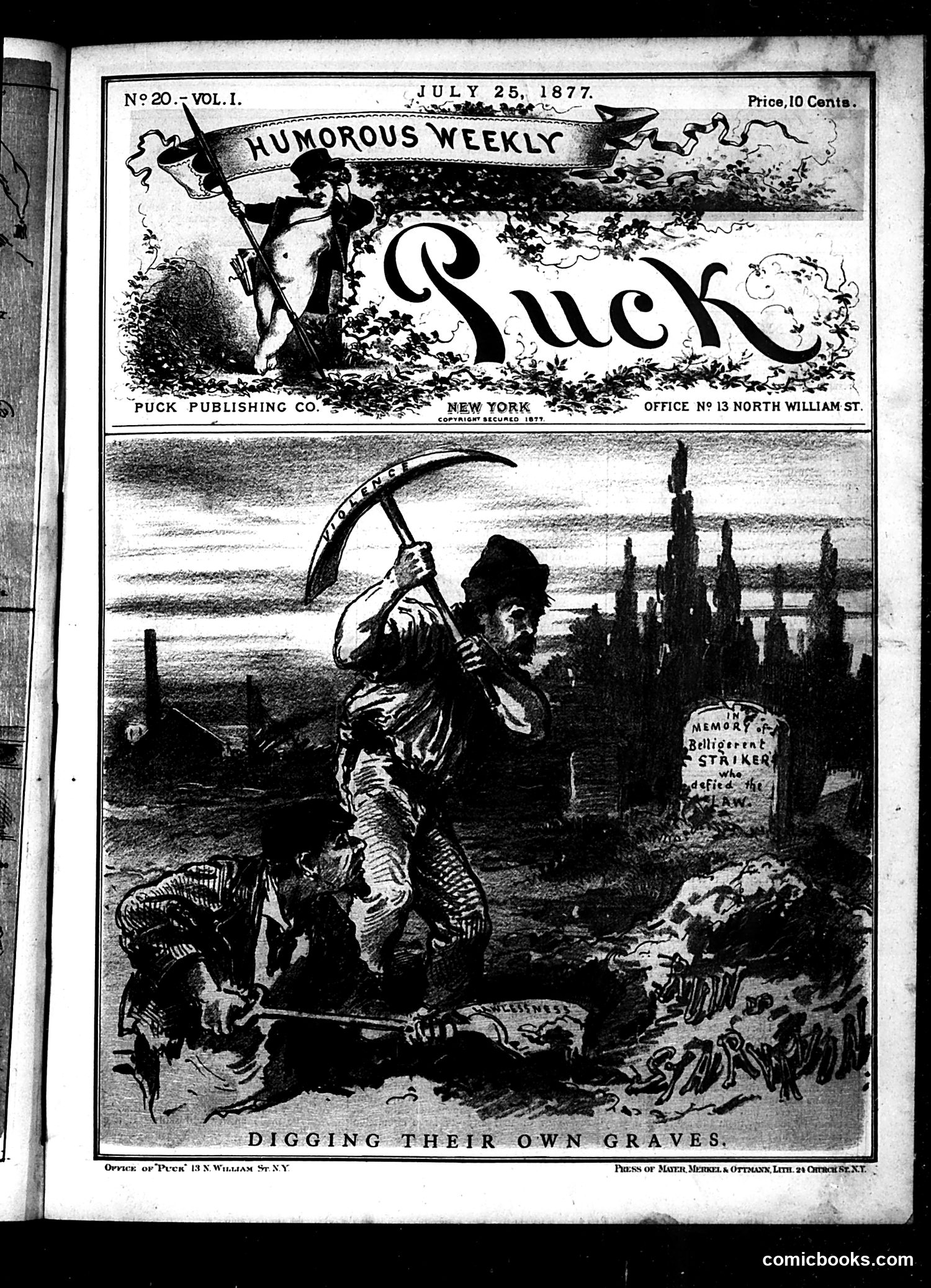
**Main Cartoon: "Digging Their Own Graves"** This political satire depicts a skeletal figure labeled "The Belliger[ent] Striker" wielding a scythe in a cemetery. The caption suggests labor strikers are self-destructively harming themselves through their actions. The cartoon references the **1877 railroad strikes**—violent labor unrest that swept across America that summer. The imagery equates strikers with death and destruction, portraying the labor movement as ultimately fatal to strikers themselves rather than to their employers. The skeleton's appearance and graveyard setting convey that Puck's editors viewed strikes as doomed, self-defeating endeavors. This reflects the magazine's apparent anti-labor position during this pivotal moment in American labor history.
This page contains satirical commentary rather than visual cartoons. Key content includes: **"The Political Pull-Back"** criticizes President Hayes's administration for perceived governmental weakness. The piece mocks Hayes and his cabinet for failing to act decisively, suggesting rival factions (David Dudley Field and Charles A. Dana) have more influence than the president himself. **"An Arithmetical Problem"** presents a humorous reader question about a canal mule's value—a satirical commentary on mercantile absurdity and perhaps railroad labor disputes. **"Puck's Personal Intelligence"** offers gossipy notes about Boston journalists and political figures, including references to elections and publications like the *Skowhegan Palladium*. The page emphasizes Puck's satirical mission: mocking governmental ineffectiveness, corporate interests, and journalistic pretension during the Gilded Age.
This page contains an unpublished editorial attacking President Rutherford B. Hayes as both "a fraudulent president" and "a murderer." The piece references Hayes's contested 1876 election victory and accuses him of complicity in the death of John H. Key during the Richmond Supremacy riots. The editorial argues Hayes fraudulently assumed the presidency and, through political malfeasance, bears responsibility for Key's murder. It condemns Hayes's failure to prevent violence and suggests his administration enabled or tolerated political violence. The "Answers for the Anxious" advice column below addresses unrelated reader queries about various personal matters. This represents harsh partisan political criticism typical of Puck's satirical approach to Republican leadership during Reconstruction-era politics.
This page contains three distinct sections: a humorous poem "My Lovers" about suitors of varying wealth and status; "Behind the Journalistic Screen," satirizing newspaper operations through dialogue between a Managing Editor and various reporters; and "College Notes" commenting on university life. The newspaper section mocks editorial hierarchies and the compromises involved in running a publication—editors demanding sensational content while managing costs and political sensitivities. The dialogue reveals period tensions between journalistic integrity and commercial pressures. "College Notes" offers lighthearted observations about Harvard, Columbia, Yale, and Princeton students' activities, including crew teams, billiards, and scientific expeditions. A separate piece discusses Italian newspapers and press freedom under the Risorgimento. The content reflects Puck's satirical approach to American institutions and social life circa the 1880s-1890s.
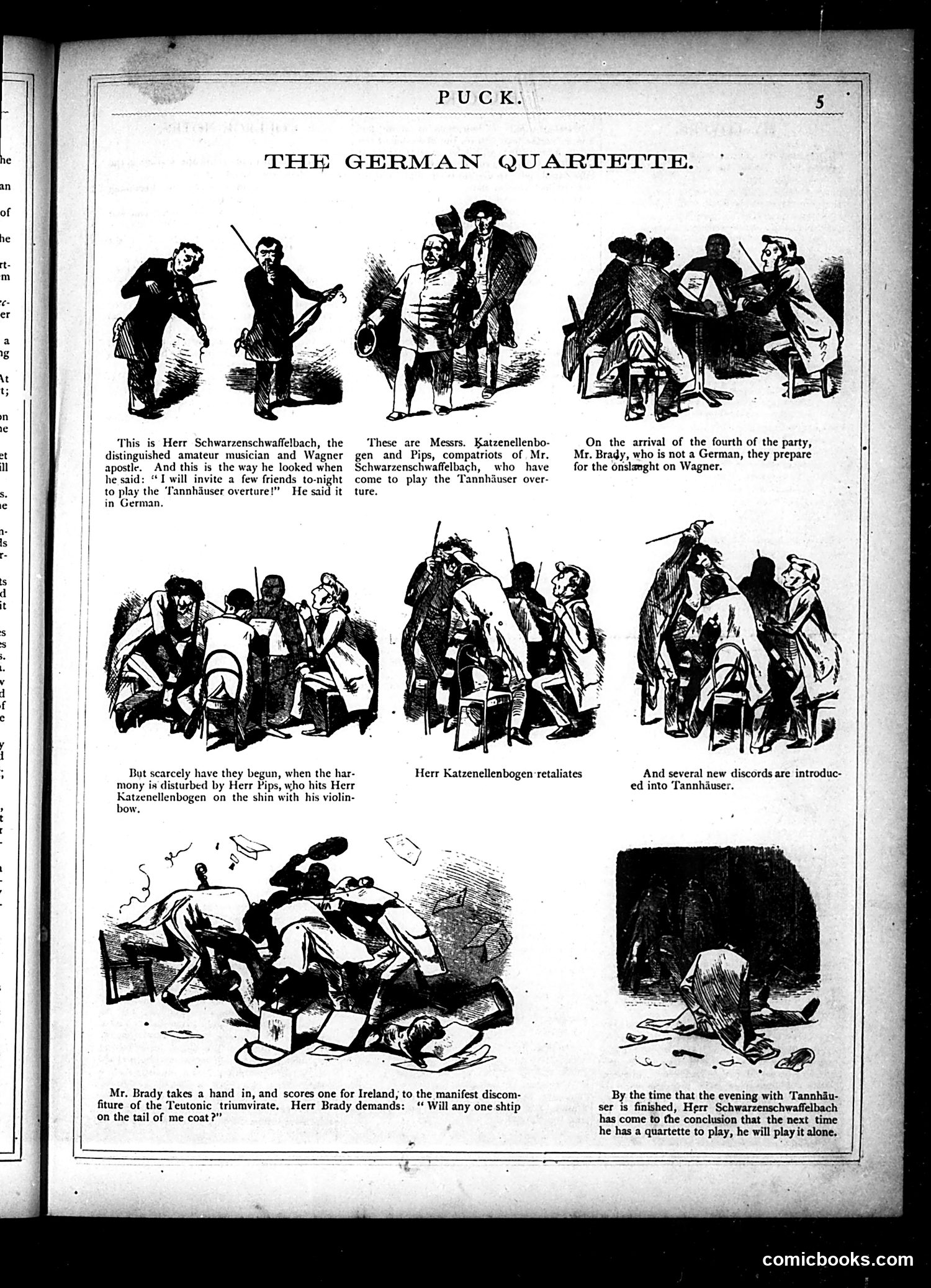
This satirical piece mocks a musical performance by German musicians. Herr Schwarzenschwaffelbach, described as an amateur musician and "Wagner apostle," invites friends to play Wagner's Tannhäuser overture. Messrs. Katzendellenbogen and Pips join him, with Mr. Brady (identified as non-German) arriving fourth. The satire escalates as the performance devolves into chaos: Pips disturbs the harmony, Katzendellenbogen retaliates violently, new discords erupt, and Brady scores "one for Ireland" by criticizing the "Teutonic triumvirate." By evening's end, Schwarzenschwaffelbach concludes he must perform the quartet solo. The joke: ambitious amateur musicians attempting Wagner create discord—both musical and interpersonal—ending in complete failure.
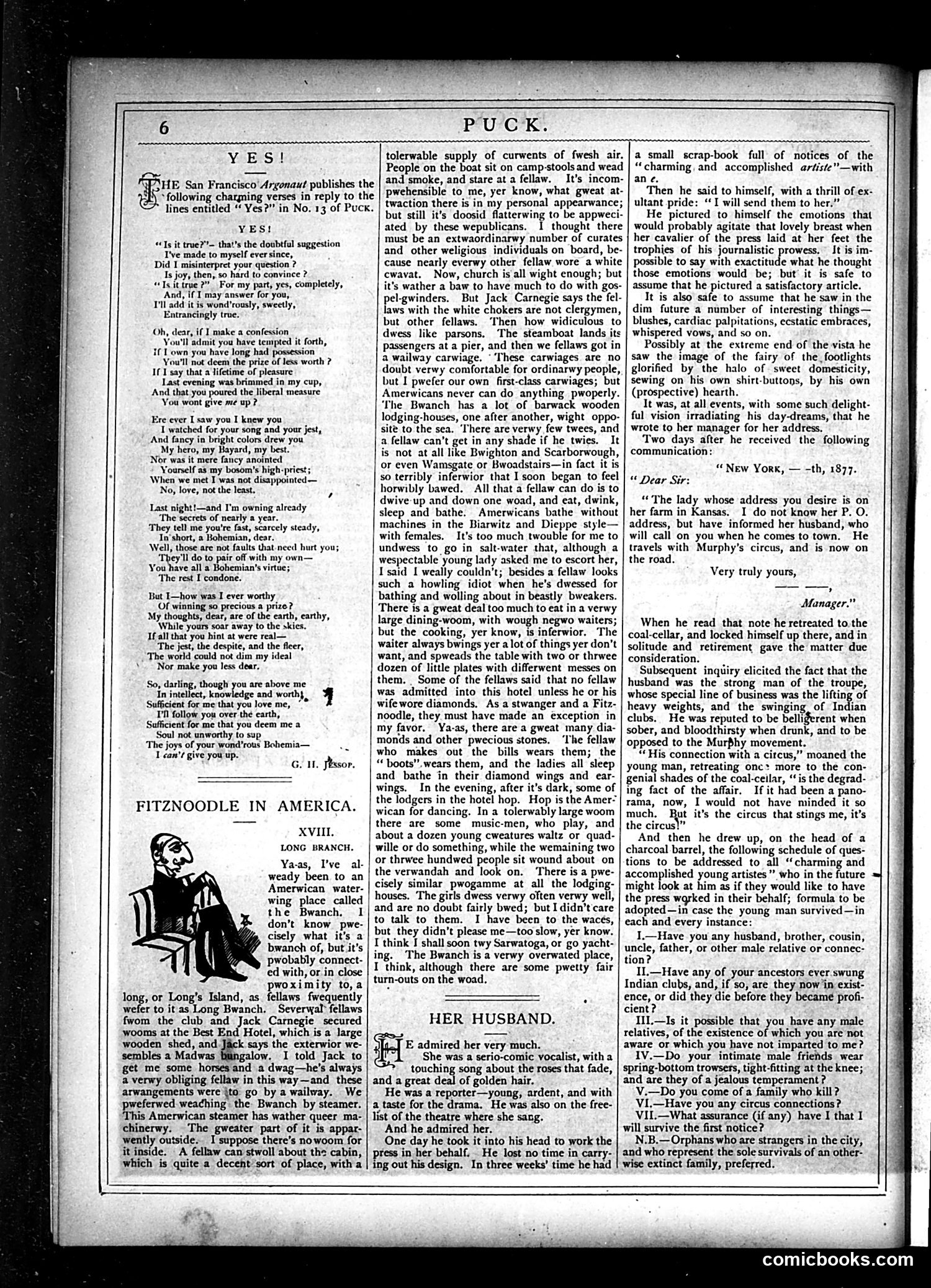
This page contains three separate pieces of satirical content: 1. **"Yes!"** - Verse mocking San Francisco's *Argonaut* newspaper's response to criticism. The satire ridicules flowery language and defensive posturing. 2. **"Fitznoodle in America XVIII"** - A cartoon featuring a character discussing Long Island/Long Branch. The accompanying illustration shows a man in period dress. The text satirizes American tourist destinations and social pretensions, likely mocking both European visitors' impressions and American vanity about their resorts. 3. **"Her Husband"** and advice column responses - Various letters addressing domestic and social matters, including questions about inheritance and family obligations. The overall tone targets American social aspirations, journalistic excess, and domestic conventions of the era (appears to be 1877 based on visible date).
This page contains three distinct articles with no visible political cartoons. The content includes: 1. **"Mount Desert"** — a humorous travel piece describing a Maine island destination, mocking both the landscape's barrenness and tourists' pretensions. 2. **"The Tyranny of Trousers"** — a satirical commentary on men's fashion, specifically criticizing the adoption of trousers as oppressive menswear. The piece advocates for men wearing skirts or looser garments as liberating reform, using heated language about masculine discomfort. This appears to be social satire about rigid dress codes rather than serious advocacy. 3. **"Summer Resort Notes"** — brief observations about various vacation destinations and social issues at resorts. The page demonstrates Puck's satirical approach to American life, society, and fashion conventions through written humor rather than visual cartoons.
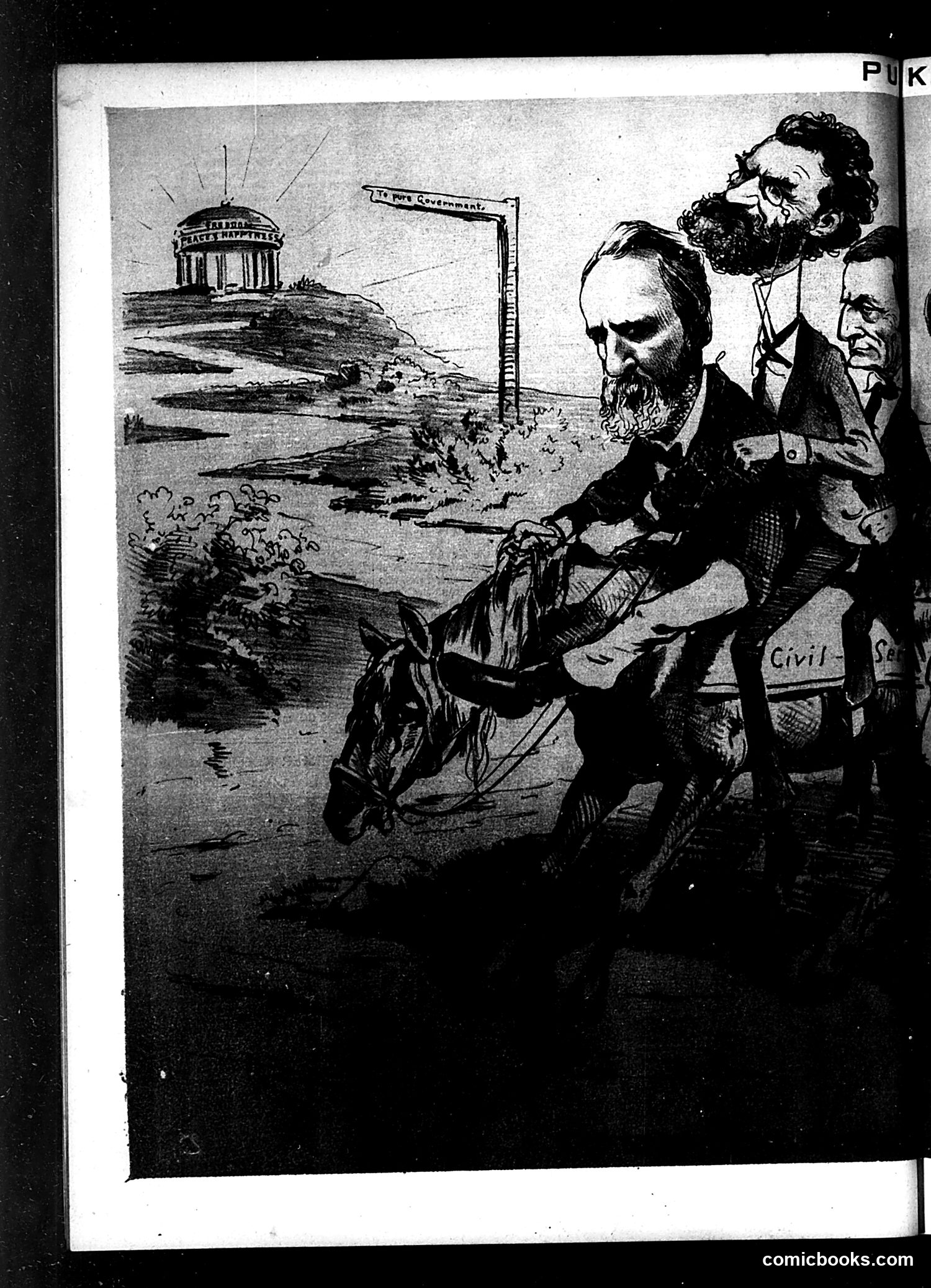
This Puck cartoon depicts three bearded men operating a gallows labeled "U.S. pure Government" overlooking a classical building (likely representing the Capitol or government institution). The men appear to be executing or eliminating something, with one figure labeled "CIVIL" visible. The satire criticizes political corruption or the manipulation of government institutions by specific political figures. The gallows imagery suggests these men are destroying or perverting "pure government" through their actions. The classical architecture represents legitimate democratic institutions being corrupted. Without clearer identification of the specific figures or visible dates, the exact political moment referenced remains unclear—though the theme of partisan actors destroying governmental integrity through corruption or manipulation was common in Gilded Age political satire.
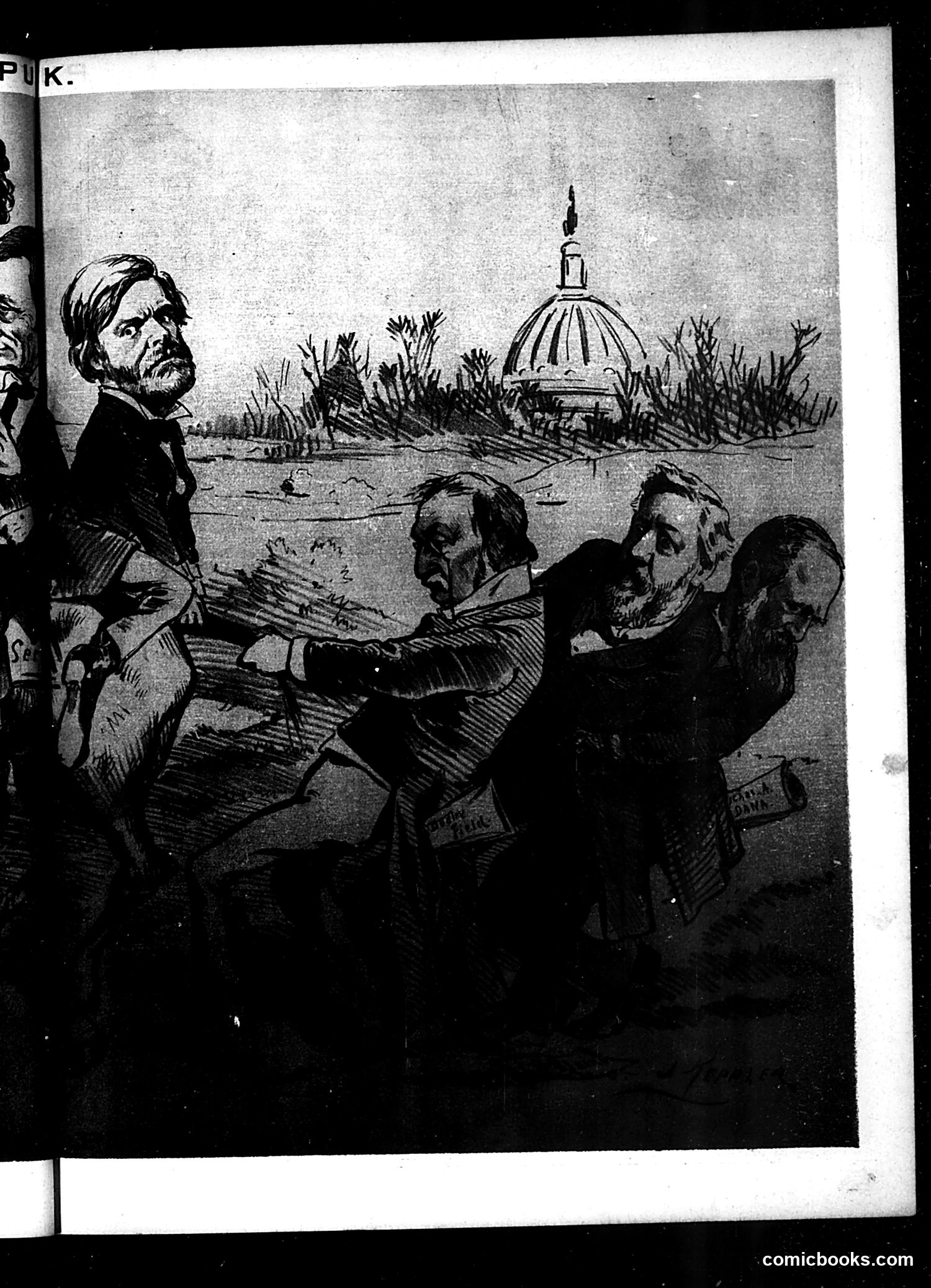
This Puck cartoon depicts a satirical scene set near the U.S. Capitol building (visible in the background). On the left stands a stern-faced figure who appears to be a prominent politician or statesman, observing three men in the foreground who seem to be struggling or laboring together. The composition suggests commentary on political power dynamics or congressional politics—likely depicting tensions between leadership and legislators, or perhaps satirizing corruption or political maneuvering of the era. The Capitol dome serves as a symbol of governmental authority. Without the accompanying text being fully legible, the specific political event or figures cannot be definitively identified, though the style and composition indicate this critiques mid-to-late 19th-century American political conflicts or parliamentary dysfunction.
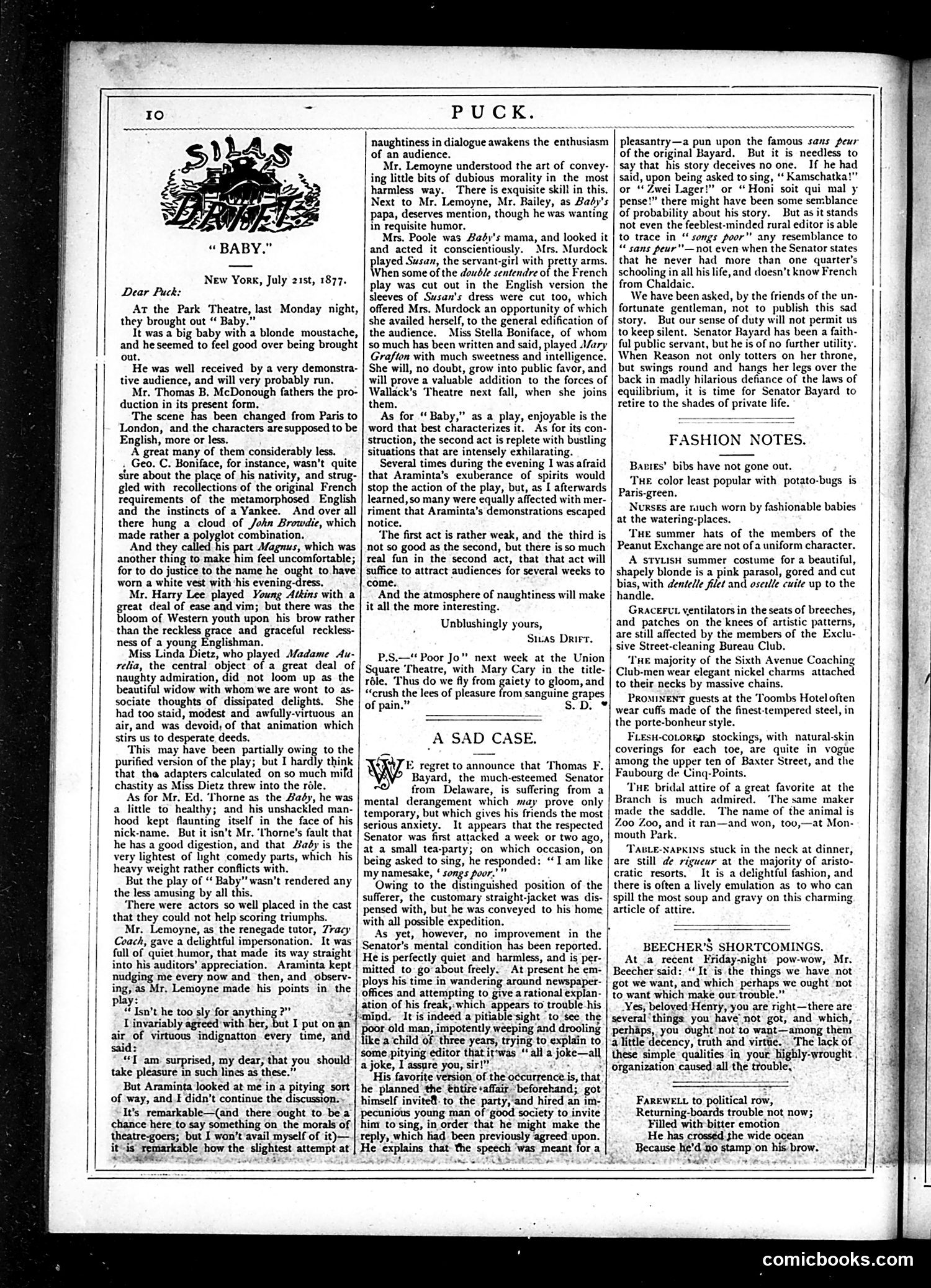
This page is primarily **text-based commentary**, not a political cartoon. The main content is a letter from "Silas Drift" reviewing theatrical performances at the Park Theatre in New York (dated July 21, 1877). The review critiques a production of "Baby," noting the cast's uneven quality and that American actors couldn't match their English counterparts. The writer praises certain performers while criticizing others for being overwrought or poorly suited to their roles. The page includes a "Fashion Notes" section discussing babies' clothing trends and a brief item called "A Sad Case" about Senator Thomas Bayard's mental illness. The content reflects **1870s theatrical culture and social commentary** rather than overt political satire, though it reveals period attitudes about American versus English theatrical sophistication.
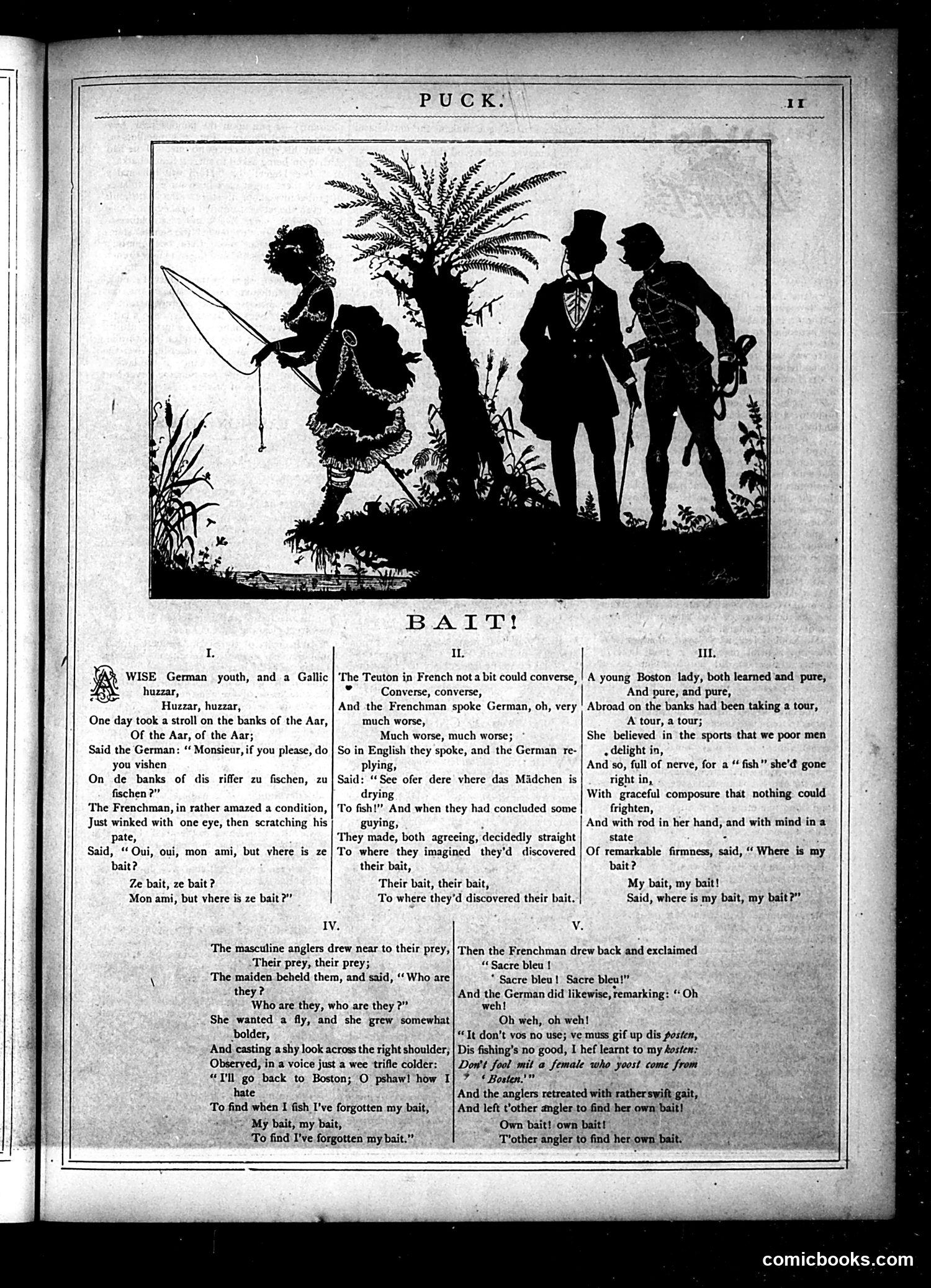
This silhouette cartoon depicts a fishing scene with satirical intent. A woman holds a fishing rod while three well-dressed men (appearing to be gentlemen, possibly European based on their formal attire) stand nearby. The accompanying verse describes a "Wise German youth, and a Gallic buzzer" discussing lost fishing bait—but the humor operates on multiple levels. The "bait" appears metaphorical: the woman represents bait used to attract the men. The poem's wordplay between literal fishing bait and romantic/social attraction suggests the cartoon satirizes courtship rituals or gender relations of the era. The reference to a "young Boston lady" and men "taking a tour" implies commentary on international romance or the social dynamics between American women and foreign gentlemen travelers, a common subject in Puck's satirical humor.
This page contains the continuation of **"Two Knaves and a Queen,"** an English serialized story running in Puck magazine (Chapter XVII). The narrative focuses on romantic and social entanglements among characters including René, M. de Gaillefontaine, and Miss Biron. The text is purely **literary fiction—not political satire**. It concerns a love triangle and questions of propriety, honor, and marriage arrangements among the English and French gentry. Key plot points involve letters, financial matters, and questions about a woman's affections and future. There are **no visible political cartoons or caricatures** on this page. The content is a serialized romantic drama typical of Puck's literary offerings, not satirical commentary on contemporary events or figures.
This page is primarily text-based commentary rather than political cartoons. It features "Puck's Jottings"—a column of satirical observations about current events and media. The content includes commentary on: - A Kansas City newspaper incident involving arrested brothers named Hart - Media absurdities and journalistic practices - Various newspaper items and their questionable accuracy - Social commentary on contemporary issues A small decorative illustration appears at the top showing cherubs or putti (classical figures), typical of Puck's ornamental style. The page consists largely of reprinted excerpts from other publications with Puck's satirical commentary, mocking journalistic standards, editorial practices, and the credibility of contemporary reporting—reflecting Puck's role as a media critic and satirist of the era.
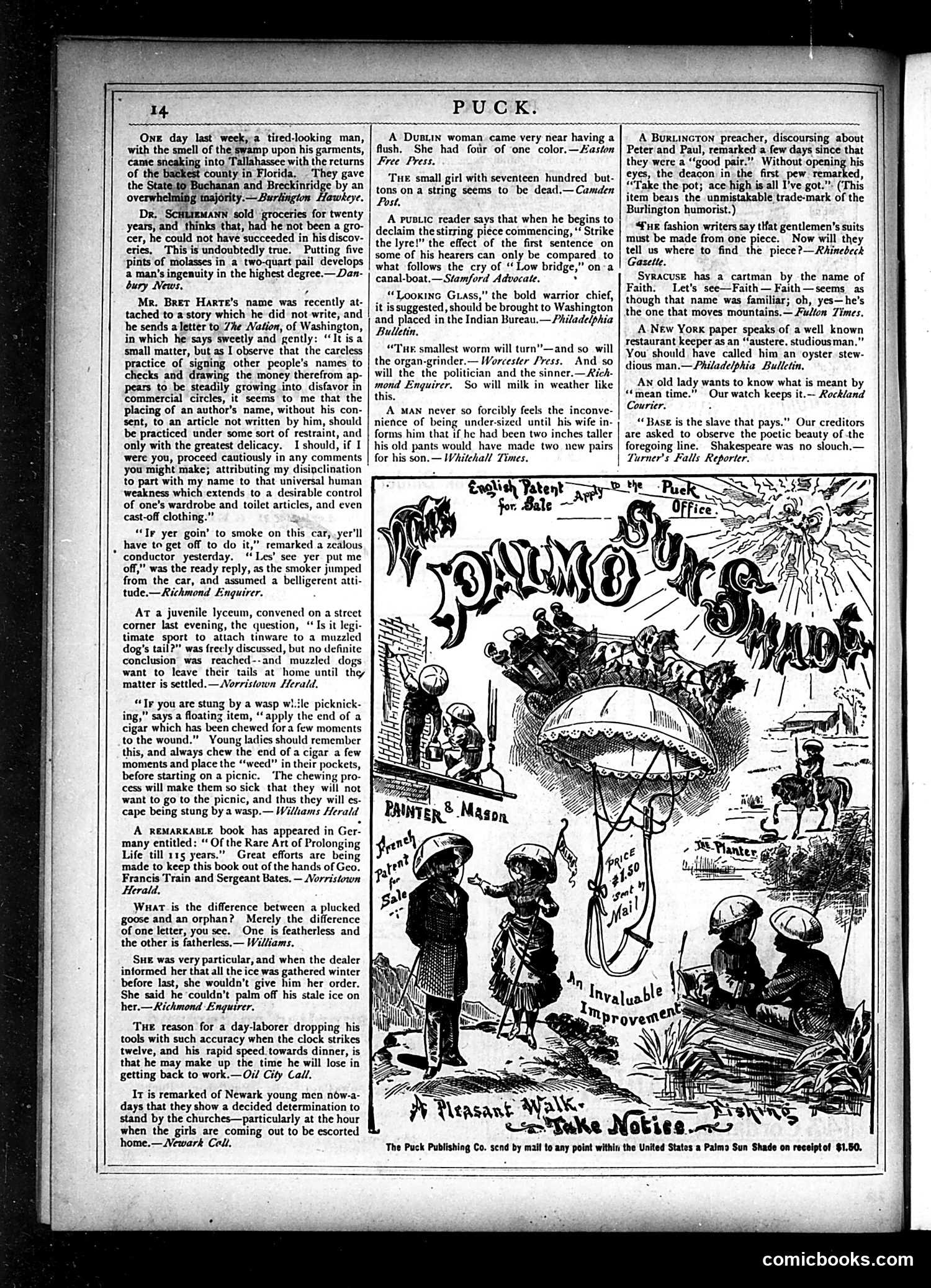
This page contains miscellaneous humor items and advertisements rather than a single coherent political cartoon. The left column includes brief jokes and observations about contemporary life—smoking etiquette, a woman's haggling skills, wasp stings, and Newark social customs. The right side features multiple product advertisements with illustrated vignettes, including "Pandowdy" (a food product), patent medicines and remedies, and "A Pleasant Walk" (shoe notices). These ads use exaggerated drawings typical of Victorian-era marketing. The humor is gentle social satire rather than sharp political commentary—poking fun at everyday behavioral quirks, gender relations, and consumer culture. Without specific date context or clearer identification of caricatured figures, the precise political references remain unclear, though the content reflects typical turn-of-the-century American middle-class concerns and advertising practices.
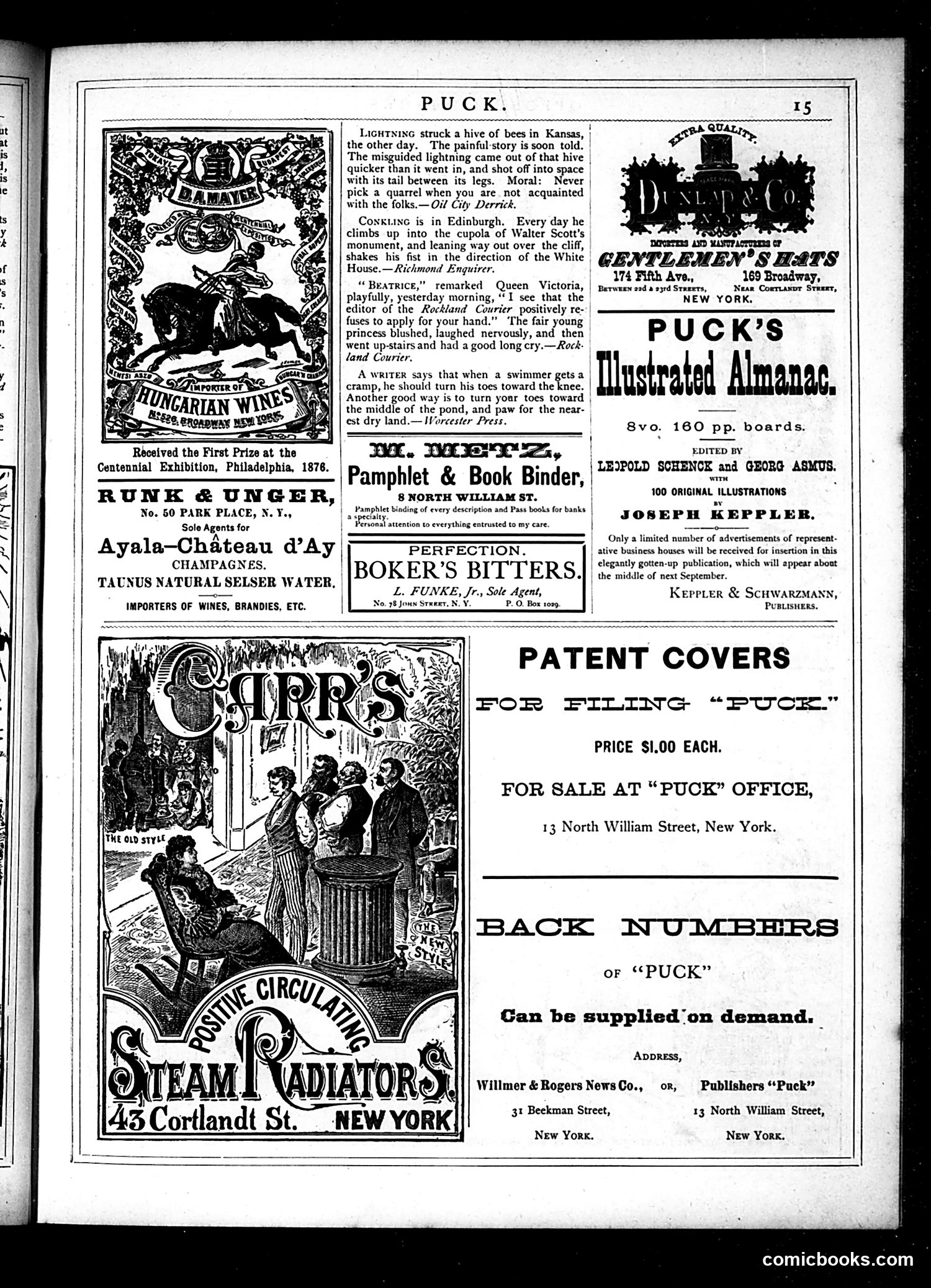
This is primarily an **advertising page** from Puck magazine (page 15), not a political cartoon page. The content consists of various commercial advertisements for late 19th-century products and services: - Wine and spirits importers (Hungarian wines, Champagne) - Dunlap & Co. gentlemen's hats - Puck's Illustrated Almanac (a publication) - Boker's Bitters (a patent medicine) - Steam radiators - Patent covers for filing Puck magazine There is one small illustrated advertisement showing what appears to be **Victorian-era domestic or social humor** (the "Corrs" steam radiators ad), but without clearer context or captions, the specific satirical point is unclear. The page demonstrates how 19th-century magazines funded themselves through advertising alongside editorial content.
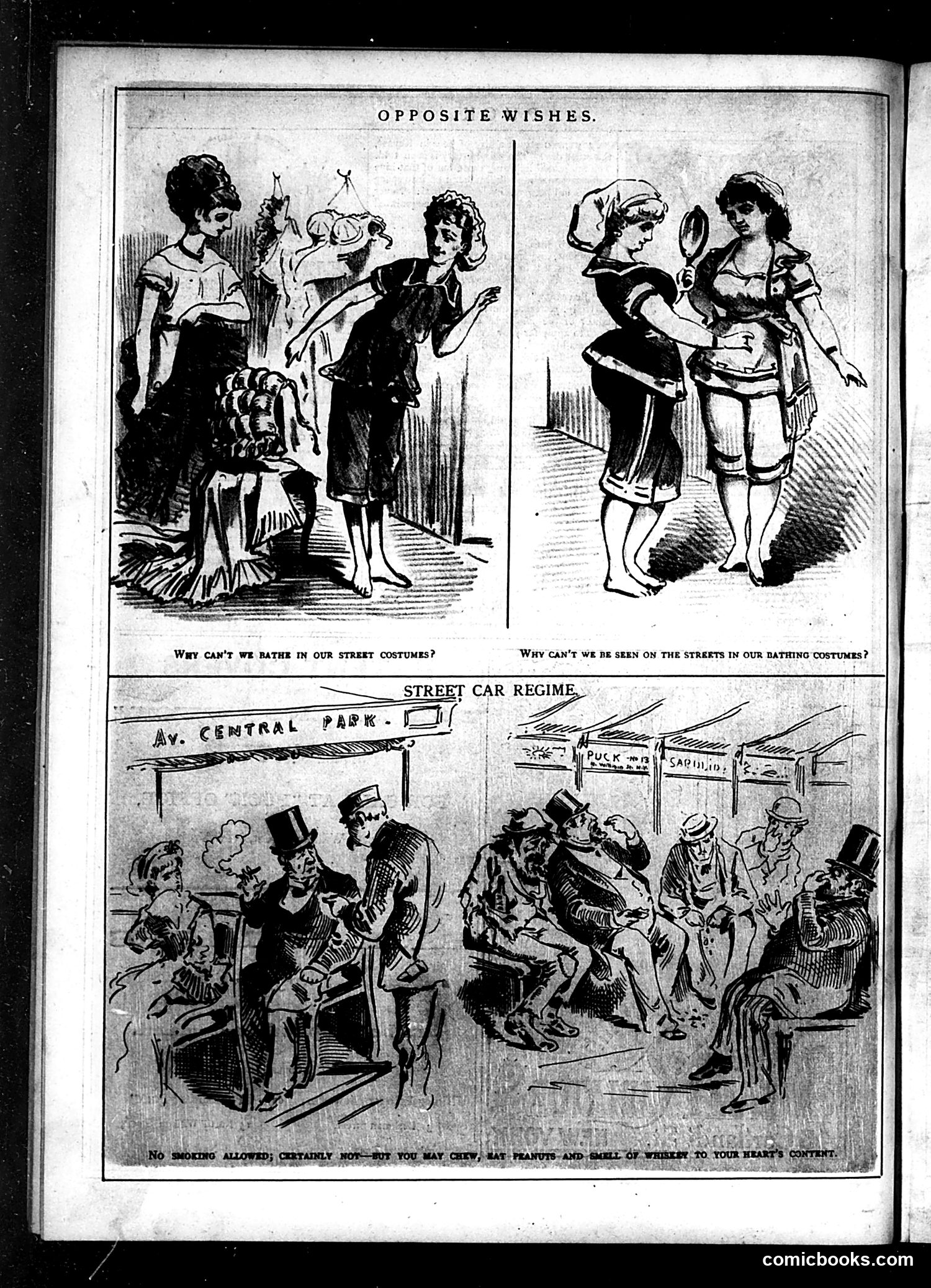
This Puck page satirizes early 20th-century social hypocrisy through two cartoon sequences: **"Opposite Wishes"** (top) mocks contradictory attitudes about women's fashion. The left panel shows women wanting to wear revealing "street costumes" (swimwear), while the right panel shows the opposite desire—wearing bathing costumes on public streets. The satire highlights how society imposed strict dress codes: women couldn't expose themselves swimming or in public, creating an absurd double standard. **"Street Car Regime"** (bottom) depicts crowded public transit where men smoke cigars, eat peanuts, and generally behave uncouthly around women passengers. The caption sarcastically notes smoking is "allowed," but you may spit, eat peanuts, and smell of whiskey "to your heart's content." This ridicules the lax enforcement of public decorum standards on streetcars, contrasting with the restrictive dress codes satirized above.