
Puck, 1877-07-25 · page 12 of 16
Puck — July 25, 1877 — page 12: what you’re looking at
What you’re looking at
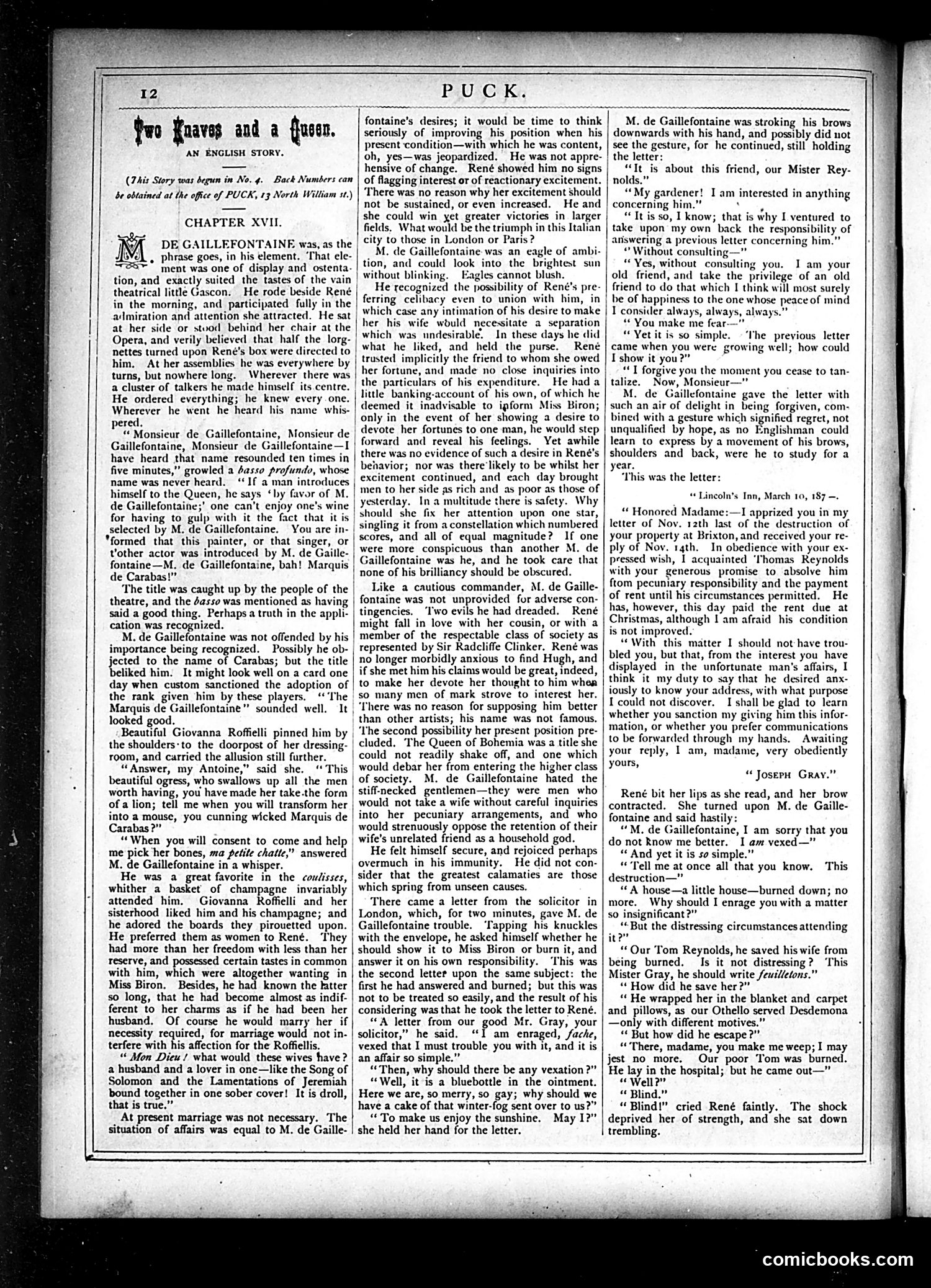
This page contains the continuation of **"Two Knaves and a Queen,"** an English serialized story running in Puck magazine (Chapter XVII). The narrative focuses on romantic and social entanglements among characters including René, M. de Gaillefontaine, and Miss Biron. The text is purely **literary fiction—not political satire**. It concerns a love triangle and questions of propriety, honor, and marriage arrangements among the English and French gentry. Key plot points involve letters, financial matters, and questions about a woman's affections and future. There are **no visible political cartoons or caricatures** on this page. The content is a serialized romantic drama typical of Puck's literary offerings, not satirical commentary on contemporary events or figures.
📄 Transcribed text from this page (OCR, searchable)
Machine-transcribed from the original scan — historical spelling and the odd misread are preserved.
fuo foaves anda fuse. AN ENGLISH STORY. (This Story was begun in No.4. Back Numbers can be obtained at the office of PUCK, 13 North William st.) CHAPTER XVII. ] ey DE GAILLEFONTAINE was, as the (el, phrase goes, in his element. ‘That ele- *~ ment was one of display and ostenta tion, and exactly suited the tastes of the vain theatrical little Gascon. He rode beside René in the morning, and participated fully in the | admiration and attention she attracted. He sat at her side or stood behind her chair at the Opera, and verily believed that half the lorg- nettes turned upon René's box were directed to | him. At her assemblies he was everywhere by turns, but nowhere long. Wherever there was a cluster of talkers he made himself its.centre. | He ordered everything; he knew every one. Wherever he went he heard his name whis- pered. “ Monsieur de Gaillefontaine, Monsieur de Gaillefontaine, Monsieur de Gaillefontaine—I | have heard that name resounded ten times in five minutes,” growled a basso profundo, whose name was never heard. ‘If a man introduces | himself to the Queen, he says ‘by favor of M. | de Gaillefontaine;’ one can’t enjoy one's wine for having to gulp with it the fact that it is selected by M. de Gaillefontaine. You are in- | "formed that this painter, or that singer, or other actor was introduced by M. de Gaill fontaine—M. de Gaillefontaine, bah! Marquis | de Carabas!” | The title was caught up by the people of the | theatre, and the asso was mentioned as having said a good thing. Perhaps a truth in the appli- cation was recognized. M. de Gaillefontaine was not offended by his importance being recognized. Possibly he ob- jected to the name of Carabas; but the title beliked him. It might look well on a card one day when custom sanctioned the adoption of the rank given him by these players. ‘The Marquis de Gaillefontaine" sounded well. It looked good. Beautiful Giovanna Roffielli pinned him by the shoulders-to the doorpost of her dressing- | room, and carried the allusion still further. | “ Answer, my Antoine,” said she. ‘ This beautiful ogress, who swallows up all the men | worth having, you have made her take.the form | of a lion; tell me when you will transform her into a mouse, you cunning wicked Marquis de | Carabas?” “‘When you will consent to come and help me pick her bones, ma petite chatle,” answered M. de Gaillefontaine in a whisper. He was a great favorite in the coulisses, whither a basket of champagne invariably attended him. Giovanna Roffielli and her sisterhood liked him and his champagne; and he adored the boards they pirouetted upon. | He preferred them as women to René. They | had more than her freedom with less than her reserve, and possessed certain tastes in common with him, which were altogether wanting in Miss Biron. Besides, he had known the hatter so long, that he had become almost as indif- ferent to her charms as if he had been her | husband. Of course he would marry her if necessity required, for marriage would not in- terfere with his affection for the Roffellis. “ Mon Dieu ! what would these wives have? a husband and a lover in one—like the Song of Solomon and the Lamentations of Jeremiah bound together in one sober cover! It is droll, that is true,” At present marriage was not necessary. The | overmuch in his immunity. fontaine’s desires; it would be time to think seriously of improving his position when his present ‘condition—with which he was content, oh, yes—was jeopardized. He was not appre- | hensive of change. René showed him no signs of flagging interest or of reactionary excitement. ‘There was no reason why her excitement should not be sustained, or even increased. He and she could win yet greater victories in larger | fields. What would be the triumph in this Italian city to those in London or Paris? M. de Gaillefontaine was an eagle of ambi- tion, and could look into the brightest sun without blinking. Eagles cannot blush. He recognized the possibility of Ren ferring celibacy even to union with him, in which case any intimation of his desire to make her his wife would necessitate a separation which was undesirable. In these days he did what he liked, and held the purse. René trusted implicitly the friend to whom she owed her fortune, and made no close inquiries into the particulars of his expenditure. He had a litle banking-account of his own, of which he deemed it inadvisable to ipform Miss Biron; only in the event of her showing a desire to devote her fortunes to one man, he would step forward and reveal his feelings. Yet awhile there was no evidence of such a desire in René’s behavior; nor was there'likely to be whilst her excitement continued, and each day brought men to her side as rich and _as poor as those of yesterday. In a multitude there is safety. Why should she fix her attention upon one star, singling it from a constellation which numbered scores, and all of equal magnitude? If one were more conspicuous than another M. de Gaillefontaine was he, and he took care that none of his brilliancy should be obscured. Like a cautious commander, M. de Gaille- fontaine was not unprovided for adverse con- tingencies. ‘I'wo evils he had dreaded. René might fall in love with her cousin, or with a member of the respectable class of society as represented by Sir Radcliffe Clinker. René was no longer morbidly anxious to find Hugh, and if she met him his claims would be great, indeed, to make her devote her thought to him whea so many men of mark strove to interest her. ‘There was no reason for supposing him better than other artists; his name was not famous. ‘The second possibility her present position pre- cluded. The Queen of Bohemia was a title she could not readily shake off, and one which would debar her from entering the higher class of society. M. de Gaillefontaine hated the stiff-necked gentlemen—they were men who | would not take a wife without careful inquiries into her pecuniary arrangements, and who | would strenuously oppose the retention of their wife's unrelated friend as a household god. He felt himself secure, and rejoiced perhaps He did not con- sider that the greatest calamaties are those which spring from unseen causes. There came a letter from the solicitor in London, which, for two minutes, gave M. de Gaillefontaine trouble. ‘Tapping his knuckles with the envelope, he asked himself whether he should show it to Miss Biron or burn it, and answer it on his own responsibility. ‘This was the second letter upon the same subject: the first he had answered and burned; but this was not to be treated so easily, and the result of his considering was that he took the letter to René. “A letter from our good Mr. Gray, your solicitor,” he said. “I am enraged, fache, | vexed that I must trouble you with it, and it is an affair so simple.” “Then, why should there be any vexation ?” “Well, it is a bluebottle in the ointment. Here we are, so merry, so gay; why should we have a cake of that winter-fog sent over to us?” “To make us enjoy the sunshine. May 1?” M. de Gaillefontaine was stroking his brows downwards with his hand, and possibly did not see the gesture, for he continued, still holding the letter: “It is about this friend, our Mister Rey- nolds.”” “My gardener! Iam concerning him.” ; “Tt is so, I know; that is why I ventured to take upon my own back the responsibility of ariswering a previous letter concerning him.” © Without consulting—" “Yes, without consulting you. I am your old friend, and take the privilege of an old friend to do that which I think will most surely be of happiness to the one whose peace of mind I consider always, always, always.” “You make me fear-— “Yet it is so simple. ‘The previous letter came when you were growing well; how could I show it you?” ‘1 forgive you the moment you cease to tan- talize. Now, Monsieur—" M. de Gaillefontaine gave the letter with such an air of delight in being forgiven, com- bined with a gesture which signified regret, not unqualified by hope, as no Englishman could learn to express by a movement of his brows, shoulders and back, were he to study for a interested in anything ear. ‘This was the letter: incoln’s Inn, March 10, 187 —. “ Honored Madame:—I apprized you in my letter of Nov. 12th last of the destruction of your property at Brixton, and received your re- ply of Nov. 14th. In obedience with your ex- pressed wish, I acquainted ‘Ihomas Reynolds with your generous promise to absolve him ftom pecuniary responsibility and the payment of rent until his circumstances permitted. He has, however, this day paid the rent due at Christmas, although I am afraid his condition is not improved. “With this matter I should not have trou- bled you, but that, from the interest you have displayed in the unfortunate man’s affairs, I think it my duty to say that he desired anx- iously to know your address, with what purpose I could not discover. I shall be glad to learn whether you sanction my giving him this infor- mation, or whether you prefer communications to be forwarded through my hands. Awaiting your reply, I am, madame, very obediently yours, “ JoserH Gray.” René bit her lips as she read, and her brow contracted. She turned upon M. de Gaille- fontaine and said hastily: “™M. de Gaillefontaine, I am sorry that you do not Know me better. I am vexed—” “And yet it is so simple.” “Tell me at once all that you know. destruction—” “A house—a little house—burned down; no more. Why should I enrage you with a matter so insignificant?” “«But the distressing circumstances attending ine” “Our Tom Reynolds, he saved his wife from being burned. Is it not distressing? ‘This Mister Gray, he should write feuil/etons.” “ How did he save her?” “« He wrapped her in the blanket and _ carpet and pillows, as our Othello served Desdemona —only with different motives.” “ But how did he escape?” “There, madame, you make me weep; I may jest no more. Our poor Tom was burned. He lay in the hospital; but he came out—” “Well?” “ Blind.” “Blind!” cried René faintly. The shock deprived her of strength, and she sat down This situation of affairs was equal to M. de Gaille- | she held her hand for the letter. trembling. comicbooks.com