
Puck, 1877-07-25 · page 2 of 16
Puck — July 25, 1877 — page 2: what you’re looking at
What you’re looking at
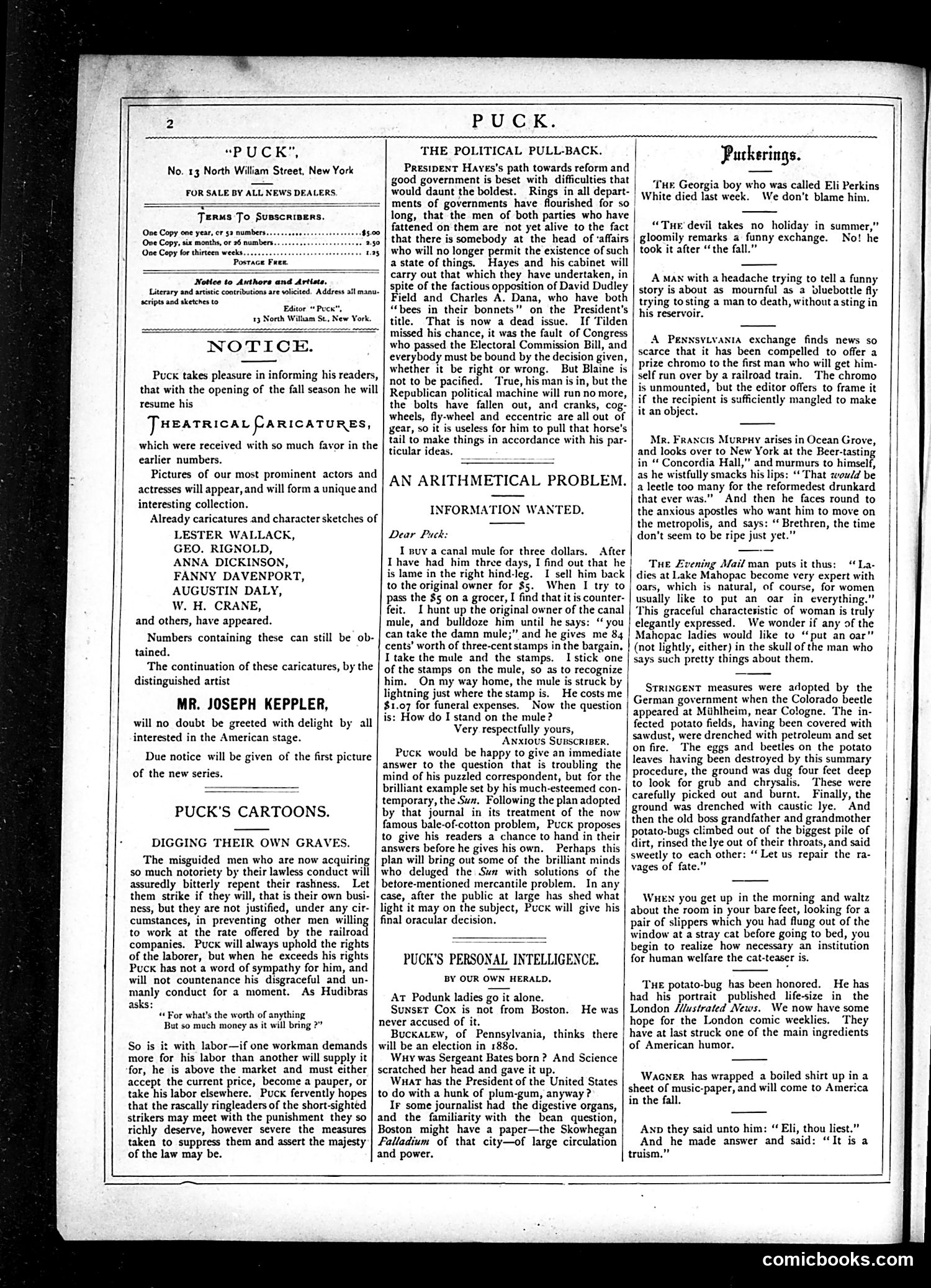
This page contains satirical commentary rather than visual cartoons. Key content includes: **"The Political Pull-Back"** criticizes President Hayes's administration for perceived governmental weakness. The piece mocks Hayes and his cabinet for failing to act decisively, suggesting rival factions (David Dudley Field and Charles A. Dana) have more influence than the president himself. **"An Arithmetical Problem"** presents a humorous reader question about a canal mule's value—a satirical commentary on mercantile absurdity and perhaps railroad labor disputes. **"Puck's Personal Intelligence"** offers gossipy notes about Boston journalists and political figures, including references to elections and publications like the *Skowhegan Palladium*. The page emphasizes Puck's satirical mission: mocking governmental ineffectiveness, corporate interests, and journalistic pretension during the Gilded Age.
📄 Transcribed text from this page (OCR, searchable)
Machine-transcribed from the original scan — historical spelling and the odd misread are preserved.
PUCK. “PUCK”, No. 13 North William Street, New York FOR SALE BY ALL NEWS DEALERS. Terms To Susscripens. One Copy one year, or $2 numbers. Ove Copy, six months, or 26 num! Literary and artistic contributions are wolicited. Address all manu- scripts and sketches to +o Editor * Puck”, 13 North Wilham St. New Vork. Puck takes pleasure in informing his readers, that with the opening of the fall season he will resume his THEATRICAL CARICATURES, which were received with so much favor in the earlier numbers. Pictures of our most prominent actors and actresses will appear, and will form a unique and interesting collection. Already caricatures and character sketches of LESTER WALLACK, GEO. RIGNOLD, ANNA DICKINSON, FANNY DAVENPORT, AUGUSTIN DALY, W. H. CRANE, and others, have appeared. Numbers containing these can still be ob- tained. The continuation of these caricatures, by the distinguished artist MR. JOSEPH KEPPLER, will no doubt be greeted with delight by all interested in the American stage. Due notice will be given of the first picture of the new seri PUCK’S CARTOONS. DIGGING THEIR OWN GRAVES. The misguided men who are now acquiring so much notoriety by their lawless conduct will assuredly bitterly repent their rashness. Let them strike if they will, that is their own busi- ness, but they are not justified, under any cir- cumstances, in preventing other men willing to work at the rate offered by the railroad companies. Puck will always uphold the rights of the laborer, but when he exceeds his rights Puck has not a word of sympathy for him, and will not countenance his disgraceful and un- manly conduct for a moment. As Hudibras «« For what's the worth of anything But so much money as it will bring ?” So is it with labor—if one workman demands more for his labor than another will supply it for, he is above the market and must either accept the current price, become a pauper, or take his labor elsewhere. Puck fervently hopes that the rascally ringleaders of the short-sighted strikers may meet with the punishment they so richly deserve, however severe the measures taken to suppress them and assert the majesty of the law may be. THE POLITICAL PULL-BACK. Presipent Hayes’s path towards reform and good government is beset with difficulties that would daunt the boldest. ments of governments have flourished for so long, that the men of both parties who have fattened on them are not yet alive to the fact that there is somebody at the head of ‘affairs who will no longer permit the existence of such a state of things. Hayes and his cabinet will carry out that which they have undertaken, in spite of the factious opposition of David Dudley Field and Charles A. Dana, who have both “bees in their bonnets” on the President's title. That is now a dead issue. If Tilden missed his chance, it was the fault of Congress who passed the Electoral Commission Bill, and everybody must be bound by the decision given, whether it be right or wrong. But Blaine is not to be pacified. True, his man is in, but the Republican political machine will run no more, the bolts have fallen out, and cranks, cog- | wheels, fly-wheel and eccentric are all out of gear, so it is useless for him to pull that horse's tail to make things in accordance with his par- ticular ideas, AN ARITHMETICAL PROBLEM. INFORMATION WANTED, Dear Puck: I puy a canal mule for three dollars. After Ihave had him three days, I find out that he is lame in the right hind-leg. I sell him back to the original owner for $5. When I try to pass the $5 on a grocer, I find that it is counter- feit. I hunt up the original owner of the canal mule, and bulldoze him until he says: “ you can take the damn mule;” and he gives me 84 cents’ worth of three-cent stamps in the bargain, I take the mule and the stamps. I stick one of the stamps on the mule, so as to recognize him. On my way home, the mule is struck by lightning just where the stamp is. He costs me $1.07 for funeral expenses. Now the question is: How do I stand on the mule? Very respectfully yours, ANxIOUS SUBSCRIBER. Puck would be happy to give an immediate answer to the question that is troubling the mind of his puzzled correspondent, but for the brilliant example set by his much-esteemed con- temporary, the Sux, Following the plan adopted by that journal in its treatment of the now famous bale-of-cotton problem, Puck proposes to give his readers a chance to hand in their answers before he gives his own. Perhaps this plan will bring out some of the brilliant minds who deluged the Sun with solutions of the betore-mentioned mercantile problem. In any case, after the public at large has shed what light it may on the subject, Puck will give his final oracular decision. BY OUR OWN HERALD. At Podunk ladies go it alone. Sunset Cox is not from Boston. never accused of it. Buckatew, of Pennsylvania, thinks there will be an election in 1880. Wuy was Sergeant Bates born? And Science scratched her head and gave it up. Wuart has the President of the United States to do with a hunk of plum-gum, anyway ? Ir some journalist had the digestive organs, and the familiarity with the bean question, Boston might have a paper—the Skowhegan Falladium of that city—of large circulation and power. He was Rings in all depart- | Puckerings. ‘Tue Georgia boy who was called Eli Perkins White died last week. We don’t blame him. “Tue devil takes no holiday in summer,” gloomily remarks a funny exchange. No! he took it after ‘the fall.” A MAN with a headache trying to tell a funny story is about as mournful as a bluebottle fly trying tosting a man to death, without a sting in his reservoir. A Pennsvtvania exchange finds news so scarce that it has been compelled to offer a prize chromo to the first man who will get him- self run over by a railroad train. The chromo is unmounted, but the editor offers to frame it if the recipient is sufficiently mangled to make it an object. Mr. Francis Murpuy arises in Ocean Grove, and looks over to New York at the Beer-tasting in “ Concordia Hall,” and murmurs to himself, as he wistfully smacks his lips: ‘That woud be a leetle too many for the reformedest drunkard that ever was.” And then he faces round to the anxious apostles who want him to move on the metropolis, and says: “ Brethren, the time don't seem to be ripe just yet.” Tue Evening Mail man puts it thus: “La- dies at Lake Mahopac become very expert with oars, which is natural, of course, for women usually like to put an oar in everything.” ‘This graceful charactesistic of woman is truly elegantly expressed. We wonder if any of the Mahopac ladies would like to “put an oar” (not lightly, either) in the skull of the man who says such pretty things about them. STRINGENT measures were adopted by the German government when the Colorado beetle | appeared at Mihlheim, near Cologne. The in- fected potato fields, having been covered with sawdust, were drenched with petroleum and set on fire. The eggs and beetles on the potato leaves having been destroyed by this summary procedure, the ground was dug four feet deep to look for grub and chrysalis, These were carefully picked out and burnt. Finally, the ground was drenched with caustic lye. And then the old boss grandfather and grandmother potato-bugs climbed out of the biggest pile of dirt, rinsed the lye out of their throats, and said sweetly to each other: ‘Let us repair the ra- vages of fate.” Wuen you get up in the morning and waltz about the room in your bare feet, looking for a pair of slippers which you had flung out of the window at a stray cat before going to bed, you begin to realize how necessary an institution for human welfare the cat-teaser is. ‘Tue potato-bug has been honored. He has had his portrait’ published life-size in the London Mlustrated News. We now have some hope for the London comic weeklies. ‘They | have at last struck one of the main ingredients of American humor. Wacwer has wrapped a boiled shirt up in a sheet of music-paper, and will come to America in the fall. Anp they said unto him: “ Eli, thou liest.” And he made answer and said: “It is a truism.” comicbooks.com