
Puck, 1877-07-25 · page 10 of 16
Puck — July 25, 1877 — page 10: what you’re looking at
What you’re looking at
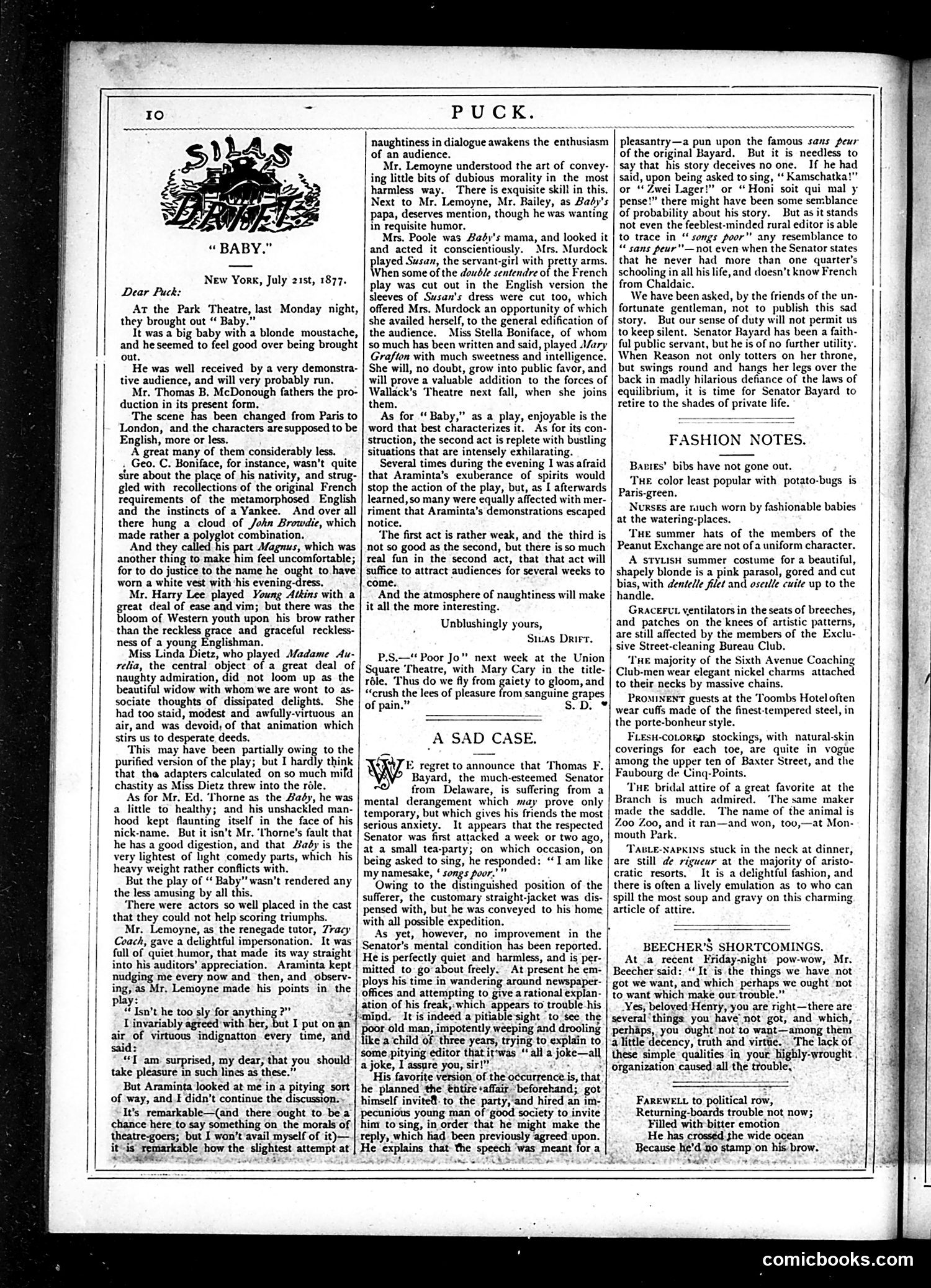
This page is primarily **text-based commentary**, not a political cartoon. The main content is a letter from "Silas Drift" reviewing theatrical performances at the Park Theatre in New York (dated July 21, 1877). The review critiques a production of "Baby," noting the cast's uneven quality and that American actors couldn't match their English counterparts. The writer praises certain performers while criticizing others for being overwrought or poorly suited to their roles. The page includes a "Fashion Notes" section discussing babies' clothing trends and a brief item called "A Sad Case" about Senator Thomas Bayard's mental illness. The content reflects **1870s theatrical culture and social commentary** rather than overt political satire, though it reveals period attitudes about American versus English theatrical sophistication.
📄 Transcribed text from this page (OCR, searchable)
Machine-transcribed from the original scan — historical spelling and the odd misread are preserved.
« BABY.” New York, July 21st, 1877. Dear Puck: At the Park Theatre, last Monday night, they brought out “ Baby Tt was a big baby with a blonde moustache, and he seemed to feel good over being brought out. He was well received by a very demonstra- tive audience, and will very probably run. Mr. Thomas B. McDonough fathers the pro- duction in its present form, The scene has been changed from Paris to London, and the characters are supposed to be English, more or less. A great many of them considerably less. . Geo. C. Boniface, for instance, wasn't quite shre about the place of his nativity, and strug- gled with recollections of the original French requirements of the metamorphosed English and the instincts of a Yankee. And over all there hung a cloud of John Browdie, which made rather a pol lot combination. And they ed his Magnus, which was another thing to make im feel uncomfortable; for to do justice to the name he ought to have worn a white vest with ‘his evening-dress. Mr. Harry Lee played Young Atkins with a great deal of ease and vim; but there was the bloom of Western youth upon his brow rather than the reckless grace and graceful reckless- ness of a young Englishman. Miss Linda Dietz, who played Madame Au- relia, the central object of a great deal of naughty admiration, did not loom up as the beautiful widow with whom we are wont to as- sociate thoughts of dissipated delights. She had too staid, modest and awfully-virtuous an air, and was devoid, of that animation which stirs us to desperate deeds. This may have been partially owing to the purified version of the play; but I hardly think that tha adapters calculated on so much mifd chastity as Miss Dietz threw into the réle. As for Mr. Ed. ‘Thorne as the Baédy, he was a little to healthy; and his unshackled man- hood kept flaunting itself in the face of his nick-name. But it isn’t Mr. ‘Vhorne’s fault that he has a good digestion, and that Bady is the very lightest of light comedy purts, which his heavy weight rather conflicts with, But the play of “ Baby” wasn’t rendered any the less amusing by all this. ‘There were actors so well placed in the cast that they could not help scoring triumphs. Mr. Lemoyne, as the renegade tutor, 7racy Coach, gave a delightful impersonation. It was full of quiet humor, that made its way straight into his auditors’ appreciation. Araminta kept nudging me every now and then, and_observ- ing, as Mr, Lemoyne made his points in. the play: “Isn't he too sly for anythin; L invariably agreed with her, ‘but 1 put on an air of virtuous andignattos every time, and said: “I am surprised, my dear; that you should take pleasure in such lines as these.” But Araminta looked at me in a pitying so sort of way, and I didn’t continue the It’s remarkable—(and there ought to bea chance here to say something on the morals of: theatre-goers; but I won't avail myself of it)— itis’ Sepa how the ic sgntest attempt at <i? naughtiness in dialogue awakens the enthusiasm of an audience. Mr. Lemoyne understood the art of convey: j ing little bits of dubious morality in the most harmless way, There is exquisite skill in this. Next to Mr. Lemoyne, Mr. Bailey, as Bady's papa, deserves mention, though he was wanting in requisite humor. Mrs, Poole was Bady's mama, and looked it and acted it conscientiously. Mrs. Murdock layed Susan, the servant-girl with pretty arms. When some of the doudle sentendre of the French play was cut out in the English version the sleeves of Susan's dress were cut too, which offered Mrs. Murdock an opportunity of which she availed herself, to the general edification of the audience. Miss Stella Boniface, of whom so much has been written and said, played A/ary Grafton with much sweetness and intelligence. She will, no doubt, grow into public favor, and will prove a valuable addition to the forces of Wallack’s Theatre next fall, when she joins them. As for “Baby,” as a play, enjoyable is the word that best characterizes it. As for its con- struction, the second act is replete with bustling situations that are intensely exhilarating. Several times during the evening I was afraid that Araminta’s exuberance of spirits would stop the action of the play, but, as I afterwards learned, so many were equally affected with mer- riment that Araminta’s demonstrations escaped notice. ‘The first act is rather weak, and the third is not so good as the second, but there is so much real fun in the second act, that that act will suffice to attract audiences for several weeks to come. And the atmosphere of naughtiness will make it all the more interesting. Unblushingly yours, Sivas Drirt. P.S.— Poor Jo” next week at the Union Square ‘Theatre, with Mary Cary in the title- réle. Thus do we fly from gaiety to gloom, and “crush the lees of pleasure from sanguine, grapes, of pain.” S.D. _A SAD CASE. (V7, regret to announce that ‘Thomas F. Bayard, the much-esteemed Senator from Delaware, is suffering from a mental derangement which may prove only temporary, but which gives his friends the most serious anxiety, It appears that the respected Senator was first attacked a week or two ago, at a small tea-party; on which occasion, on being asked to sing, he responded: “I am like my namesake, ‘ songs poor,’ Owing to the distinguished position of the sufferer, the customary straight-jacket was dis- pensed with, but he was conveyed to his home with all possible expedition. As yet, however, no improvement in the Senator’s mental condition has been reported. Heis perfectly quiet and harmless, and is per- mitted to go’ about freely. At present he em- ploys his time in wandering around newspaper- offices and attempting to give a rational explan- ation of his freak,;which appears to trouble-his ‘mind. It is indeed a pitiable'sight ‘to. see the old man, impotently weeping and drooling ike a child Of three years, trying to explain to some pitying editor that it‘was ‘alla joke—all a joke, I assure you, sir!” His favorite version of the cSearpence is is, that he planned ‘the’ ttire ‘affair ‘beforehand; got himself invite@: to the party,‘and hired an im- pecunious young man of good society to invite him to sing, in order that he might make the reply, which had been previously agreed u He explains that ee speech." ‘was meant fe a a pun upon the famous sans peur of the original Bayard. But it is needless to say that his story deceives no one. If he had said, upon being asked to sing, ‘‘ Kamschatka!”” or ‘ Zwei Lager!” or “Honi soit qui mal y pense!” there might have been some semblance of probability about his story. But as it stands not even the feeblest-minded rural editor is able to trace in “ songs poor” any resemblance to “ sans peur"’—not even when the Senator states that he never had more than one quarter's schooling in all his life, and doesn’t know French from Chaldaic. We have been asked, by the friends of the un- fortunate gentleman, not to publish this sad story. But our sense of duty will not permit us to keep silent. Senator Bayard has been a faith- ful public servant, but he is of no further utility. When Reason not only totters on her throne, but swings round and hangs her legs over the back in madly hilarious defiance of the laws of equilibrium, it is time for Senator Bayard to retire to the shades of private life. FASHION NOTES. pleasantr: Banies’ bibs have not gone out. ‘Tue color least popular with potato-bugs is Paris-green. Nurses are much worn by fashionable babies at the watering-places. ‘Tue summer hats of the members of the Peanut Exchange are not of a uniform character. A STYLISH summer costume for a beautiful, shapely blonde is a pink parasol, gored and cut bias, with dentelle filet and osetlle cuite up to the handle. Gracerut ventilators in the seats of breeches, and patches on the knees of artistic patterns, are still affected by the members of the Exclu- sive Street-cleaning Bureau Club. ‘THe majority of the Sixth Avenue Coaching Club-men wear elegant nickel charms attach to their necks by massive chains. PROMINENT guests at the ‘Toombs Hotel often wear cuffs made of the finest-tempered steel, in the porte-bonheur style. FLEsu-CoLorgp stockings, with natural-skin coverings for each toe, are quite in vogue among the upper ten of Baxter Street, and the Faubourg de Cing-Points. ‘Tue bridal attire of a great favorite at the Branch is much admired. ‘The same maker made the saddle. The name of the animal is Zoo Zoo, and it ran—and won, too,—at Mon- mouth Park, ‘Tabte-Napkins stuck in the neck at dinner, are still de rigueur at the majority of aristo- cratic resorts. It is a delightful fashion, and there is often a lively emulation as to who can spill the most soup and gravy on this charming article of attire. BEECHER'S SHORTCOMINGS. Ata recent Friday-night pow-wow, Mr. Beecher said: “It is the things we have not got we want, and which perhaps \ we ought ‘not to want which make our trouble.” Yes, beloved'Henry, you are right—there are several'things you have’ not got, and which, perhaps, you ought not to want—among them alittle decency, truth and virtué... ‘The lack of these simple qualities in your highly- wrought, organization caused_all the oebles ELL to political re Returning-boards trouble not now; Filled with-bitter emotion He has crosséd-the wide ocean Hecate, Hedeo stamp on his brow. comicbooks.com