
Puck, 1877-07-25 · page 4 of 16
Puck — July 25, 1877 — page 4: what you’re looking at
What you’re looking at
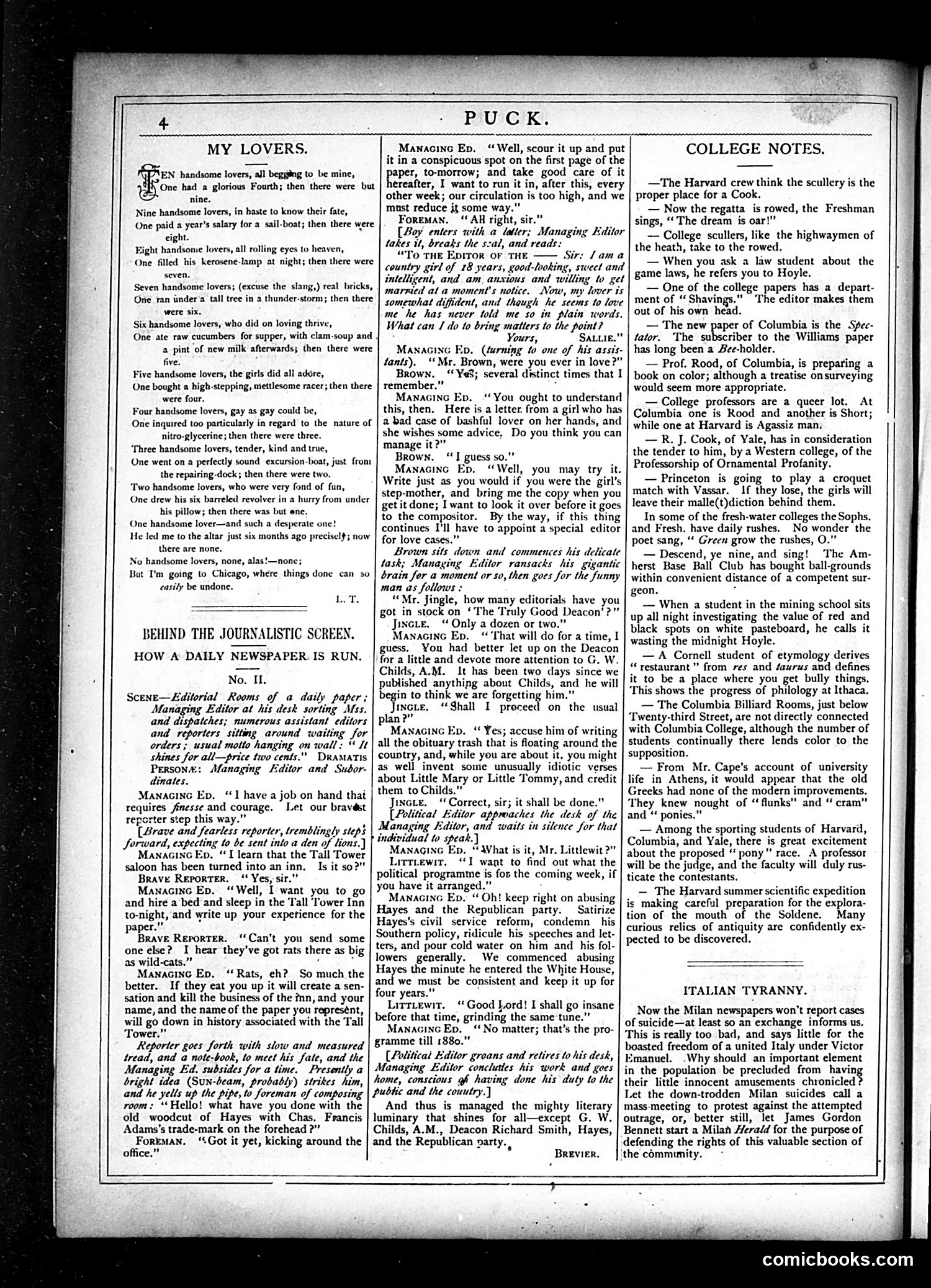
This page contains three distinct sections: a humorous poem "My Lovers" about suitors of varying wealth and status; "Behind the Journalistic Screen," satirizing newspaper operations through dialogue between a Managing Editor and various reporters; and "College Notes" commenting on university life. The newspaper section mocks editorial hierarchies and the compromises involved in running a publication—editors demanding sensational content while managing costs and political sensitivities. The dialogue reveals period tensions between journalistic integrity and commercial pressures. "College Notes" offers lighthearted observations about Harvard, Columbia, Yale, and Princeton students' activities, including crew teams, billiards, and scientific expeditions. A separate piece discusses Italian newspapers and press freedom under the Risorgimento. The content reflects Puck's satirical approach to American institutions and social life circa the 1880s-1890s.
📄 Transcribed text from this page (OCR, searchable)
Machine-transcribed from the original scan — historical spelling and the odd misread are preserved.
PUCK. MY LOVERS. EN handsome lovers, all begging to be mine, ‘One had a glorious Fourth; then there were but nine. Nine handsome lovers, in haste to know their fate, One paid a year’s salary for a sail-boat; then there were eight. Eight handsome lovers, all rolling eyes to heaven, One filled his kerosene-lamp at night; then there were seven. ‘Seven handsome lovers; (excuse the slang,) real bricks, One ran inder'a tall tree in a thunder-storm; then there were six. Six handsome lovers, who did on loving thrive, One ate raw cucumbers for supper, with clam-soup and a pint of new milk afterwards; then there were five. Five handsome lovers, the girls did all adore, One bought a high-stepping, mettlesome racer; then there were four. Four handsome lovers, gay as gay could be, One inquired too particularly in regard to the nature of nitro-glycerine; then there were three. ‘Three handsome lovers, tender, kind and true, One went on a perfectly sound excursion-boat, just from the repairing-dock; then there were two. Two handsome lovers, who were very fond of fun, One drew his six barreled revolver in a hurry from under his pillow; then there was but ene. One handsome lover—and such a desperate one! He led me to the altar just six months ago preciself; now there are none. No handsome lovers, none, alas!—none; But I'm going to Chicago, where things done can so easily be undone. BEHIND THE JOURNALISTIC SCREEN. HOW A DAILY NEWSPAPER. IS RUN. No. II. Scene—ELditorial Rooms of a daily paper; Managing Editor at his desk sorting Mss. and dispatches; numerous assistant editors and reporters sitting around waiting for orders; usual motto hanging on wall: * It shines for all—price two cents.” DRAMATIS Persona: Managing Editor and Subor- dinates. Manacine Ep. “I have a job on hand that requires finesse and courage. Let our bravést reporter step this way.” j [Brave and fearless reporter, tremblingly steps forward, expecting to be sent into a den of lions.] Manaainc Ep. “I learn that the Tall Tower saloon has been turned into an inn, Is it so?” Brave Reporter. “Yes, sir.’ Manacinc Ep. “Well, I want you to go and hire a bed and sleep in the ‘Tall ‘Tower Inn to-night, and write up your experience for the paper.” Brave Reporter. ‘Can't you send some one else? I hear they've got rats there as big as wild-cats.” . i Manacinc Ep, “Rats, eh? So much the better. If they eat you up it will create a sen- sation and kill the business of the fn, and your name, and the name of the paper you represént, will go down in history associated with the Tall Tower.” Reporter goes forth with slow and measured tread, and a note-book, to meet his fate, and the Managing Ed. subsides for a time. Presently a bright idea (SuN-beam, probably) strikes him, and he yells up the pipe, to foreman of composing room: ‘Hello! what have you done with the old woodcut of Hayes with Chas, Francis Adams's trade-mark on the forehead ?” eaeroee ‘SGot it yet, kicking around the office.” Manaainc Ep. “Well, scour it up and put it in a conspicuous spot on the first page of the aper, to-morrow; and take good care of it ereafter, I want to run it in, after this, every other week; our circulation is too high, and we mast reduce jt some way.” Foreman. ‘AH right, [Boy enters with a later; Managing Editor takes it, breaks the szal, and reads: “To tHE Epitor or THE —— Sir: Jama country girl of 18 years, good-looking, sweet and intelligent, and am. anxious and willing to get married ata moment's notice. Now, my lover is somewhat diffident, and though he seems to love me he has never told me so in plain words. What can I do to bring matters to the point? Yours, Satie.” Manacine Ep. (turning fo one of his assis- fants). “Mr. Brown, were you ever in love?” Brown. “ Ye3; several distinct times that I remember.” Manacinc Ep. ‘You ought to understand this, then. Here is a letter from a girl who has a bad case of bashful lover on her hands, and she wishes some advice, Do you think you can manage it?” Brown. “J guess so.”” Manacinc Ep, “Well, you may try it. Write just as you would if you were the girl’s step-mother, and bring me the copy when you get it done; I want to look it over before it goes to the compositor. By the way, if this thing continues I'll have to appoint a special editor for love cases.”” Brown sits down and commences his delicate task; Managing Editor ransacks his gigantic brain for a moment or so, then goes for the funny man as follows : “Mr. Jingle, how many editorials have you got in stock on ‘The Truly Good Deacon’?” Jincie, “ Only a dozen or two.” Manacinc Ep. “That will do for a time, I guess. You had better let up on the Deacon for a little and devote more attention to G. W. Childs, A.M. It has been two days since we published anything about Childs, and he will begin to think we are forgetting him.” Vinore. “Shall I proceed on the usual plan?” Manacinc Ep. “ Yes; accuse him of writing all the obituary trash that is floating around the country, and, while you are about it, you might as well invent some unusually idiotic verses about Little Mary or Little Tommy, and credit them to Childs.” Jincte. “Correct, sir; it shall be done.” [Political Editor approaches the desk of the Managing Editor, and waits in silence for that individual to speak} Managinc Ep, ‘What is it, Mr. Littlewit ?” Lirttewit. “I want to find out what the political programme is for the coming week, if you have it arranged.” Manacinc Ep. “Oh! keep right on abusing Hayes and the Republican party. Satirize Hayes’s civil service reform, condemn_ his Southern policy, ridicule his speeches and let- ters, and pour cold water on him and his fol- lowers generally. We commenced abusing Hayes the minute he entered the White House, and we must be consistent and keep it up for four years.” Litttewit. ‘Good Lord! I shall go insane before that time, grinding the same tune.” Manacinc Ep. ‘No matter; that’s the pro- gramme till 1880." [Political Editor groans and retires to his desk, Managing Editor conclutles his work and goes home, conscious of having done his duty to the public and the couutry.} And thus is managed the mighty literary luminary that shines for all—except G. W. Childs, A.M., Deacon Richard Smith, Hayes, and the Republican party. , Brevier. COLLEGE NOTES. —The Harvard crew think the scullery is the proper place for a Cook. — Now the regatta is rowed, the Freshman sings, ‘‘ The dream is oar!’ — College scullers, like the highwaymen of the heath, take to the rowed. — When you ask a law student about the game laws, he refers you to Hoyle. — One of the college papers has a depart- ment of “Shavings.” ‘The editor makes them out of his own head. — The new paper of Columbia is the Spec- fator. The subscriber to the Williams paper has long been a Bee-holder. — Prof. Rood, of Columbia, is preparing a book on color; although a treatise on surveying would seem more appropriate. — College professors are a queer lot. At Columbia one is Rood and another is Short; while one at Harvard is Agassiz man. — R. J. Cook, of Yale, has in consideration the tender to him, by a Western college, of the Professorship of Ornamental Profanity. — Princeton is going to play a croquet match with Vassar. If they lose, the girls will leave their malle(t)diction behind them. In some of the fresh-water colleges the Sophs. and Fresh. have daily rushes. No wonder the poet sang, “ Green grow the rushes, O.” — Descend, ye nine, and sing! The Am- herst Base Ball Club has bought ball-grounds within convenient distance of a competent sur- geon. . — When a student in the mining school sits up all night investigating the value of red and black spots on white pasteboard, he calls it wasting the midnight Hoyle. — A Cornell student of etymology derives “restaurant ” from res and faurus and defines it to be a place where you get bully things. This shows the progress of philology at Ithaca. — The Columbia Billiard Rooms, just below Twenty-third Street, are not directly connected with Columbia College, although the number of students continually there lends color to the supposition. — From Mr. Cape’s account of university life in Athens, it would appear that the old Greeks had none of the modern improvements. They knew nought of flunks" and “cram” and “ ponies.” — Among the sporting students of Harvard, Columbia, and Yale, there is great excitement about the proposed “ pony” race. A professor will be the judge, and the faculty will duly rus- ticate the contestants. — The Harvard summer scientific expedition is making careful preparation for the explora- tion of the mouth of the Soldene. Many curious relics of antiquity are confidently ex- pected to be discovered. ITALIAN TYRANNY. Now the Milan newspapers won't report cases of suicide—at least so an exchange informs us. This is really too bad, and says little for the boasted freedom of a united Italy under Victor Emanuel. .Why should an important element in the population be precluded from havin, their little innocent amusements chronicled $ Let the down-trodden Milan suicides call a mass-meeting to protest against the attempted outrage, or, better still, let James Gordon Bennett start a Milan Hera/d for the purpose of defending the rights of this valuable section of the commumity. - comicbooks.com