
Puck, 1877-07-25 · page 13 of 16
Puck — July 25, 1877 — page 13: what you’re looking at
What you’re looking at
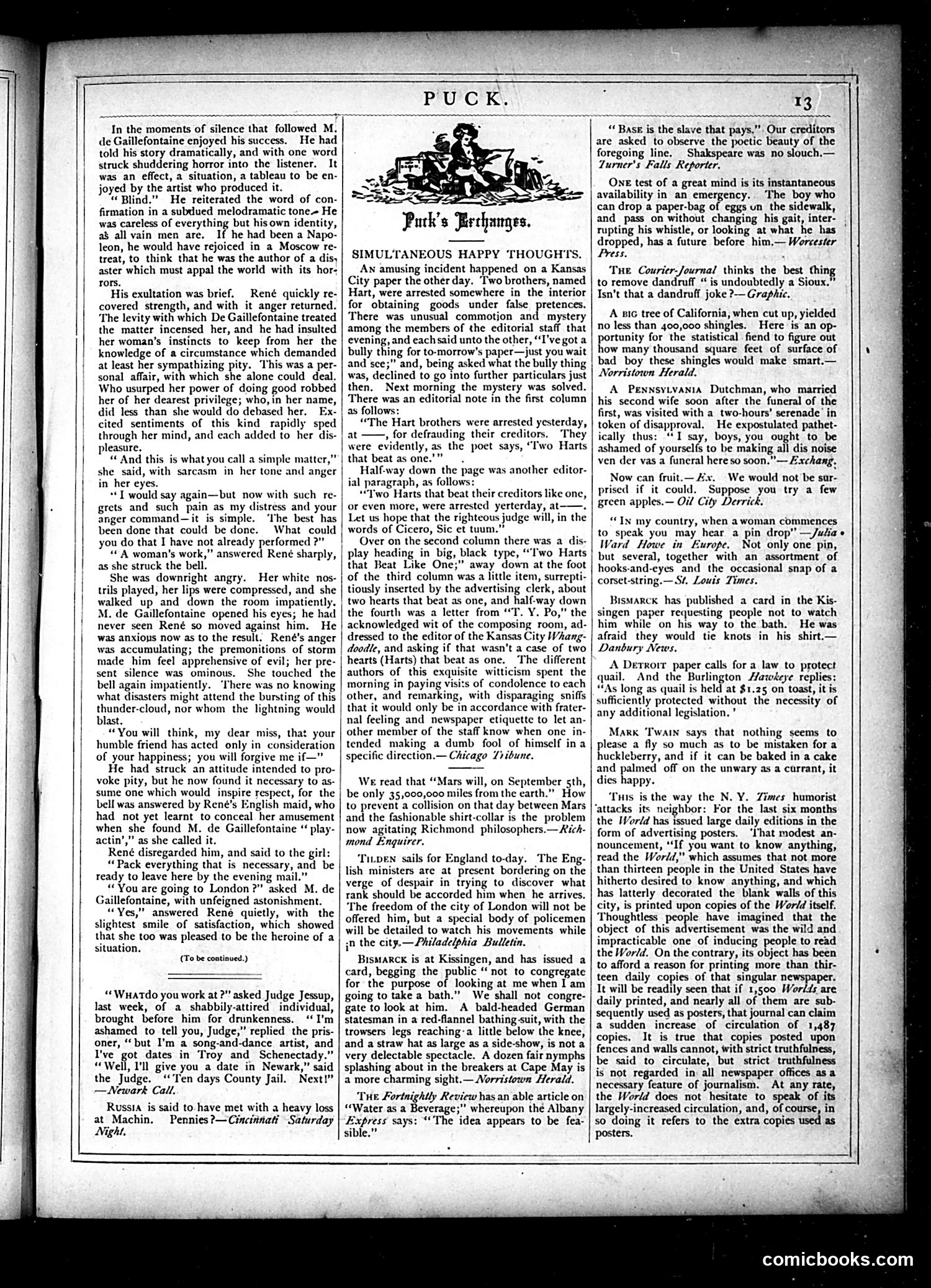
This page is primarily text-based commentary rather than political cartoons. It features "Puck's Jottings"—a column of satirical observations about current events and media. The content includes commentary on: - A Kansas City newspaper incident involving arrested brothers named Hart - Media absurdities and journalistic practices - Various newspaper items and their questionable accuracy - Social commentary on contemporary issues A small decorative illustration appears at the top showing cherubs or putti (classical figures), typical of Puck's ornamental style. The page consists largely of reprinted excerpts from other publications with Puck's satirical commentary, mocking journalistic standards, editorial practices, and the credibility of contemporary reporting—reflecting Puck's role as a media critic and satirist of the era.
📄 Transcribed text from this page (OCR, searchable)
Machine-transcribed from the original scan — historical spelling and the odd misread are preserved.
In the moments of silence that followed M. de Gaillefontaine enjoyed his success. He had told his story dramatically, and with one word struck shuddering horror into the listener. It was an effect, a situation, a tableau to be en- joyed by the artist who produced it. “Blind.” He reiterated the word of con- firmation in a subdued melodramatic tone» He was careless of everything but his own identity, a8 all vain men are. If he had been a Napo- leon, he would have rejoiced in a Moscow re- treat, to think that he was the author of a dis, aster which must appal the world with its hor- rors. His exultation was brief, René quickly re- covered strength, and with it anger returned. The levity with which De Gaillefontaine treated the matter incensed her, and he had insulted her woman’s instincts to keep from her the knowledge of a circumstance which demanded at least her sympathizing pity. ‘This was a per- sonal affair, ‘vith which she alone could deal. Who usurped her power of doing good robbed her of her dearest privilege; who, in her name, did less than she would do debased her. Ex- cited sentiments of this kind rapidly sped through her mind, and each added to her dis- pleasure. “And this is what you call a simple matter,” she said, with sarcasm in her tone and anger in her eyes. “T would say again—but now with such re- grets and such pain as my distress and your anger command—it is simple. ‘he best has been done that could be done. What could you do that I have not already performed ?” “A woman's work,” answered René sharply, as she struck the bell. She was downright angry. Her white nos- trils played, her lips were compressed, and she walked up and down the room impatiently. M. de Gaillefontaine opened his eyes; he had never seen René so moved against him. He was anxious now as to the result. René’s anger was accumulating; the premonitions of storm made him feel apprehensive of evil; her pre- sent silence was ominous. She touched the bell again impatiently. ‘There was no knowing what disasters might attend the bursting of this thunder-cloud, nor whom the lightning would blast. “You will think, my dear miss, that your humble friend has acted only in consideration of your happiness; you will forgive me if—” He had struck an attitude intended to pro- voke pity, but he now found it necessary to as- sume one which would inspire respect, for the bell was answered by René’s English maid, who had not yet learnt to conceal her amusement when she found M. de Gaillefontaine “ play- actin’,” as she called it. “Pack everything that is necessary, and be ready to leave here by the evening mail.” “You are going to London ?” asked M. de Gaillefontaine, with unfeigned astonishment. “Yes,” answered René quietly, with the slightest smile of satisfaction, which showed that she too was pleased to be the heroine of a situation, (To be continued.) “Wuatdo you work at ?” asked Judge Jessup, last week, of a shabbily-attired individual, brought before him for drunkenness. ‘I’m ashamed to tell you, Judge,” replied the pris- oner, ‘but I’m a song-and-dance artist, and I've got dates in Troy and Schenectady.” “Well, I'll give you a date in Newark,” said the Judge. ‘Ten days County Jail. Next!” —Newark Call. Russia is said to.have met with a heavy loss at Machin. Pennies?—Cinciinati Saturday Night, SIMULTANEOUS HAPPY THOUGHTS. Aw amusing incident happened on a Kansas City paper the other day. ‘Two brothers, named Hart, were arrested somewhere in the interior for obtaining goods under false pretences. There was unusual commotjon and mystery among the members of the editorial staff that evening, and each said unto the other, “I've got a bully thing for to-morrow’s paper—just you wait and sce;” and, being asked what the bully thing was, declined to go into further particulars just then. Next morning the mystery was solved. There was an editorial note in the first column as follows: “The Hart brothers were arrested yesterday, at , for defrauding their creditors. ‘They | were evidently, as the poet says, “Iwo Harts that beat as one.’ 5 Half-way down the page was another editor- ial paragraph, as follows: “Two Harts that beat their creditors like one, or even more, were arrested yerterday, at. * Let us hope that the righteous judge will, in the words of Cicero, Sic et tuum.” Over on the second column there was a dis- play heading in big, black type, “Two Harts that Beat Like One;” away down at the foot of the third column was a little item, surrepti- tiously inserted by the advertising clerk, about two hearts that beat as one, and half-way down the fourth was a letter from ‘‘T. Y. Po,” the acknowledged wit of the composing room, ad- dressed to the editor of the Kansas City Whang- | doodle, and asking if that wasn’t a case of two The different | hearts (Harts) that beat as one. authors of this exquisite witticism spent the morning in paying visi:s of condolence to each other, and remarking, with disparaging sniffs | that it would only be in accordance with frater- nal feeling and newspaper etiquette to let an- other member of the staff know when one in- tended making a dumb fool of himself ina specific direction.— Chicago Lribune. We read that “Mars will, on September sth, be only 35,000,000 miles from the earth.” How to prevent a collision on that day between Mars and the fashionable shirt-collar is the problem now agitating Richmond philosophers.—Rich- | mond Enquirer. René disregarded him, and said to the girl: | ‘Tivpen sails for England to-day. The Eng- lish ministers are at present bordering on the verge of despair in trying to discover what rank should be accorded him when he arrives. ‘The freedom of the city of London will not be offered him, but a special body of policemen will be detailed to watch his movements while jn the city.—Philadelphia Bulletin. Bismarck is at Kissingen, and has issued a card, begging the public “ not to congregate for the purpose of looking at me when 1 am going to take a bath.” We shall not congre- gate to look at him. A bald-headed German statesman in a red-flannel bathing-suit, with the trowsers legs reaching:a little below the knee, and a straw hat as large as a side-show, is not a very delectable spectacle. A dozen fair nymphs splashing about in the breakers at Cape May is a more charming sight.— Norristown Herald. ‘THe Fortnightly Review hasan able article on “Water as a Beverage;” whereupon thé Albany Express says: ‘The idea appears to be fea- sible.” 13 “ Base is the slave that pa Our creditors are asked to observe the poetic beauty of the foregoing line. _Shakspeare was no slouch.— Turner's Falls Reporter, One test of a great mind is its instantaneous availability in an emergency... ‘The boy who can drop a paper-bag of eggs un the sidewalk, and pass on without changing his gait, inter- rupting his whistle, or looking at what he has dropped, has a future before him.— Worcester Press. “ THe Courier-Journal thinks the best thing to remove dandruff “ is undoubtedly a Sioux.” Isn't that a dandruff joke ?— Graphic. A pic tree of California, when cut up, yielded no less than 400,000 shingles. Here is an op- portunity for the statistical fiend to figure out how many thousand square feet of surface of | bad boy these shingles would make smart.— Norristown Herald. A PennsytvaniA Dutchman, who married his second wife soon after the funeral of the first, was visited with a_two-hours’ serenade’ in token of disapproval. He expostulated pathet- ically thus: “I say, boys, you ought to be ashamed of yourselfs to be making all dis noise ven der vas a funeral here so soon.” — Exchang. Now can frui We would not be sur- prised if it could. Suppose you try a few green apples.— Oil City Derrick. “In my country, when a woman commences to speak you may hear a pin drop” —Julia Ward Howe in Europe, Not only one pin, but several, together with an assortment of hooks-and-eyes and the occasional snap of a corset-string.—St. Louis Times. Bismarck has published a card in the Kis- | singen paper requesting people not to watch him while on his way to the bath. He was afraid they would tie knots in his shirt.— Danbury News. A Derrorr paper calls for a law to protect quail. And the Burlington Hawkeye replies: “As long as quail is held at $1.25 on toast, it is sufficiently protected without the necessity of any additional legislation. * Mark ‘Twain says that nothing seems to please a fly so much as to be mistaken for a huckleberry, and if it can be baked in a cake and palmed off on the unwary as a carrant, it dies happy. ‘Tus is the way the N. Y. Zimes humorist ‘attacks its neighbor: For the last six months the World has issued large daily editions in the form of advertising posters. ‘That modest an- nouncement, ‘If you want to know anything, read the World,” which assumes that not more than thirteen people in the United States have hitherto desired to know anything, and which has latterly decorated the blank walls of this city, is printed upon copies of the World itself. Thoughtless people have imagined that the object of this advertisement was the wild and impracticable one of inducing ple to read the World. On the contrary, its object has been to afford a reason for printing more than thir- teen daily copies of that singular news; y It will be readily seen that if 1,500 Worlds are daily printed, and nearly all of them are sab- sequently used as posters, that journal can claim a sudden increase of circulation of 1,487 copies. It is true that copies posted upon fences and walls cannot, with strict truthfulness, be said to circulate, but strict truthfulness is not regarded in all newspaper offices asa necessary feature of journalism. At any rate, the World does not hesitate to speak of its largely-increased circulation, and, of course, in so doing it refers to the extra copies used as posters. comicbooks.com