
Puck, 1877-07-25 · page 6 of 16
Puck — July 25, 1877 — page 6: what you’re looking at
What you’re looking at
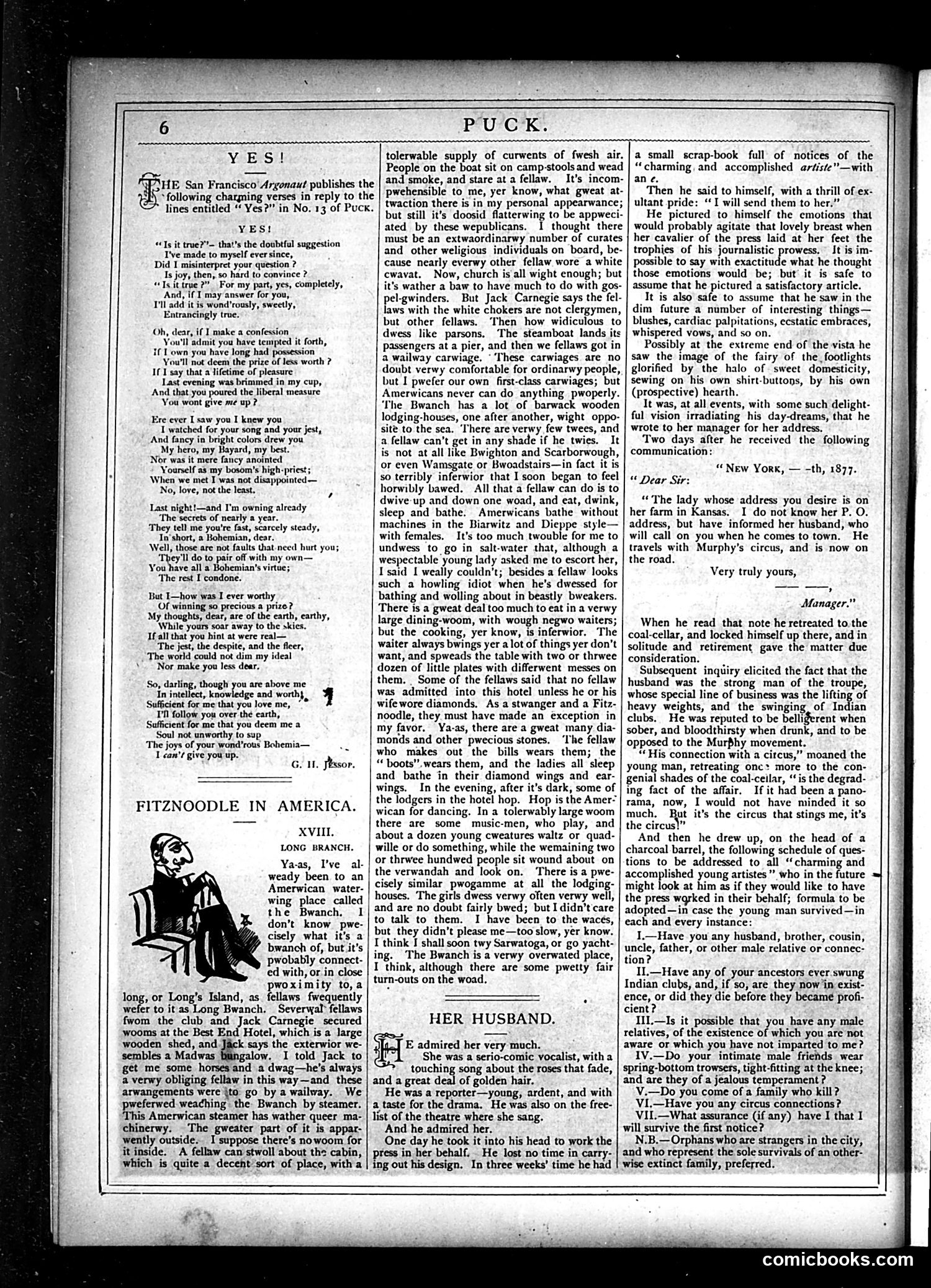
This page contains three separate pieces of satirical content: 1. **"Yes!"** - Verse mocking San Francisco's *Argonaut* newspaper's response to criticism. The satire ridicules flowery language and defensive posturing. 2. **"Fitznoodle in America XVIII"** - A cartoon featuring a character discussing Long Island/Long Branch. The accompanying illustration shows a man in period dress. The text satirizes American tourist destinations and social pretensions, likely mocking both European visitors' impressions and American vanity about their resorts. 3. **"Her Husband"** and advice column responses - Various letters addressing domestic and social matters, including questions about inheritance and family obligations. The overall tone targets American social aspirations, journalistic excess, and domestic conventions of the era (appears to be 1877 based on visible date).
📄 Transcribed text from this page (OCR, searchable)
Machine-transcribed from the original scan — historical spelling and the odd misread are preserved.
PUCK. YES! AHE San Francisco! Argonaut publishes the following chargning verses in reply to the lines entitled “Yes?” in No. 13 of Puck. YES! «Is it true?" that’s the doubtful suggestion I've made to myself ever since, Did I misinterpret your question ? Is joy, then, so hard to convince ? “Is it true?” For my part, yes, completely, ‘And, if I may answer for you, I'll add it is wond’rously, sweetly, Entrancingly true. Oh, dear, if I make a confession You'll admit you have tempted it forth, If Town you have long had possession You'll not deem the prize of less worth ? ICI say that a fifetime of pleasure Last evening was brimmed in my cup, And that you poured the liberal measure You wont give me up ? Ere ever I saw you I knew you I watched for your song and your jest, And fancy in bright colors drew you My hero, my Bayard, my best. Nor was it mere fancy anointed Yourself as my bosom’s high-priest; When we met I'was not disappointed — No, love, not the least. Last night!—and I'm owning already ‘The secrets of nearly a year. They tell me you're fast, scarcely steady, In’short, a Bohemian, dear. Well, those are not faults that-need hurt you; ‘They'll do to pair off with my own— Youave ala Bohemians virtue; ‘The rest I condone. But I—how was I ever worthy Of winning so precious a prize? My thoughts, dear, are of the earth, earthy, ‘While yours soar away to the skies. If all that you hint at were real— The jest, the despite, and the ficer, ‘The world could not dim my ideal Nor make you less dear. So, darling, though In intellect, know! Sufficient for me that you love me, I'l follow you over the earth, Sufficient for me that you deem me a Soul not unworthy to sup The joys of your wond’rous Bohemia— I can’t give you up. ou are above me cs, 11, fessor. FITZNOODLE IN AMERICA. XVIII. LONG BRANCH. Ya-as, I've al- weady been to an Amerwican water- wing place called the Bwanch, I don’t know pwe- cisely what it’s a bwanch of, but it’s pwobably connect- ed with, or in close pwoximity to, a long, or Long’s Island, as. fellaws fwequently wefer to it as Long Bwanch. Severwal* fellaws fwom the club and Jack Carnegie secured wooms at the Best End Hotel, which is a large wooden shed, and Jack says the exterwior we- sembles a Madwas galow. I told Jack to get me some horses and a dwag—he’s always a verwy obliging fellaw in this way—and these arwangements were {to go by a wailway. We pweferwed weaching. the Bwanch by steamer. ‘This Amerwican steamer has wather queer ma- chinerwy. The gweater part of it is appar- wently outside. I suppose there’s nowoom for it inside. A fellaw can stwoll about the cabin, which is quite a deceht*sort of place, witha tolerwable supply of curwents of fwesh air. People on the boat sit on camp-stools and wead and smoke, and stare at a fellaw. It’s incom- pwehensible to me, yer know, what gweat at- twaction there is in my personal appearwance; but still it’s doosid flatterwing to be appweci- ated by these wepublicans. I thought there must be an extwaordinarwy number of curates and other weligious individuals on board, be- cause nearly everwy other fellaw. wore a white cwavat. Now, church is all wight enough; but it's wather a baw to have much to do with gos- pel-gwinders. But Jack Carnegie says the fel- laws with the white chokers are not clergymen, but other fellaws. ‘Then how widiculous to dwess like parsons. The steamboat lands its passengers at a pier, and then we fellaws got in a wailway carwiage. * ‘These carwiages are no doubt verwy comfortable for ordinarwy people, but I pwefer our own first-class carwiages; but Amerwicans never can do anything pwoperly. ‘The Bwanch has a lot of barwack wooden lodging-houses, one after another, wight oppo- site to the sea. ‘here are verwy few twees, and a fellaw can’t get in any shade if he twies. It is not at all like Bwighton and Scarborwough, or even Wamsgate or Bwoadstairs—in fact it is so terribly inferwior that I soon began to feel horwibly bawed. All that a fellaw can do is to dwive-up and down one woad, and eat, dwink, sleep and bathe. Amerwicans bathe without machines in the Biarwitz and Dieppe style— with females. It’s too much twouble for me to undwess to go in salt-water that, although a wespectable young lady asked me to escort her, I said I weally couldn't; besides a fellaw looks such a howling idiot when he's dwessed for bathing and wolling about in beastly bweakers. There is a gweat deal too much to eat in a verwy large dining-woom, with wough negwo waiters; but the cooking, yer know, is inferwior. ‘The waiter always bwings yer a lot of things yer don’t want, and spweads the table with two or thrwee dozen of little plates with differwent messes on them. _ Some of the fellaws said that no fellaw was admitted into this hotel unless he or his wife wore diamonds. As a stwanger and a Fitz- noodle, they must have made an exception in my favor. Ya-as, there are a gweat many dia- monds and other pwecious stones. ‘I'he fellaw who makes out the bills wears them; the “ boots”. wears them, and the ladies all sleep and bathe in their diamond wings and ear- wings. In the evening, after it’s dark, some of the lodgers in the hotel hop. Hop is the Amer” wican for dancing. In a tolerwably large woom there are some music-men, who play, and about a dozen young cweatures waltz or quad- wille or do something, while the wemaining two or thrwee hundwed people sit wound about on the verwandah and look on. ‘here is a pwe- cisely similar pwogamme at all the lodging- houses. ‘The girls dwess verwy often verwy well, and are no doubt fairly bwed; but I didn’t’care to talk to them. I have been to the wacés, but they didn’t please me—too slow, yer know. T think I shall soon twy Sarwatoga, or go yacht- ing. The Bwanch is a verwy overwated place, I think, although there are some pwetty fair turn-outs on the woad, HER HUSBAND. ooh admired her very much. She was a serio-comic vocalist, with a touching song about the roses that fade, and a great deal of golden hair. He was a reporter—young, ardent, and with a taste for the drama. He was also on the free- list of the theatre where she sang. And he admired her. One day he took it into his head to work the press in her behalf. _ He lost no time in carry- ing out his design. In three weeks’ time he had a small scrap-book full of notices of the “charming, and accomplished artiste”—with ane. Then he said to himself, with a thrill of ex- ultant pride: ‘I will send them to her.” He pictured to himself the emotions that would probably agitate that lovely breast when her cavalier of the press laid at her feet the trophies of his journalistic prowess.” It is im- possible to say with exactitude what he thought those emotions would be; but’ it is safe to assume that he pictured a satisfactory article. It is also safe to assume that he saw in the dim future a number of interesting things— blushes, cardiac palpitations, ecstatic embraces, whispered vows, and so on. Possibly at the extreme end of the vista he saw the image of the fairy of the footlights glorified by the halo of sweet domesticity, sewing on his own shirt-buttons, by his own (prospective) hearth. It was, at all events, with some such delight- ful vision irradiating his day-dreams, that he wrote to her manager for her address. Two days after he received the following communication: “ New York, — -th, 1877. “ Dear Sir: “The lady whose address you desire is on her farm in Kansas. I do not know her P. O. address, but have informed her husband, who will call on you when he comes to town. He travels with Murphy's circus, and is now on the road. Very truly yours, erg ero Manager.” When he read that note he retreated to.the coal-cellar, and locked himself up there, and in solitude and retirement gave the matter due consideration. Subsequent inquiry elicited the fact that the husband was the strong man of the troupe, whose special line of business was the lifting of heavy weights, and the swinging of Indian clubs. He was reputed to be belligerent when sober, and bloodthirsty when drunk, and to be opposed to the Murfhy movement. ‘His connection with a citcus,” moaned the young man, retreating onc> more to the con- genial shades of the coal-ceilar, “is the degrad- ing fact of the affair. If it had been a pano- rama, now, I would not have minded i much, Rat it’s the circus that stings me, it’s the circus!” And then he drew up, on the head of a charcoal barrel, the following schedule of ques- tions to be addressed to all “charming and sccomplished young artistes” who in the future might look at him as if they would like to have the press wqrked in their behalf; formula to be adopted—in case the young man survived—in each and every instance: I,—Have you any husband, brother, cousin, uncle, father, or other male relative or connec- tion? Il.—Have any of your ancestors ever swung Indian clubs, and, if so, are they now in exist- ence, or did they die before they became profi- cient? Ill.—Is it possible that you have any male relatives, of the existence of: which you are not aware or which you have not imparted to me? IV.—Do your intimate male friehds wear spring-bottom trowsers, tight-fitting at the knee; and are they of a jealous temperament? V.—Do you come of a family who kill? VI.—Have you any circus connections? VII.—What assurance (if any) have I that I will survive the first notice? N.B.— Orphans who are strangers in the city, and who represent the sole survivals of an other- wise extinct family, preferred.