
Puck, 1877-07-25 · page 7 of 16
Puck — July 25, 1877 — page 7: what you’re looking at
What you’re looking at
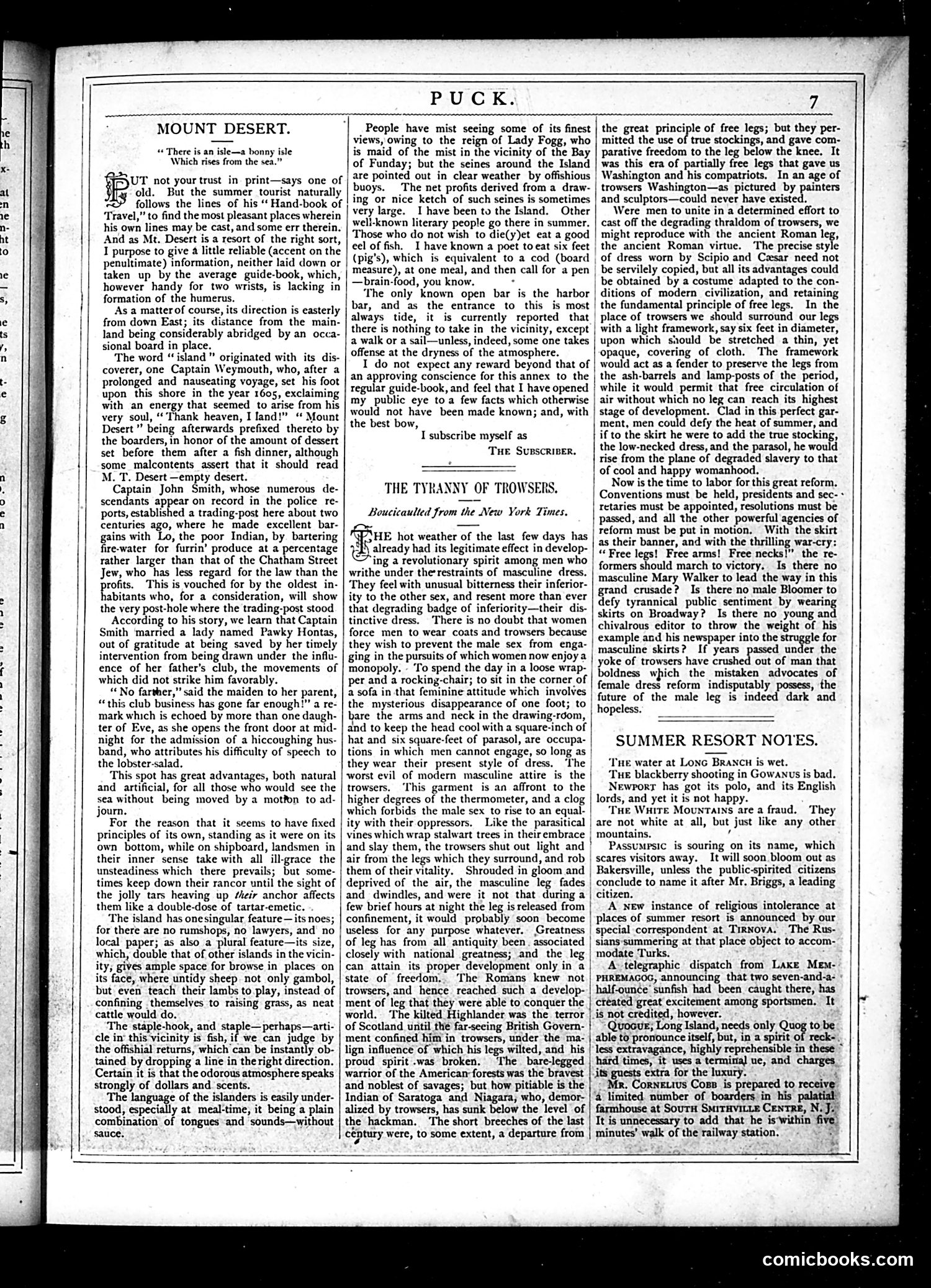
This page contains three distinct articles with no visible political cartoons. The content includes: 1. **"Mount Desert"** — a humorous travel piece describing a Maine island destination, mocking both the landscape's barrenness and tourists' pretensions. 2. **"The Tyranny of Trousers"** — a satirical commentary on men's fashion, specifically criticizing the adoption of trousers as oppressive menswear. The piece advocates for men wearing skirts or looser garments as liberating reform, using heated language about masculine discomfort. This appears to be social satire about rigid dress codes rather than serious advocacy. 3. **"Summer Resort Notes"** — brief observations about various vacation destinations and social issues at resorts. The page demonstrates Puck's satirical approach to American life, society, and fashion conventions through written humor rather than visual cartoons.
📄 Transcribed text from this page (OCR, searchable)
Machine-transcribed from the original scan — historical spelling and the odd misread are preserved.
PUCK. MOUNT DESERT. « There is an iske—a bonny isle Which rises from the sea.” UT not your trust in print—says one of ie old. But the summer tourist naturally follows the lines of his “ Hand-book of Travel,” to find the most pleasant places wherein his own lines may be cast, and some err therein. And as Mt. Desert is a resort of the right sort, 1 purpose to give 4 little reliable (accent on the penultimate) information, neither laid down or taken up by the average guide-book, which, however handy for two wrists, is lacking in formation of the humerus. As a matter of course, its direction is easterly from down East; its distance from the main- land being considerably abridged by an occa- sional board in place. ‘The word “island” originated with its dis- coverer, one Captain Weymouth, who, after a prolonged and nauseating voyage, set his foot upon this shore in the year 1605, exclaiming with an energy that seemed to arise from his very soul, “Thank heaven, I land!” Mount Desert” being afterwards prefixed thereto by the boarders, in honor of the amount of dessert set before them after a fish dinner, although some malcontents assert that it should read M. T. Desert empty desert. Captain John Smith, whose numerous de- seeadants appear on record in the police re- ports, established a trading-post here about two centuries ago, where he made excellent bar- gains with Lo, the poor Indian, by. bartering fire-water for furrin’ produce at a percentage rather larger than that of the Chatham Street Jew, who has less regard for the law than the ofits. This is vouched for by the oldest in- abitants who, for a consideration, will show the very post-hole where the trading-post stood According to his story, we learn that Captain Smith ‘married a lady named Pawky Hontas, out of gratitude at being saved by her timely intervention from being drawn under the influ- ence of her father’s club, the movements of which did not strike him favorably. “No farther,” said the maiden to her parent, “this club business has gone far enough!” a re- mark which is echoed by more than one daugh- ter of Eve, as she opens the front door at mid- night for the admission of a hiccoughing hus- band, who attributes his difficulty of speech to the lobster-salad. This spot has great advantages, both natural and artificial, for all those who would see the sea without being moved by a mot?on to ad- journ. For the reason that it seems to have fixed principles of its own, standing as it were on its own bottom, while on shipboard, landsmen in their inner sense take with all ill-grace the unsteadiness which there prevails; but some- times keep down their rancor until the sight of the jolly tars heaving up ¢keir anchor affects them like a double-dose of tartar-emetic. The island has onesingular feature— its noes; for there are no rumshops, no lawyers, and no local paper; as also a plural feature—its size, which, double that of other islands in the vicin- ity; gives ample space for browse in places on its face, where untidy sheep not only gambol, but even teach their lambs to play, instead of confining themselves to raising grass, as neat | | world. cattle would do. i ‘The staple-hook, and staple—perhaps—arti- cle in: this-vicinity is fsb, if we can jad © by the offishial returns, which’ can be instantly ob- tained by dro} ping a line in the right direction. Certain it is that the odorous atmosphere speaks strongly of dollars and. scents. The lan; ¢ of the islanders is easily under- stood, especially at meal-time, it being a plain combination of tongues and sounds—without sauce. People have mist seeing some of its finest views, owing to the reign of Lady Fogg, who is maid of the mist in the vicinity of the Bay of Funday; but the seines around the Island are pointed out in clear weather by offishious | buoys. The net profits derived from a draw- ing or nice ketch of such seines is sometimes very large. I have been to the Island. Other well-known literary people go there in summer, Those who do not wish to die(y)et eat a good | eel of fish. I have known a poet to eat six feet (pig's), which is equivalent to a cod (board measure), at one meal, and then call for a pen —brain-food, you know. : ‘The only known open bar is the harbor bar, and as the entrance to this is most always tide, it is currently reported that there is nothing to take in the vicinity, except a walk or a sail—unless, indeed, some one takes offense at the dryness of the atmosphere. I do not expect any reward beyond that of an approving conscience for this annex to the | regular guide-book, and feel that I have opened | my public eye toa few facts which otherwise | would not have been made known; and, with | the best bow, I subscribe myself as Tue Supscriper. THE TYRANNY OF TROWSERS, Boucicaulted from the New York Times, ‘Pur hot weather of the last few days has already had its legitimate effect in develop- ing a revolutionary spirit among men who writhe under the’restraints of masculine dress. They feel with unusual bitterness their inferior- ity to the other sex, and resent more than ever that degrading badge of inferiority—their dis- tinctive dress. ‘There is no doubt that women force men to wear coats and trowsers because | they wish to prevent the male sex from enga- | ging in the pursuits of which women now enjoy a monopoly. - ‘To spend the day in a loose wrap- per and a rocking-chair; to sit in the corner of a sofa in that feminine attitude which involves the mysterious disappearance of one foot; to bare the arms and neck in the drawing-room, and to keep the head cool with a square-inch of hat and six square-feet of parasol, are occupa- tions in which men cannot engage, so long as they wear their present style of dress. ‘The worst evil of modern masculine attire is the trowsers. ‘This garment is an affront to the higher degrees of the thermometer, and a clog which forbids the male sex to rise to an equal- ity with their oppressors. Like the parasitical | vines which wrap stalwart trees in theirembrace and slay them, the trowsers shut out light and air from the legs which they surround, and rob them of their vitality. Shrouded in gloom and | deprived of the air, the masculine leg fades | and dwindles, and were it not that during a | few brief hours at night the leg is released from | confinement, it would probably soon become | useless for any purpose whatever. Greatness | of leg has from all antiquity been. associated | closely with national greatness; and the leg | can attain its proper development only in a | state of freedom., The Romans knew not trowsers, and hence reached such a develop-| ment of leg that they were able to conquer the | The kilted Highlander was the terror | of Scotland until the far-seeing British Govern- | ment confined him'in trowsers, under the ma- | lign influence of which his legs wilted, and his | proud spirit .was broken. ‘The bare-legged warrior of the American: forests was the bravest and noblest of savages; but how pitiable is the Indian of Saratoga and Niagara, who, demor- alized by trowsers, has sunk below the level of the hackman. The short breeches of the last ceptury were, to some extent, a departure from | future of the male leg is indeed dark | the great principle of free legs; but they per- mitted the use of true stockings, and gave com- parative freedom to the leg below the knee. It was this era of partially free legs that gave us Washington and his compatriots. In an age of trowsers Washington—as pictured by painters and sculptors—could never have existed. Were men to unite in a determined effort to cast off the degrading thraldom of trowsers, we might reproduce with the ancient Roman leg, the ancient Roman virtue. The precise style of dress worn by Scipio and Cesar need not be servilely copied, but all its advantages could be obtained by a costume adapted to the con- ditions of modern civilization, and retaining the fundamental principle of free legs. In the place of trowsers we should surround our legs | with a light framework, say six feet in diameter, upon which should be stretched a thin, yet opaque, covering of cloth. The framework would act as a fender to preserve the legs from the ash-barrels and lamp-posts of the period, | while it would permit that free circulation of air without which no leg can reach its highest stage of development. Clad in this perfect gar- ment, men could defy the heat of summer, and if to the skirt he were to add the true stocking, the low-necked dress, and the parasol, he would rise from the plane of degraded slavery to that of cool and happy womanhood. Now is the time to labor for this great reform. Conventions must be held, presidents and sec- retaries must be appointed, resolutions must be passed, and all the other powerful agencies of reform must be put in motion. With the skirt as their banner, and with the thrilling war-cry: “Free legs! Free arms! Free necks!” the re- formers should march to victory. Is there no masculine Mary Walker to lead the way in this grand crusade? Is there no male Bloomer to defy tyrannical public sentiment by wearing skirts on Broadway? Is there no young and chivalrous editor to throw the weight of his example and his newspaper into the struggle for masculine skirts? If years passed under the yoke of trowsers have crushed out of man that boldness which the mistaken advocates of female dress reform indisputably possess, ite an hopeless. SUMMER RESORT NOTES. ‘THe water at Lonc Brancu is wet. ‘Tue blackberry shooting in Gowanus is bad. Newrorr has got its polo, and its English lords, and yet it is not happy. THe Wutre Mountains are a fraud. They are not white at all, but just like any other mountain: f Passumpsic is souring on its name, which scares visitors away. It will soon bloom out as Bakersville, unless the public-spirited citizens conclude to name it after Mr. Briggs, a leading citizen. A new instance of religious intolerance at places of summer resort is announced by our special correspondent at TirNova. The Rus- sians‘summering at that place object to accom- modate Turks. : A-telegraphic dispatch from Lake Mem- HREMAGOG, announcing that two seven-and-a- half-ounée’ sunfish had been caught there, has created great excitement among sportsmen. It is not credited, however. QuocueE; Long Island, needs only Quog to be able to’pronounce itself, but, in a spirit of reck-. less extravagance, highly reprehensible in these ~ hard times, it uses a termina] ue, and charges its guests extra for the luxury. ‘i Mr. Cornetius Coss is prepared to receive ‘4 limited. number of i lers in his farmhouse at SourH SMITHVILLE CenTRE, N. J.” Tt is unnecessary to add that he is‘within five) minutes’ walk of the railway station. comicbooks.com