
Puck, 1877-07-25 · page 3 of 16
Puck — July 25, 1877 — page 3: what you’re looking at
What you’re looking at
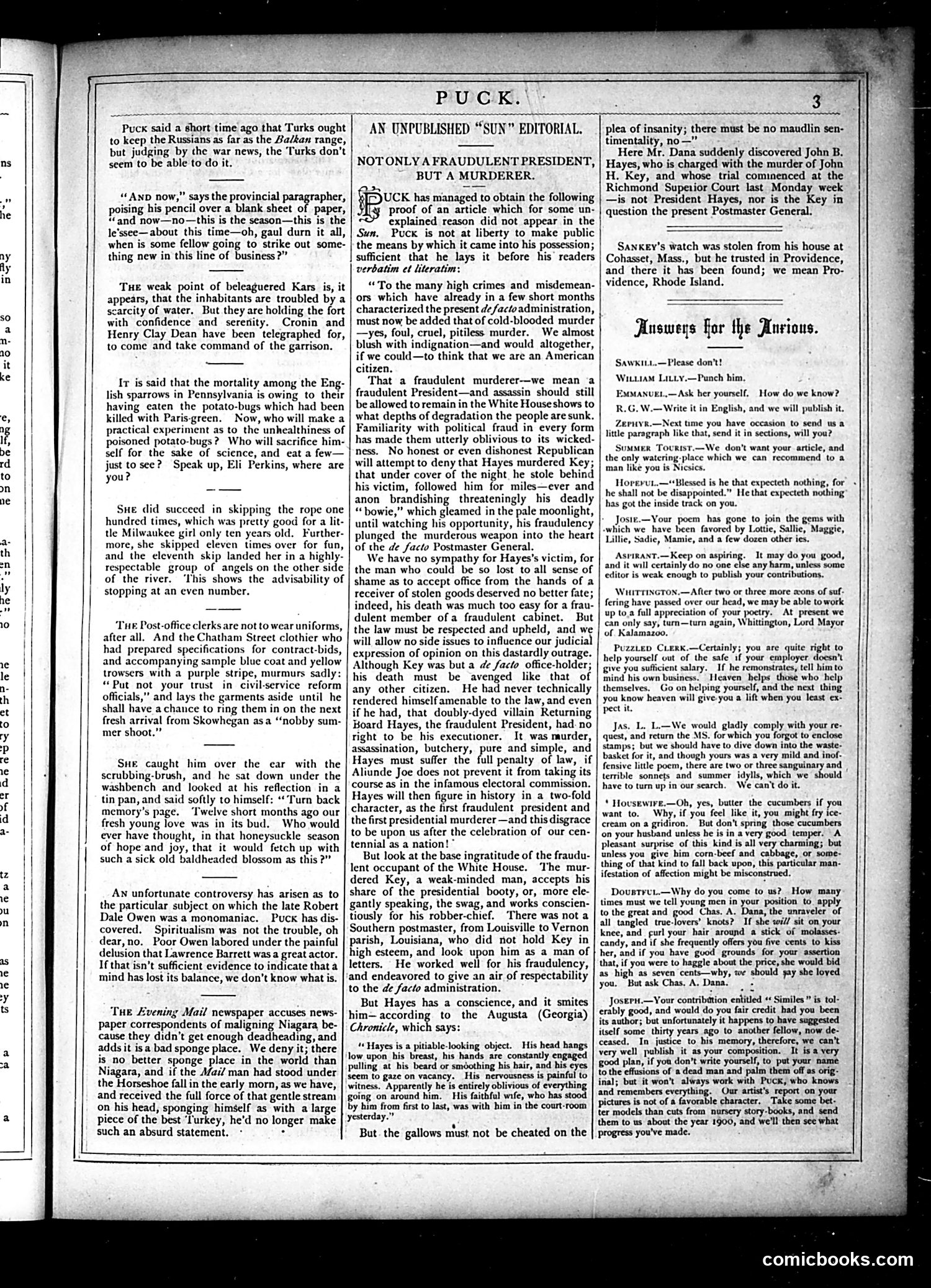
This page contains an unpublished editorial attacking President Rutherford B. Hayes as both "a fraudulent president" and "a murderer." The piece references Hayes's contested 1876 election victory and accuses him of complicity in the death of John H. Key during the Richmond Supremacy riots. The editorial argues Hayes fraudulently assumed the presidency and, through political malfeasance, bears responsibility for Key's murder. It condemns Hayes's failure to prevent violence and suggests his administration enabled or tolerated political violence. The "Answers for the Anxious" advice column below addresses unrelated reader queries about various personal matters. This represents harsh partisan political criticism typical of Puck's satirical approach to Republican leadership during Reconstruction-era politics.
📄 Transcribed text from this page (OCR, searchable)
Machine-transcribed from the original scan — historical spelling and the odd misread are preserved.
PUCK.’ to keep the Russians as far as the Balkan range, but judging by che war news, the Turks don't seem to be able to do it. “‘Anp now,” says the provincial paragrapher, poising his pencil over a blank sheet of paper, “and now—no—this is the season—this is the le'ssee— about this time—oh, gaul durn it all, when is some fellow going to strike out some- thing new in this line of business?” Tue weak point of beleaguered Kars is, it appears, that the inhabitants are troubled by a scarcity of water, But they are holding the fort with confidence and serenity. Cronin and Henry Clay Dean have been telegraphed for, to come and take command of the garrison. Ir is said that the mortality among the Eng- lish sparrows in Pennsylvania is owing to their having eaten the potato-bugs which had been killed with Paris-green. Now, who will make a practical experiment as to the unhealthiness of isoned potato-bugs? Who will sacrifice him- self for the sake of science, and eat a few— just to see? Speak up, Eli Perkins, where are you? Sue did succeed in skipping the rope one hundred times, which was pretty good for a lit- tle Milwaukee girl only ten years old. Further- more, she skipped eleven times over for fun, and the eleventh skip landed her in a highly- respectable group of angels on the other side of the river. ‘This shows the advisability of stopping at an even number. ‘Tue Post-office clerks are not to wear uniforms, after all, And the Chatham Street clothier who had prepared specifications for contract-bids, and accompanying sample bluc coat and yellow trowsers with a purple stripe, murmurs sadly: “Put not your trust in civil-service reform officials,” and lays the garments aside until he shall have a chance to ring them in on the next fresh arrival from Skowhegan asa “nobby sum- mer shoot.” Sue caught him over the car with the scrubbing-brush, and he sat down under the washbench and looked at his reflection in a tin pan, and said softly to himself: “Turn back memory’s page. ‘I'welve short months ago our fresh young love was in its bud. Who would ever have thought, in that honeysuckle season of hope and joy, that it would fetch up with such a sick old baldheaded blossom as this ?” AN unfortunate controversy has arisen as to the particular subject on which the late Robert Dale Owen was a monomaniac. Puck has dis- covered. Spiritualism was not the trouble, oh dear, no. Poor Owen labored under the painful delusion that Lawrence Barrett was a great actor. If that isn’t sufficient evidence to indicate that a mind has lost its balance, we don’t know what is. Tue Evening Mail newspaper accuses news- Paper correspondents of maligning Niagara be- cause they didn’t get enough deadheading, and adds it is a bad sponge place. We deny it; there is no better sponge place in the world than Niagara, and if the Afai/ man had stood under the Horseshoe fall in the early morn, as we have, and received the full force of that gentle stream on his head, sponging himéelf as with a large piece of the best ‘Iurkey, he'd no longer make such an absurd statement. ° Puck said a short time ago that Turks ought AN UNPUBLISHED “SUN” EDITORIAL. NOT ONLY A FRAUDULENT PRESIDENT, BUT A MURDERER. fs EUR i UCK has managed to obtain the following proof of an article which for some un- explained reason did not appear in the Sun, Puck is not at liberty to make public the means by which it came into his possession; sufficient that he lays it before his’ readers verbatim et literatim: “To the many high crimes and misdemean- ors which have already in a few short months characterized the present defacfoadministration, must now be added that of cold-blooded murder —yes, foul, cruel, pitiless murder. We almost blush with indignation—and would altogether, if we could—to think that we are an American citizen, That a fraudulent murderer—we mean ‘a fraudulent President—and assassin should still be allowed to remain in the White House shows to what depths of degradation the people are sunk. Familiarity with political fraud in every form has made them utterly oblivious to its wicked- ness. No honest or even dishonest Republican will attempt to deny that Hayes murdered Key; that under cover of the night he stole behind his victim, followed him for miles—ever and anon brandishing threateningly his deadly “bowie,” which gleamed in the pale moonlight, until watching his opportunity, his fraudulency plunged the murderous weapon into the heart of the de facto Postmaster General. We have no sympathy for Hayes’s victim, for the man who could be so lost to all sense of shame as to accept office from the hands of a receiver of stolen goods deserved no better fate; indeed, his death was much too easy for a frau- dulent member of a fraudulent cabinet. But the law must be respected and upheld, and we will allow no side issues to influence our judicial expression of opinion on this dastardly outrage. Although Key was but a de facto office-holder; his death must be avenged like that of any other citizen. He had never technically rendered himselfamenable to the law, and even if he had, that doubly-dyed villain Returning Board Hayes, the fraudulent President, had- no right to be his executioner. It was murder, assassination, butchery, pare, and simple, and Hayes must suffer the full penalty of law, if Aliunde Joe does not prevent it from taking its course as in the infamous electoral commission. Hayes will then figure in history in a two-fold character, as the first fraudulent president and the first presidential murderer —and this disgrace to be upon us after the celebration of our cen- tennial as a nation!” But look at the base ingratitude of the fraudu- lent occupant of the White House. The mur- dered Key, a weak-minded man, accepts his share of the presidential booty, or, more ele- gantly speaking, the swag, and works conscien- tiously for his robber-chief. ‘There was not a Southern postmaster, from Louisville to Vernon parish, Louisiana, who did not hold Key in high esteem, and look upon him as a man of letters. He worked well for his fraudulency, and endeavored to give an air of respectability to the de facto administration. But Hayes has a conscience, and it smites him- according to the Augusta (Georgia) Chronicle, which says: “« Hayes is a pitiable-looking object. His head hangs low upon his breast, his hands are constantly engaged pulling at his beard or smoothing his hair, and his eyes seem to gaze on vacancy. His nervousness is painful to witness. Apparently he is entirely oblivious of everything going on around him. His faithful wife, who has stood by him from first to last, was with him in the court-room yesterday.” But. the gallows must not be cheated on the plea of insanity; there must be no maudlin sen- timentality, no—” Here Mr. Dana suddenly discovered John B. Hayes, who is charged with the murder of John H. Key, and whose trial cominenced at the Richmond Superior Court last Monday week —is not President Hayes, nor is the Key in question the present Postmaster General. Sankey's watch was stolen from his house at Cohasset, Mass., but he trusted in Providence, and there it has been found; we mean Pro- vidence, Rhode Island. Aunsweys for the Anrious. SawkiLt.—Please don’t! WittiaM Litty.—Punch him, EmManvet,—Ask her yourself, How do we know? R.G, W.—Write it in English, and we will publish it, Zeruve.—Next time you have occasion to send us a little paragraph like that, send it in sections, will you? Sumer Tovrist.—We don’t want your article, and the only watering-place which we can recommend to a man like you is Nicsics. Horerut..—Blessed is he that expecteth nothing, for he shall not be disappointed.” He that expecteth nothing has got the inside track on you. Joste.—Your poem has gone to join the gems with «which we have been favored by Lottie, Sallie, Maggie, Lillie, Sadie, Mamie, and a few dozen other ies. Asrirant.—Keep on aspiring. It may do you good, and it will certainly do no one else any harm, unless some editor is weak enough to publish your contributions. Wurrrincton.—After two or three more sons of suf- fering have passed over our head, we may be able to work up to.a full appreciation of your poetry. At present we can only say, tum—turn again, Whittington, Lord Mayor of Kalamazoo. Puzziep CieRK.—Certainly; you are quite right to help yourself out of the safe’ if Jour employer, dotsat give you sufficient salary. If he remonstrates, tell him to mind his own business. Heaven helps those who help themselves. Go on helping yourself, and the next thing you know heaven will give you a lift when you least ex- pect it. Jas. L. L.—We would gladly comply with your re- quest, and return the MS. for which you forgot to enclose stamps; but we should have to dive down into the waste- basket for it, and though yours was a very mild and inof- fensive little poem, there are two or three sanguinary and terrible sonnets and summer idylls, which we should have to turn up in our search. We can’t do it. * Hovsewire.—Oh, yes, butter the cucumbers if you want to. Why, if you feel like it, you might fry ice- cream on a gridiron. But don't spring those cucumbers on your husband unless he is in a very good temper. A pleasant surprise of this kind is all very charming; but unless you give him corn-beef and cabbage, or some- thing of that kind to fall back upon, this particular man- ifestation of affection might be misconstrued. Doustyet.—Why do you come to us? How many times must we tell young men in your position to. apply to the great and good Chas. A. Dana, the unraveler of all tangled true-lovers’ knots? If she wid/ sit on your knee, and furl your hair around a stick of molasses- candy, and if she frequently offers you five cents to kiss her, and if you have good grounds for your assertion that, if you were to haggle about the price, she would bid as high as seven cents—why, we should gay she loyed you, But ask Chas. A. Dana. - JoserH.—Your contribmtion entitled + Similes” is tol- erably good, and would do you fair credit had you been its author; but unfortunately it happens to have suggested itself some thirty years ago to another fellow, now de- ceased, In justice to his memory, therefore, we can’t very well publish it as your composition. It is a very good plan, if you don’t write yourself, to put your name to the effusions of a dead man and palm them off as orig- inal; but it won't always work with Puck, who knows and remembers everything. Our artist's Teport.on your pictures is not of a favorable character, Take some bet- ter models than cuts from nursery story-books, and send them to us about the year 1900, and we'll then see what progress you've made. comicbooks.com