
A complete issue · 20 pages · 1877
Puck — July 11, 1877
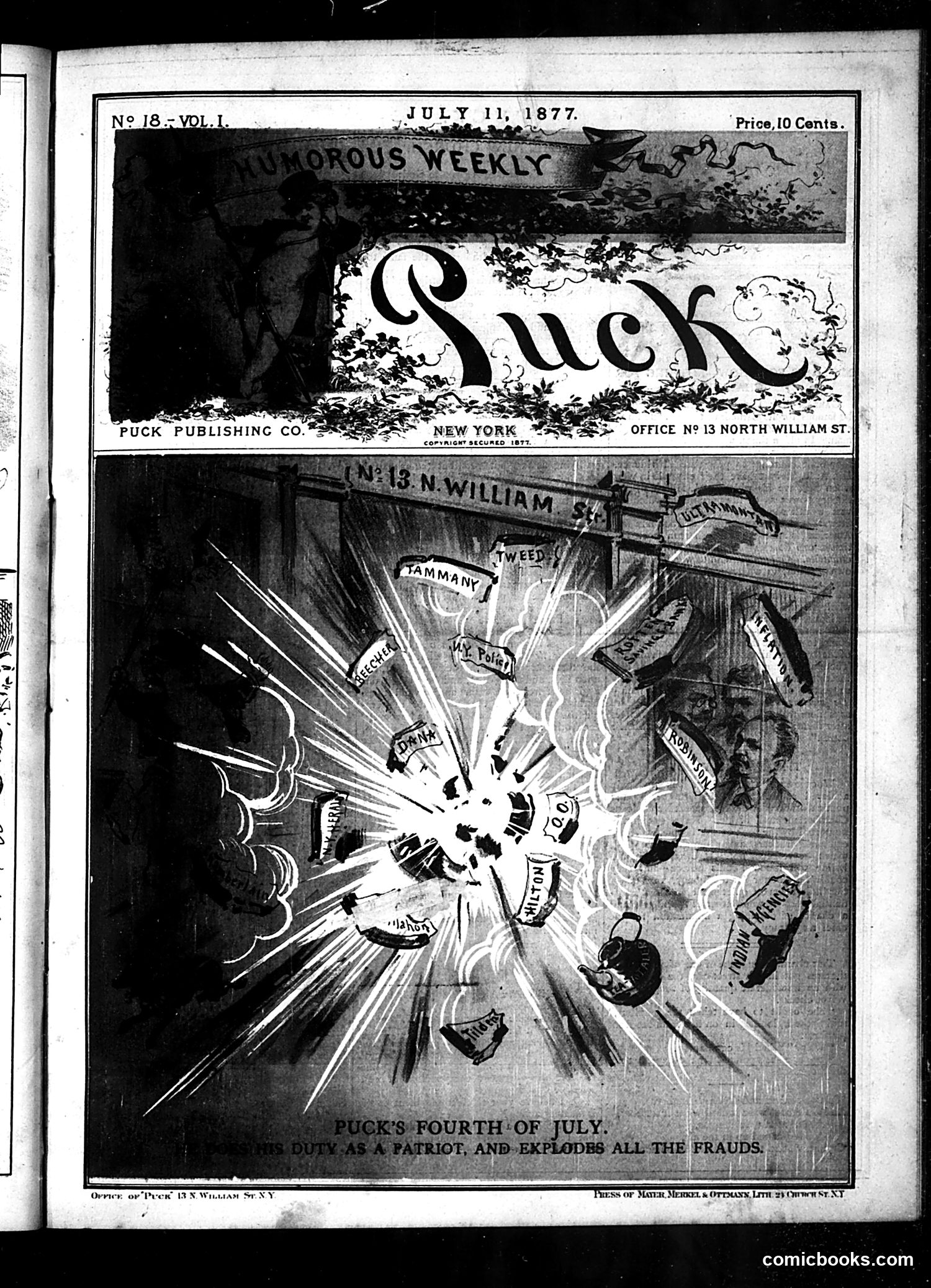
This satirical cartoon depicts an explosion of fraudulent schemes and corruption, presented as Puck's patriotic duty to expose American dishonesty on Independence Day. Various labeled bottles and containers scatter from a central blast—each appears to represent different types of fraud or corruption plaguing American society in the Reconstruction era. The caption states Puck's "FOURTH OF JULY DUTY AS A PATRIOT, AND EXPLODES ALL THE FRAUDS," positioning the magazine's satirical mission as patriotic truth-telling. While specific fraud labels are difficult to read in this image quality, the cartoon's central conceit uses Fourth of July imagery to critique systemic corruption in post-Civil War America.

I can see this is a page from Puck magazine, but the image is almost entirely black with only faint marks and sparse white dots visible. The OCR text provided appears to be empty or unreadable. Without legible visual content or accompanying text, I cannot identify specific figures, caricatures, political references, or satirical points on this page. The page may be severely degraded, improperly scanned, or blank. To provide accurate historical context about the cartoon(s) and their meaning, I would need either a clearer image or the actual OCR'd text content. I cannot responsibly speculate about the page's content without seeing sufficient evidence.
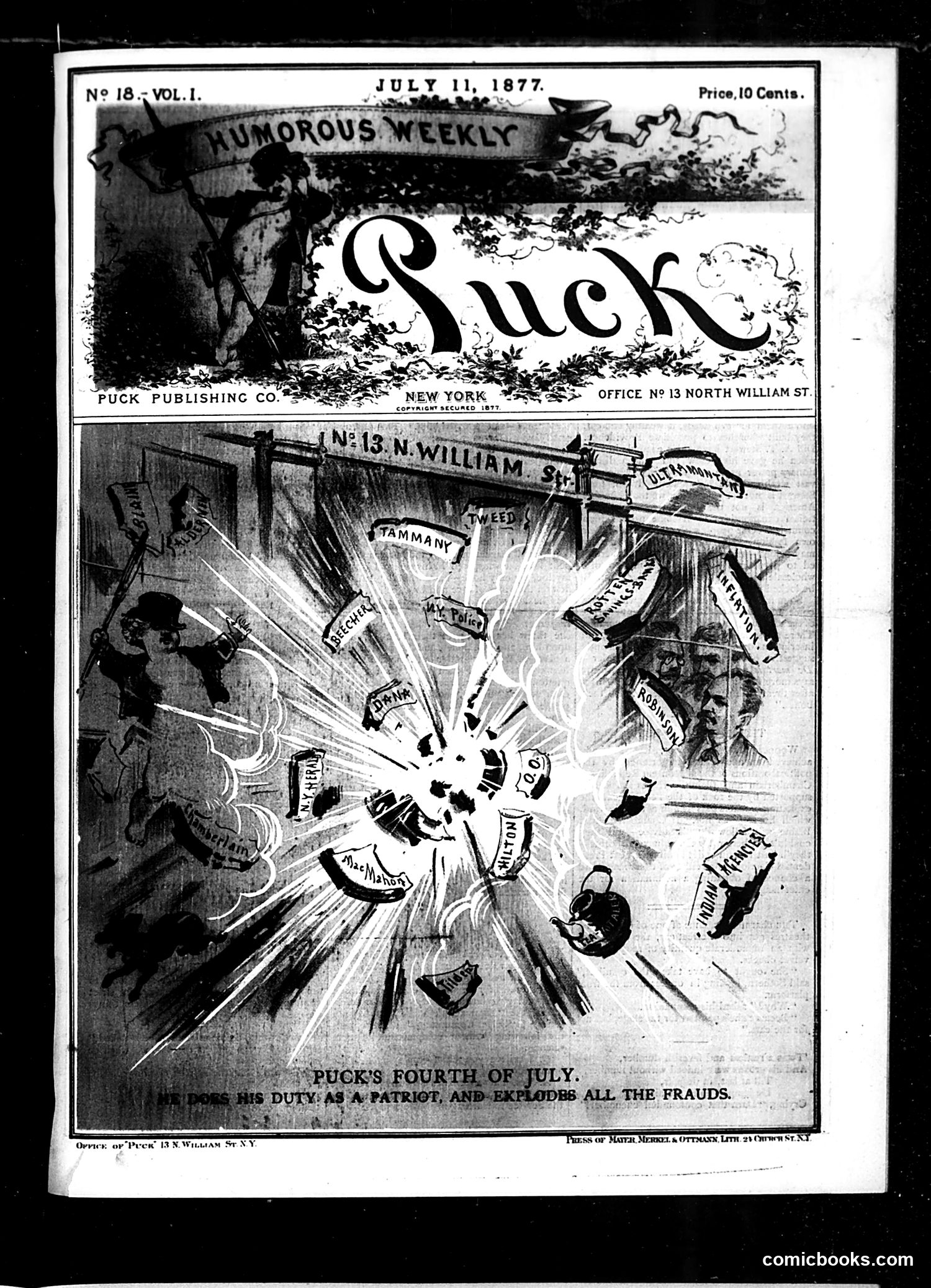
This cartoon satirizes corruption and fraud in American politics around the Fourth of July celebration. The central image shows an explosion emanating from the Puck office at 13 North William Street, with various labeled frauds and scandals bursting outward like shrapnel—banners reading "Tammany," "Tweed," "Ring," and other terms associated with political corruption are scattered throughout. The caption states Puck acts "as a patriot" to "explode all the frauds." The cartoon positions the magazine as a reformist force exposing systemic corruption, likely referencing the notorious Tammany Hall political machine and the recent Tweed Ring scandal that had dominated New York politics. This reflects Puck's satirical mission to critique institutional dishonesty.
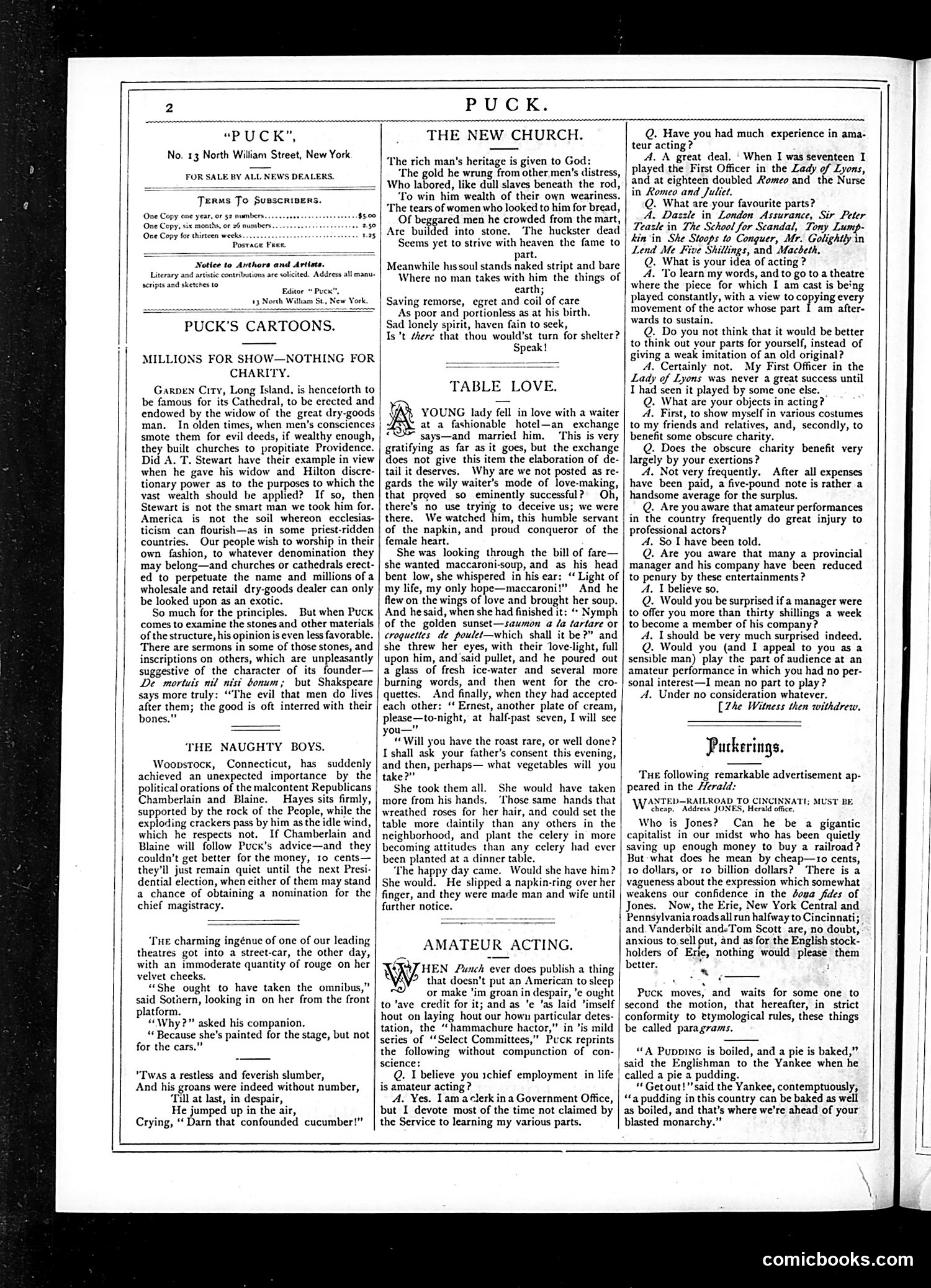
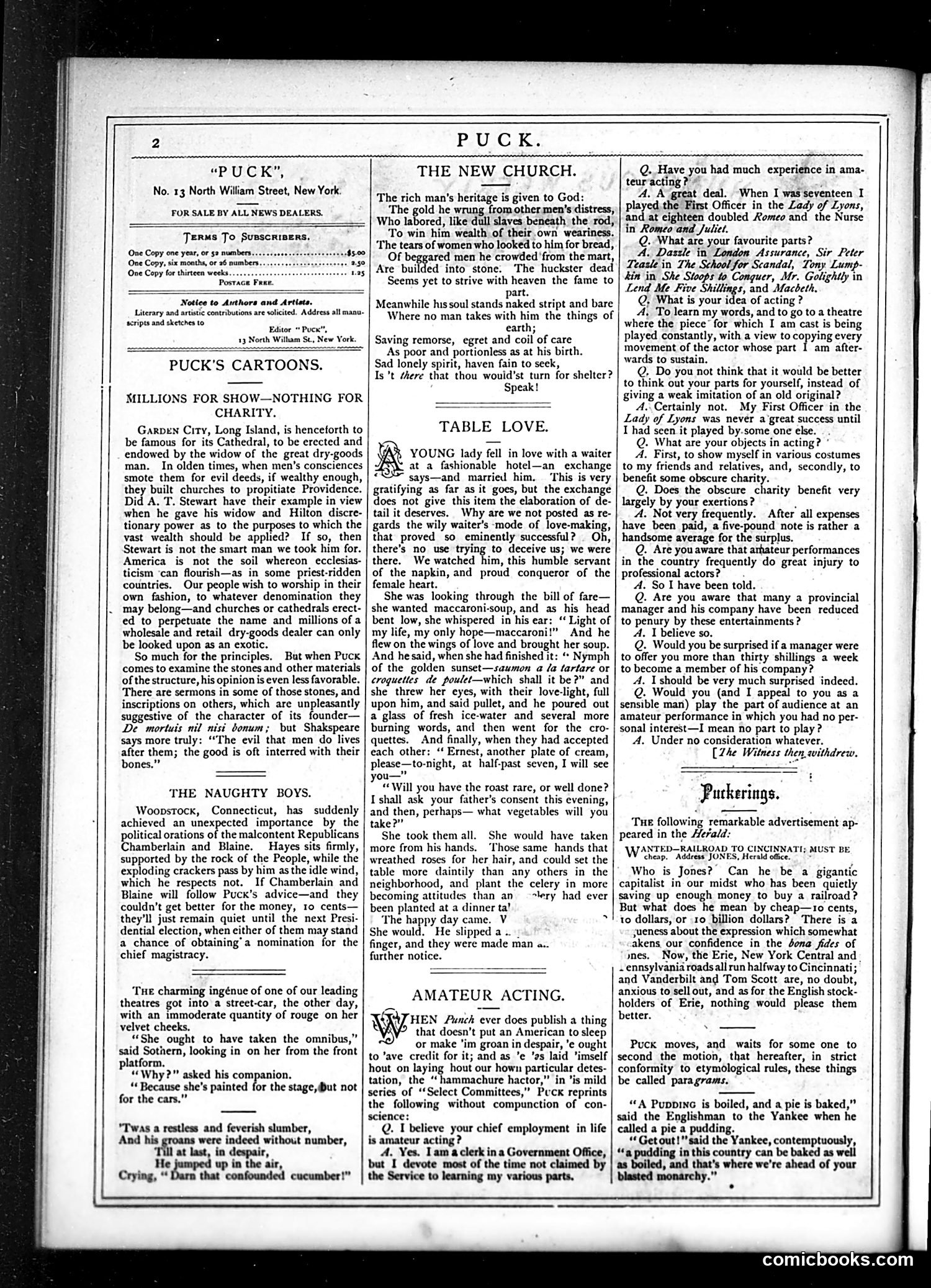
This page is primarily **text-based content** rather than political cartoons. It includes: 1. **"The New Church"** — a poem critiquing wealthy individuals who claim religious devotion while exploiting the poor ("The gold he wrung from other men's distress"). 2. **"Table Love"** — a humorous short story about a young woman who married a waiter, now observing his flirtations with other female customers. 3. **"The Naughty Boys"** — a brief political note about Connecticut Republicans supporting Blaine's presidential campaign despite his controversial record. 4. **"Amateur Acting"** — a Q&A column about theatrical performance and staging. The page demonstrates Puck's characteristic approach: mixing social satire (wealth and hypocrisy), domestic humor, and light political commentary. The "Naughty Boys" section appears the most overtly political, mocking Republican support for Blaine despite acknowledged scandals.
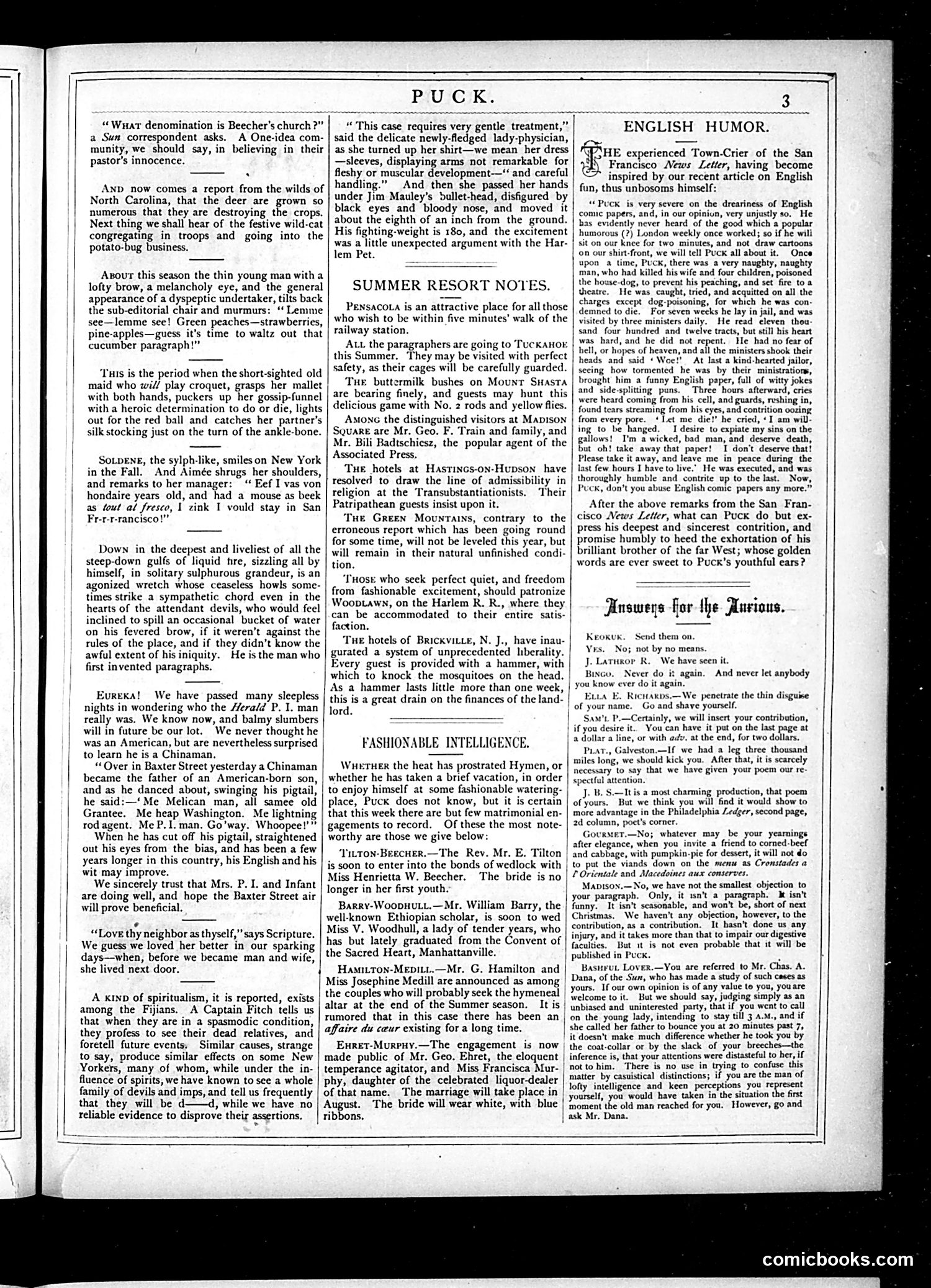
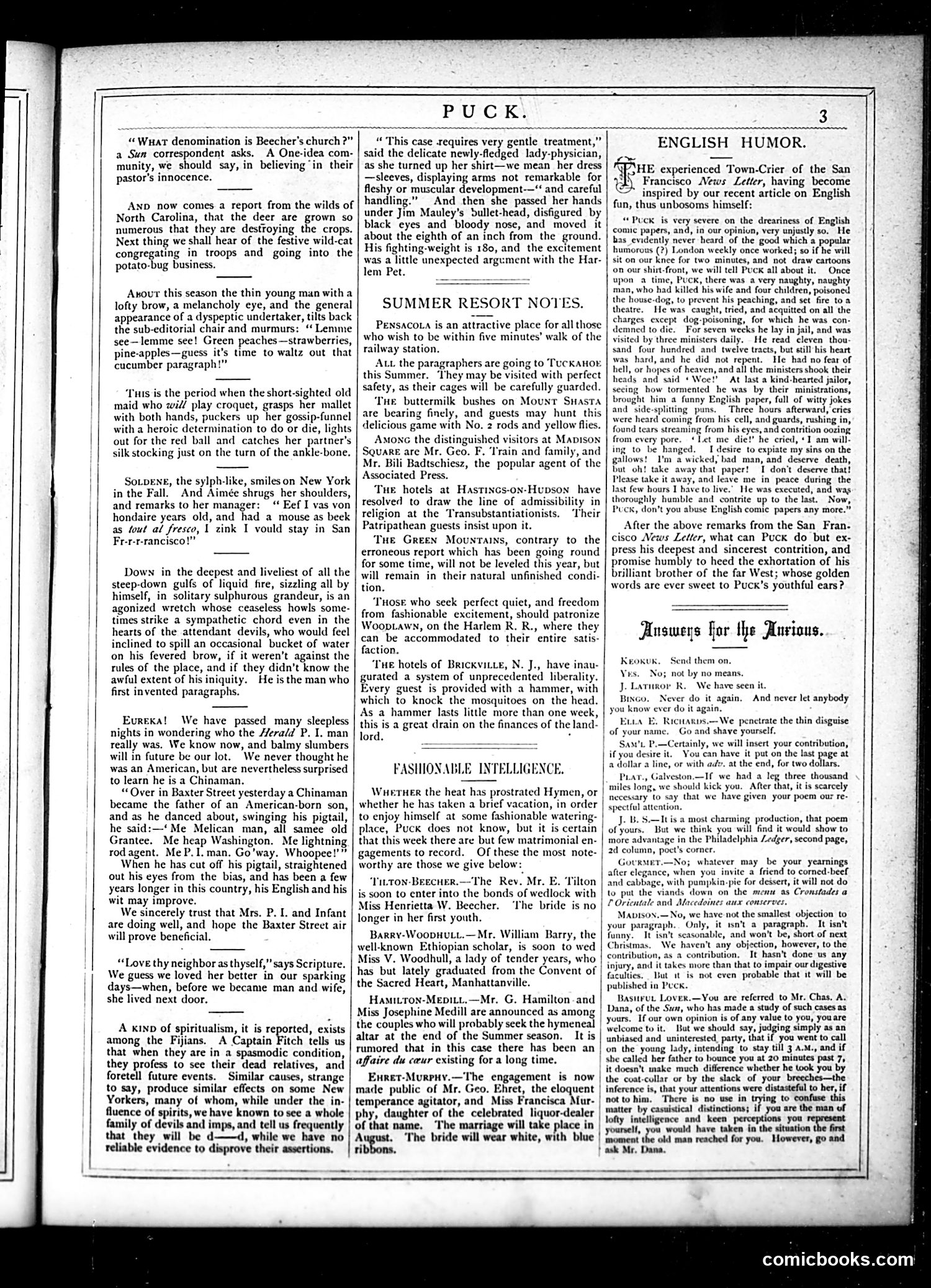
This page from *Puck* contains no visible political cartoons—it's primarily text content with three distinct sections: 1. **Humor pieces** mocking various subjects: deer hunting in North Carolina, a melancholy aristocrat, and New York's "Solodne" (likely a misspelling or coded reference). 2. **"Summer Resort Notes"** satirizing vacation destinations like Tuckahoe and their pretentious clientele, with jabs at mosquitoes and the wealthy's leisure habits. 3. **"Answers for the Curious"** and **"Fashionable Intelligence"** sections featuring society gossip and engagement announcements. The page exemplifies *Puck's* satirical approach to American social life, targeting upper-class pretensions and seasonal fashions rather than specific political figures. It's primarily written satire rather than visual cartooning.
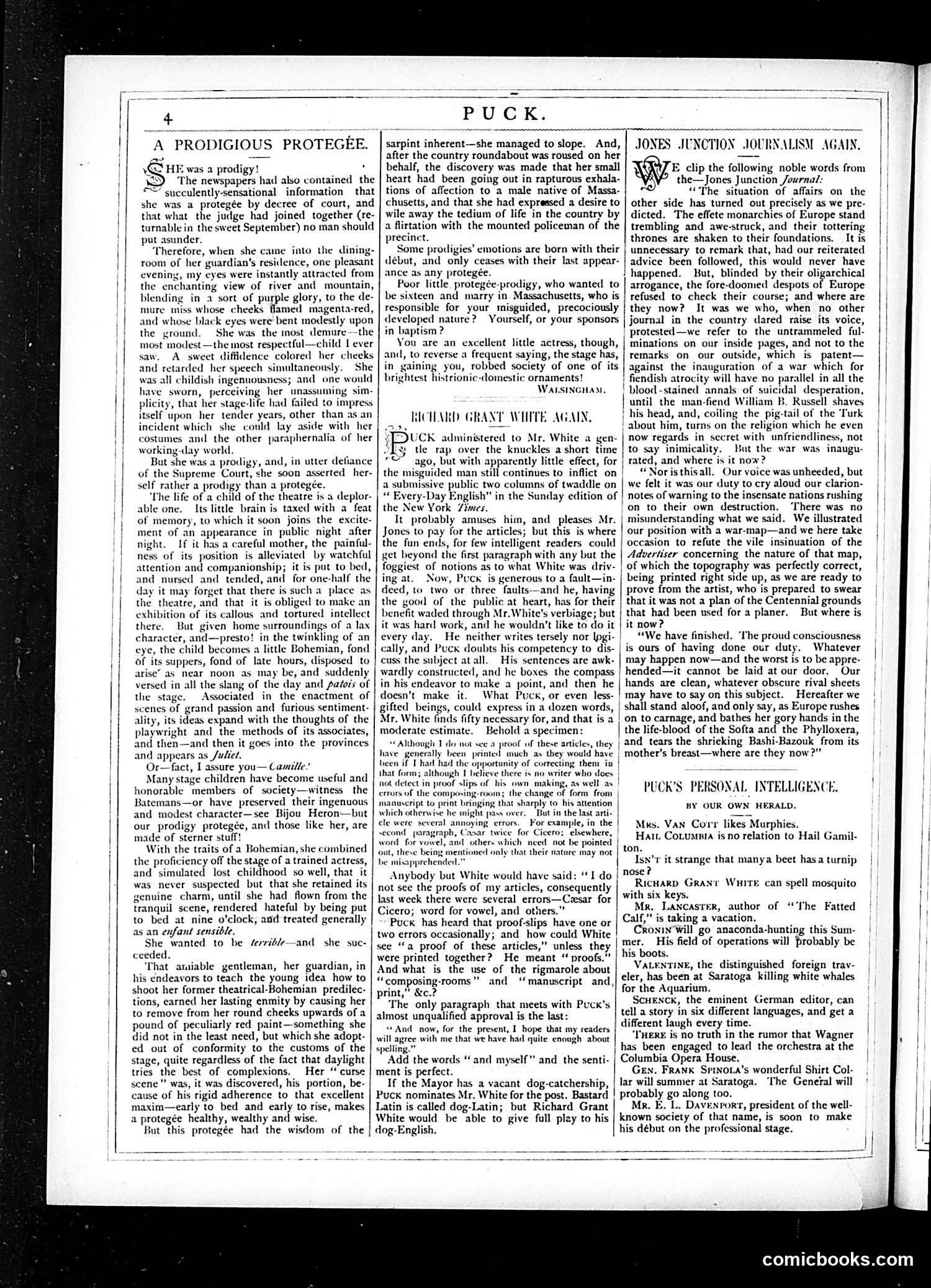
This page contains three distinct articles rather than political cartoons: 1. **"A Prodigious Protégée"** — A sentimental story about a gifted child actress (appears to be a Bohemian girl) raised by a guardian in Massachusetts who wants to return to Europe rather than pursue stage fame in America. 2. **"Richard Grant White Again"** — A critical commentary on theater critic Richard Grant White's writing in the New York Times, attacking his competence and arguing his articles contain numerous errors and poor reasoning. 3. **"Puck's Personal Intelligence"** — Brief gossip items about various theatrical and cultural figures, including actors and musicians. The page emphasizes Puck's role as cultural critic and satirist, targeting theatrical pretensions and incompetent critics of the era, rather than primarily featuring visual political satire.
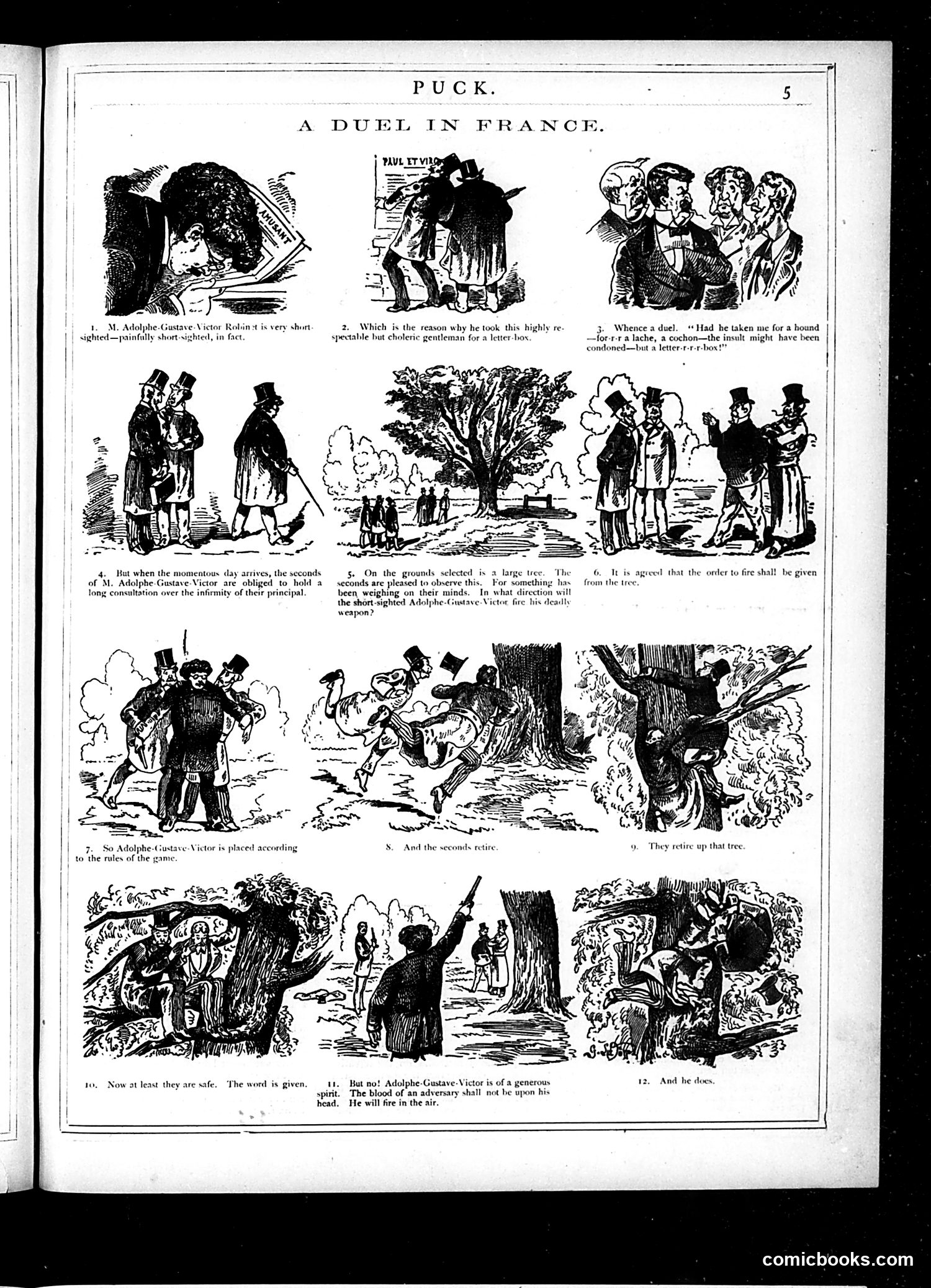
This is a 12-panel satirical narrative about a duel involving French political figures. The main character is identified as "M. Adolphe Gustavc Victor," described as "painfully short-sighted." The cartoon mocks a dispute over whether Victor should use a "bound" (lace) or "cock" (rooster) as his weapon—apparently a humorous disagreement over dueling terms. Panels show the seconds negotiating, selecting a tree as the dueling ground, and placing Victor according to "the rules of the game." The satire appears to ridicule both French honor culture and Victor's practical disadvantage due to his poor eyesight. The final panels show the actual duel, with Victor's nearsightedness making him ineffectual, ultimately sparing his opponent from harm. The joke targets both aristocratic pretension and physical comedy.
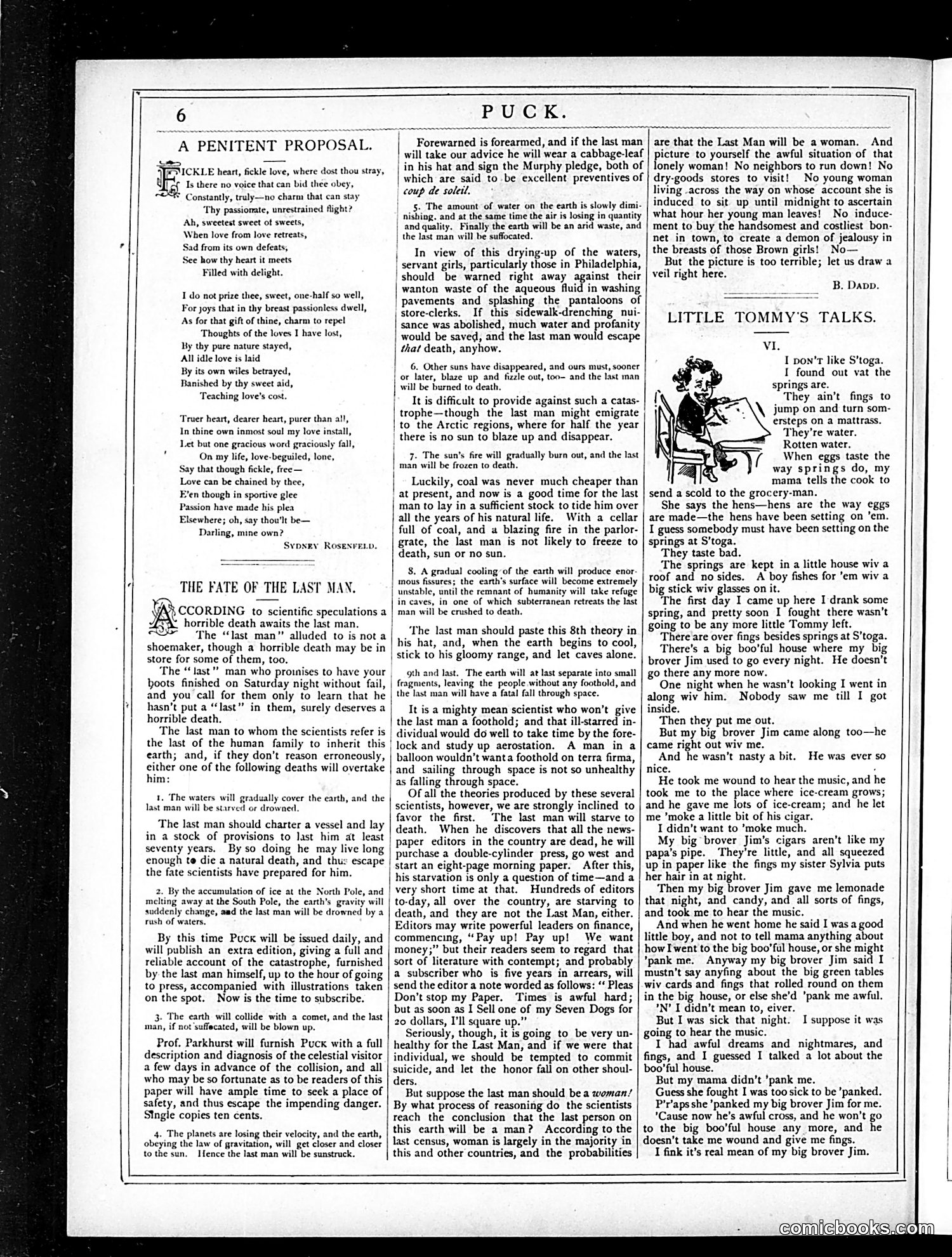
This page contains three separate pieces: a poem titled "A Penitent Proposal" (bylined Sidney Rosenfeld), an article called "The Fate of the Last Man" describing a scientific scenario, and a children's humor column "Little Tommy's Talks, VI." The "Last Man" article satirizes pseudoscientific theories popular in the era, imagining catastrophic scenarios—earth cooling, sun dying, water disappearing—that would leave humanity's final survivor. The satire targets scientists who produce overwrought doomsday predictions without practical solutions. "Little Tommy's Talks" is humorous domestic fiction about a young boy's observations of everyday life, family dynamics, and his older brother's romantic interests—typical period children's humor emphasizing innocent commentary on adult behavior. The page reflects Puck's mix of sophisticated literary satire and family-friendly content.
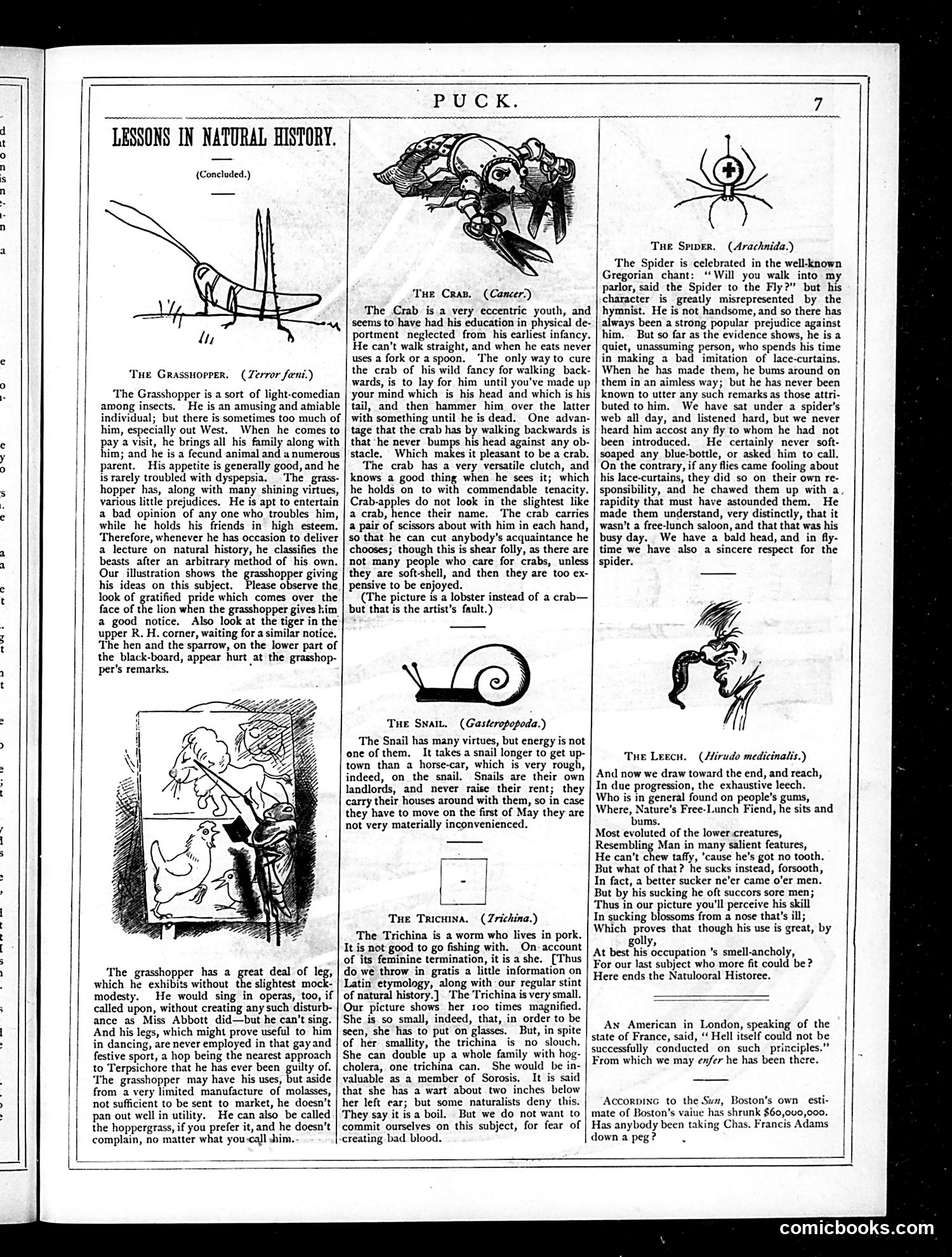
This page from *Puck* magazine presents "Lessons in Natural History" (Concluded)—a humorous educational feature, not political satire. The text provides comedic descriptions of various creatures: the Grasshopper, Crab, Snail, Leech, Spider, and Trichinella worm. The humor derives from anthropomorphizing animals with human flaws and social commentary. The Grasshopper is a "light-comedian" troublemaker; the Crab walks backward and is "eccentric"; the Snail lacks energy; the Leech is parasitic and bloodsucking; the Spider is celebrated despite being "misrepresented by the hymnist." The accompanying satirical illustrations exaggerate these animal characteristics to mock human behavior—laziness, selfishness, social pretension, and parasitism. This format was typical of *Puck*'s approach: using nature observation as a vehicle for social criticism without targeting specific political figures.
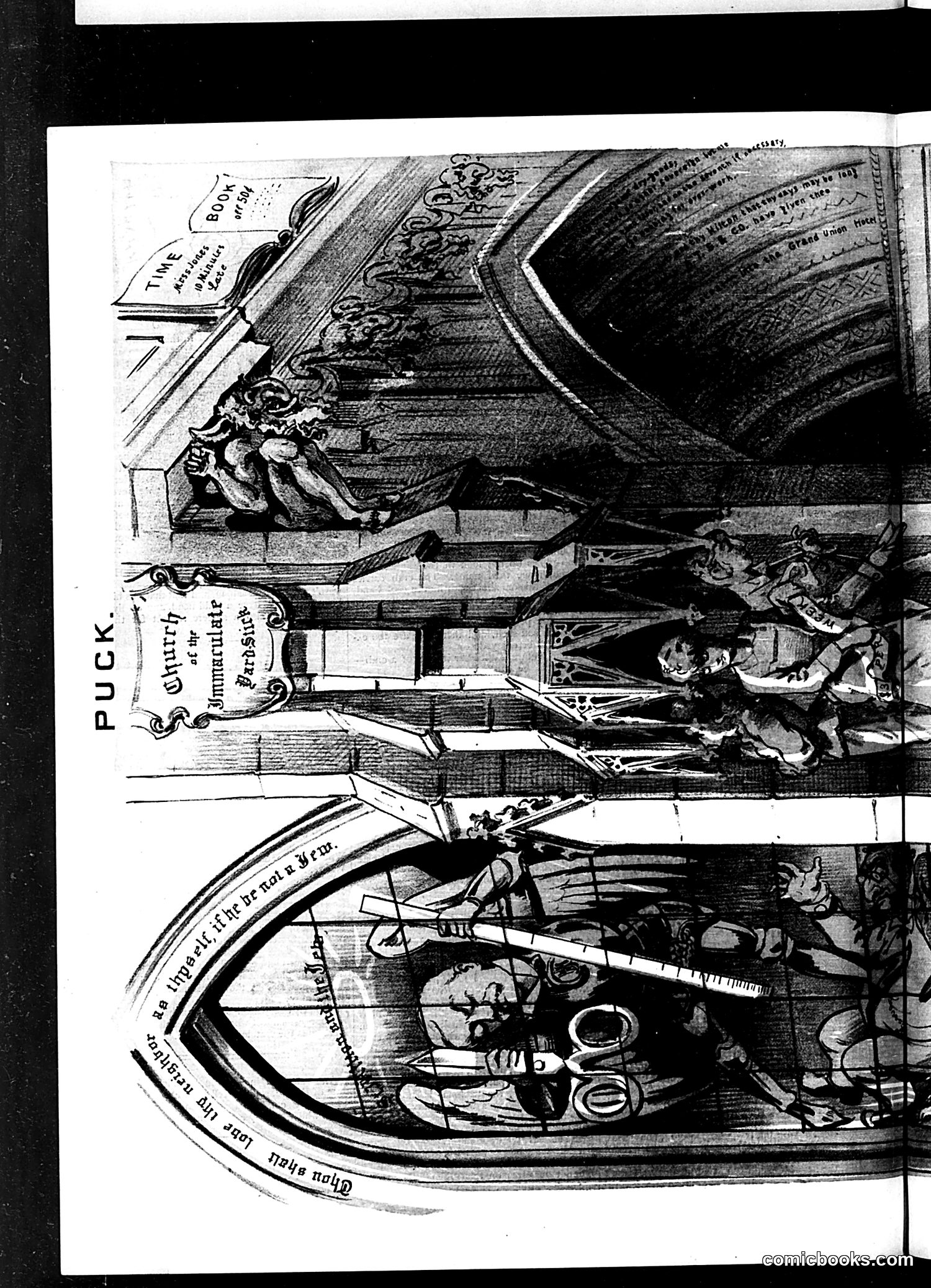
This page displays **Puck** branding and what appears to be a classical architectural or religious interior scene. The upper portion shows ornate ceiling details and decorative elements typical of grand buildings. The central image depicts figures in what seems to be a formal or ceremonial setting with classical architectural framing. However, the image quality and orientation make specific satirical content difficult to discern with certainty. The OCR text provided is incomplete or illegible, preventing clear identification of the cartoon's subject, the figures depicted, or the specific political/social commentary intended. To accurately explain this cartoon's meaning to a modern reader, I would need clearer text or a better-quality image showing the caption, captions, or additional context that Puck typically provided with its satirical illustrations.
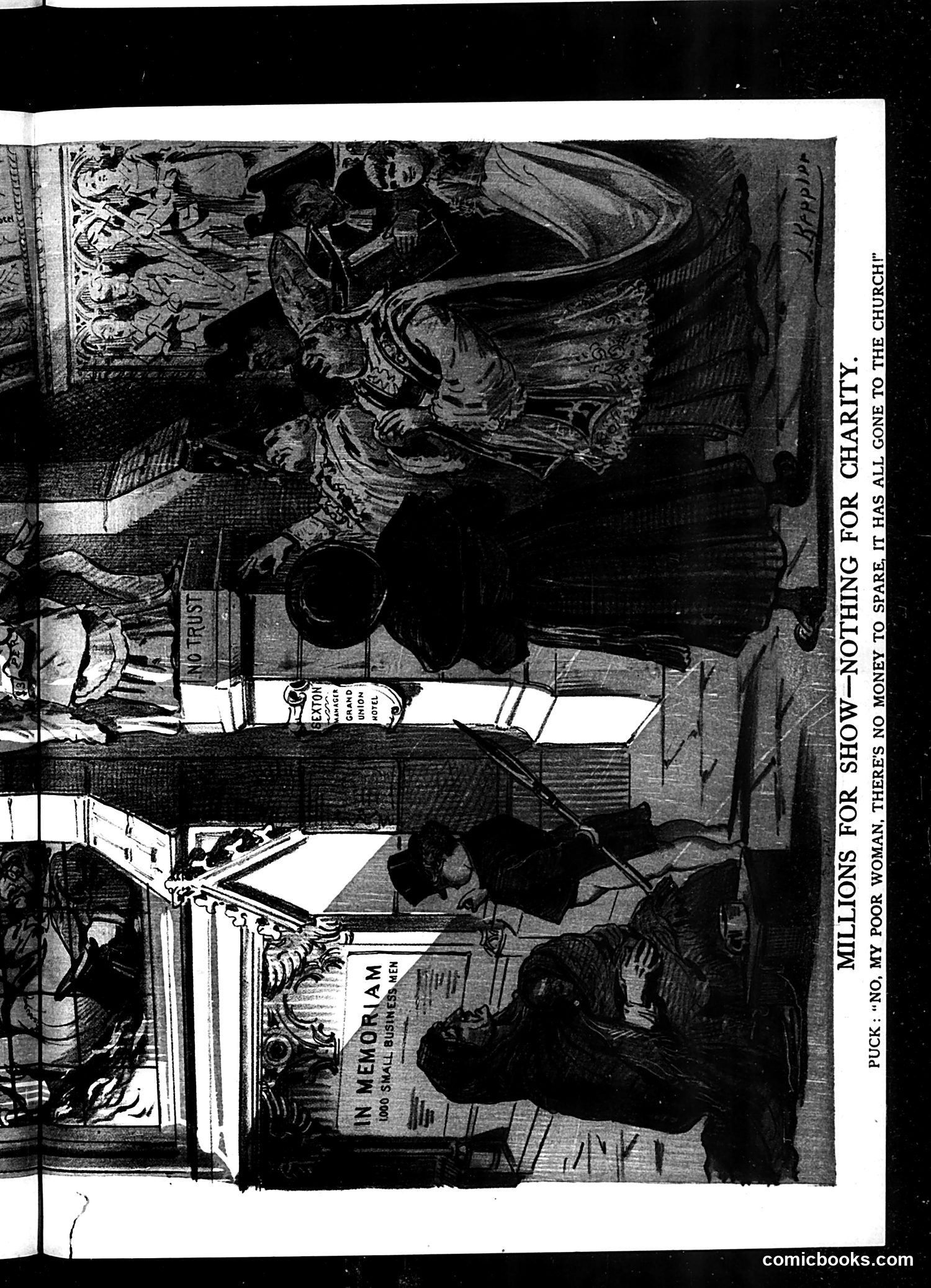
This page contains two illustrations. The bottom shows "In Memoriam" text with what appears to be a memorial or commemorative scene. The top illustration depicts a religious or allegorical scene with robed figures in dramatic poses. The caption reads: "MILLIONS FOR SHOW—NOTHING FOR CHARITY. PUCK.—NO. BY POOR WOMEN. THERE IS NO MONEY TO SPARE. IT HAS ALL GONE TO THE CHURCH." The satire criticizes wealthy individuals or institutions (likely the Church) for spending lavishly on displays and ceremonies ("millions for show") while neglecting charitable aid to poor women. This appears to be a Gilded Age critique of hypocrisy: condemning the gap between public religious display and actual charitable action toward the poor. The cartoon suggests church resources go toward ornate presentation rather than material assistance to those in need.
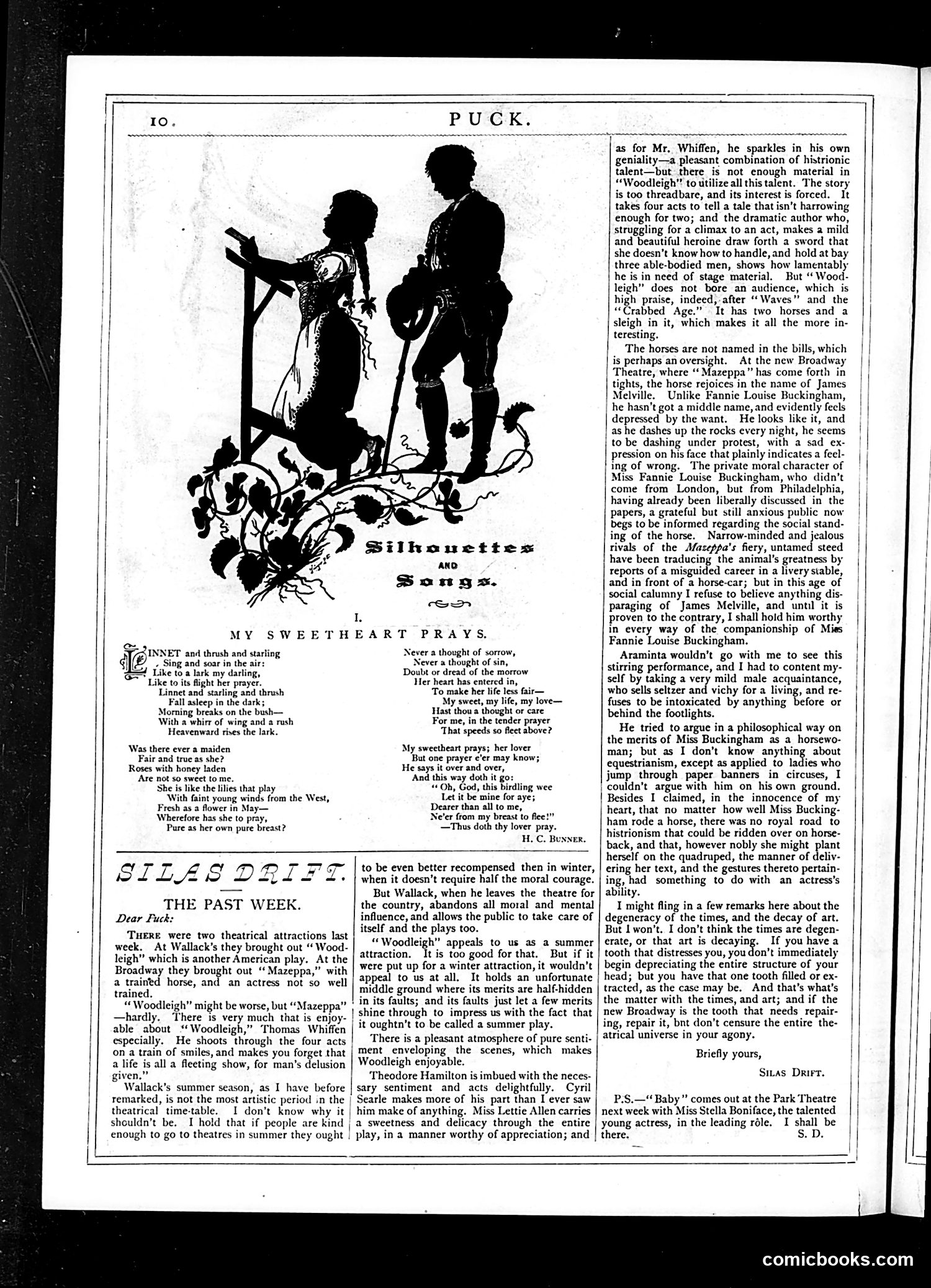
This page features a silhouette illustration titled "My Sweetheart Prays" alongside theatrical criticism. The silhouette depicts two figures in romantic pose—a woman and soldier or gentleman—in a sentimental scene. The accompanying poem is a love song expressing devotion and prayer. Below, drama critic Silas Drift reviews recent Broadway productions, specifically praising "Woolleigh" and "Maseppa" (likely "Mazeppa"). Drift criticizes summer theater generally but acknowledges these plays' merits, particularly Theodore Hamilton's acting and Miss Lettie Allen's performance. He dismisses concerns about theatrical quality during off-season, arguing that worthwhile entertainment justifies public attendance regardless of season. The page blends sentimental visual art with contemporary theatrical commentary.
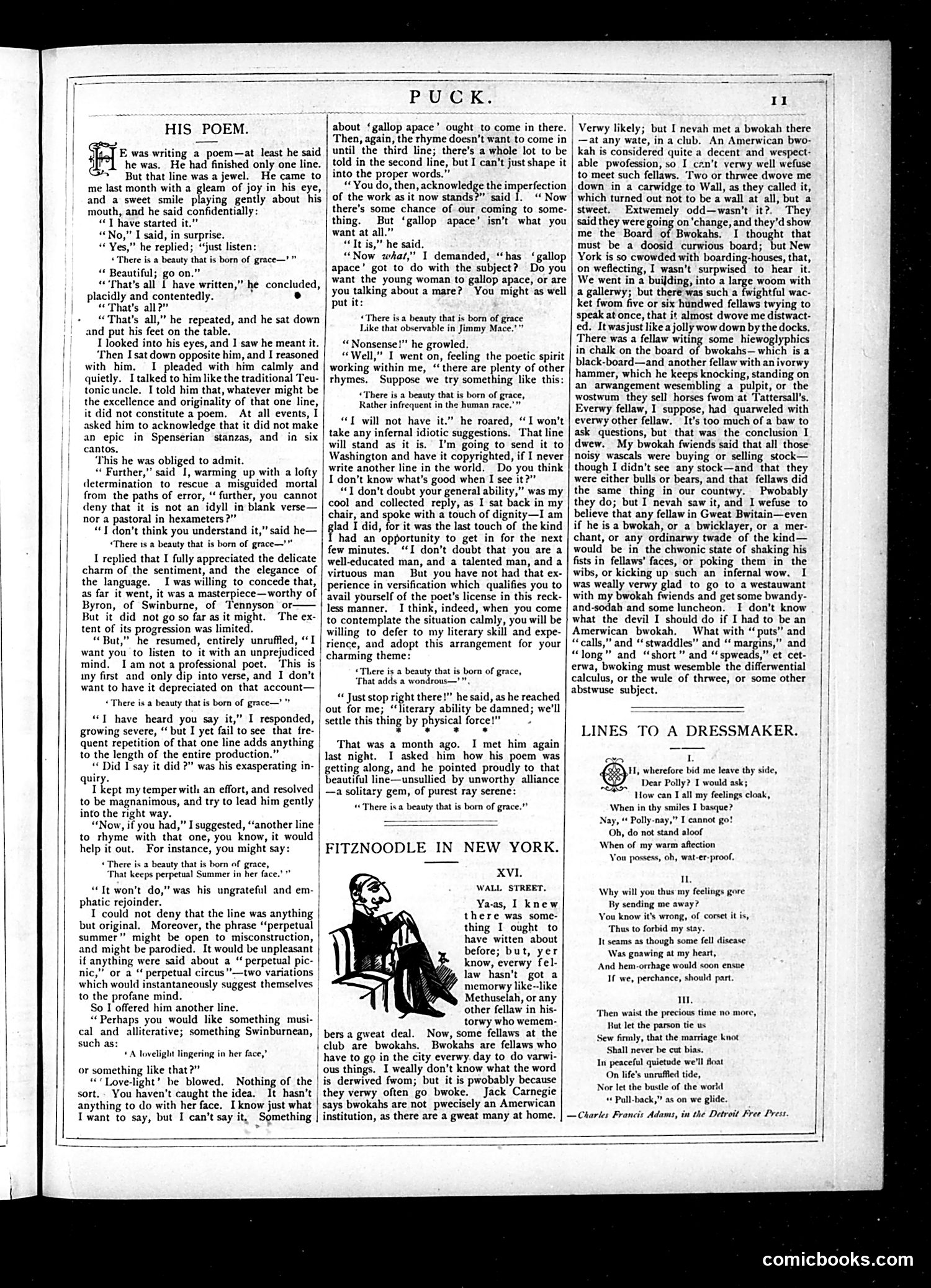
This page contains **three separate pieces**: a prose essay titled "His Poem" about a man writing poetry, a short poem called "Lines to a Dressmaker," and a section titled "Fitznoodle in New York: Wall Street" featuring a cartoon illustration. The **Fitznoodle cartoon** (bottom right) shows a man sitting at a desk in what appears to be a Wall Street office. The accompanying text discusses "Bowaks"—apparently slang for financial speculators or fraudsters who operate in New York's financial district. The satire mocks these shady operators as common fixtures of Wall Street culture. The other two literary pieces appear to be general humor pieces rather than political satire.
This page from *Puck* magazine contains the beginning of a serialized English short story titled "Two Knaves and a Queen" (Chapter XV), credited to an author identified in the header as writing "for the office of PUCK, 13 North William st." The page is **not a political cartoon or satire**—it's a work of fiction. The story concerns M. de Gaillefontaine and matters of estate management, inheritance, and romantic relationships among nobility. It appears to be a melodramatic narrative typical of serial fiction published in 19th-century American magazines. The text discusses characters like Tom Reynolds, Mattie Blake, and Rene, involving themes of class distinction, unrequited love, and social propriety. This is literary content rather than political commentary.
This page is primarily **text content** — dialogue and narrative from a serialized story titled "Puck" (visible at the top). The page contains no political cartoons or satirical illustrations. The narrative concerns romantic drama: a woman (Mattie) struggles with her feelings toward Tom Reynolds while her father pressures her toward a more advantageous match. Tom has left for London, and Mattie debates following him or accepting her father's wishes. There are two small **non-satirical boxes** at the bottom with literary quotations about Egypt and park paths — these appear to be decorative filler rather than commentary. **No political or social satire is evident on this page.** It represents Puck's serialized fiction content rather than its signature cartoon humor.
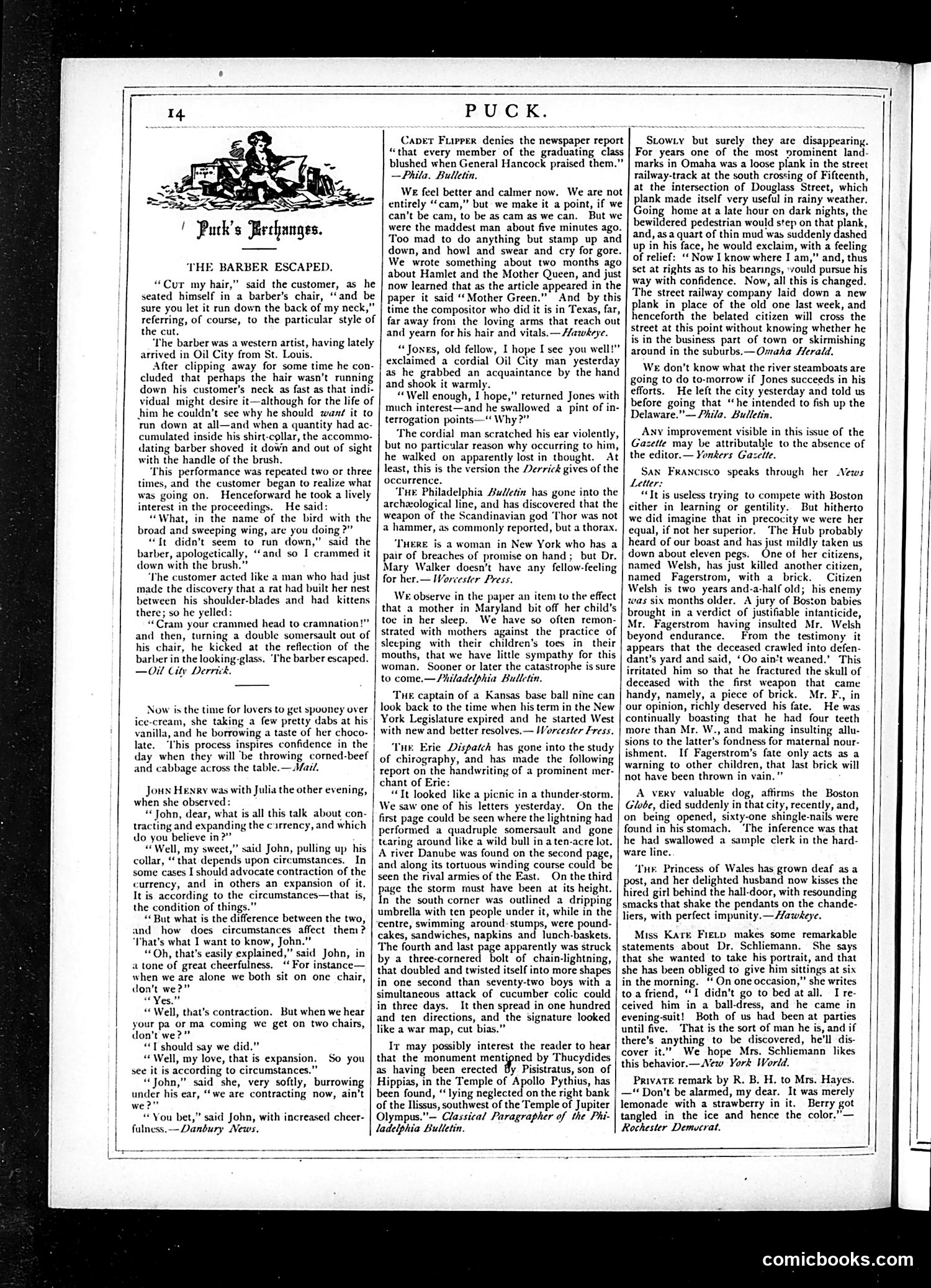
This page contains a humorous short story rather than a political cartoon. The narrative describes a barber in an Old City town who, after accidentally cutting a customer's neck, flees town in panic. The customer, initially injured, eventually realizes the wound is minor. The story satirizes overreaction and cowardice—the barber's extreme response to a small mistake. The piece appears designed for comedic effect through exaggeration of consequences and fear. Various editorial snippets and "letters" fill the rest of the page, addressing miscellaneous social topics like river steamboats, a woman in New York, and a valuable Boston dog. This reflects *Puck's* format of combining narrative humor with social commentary rather than relying solely on visual caricature.
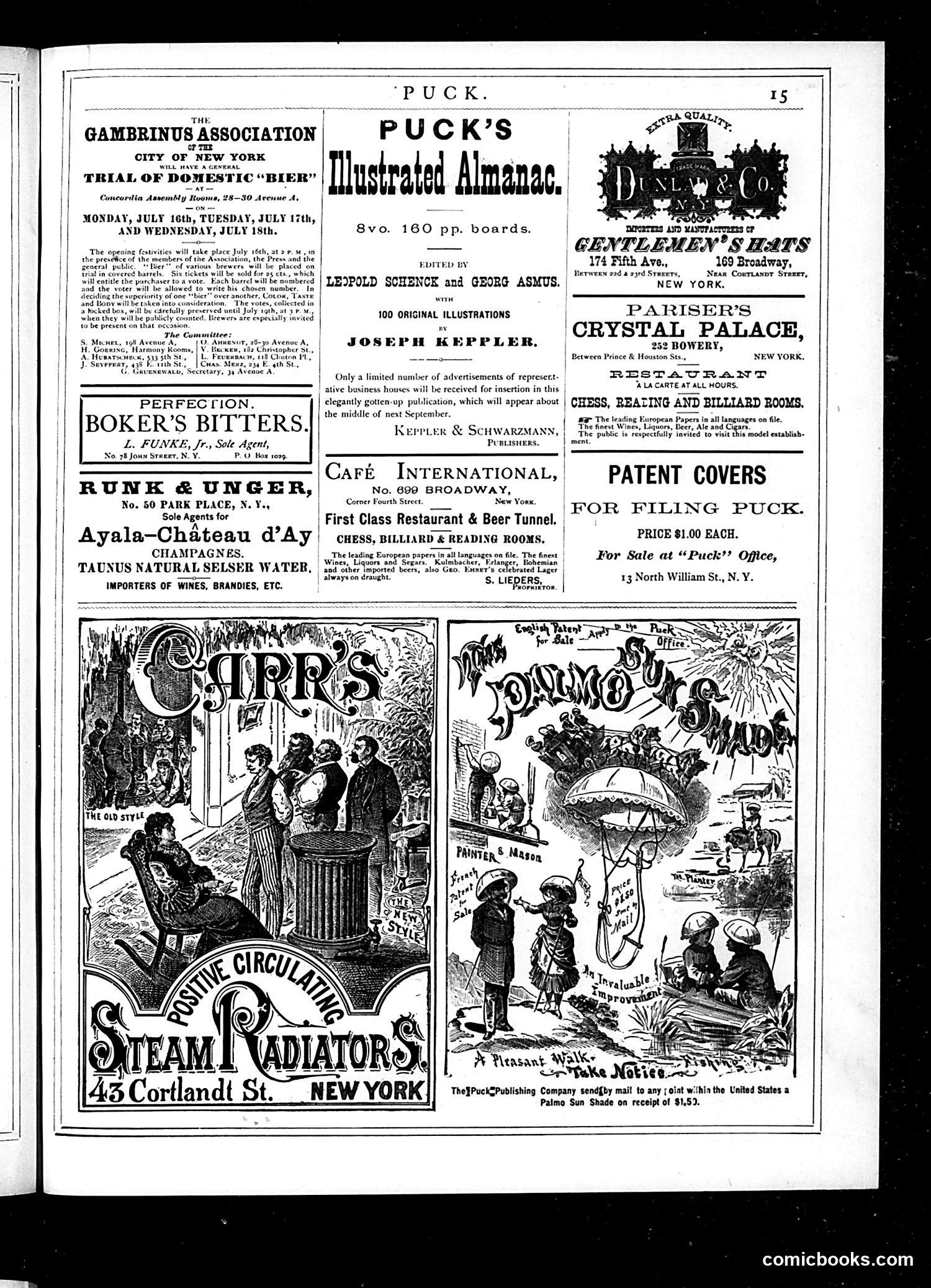
This is primarily an **advertising page** from Puck's July 1818 issue, dominated by commercial notices for New York businesses and products (Boker's Bitters, Steam Radiators, restaurants, etc.). The two illustrated cartoons at bottom appear to be **general-audience humorous illustrations** rather than political satire: - **Left cartoon**: Shows people at what's labeled "Portentine Circulating Steam Radiators," depicting domestic life with the product. - **Right cartoon**: Titled "Pumps Made" with various domestic and outdoor scenes, appearing to advertise or joke about pump-related products. Neither cartoon appears to reference specific political figures or events. Instead, they're typical period humor focused on consumer products and everyday life—the kind of gentle satire Puck used to make advertisements more entertaining rather than hard-hitting political commentary.
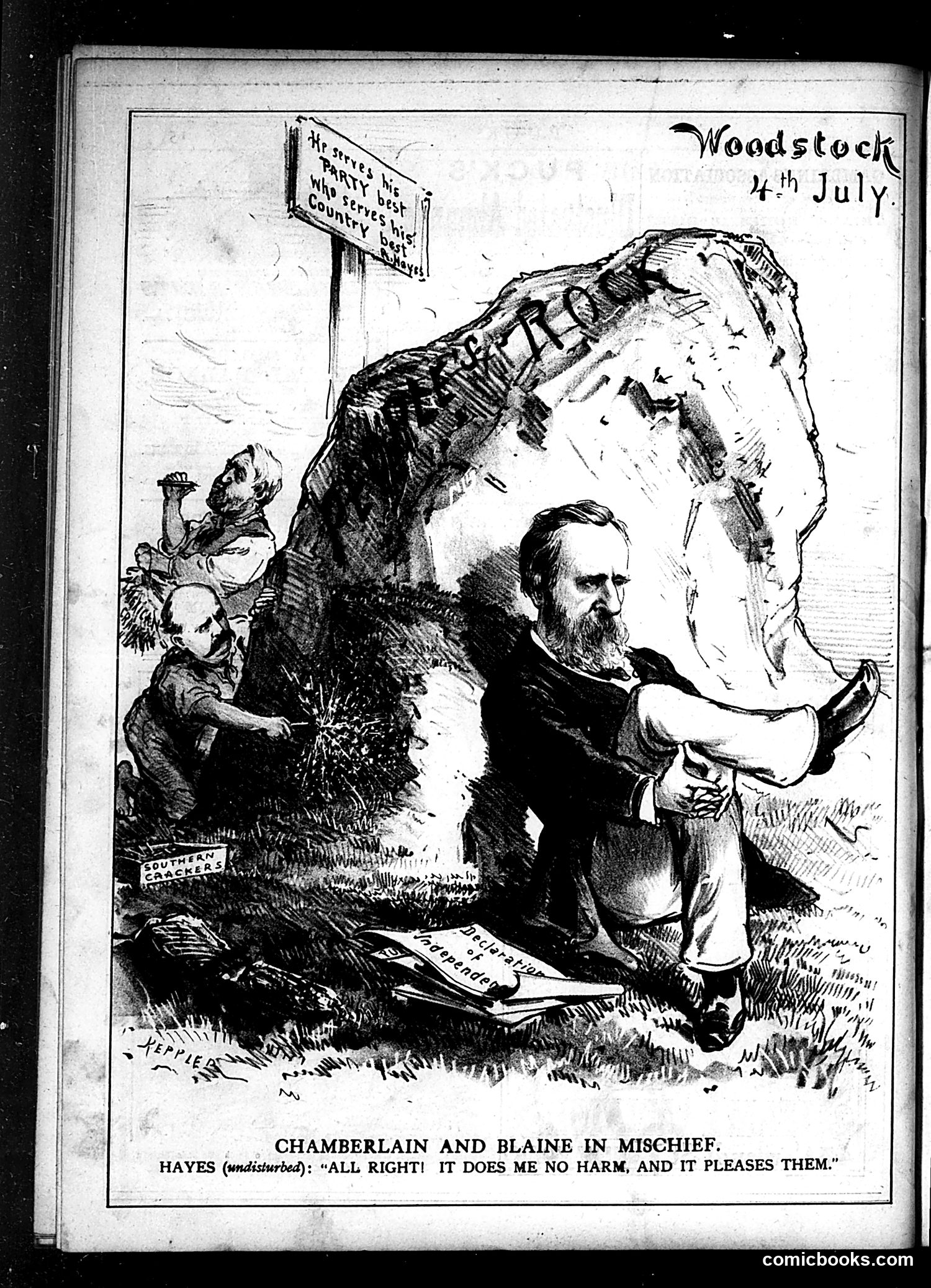
This Puck cartoon satirizes a mishap at Woodstock (location unclear from image alone) during Fourth of July celebrations. The caption identifies the figures as "Chamberlain and Blaine in Mischief," with Hayes (identified as undisturbed) saying "All right! It does me no harm, and it pleases them." The cartoon depicts two bearded men causing chaos—one climbing a large rock with a sign, another standing nearby—while smaller figures (possibly children or attendants) create additional disorder around them. The satire appears to target political figures Chamberlain and Blaine's reckless behavior at a public holiday celebration, suggesting their actions cause disruption yet receive indulgent tolerance from authority figures like Hayes (likely President Rutherford B. Hayes).