
Puck, 1877-07-11 · page 15 of 20
Puck — July 11, 1877 — page 15: what you’re looking at
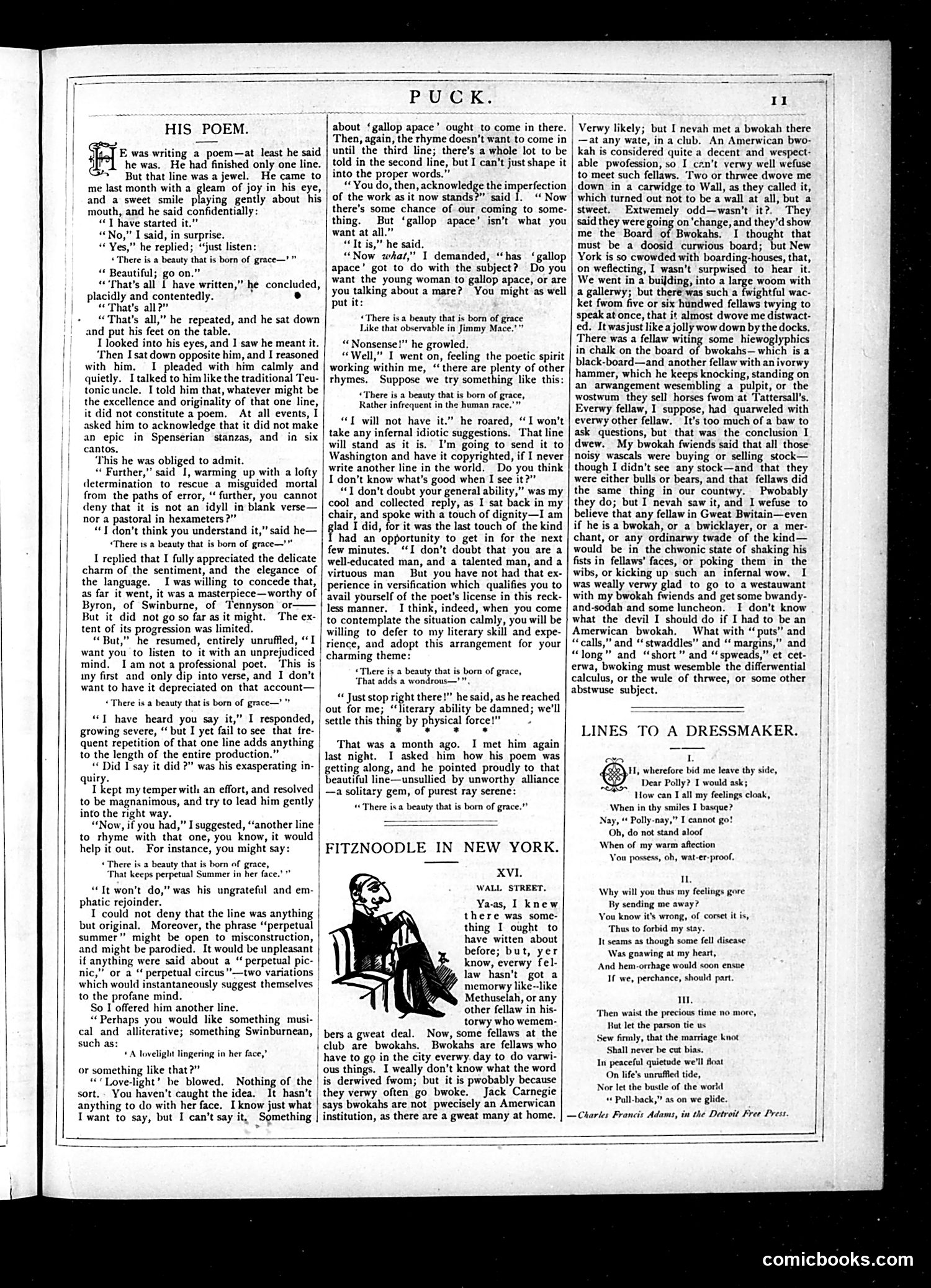
What you’re looking at
This page contains **three separate pieces**: a prose essay titled "His Poem" about a man writing poetry, a short poem called "Lines to a Dressmaker," and a section titled "Fitznoodle in New York: Wall Street" featuring a cartoon illustration. The **Fitznoodle cartoon** (bottom right) shows a man sitting at a desk in what appears to be a Wall Street office. The accompanying text discusses "Bowaks"—apparently slang for financial speculators or fraudsters who operate in New York's financial district. The satire mocks these shady operators as common fixtures of Wall Street culture. The other two literary pieces appear to be general humor pieces rather than political satire.
📄 Transcribed text from this page (OCR, searchable)
Machine-transcribed from the original scan — historical spelling and the odd misread are preserved.
| = oe | HIS POEM. | E was writing a poem—at least he said “1 he was. He had finished only one line. ‘> But that line was a jewel. He came to me last month with a gleam of joy in his eye, and a sweet smile playing gently about his mouth, and he said confidentially: ““T have started it.” “No,” I said, in surprise. “Yes,” he replied; “just listen: “There is a beauty that is born of grace—?” “ Beautiful; go on.” “That's all I have written,” he concluded, placidly and contentedly. : ° “That's all?” “That's all,” he repeated, and he sat down and put his feet on the table. 1 looked into his eyes, and I saw he meant it. ‘Then I sat down opposite him, and I reasoned with him. I pleaded with him calmly and quietly. I talked to him like the traditional Teu- tonicuncle. I told him that, whatever might be the excellence and originality of that one line, it did not constitute a poem. At all events, I asked him to acknowledge that it did not make an epic in Spenserian stanzas, and in six cantos. ‘This he was obliged to admit. “ Further,” said I, warming up with a lofty determination to rescue a misguided mortal from the paths of error, “ further, you cannot deny that it is not an idyll in blank verse— nor a pastoral in hexameters ?” “I don’t think you understand it,” said he— “There 1s a beauty that is born of grace—’” I replied that I fully appreciated the delicate charm of the sentiment, and the elegance o! the language. I was willing to concede that, as far it went, it was a masterpiece—worthy of Byron, of Swinburne, of Tennyson or— But it did not go so far as it might. The ex- tent of its progression was limited. “But,” he resumed, entirely unruffled, “1 mind. I am not a professional poet. iny first. and only dip into verse, and I don't want to have it depreciated on that account— «There is a beauty that is born of grace—’ "” “I have heard you say it,” I responded, growing severe, “ but I yet fail to see that fre- quent repetition of that one line adds anything to the length of the entire production.” “Did I say it did ?” was his exasperating in- quiry. I kept my temper with an effort, and resolved to be magnanimous, and try to lead him gently into the right way. “Now, if you had,” I suggested, “another line to rhyme with that one, you know, it would help it out. For instance, you might say: “There is a beauty that is born of grace, ‘That keeps perpetual Summer in her face.’ “It won’t do,” was his ungrateful and em- phatic rejoinder. but original. Moreover, the phrase “perpetual summer” might be open to misconstruction, and might be parodied. It would be unpleasant if anything were said about a “ perpetual pic- nic,” or a “ perpetual circus ""—two variations which would instantaneously suggest themselves to the profane mind. So I offered him another line. “Perhaps you would like something musi- cal and alliterative; something Swinburnean, such as: +A lovelight lingering in her face,’ or something like that?” “Love-light’ be blowed. Nothing of the sort. You haven’t caught the idea. It hasn’t anything to do with her face. I know just what I want to say, but I can’t say Something want you to listen to it with an unprejudiced This is | I could not deny that the line was anything | PUCK. Then, again, the rhyme doesn’t want to come in until the third line; there’s a whole lot to be told in the second line, but I can’t just shape it into the proper words.”” “You do, then, acknowledge the imperfection | of the work as it now stands?” said 1. “ Now there’s some chance of our coming to some- thing. But ‘gallop apace’ isn’t what you want at all.” “Tt is,” he said. “Now what,” I demanded, “bas ‘gallop apace’ got to do with the subject? Do you want the young woman to gallop apace, or are you talking about a mare? You might as well put it: There iss beauty that i born of ace ike that observable in Jimmy Mace.’” “ Nonsense!” he growled. “Well,” I went on, feeling the poetic spirit working within me, “there are plenty of other thymes. Suppose we try something like this: «There is a beauty that is born of grace, Rather infrequent in the human race.’” “T will not have he roared, “1 won't take any infernal idiotic suggestions. That line will stand as it is. I’m going to send it to Washington and have it copyrighted, if I never write another line in the world. Do you think I don’t know what's good when I see it?” “1 don't doubt your general ability,” was my cool and collected reply, as I sat back in my chair, and spoke with a touch of dignity—I am lad I did, for it was the last touch of the kind had an opportunity to get in for the next few minutes. ‘I don’t doubt that you are a well-educated man, and a talented man, and a virtuous man But you have not had that ex- perience in versification which qualifies you to avail yourself of the poet’s license in this reck- less manner. I think, indeed, when you come to contemplate the situation calmly, you will be willing to defer to my literary skill and expe- rience, and adopt this arrangement for your charming theme: «There is a beauty that is born of grace, ‘That adds a wondrous—'”, “ Just stop right there!” he said, as he reached out for me; “literary ability be damned; we'll | settle this thing by physical force!” alee nhaarsaair ‘That was a month ago. I met him again last night. I asked him how his poem was getting along, and he pointed proudly to that beautiful line—unsullied by unworthy alliance —a solitary gem, of purest ray serene: «There isa beauty that is born of grace.” FITZNOODLE IN NEW YORK. XVI. WALL STREET. Ya-as, I knew there was some- thing I ought to have witten about before; but, yer know, everwy fel- law hasn't got a memorwy like-like Methuselah, or any other fellaw in his- | torwy who wemem- | bers a gweat deal. Now, some fellaws at the | club are bwokahs. Bwokahs are fellaws who have to go in the city everwy. day to do varwi- | ous things. I weally don’t know what the word | is derwived fwom; but it is pwobably because they verwy often go bwoke. Jack Carnegie | says bwokahs are not pwecisely an Amerwican institution, as there are a gweat many at home. P | about ‘gallop apace’ ought to come in there. | Verwy likely; but I nevah met a bwokah there —at any wate, in a club. An Amerwican bwo- kah is considered quite a decent and wespect- able pwofession, so I can't verwy well wefuse to meet such fellaws. ‘Two or thrwee dwove me down in a carwidge to Wall, as they called it, which turned out not to be a wall at all, but a stweet. Extwemely odd—wasn’t it?. They said they were going on ‘change, and they'd show me the Boar efepwokats: I thought that must be a doosid curwious board; but New York is so cwowded with boarding-houses, that, on weflecting, I wasn’t ae | to hear it. We went in a building, into a large woom with a gallerwy; but there was such a fwightful wac- ket fwom five or six hundwed fellaws twying to speak at once, that it almost dwove me distwact- ed. It wasjust like a jolly wow down by the docks. There was a fellaw witing some hiewoglyphics in chalk on the board of bwokahs—which is a black-board—and another fellaw with anivorwy hammer, which he keeps knocking, standing on an arwangement wesembling a pulpit, or the wostwum they sell horses fwom at Tattersall’s. Everwy fellaw, I suppose, had quarweled with everwy other fellaw. It’s too much of a baw to ask questions, but that was the conclusion I dwew. My bwokah fwiends said that all those noisy wascals were buying or selling stock— though I didn’t see any stock—and that they were either bulls or bears, and that fellaws did the same thing in our countwy. Pwobably they do; but I nevah saw it, and I wefuse to believe that any fellaw in Gweat Bwitain—even if he is a bwokah, or a bwicklayer, or a mer- chant, or any ordinarwy twade of the kind— would be in the chwonic state of shaking his fists in fellaws’ faces, or poking them in the wibs, or kicking up such an infernal wow. I was weally verwy glad to go to a westauwant with my bwokah fwiends and get some bwandy- and-sodah and some luncheon. I don’t know what the devil I should do if I had to be an Amerwican bwokah. What with “puts” and “calls,” and “ stwaddles” and “ margin: “Jong” and “short” and “ spwead erwa, bwoking must wesemble the differwential calculus, or the wule of thrwee, or some other abstwuse subject. LINES TO A DRESSMAKER. oe 1 H, wherefore bid me leave thy side, Dear Polly? I would ask; Mow can I all my feelings cloak, When in thy smiles I basque? Nay, “ Polly-nay,” I cannot go! Oh, do not stand aloof When of my warm affection You possess, oh, wat-er- proof, x MM. Why will you thus my feelings gore By sending me away? You know it's wrong, of corset it is, Thus to forbid my stay. It seams as though some fell disease Was gnawing at my heart, And hem-orrhage would soon ensue If we, perchance, should part. 1, ‘Then waist the precious time no more, Hat let the parson tie us Sew firmly, that the marriage knot Shall never be cut bias. In peaceful quietude we'll oat On life's unruffled tide, Nor let the bustle of the workd « Pull-back,” as on we glide. —Charles Francis Adams, in the Detroit Free Press. comicbooks.com