
Puck, 1877-07-11 · page 11 of 20
Puck — July 11, 1877 — page 11: what you’re looking at
What you’re looking at
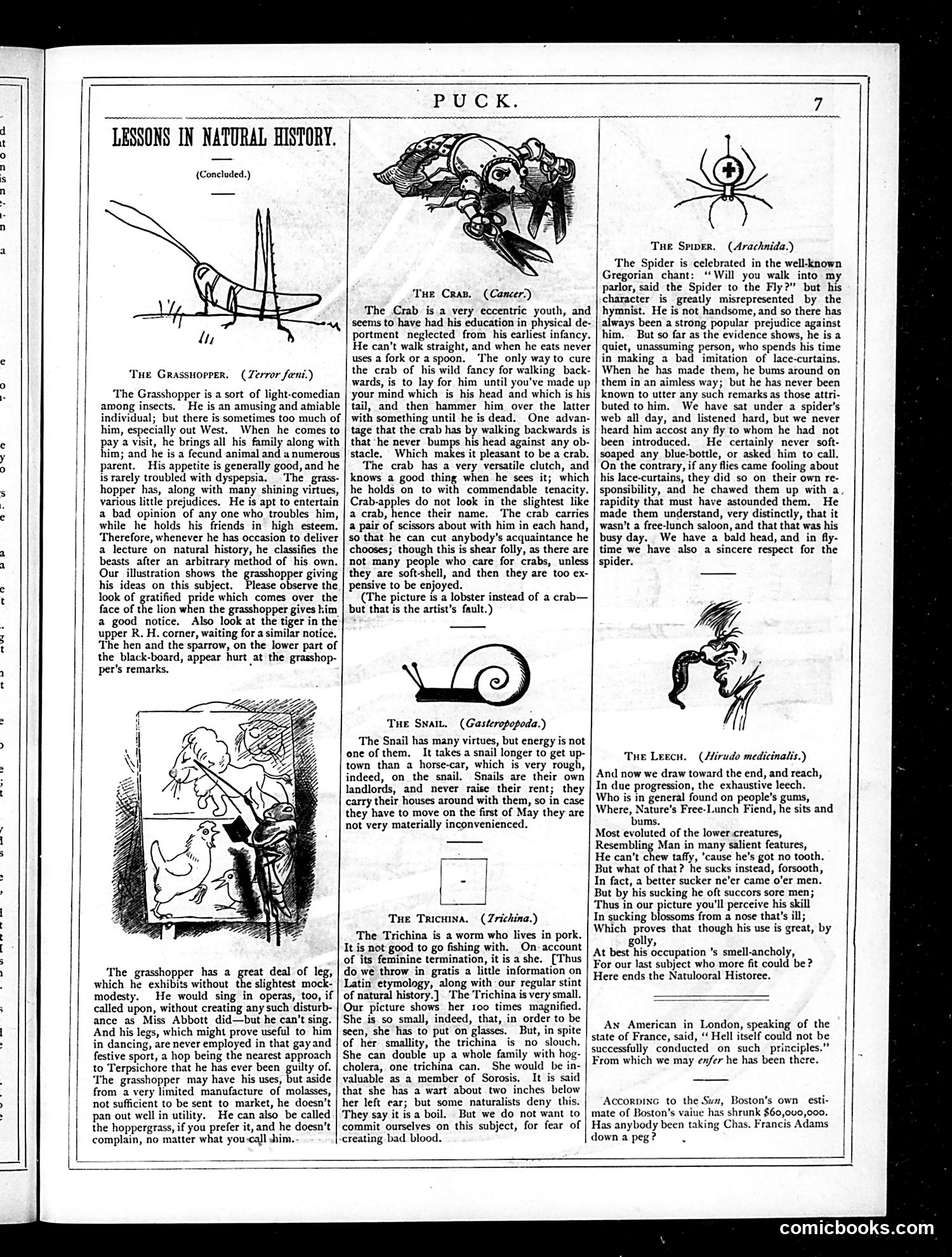
This page from *Puck* magazine presents "Lessons in Natural History" (Concluded)—a humorous educational feature, not political satire. The text provides comedic descriptions of various creatures: the Grasshopper, Crab, Snail, Leech, Spider, and Trichinella worm. The humor derives from anthropomorphizing animals with human flaws and social commentary. The Grasshopper is a "light-comedian" troublemaker; the Crab walks backward and is "eccentric"; the Snail lacks energy; the Leech is parasitic and bloodsucking; the Spider is celebrated despite being "misrepresented by the hymnist." The accompanying satirical illustrations exaggerate these animal characteristics to mock human behavior—laziness, selfishness, social pretension, and parasitism. This format was typical of *Puck*'s approach: using nature observation as a vehicle for social criticism without targeting specific political figures.
📄 Transcribed text from this page (OCR, searchable)
Machine-transcribed from the original scan — historical spelling and the odd misread are preserved.
LESSONS IN NATURAL HISTORY. (Concluded.) (Terror feni.) ‘The Grasshopper is a sort of light-comedian among insects. He is an amusing and amiable individual; but there is sometimes too much of him, especially out West. When he comes to pay a visit, he brings all his family along with him; and he is a fecund animal and a numerous parent. His appetite is generally good, and he is rarely troubled with dyspepsia, ‘The grass- hopper has, along with many shining virtues, various little prejudices. He is apt to entertain a bad opinion of any one who troubles him, while he holds his friends in high esteem, Therefore, whenever he has occasion to deliver a lecture on natural history, he classifies the beasts after an arbitrary method of his own. Our illustration shows the grasshopper giving his ideas on this subject. Please observe the look of gratified pride which comes over the face of the lion when the grasshopper gives kim a good notice. Also look at the tiger in the upper R. H. corner, waiting for a similar notice. The hen and the sparrow, on the lower part of the black-board, appear hurt at the grasshop- per’s remarks, : ‘THe GrassHopper. The grasshopper has a Ben deal of leg, which he exhibits without the slightest mock- modesty. He would sing in operas, too, if called upon, without creating any such disturb- ance as Miss Abbott did—but he can’t sing. And his legs, which might prove useful to him in dancing, are never employed in that gayand festive sport, a hop being the nearest approach to Terpsichore that he has ever been guilty of. The grasshopper may have his uses, but aside from a very limited manufacture of molasses, not sufficient to be sent to market, he doesn’t pan out well in utility. He can also be called the hoppergrass, if you prefer it, and he doesn’t complain, no matter what you-call shim. Tue Cras, (Cancer:) The Crab is a very eccentric youth, and seems to have had his education in physical de- portment neglected from his carliest infancy. He can’t walk straight, and when he eats never uses a fork or a spoon. The only way to cure the crab of his wild fancy for walking back- wards, is to lay for him until you’ve made up your mind which is his head and which is his tail, and then hammer him over the latter with something until he is dead. One advan- tage that the crab has by walking backwards is that he never bumps his head against any ob- stacle. Which makes it pleasant to be a crab. The crab has a very versatile clutch, and knows a good thing when he sees it; which he holds on to with commendable tenacity. Grab spples do not look in the slightest like a crab, hence their name. The crab carries a pair of scissors about with him in each hand, so that he can cut anybody’s acquaintance he chooses; though this is shear folly, as there are not many people who care for crabs, unless they are soft-shell, and then they are too ex- pensive to be enjoyed. (The picture is a lobster instead of a crab— but that is the artist’s fault.) Tue Sai. (Gasteropopoda.) The Snail has many virtues, but energy is not one of them. It takes a snail longer to get y town than a horse-car, which is very rough, indeed, on the snail. Snails are their own landlords, and never raise their rent; they carry their houses around with them, so in case they have to move on the first of May they are not very materially inconvenienced. [| Tue TRICHINA. (Zrichina.) The Trichina is a worm who lives in pork. It is not good to go fishing with. On- account of its feminine termination, it is a she. [Thus do we throw in gratis a little information on Latin etymology, along with our regular stint of natural history.) ‘The Trichina is very small. Our picture shows her 100 times magnified. She is. so small, indeed, that, in order to be seen, she has to put on glasses. But, in spite of her smallity, the trichina is no slouch. She can double up a whole family with hog- cholera, one trichina can. She would be in- valuable as a member of Sorosis. It is said that she has a wart about two inches below | her left ear; but some naturalists deny this. They say it isa boil. But we do not want to commit ourselves on this subject, for fear of creating bad blood. Tue Spier. (Arachnida.) The Spider is celebrated in the well-known Gregorian chant: “Will you walk into my parlor, said the Spider to the Fly?” but his character is greatly misrepresented by the hymnist. He is not handsome, and so there has always been a strong popular prejudice against him. But so far as the evidence shows, he is a quiet, unassuming person, who spends his time in making a bad imitation of lace-curtains. When he has made them, he bums around on them in an aimless way; but he has never been known to utter any such remarks as those attri- buted to him. We have sat under a spider's web all day, and listened hard, but we never heard him accost any fly to whom he had not been introduced. He certainly never soft- soaped any blue-bottle, or asked him to call. On the contrary, if any flies came fooling about his lace-curtains, they did so on their own re- sponsibility, and he chawed them up with a rapidity that must have astounded them, He made them understand, very distinctly, that it wasn’t a free-lunch saloon, and that that was his busy day. We have a bald head, and in fly- time we have also a sincere respect for the spider. Tue Leecn. (/irudo medicinalis.) And now we draw toward the end, and reach, In due progression, the exhaustive leech. Who is in general found on people's gums, Where, Nature's Free-Lunch Fiend, he sits and ums. Most evoluted of the lower creatures, Resembling Man in many salient features, He can’t as taffy, 'cause he’s got no tooth. But what of that? he sucks instead, forsooth, In fact, a better sucker ne’er came o'er men. But by his sucking he oft succors sore men; Thus in our picture you'll perceive his skill In sucking blossoms from a nose that’s ill; Which proves that though his use is great, by olly, At best his occupation ’s smell-ancholy, For our last subject who more fit could be? Here ends the Natulooral Historee. AN American in London, speaking of the state of France, said, “ Hell itself could not be successfully conducted on such principles.” From which we may enfer he has been there. AccorpinG to the Sux, Boston's own esti- mate of Boston’s vaiue has shrunk $60,000,000. Has anybody been taking Chas, Francis Adams downapeg? comicbooks.com