
Puck, 1877-07-11 · page 6 of 20
Puck — July 11, 1877 — page 6: what you’re looking at
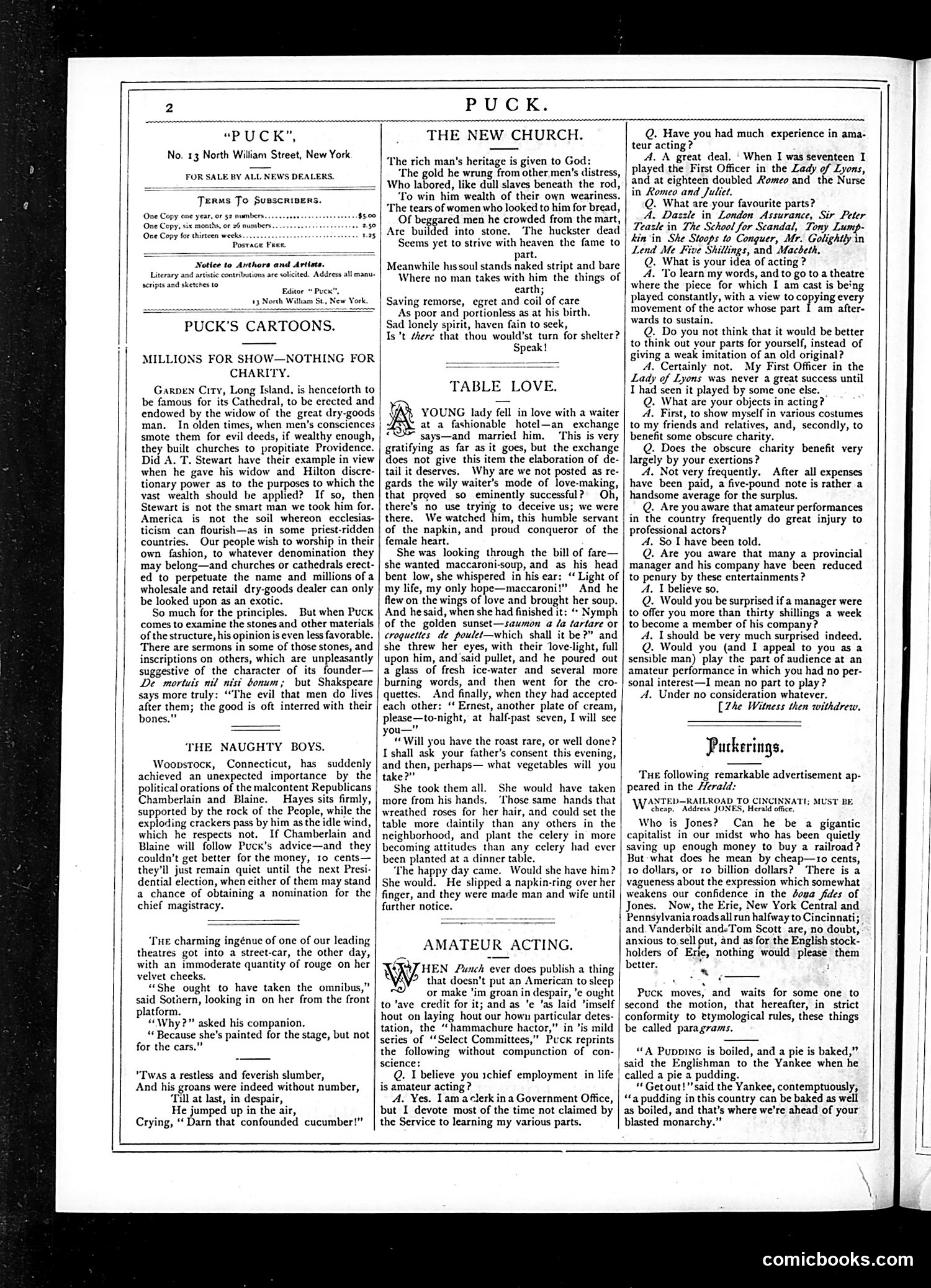
What you’re looking at
This page is primarily **text-based content** rather than political cartoons. It includes: 1. **"The New Church"** — a poem critiquing wealthy individuals who claim religious devotion while exploiting the poor ("The gold he wrung from other men's distress"). 2. **"Table Love"** — a humorous short story about a young woman who married a waiter, now observing his flirtations with other female customers. 3. **"The Naughty Boys"** — a brief political note about Connecticut Republicans supporting Blaine's presidential campaign despite his controversial record. 4. **"Amateur Acting"** — a Q&A column about theatrical performance and staging. The page demonstrates Puck's characteristic approach: mixing social satire (wealth and hypocrisy), domestic humor, and light political commentary. The "Naughty Boys" section appears the most overtly political, mocking Republican support for Blaine despite acknowledged scandals.
📄 Transcribed text from this page (OCR, searchable)
Machine-transcribed from the original scan — historical spelling and the odd misread are preserved.
PUCK. “PUCK”, No. 13 North William Street, New York. E BY ALL NEWS DEALERS. One Copy one year, o $2 01 One Copy, six months, or 24 Oxe Copy for thirtcen weeks. Literary an scripts and sketches to " Editor 13 North Willam S PUCK’S CARTOONS. MILLIONS FOR SHOW—NOTHING FOR CHARITY. Garpen City, Long Island, is henceforth to be famous for its Cathedral, to be erected and endowed by the widow of the great dry-goods man. In olden times, when men’s consciences smote them for evil deeds, if wealthy enough, they built churches to propitiate Providence. | Did A. T. Stewart have their example in view when he gave his widow and Hilton discre- tionary power as to the pu to which the vast wealth should be applied? If so, then Stewart is not the smart man we took him for. America is not the soil whereon ecclesias- ticism can flourish—as in some priest-ridden countries. Our people wish to worship in their own fashion, to whatever denomination they may belong—and churches or cathedrals erect- ed to perpetuate the name and millions of a wholesale and retail dry-goods dealer can only be looked upon as an exotic. So much for the principles. But when Puck comes to examine the stones and other materials of the structure, his opinion is even less favorable. There are sermons in some of those stones, and inscriptions on others, which are unpleasantly suggestive of the character of its founder— De mortuis nil nisi bonum; but Shakspeare says more truly: ‘The evil that men do lives after them; the good is oft interred with their bones.”” ‘THE NAUGHTY BOYS. Woopstock, Connecticut, has suddenly achieved an unexpected importance by the political orations of the malcontent Republicans Chamberlain and Blaine. Hayes sits firmly, supported by the rock of the People, while the exploding crackers pass by him as the idle wind, which he respects not. If Chamberlain and Blaine will follow Puck’s advice—and they couldn’t get better for the money, 10 cents— they'll just remain quiet until the next Presi- dential election, when either of them may stand a chance of obtaining a nomination for the chief magistracy. ‘Tue charming ingénue of one of our leading theatres got into a street-car, the other day, with an immoderate quantity of rouge on her velvet cheeks. “She ought to have taken the omnibus,” said Sothern, looking in on her from the front platform. “Why?” asked his companion, “Because she’s painted for the stage, but not for the cars.” 'Twas a restless and feverish slumber, And his groans were indeed without number, Till at last, in despair, He jumped up in the air, Crying, “Darn that confounded cucumber!” THE NEW CHURCH. | ‘The rich man’s heritage is given to God: ‘The gold he wrung from other men’s distress, Who labored, like dull slaves beneath the rod, ‘To win him wealth of their own weariness. ‘The tears of women who looked to him for bread, Of beggared men he crowded from the mart, Are builded into stone, The huckster dead Seems yet to strive with heaven the fame to part. Meanwhile hissoul stands naked stript and bare Where no man takes with him the things of earth; Saving remorse, egret and coil of care ‘As poor and portionless as at his birth. | Sad lonely spirit, haven fain to seek, TABLE LOVE. Is ’t ¢here that thou would’st turn for shelter? YOUNG lady fell in love with a waiter at a fashionable hotel—an_ exchange Speak! & says—and married him. ‘This is very gratifying as far as it goes, but the exchange does not give this item the elaboration of de- tail it deserves. Why are we not posted as re- gards the wily waiter’s mode of love-making, that proved so eminently successful? Oh, there's no use trying to deceive us; we were there. We watched him, this humble servant of the napkin, and proud conqueror of the female heart. She was looking through the bill of fare— she wanted maccaroni-soup, and as his head bent low, she whispered in his ear: “ Light of my life, my only hope—maccaroni!” And he flew on the wings of love and brought her soup. And hesaid, when she had finished it: “* Nymph of the golden sunset—saumon a /a tartare or croquettes de poulet—which shall it be?” and she threw her eyes, with their love-light, full upon him, and’said pullet, and he poured out a glass of fresh ice-water and several more burning words, and then went for the cro- quettes. And finally, when they had accepted each other: ‘ Ernest, another plate of cream, please—to-night, at half-past seven, I will see oun” we Will you have the roast rare, or well done? I shall ask your father’s consent this evening, and then, perhaps— what vegetables will you take?” She took them all. She would have taken more from his hands. ‘Those same hands that wreathed roses for her hair, and could set the table more daintily than any others in the neighborhood, and plant the celery in more becoming attitudes than any celery had ever been planted at a dinner table. ‘The happy day came. Would she have him? She would. He slipped a napkin-ring over her finger, and they were made man and wife until further notice. AMATEUR ACTING. WAZ HEN Punch ever does publish a thing P that doesn’t put an American to sleep or make ‘im groan in despair, ’e ought to ‘ave credit for it; and as 'e ‘as laid ’imself hout on laying hout our hown particular detes- tation, the “hammachure hactor,” in ’is mild series of ‘‘Select Committees,” Puck reprints the following without compunction of con- science: Q. I believe you schief employment in life is amateur acting ? A. Yes. Lam acterk ina Government Office, but I devote most of the time not claimed by the Service to learning my various parts. Q. Have you had much experience in ama- teur acting ? ‘A. A great deal. ‘When I was seventeen I | played the First Officer in the Lady of Lyons, and at eighteen doubled Romeo and the Nurse in Romeo and Juliet. Q. What are your favourite parts? A. Dazzle in London Assurance, Sir Peter Teasle in The School for Scandal, Tony Lump- kin'in She Stoops to Conquer, Mr. Golightly in Lend Me Five Shillings, and Macbeth, Q. What is your idea of acting ? A, To learn my words, and to go to a theatre where the piece for which I am cast is being played constantly, with a view to copying every | movement of the actor whose part I am after- wards to sustain. Q. Do you not think that it would be better to think out your parts for yourself, instead of giving a weak imitation of an old original? A. Certainly not. My First Officer in the Lady of Lyons was never a great success until I had seen it played by some one else. Q. What are your objects in acting? A. First, to show myself in various costumes to my friends and relatives, and, secondly, to benefit some obscure charity. @Q. Does the obscure charity benefit very largely by your exertions ? A. Not very frequently. After all expenses have been paid, a five-pound note is rather a handsome average for the surplus. Q. Are you aware that amateur performances in the country frequently do great injury to professional actors? A. So I have been told. Q. Are you aware that many a provincial manager and his company have been reduced to penury by these entertainments ? A. 1 believe so. Q. Would you be surprised if a manager were to offer you more than thirty shillings a week to become a member of his company? A. should be very much surprised indeed. Q. Would you (and I appeal to you as a sensible man) play the part of audience at an amateur performance in which you had no per- sonal interest—I mean no part to play? A. Under no consideration whatever. [The Witness then withdrew. Parkerings. ‘Tue following remarkable advertisement ap- | peared in the Herald: )—RAILROAD TO CINCINNATI; MUST BE ‘Address JONES, Herald office. Who is Jones? Can he be a gigantic capitalist in our midst who has been quietly saving up enough money to buy a railroad? But what does he mean by cheap—1o cents, 1o dollars, or 10 billion dollars? There is a vagueness about the expression which somewhat weakens our confidence in the boga fides of Jones. Now, the Erie, New York Central and Pennsylvania roadsall run halfway to Cincinnati; | and. Vanderbilt andeTom Scott are, no doubt, anxious to sell put, and as for the English stock- holders of Ene, nothing would please them better. . ‘ 3 ¢ Puck moves, and waits for some one to second the motion, that hereafter, in strict conformity to ttymological rules, these things be called paragrams. “A Puppinc is boiled, and a pie is baked,” said the Englishman to the Yankee when he called a pie a pudding. “Get out!"’said the Yankee, contemptuously, “a pudding in this country can be baked as well as boiled, and that’s where we're ahead of your blasted monarchy.” comicbooks.com