
Puck, 1877-07-11 · page 14 of 20
Puck — July 11, 1877 — page 14: what you’re looking at
What you’re looking at
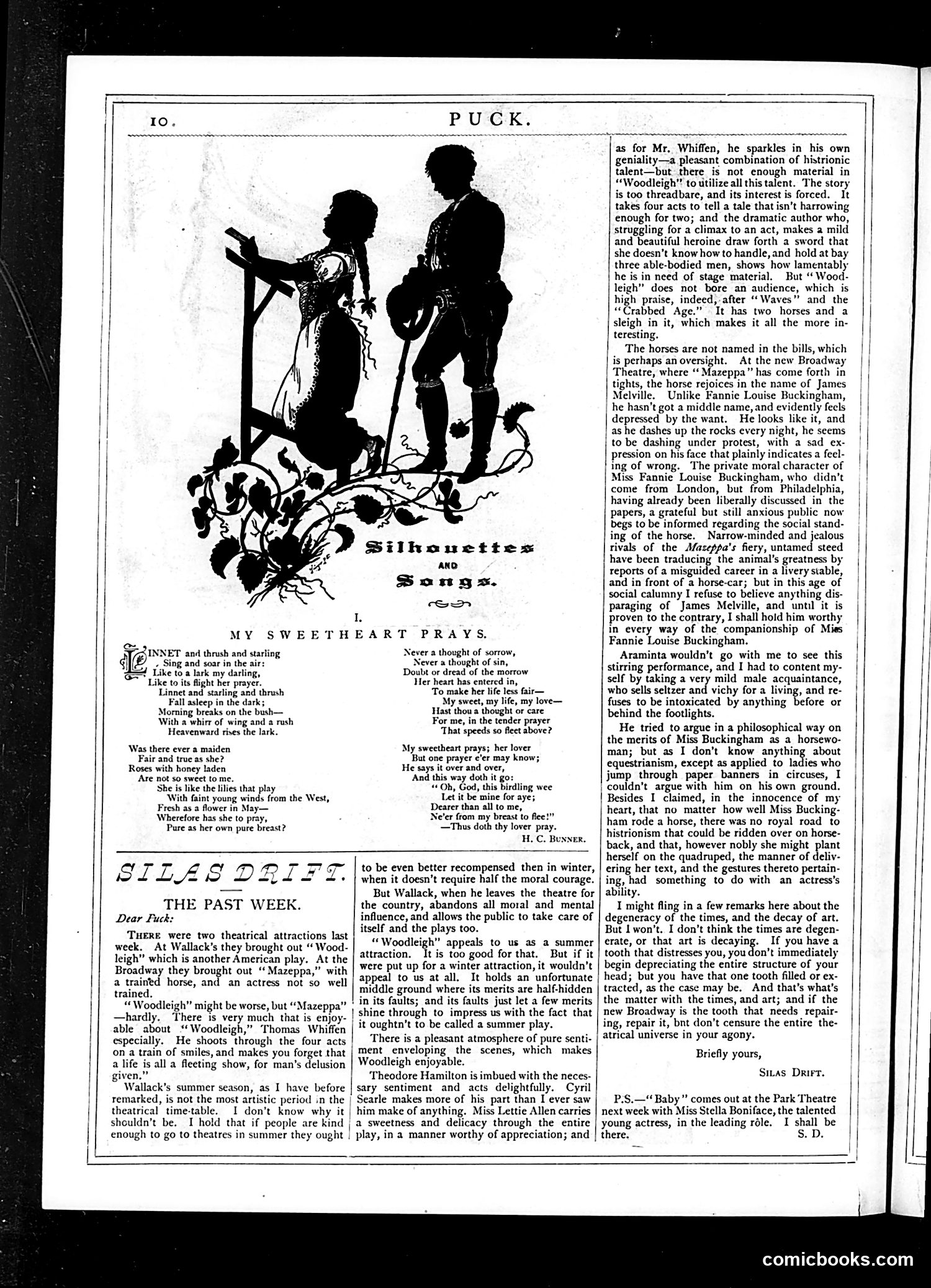
This page features a silhouette illustration titled "My Sweetheart Prays" alongside theatrical criticism. The silhouette depicts two figures in romantic pose—a woman and soldier or gentleman—in a sentimental scene. The accompanying poem is a love song expressing devotion and prayer. Below, drama critic Silas Drift reviews recent Broadway productions, specifically praising "Woolleigh" and "Maseppa" (likely "Mazeppa"). Drift criticizes summer theater generally but acknowledges these plays' merits, particularly Theodore Hamilton's acting and Miss Lettie Allen's performance. He dismisses concerns about theatrical quality during off-season, arguing that worthwhile entertainment justifies public attendance regardless of season. The page blends sentimental visual art with contemporary theatrical commentary.
📄 Transcribed text from this page (OCR, searchable)
Machine-transcribed from the original scan — historical spelling and the odd misread are preserved.
I. Silhouettes AND Songs. Cm MY SWEETHEART PRAYS, SF-ZINNET and thrush and starling Ve Sink aNd soar in the ar: LY Tike to a lark my darling, Fike to its Aight her prayer, Linnet and starling and thrush Fall asleep in the dark; Morning breaks on the bush— With a whirr of wing and a rush Heavenward rises the lark. Was there ever a maiden Fair and true as she? Roses with honey laden Are not so sweet tome. She is like the lilies that play th faint young winds from the West, Fresh as a flower in May— Wherefore has she to pray, Pure as her own pure breast? Never a thought of sorrow, Never a thought of sin, Doubt or dread of the morrow Her heart has entered in, To make her life less fair— My sweet, my life, my love— Hast thou a thought or care For me, in the tender prayer ‘That speeds so fleet above? My sweetheart prays; her lover But one prayer e’er may know; He says it over and over, ‘And this way doth it go: “Oh, God, this birdling wee Let it be mine for aye; Dearer than all to me, Ne’er from my breast to flee!” —Thus doth thy lover pray. H.C. B SILAS DRIFT. THE PAST WEEK. Dear Fuck: THERE were two theatrical attractions last week. At Wallack’s they brought out “ Wood- leigh” which is another American play. At the Broadway they brought out “ Mazeppa,” with a trained horse, aod ac actiess “ok 20: wall trained. “Woodleigh” might be worse, but “Mazeppa” —hardly. There is very much that is enjoy- able about *‘Woodleigh,” Thomas Whiffen especially. He shoots through the four acts on a train of smiles, and makes you forget that a life is all a fleeting show, for man’s delusion given.” Wallack’s summer season, as I have before remarked, is not the most artistic period in the theatrical time-table. shouldn’t be. I hold that if people are kind | enough to go to theatres in summer they ought to be even better recompensed then in winter, when it doesn’t require half the moral courage. But Wallack, when he leaves the theatre for the country, abandons all moral and mental influence, and allows the public to take care of itself and the plays too. “Woodleigh” appeals to us as a summer attraction. tt is too good for that. But if it were put up for a winter attraction, it wouldn’t appeal to us at all. It holds an unfortunate middle ground where its merits are half-hidden in its faults; and its faults just let a few merits shine through to impress us with the fact that it oughtn’t to be called a summer play. There is a pleasant atmosphere of pure senti- | ment enveloping the scenes, which makes Woodleigh enjoyable. Theodore Hamilton is imbued with the neces- sary sentiment and acts delightfully. Searle makes more of his part than I ever saw I don’t know why it | him make of anything. Miss Lettie Allen carries a sweetness and delicacy through the entire play, in a manner worthy of appreciation; and Cyril | as for Mr, Whiffen, he sparkles in his own geniality—a pleasant combination of histrionic talent—but there is not enough material in “Woodleigh" to utilize all this talent. The story is too threadbare, and its interest is forced. It takes four acts to tell a tale that isn’t harrowing enough for two; and the dramatic author who, struggling for a climax to an act, makes a mild and beautiful heroine draw forth a sword that she doesn’t know how to handle, and hold at bay three able-bodied men, shows how lamentably | he is in need of stage material. But ‘‘ Wood- leigh” does not bore an audience, which is high praise, indeed, after “Waves” and the “Crabbed Age.” It has two horses and a sleigh in it, which makes it all the more in- teresting. The horses are not named in the bills, which is perhaps an oversight. At the new Broadway Theatre, where “ Mazeppa” has come forth in tights, the horse rejoices in the name of James Melville. Unlike Fannie Louise Buckingham, he hasn't got a middle name, and evidently fecls depressed by the want. He looks like it, and as he dashes up the rocks every night, he seems to be dashing under protest, with a sad ex- pression on his face that plainly indicates a feel- ing of wrong. The private moral character of Miss Fannie Louise Buckingham, who didn’t come from London, but from Philadelphia, having already been liberally discussed in the papers, a grateful but still anxious public now begs to be informed regarding the social stand- ing of the horse. Narrow-minded and jealous rivals of the Aazeppa's fiery, untamed steed have been traducing the animal’s greatness by reports of a misguided career in a livery stable, and in front of a horse-car; but in this age of social calumny I refuse to believe anything dis- paraging of James Melville, and until it is proven to the contrary, I shall hold him worthy in every way of the companionship of Mies Fannie Louise Buckingham. Araminta wouldn't go with me to see this stirring performance, and I had to content my- self by taking a very mild male acquaintance, who sells seltzer and vichy for a living, and re- fuses to be intoxicated by anything before or behind the footlights. He tried to argue in a philosophical way on the merits of Miss Buckingham as a horsewo- man; but as I don’t know anything about equestrianism, except as applied to ladies who jump through paper banners in circuses, I | couldn't argue with him on his own ground. | Besides I claimed, in the innocence of my heart, that no matter how well Miss Bucking- ham rode a horse, there was no royal road to histrionism that could be ridden over on horse- back, and that, however nobly she might plant herself on the quadruped, the manner of deliv- ering her text, and the gestures thereto pertain- ing, had something to do with an actress’s ability. I might fling in a few remarks here about the degeneracy of the times, and the decay of art. But 1 won’t. I don’t think the times are degen- erate, or that art is decaying. If you havea tooth that distresses you, you don’t immediately begin depreciating the entire structure of your head; but you have that one tooth filled or ex- tracted, as the case may be. And that’s what's the matter with the times, and art; and if the new Broadway is the tooth that needs repair- ing, repair it, bnt don’t censure the entire the- atrical universe in your agony. Briefly yours, Siras Drirt. P.S.—“ Baby” comes out at the Park Theatre next week with Miss Stella Boniface, the talented young actress, in the leading réle. I shall be there. Ss. D. comicbooks.com