
Puck, 1877-07-11 · page 8 of 20
Puck — July 11, 1877 — page 8: what you’re looking at
What you’re looking at
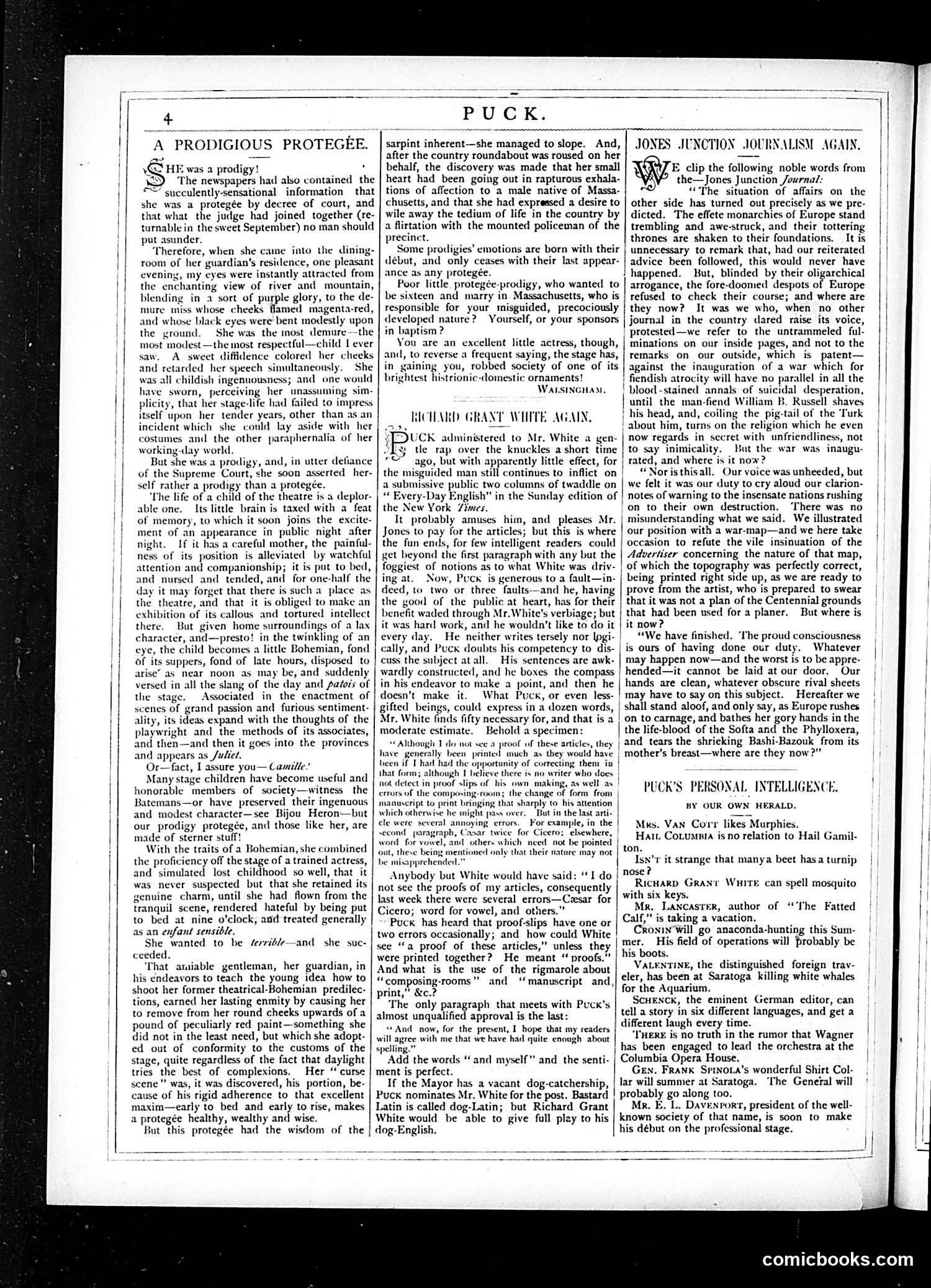
This page contains three distinct articles rather than political cartoons: 1. **"A Prodigious Protégée"** — A sentimental story about a gifted child actress (appears to be a Bohemian girl) raised by a guardian in Massachusetts who wants to return to Europe rather than pursue stage fame in America. 2. **"Richard Grant White Again"** — A critical commentary on theater critic Richard Grant White's writing in the New York Times, attacking his competence and arguing his articles contain numerous errors and poor reasoning. 3. **"Puck's Personal Intelligence"** — Brief gossip items about various theatrical and cultural figures, including actors and musicians. The page emphasizes Puck's role as cultural critic and satirist, targeting theatrical pretensions and incompetent critics of the era, rather than primarily featuring visual political satire.
📄 Transcribed text from this page (OCR, searchable)
Machine-transcribed from the original scan — historical spelling and the odd misread are preserved.
A PRODIGIOUS PROTEGEE. \QHE was a prodigy! <5) The newspapers had also contained the © succulently-sensational information that she was a protegée by decree of court, and that what the judge had joined together (re- turnable in the sweet September) no man should put asunder. ‘Therefore, when she came into the dining- room of her guardian’s residence, one pleasant evening, my eyes were instantly attracted from the enchanting view of river and mountain, blending in a sort of purple glory, to the de- mure miss whose cl s flamed magenta-red, and whose black eyes were bent modestly upon the ground. She was the most demure —the most modest—the most respectful—child | ever saw. A_ sweet diffidence colored her cheeks and retarded her speech simultaneously, She was all childish ingenuousness; and one would have sworn, perceiving her unassuming sim- plicity, that her stage-life had failed to impress itself upon her tender years, other than as an incident which she could lay aside with her costumes and the other paraphernalia of her working-day world. But she was a prodigy, and, in utter defiance of the Supreme Court, she soon asserted her- self rather a prodigy than a protegée. ‘The life of a child of the theatre is a deplor- able one. Its little brain is taxed with a feat of memory, to which it soon joins the excite- ment of an appearance in public night after night. If it has a careful mother, the painful- ness of its position is alleviated by watchful attention and companionship; it is put to bed, and nursed and tended, and for oni if the day it may forget that there is such a_pl: the theatre, and that it is obliged to make an exhibition of its callous and tortured intellect there. But given home surroundings of a lax character, and—presto! in the twinkling of an eye, the child becomes a little Bohemian, fond of its suppers, fond of late hours, disposed to arise’ as near noon as may be, and suddenly versed in all the slang of the day and patois of the stage. Associated in the enactment of scenes of grand passion and furious sentiment- ality, its ideas expand with the thoughts of the playwright and the methods of its associates, and then—and then it goes into the provinces and appears as Juliet. Or—fact, I assure you— Camille’ Many stage children have become useful and honorable members of society—witness the Batemans—or have preserved their ingenuous and modest character—see Bijou Heron—but our prodigy protegée, and those like her, are made of sterner stuff! With the traits of a Bohemian, she combined the proficiency off the stage of a trained actress, and simulated lost childhood so well, that it was never suspected but that she retained its genuine charm, until she had_ flown from the tranquil scene, rendered hateful by being put to bed at nine o'clock, and treated generally as an enfant sensible. She wanted to be ferrible ceeded. ‘That amiable gentleman, her guardian, in his endeavors to teach the young idea how to shoot her former theatrical-Bohemian predilec- tions, earned her lasting enmity by causing her to remove from her round cheeks upwards of a pound of peculiarly red paint—something she did not in the least need, but which she adopt- ed out of conformity to the customs of the stage, quite regardless of the fact that daylight tries ‘the best of complexions. Her “curse scene” was, it was discovered, his portion, be- cause of his rigid adherence to that excellent maxim—early to bed and early to rise, makes a protegée healthy, wealthy and wise. But this protegée had the wisdom of the and she suc- PUCK. sarpint inherent—she managed to slope. And, after the country roundabout was roused on her behalf, the discovery was made that her small heart had been going out in rapturous exhala- tions of affection to a male native of Massa- chusetts, and that she had expressed a desire to wile away the tedium of life in the country by a flirtation with the mounted policeman of the precinct, Some prodi; emotions are born with their début, and only ceases with their last appear- ance as any protegée. Poor little, protegée-prodigy, who wanted to be sixteen and marry in Massachusetts, who is responsible for your misguided, precociously developed nature? Yourself, or your sponsors in baptism? You are an excellent little actress, though, | and, to reverse a frequent saying, the stage has, in gaining you, robbed society of one of its brightest histrionic-domestic ornaments! WALSINGHAM. RICHARD GRANT WHITE AGA UCK administered to Mr. White a gen- J tle rap over the knuckles a short time ©" ago, but with apparently little effect, for | the misguided man still continues to inflict on a submissive public two columns of twaddle on “ Every-Day English” in the Sunday edition of the New York Zimes. It probably amuses him, and pleases Mr. Jones to pay for the articles; but this is where | the fun ends, for few intelligent readers could get beyond the first paragraph with any but the foggiest of notions as to what White was driv- | ing at. Now, Puck is generous to a fault—in- deed, to. two or three faults-—and he, having the good of the public at heart, has for their | benefit waded through Mr. White's verbiage; but | it was hard work, and he wouldn't like to do it every day. He neither writes tersely nor lpgi- cally, and Puck doubts his competency to di: cuss the subject at all. His sentences are awk- vardly constructed, and he boxes the compass in his endeavor to make a point, and then he doesn’t make it. What Puck, or even less- gifted beings, could express in a dozen words, Mr. White finds fifty necessary for, and that is a moderate estimate. Behold a specimen: “Although T do not proof of these articles, they | have generally been printed much as they would have heen if Thad had the opportunity of correcting them in that form; although I believe there is no writer who does | not detect in proof slips of his own making, as well as errors of the composing-room; the change of form from maauycript to print bringing that sharply to his attention which otherwise he might pass over. But in the last arti- cle were se noying errors. For example, in the second parag ‘asar twice for Cicero; elsewhere, word for vowel, and others nced not be pointed | Anybody but White would have said: “1 do | not see the proofs of my articles, consequently last week there were several errors—Cwsar for Cicero; word for vowel, and others.” Puck has heard that proof-slips have one or two errors occasionally; and how could White sce “a proof of these articles,” unless they were printed together? He meant “ proofs.” | And what is the use of the rigmarole about “composing-rooms” and “manuscript and, print,” &c.? The only paragraph that meets with Puck’s almost unqualified approval is the last: “And now, for the present, I hope that my readers will agrce with me that we have had quite enough about spelling.” Add the words “and myself” and the senti- ment is perfect. If the Mayor has a vacant dog-catchership, Puck nominates Mr. White for the post. Bastard Latin is called dog-Latin; but Richard Grant White would be able to give full play to his dog-English. JONES JUNCTION JOURNALISM AGAIN, E clip the following noble words from the—Jones Junction Journal: s) “The situation of affairs on the other side has turned out precisely as we pre- dicted. The effete monarchies of Europe stand trembling and awe-struck, and their tottering thrones are shaken to their foundations. It is unnecessary to remark that, had our reiterated advice been followed, this would never have happened. But, blinded by their oligarchieal arrogance, the fore-doomed despots of Europe refused to check their course; and where are they now? It was we who, when no other journal in the country dared raise its voice, protested—we refer to the untrammeled ful- minations on our inside pages, and not to the remarks on our outside, which is patent— against the inauguration of a war which for | fiendish atrocity will have no parallel in all the blood -stained ‘annals of suicidal desperation, until the man-fiend William B. Russell shaves his head, and, coiling the pig-tail of the Turk | about him, turns on the religion which he even now regards in secret with unfriendliness, not to say inimicality. But the war was inaugu- rated, and where is it now? “Nor isthisall. Our voice was unheeded, but we felt it was our duty to cry aloud our clarion- notes of warning to the insensate nations rushing on to their own destruction. ‘There was no misunderstanding what we said. We illustrated our position with a war-map—and we here take occasion to refute the vile insinuation of the Advertiser concerning the nature of that map, of which the topography was perfectly correct, being printed right side up, as we are ready to prove from the artist, who is prepared to swear that it was not a plan of the Centennial grounds that had been used for a planer. But where is it now? “We have finished. ‘The proud consciousness is ours of having done our duty. Whatever may happen now—and the worst is to be appre- hended—it cannot be laid at our door. Our hands are clean, whatever obscure rival sheets may have to say on this subject. Hereafter we shall stand aloof, and only say, as Europe rushes | on to carnage, and bathes her gory hands in the the life-blood of the Softa and the Phylloxera, and tears the shrieking Bashi-Bazouk from its mother’s breast—where are they now?” PUCK’S PERSONAL INTELLIGENCE, BY OUR OWN HERALD. Mrs. Van Corr likes Murphies. Hatt Cotumnia is no relation to Hail Gamil- | ton. Isn’r it strange that manya beet hasa turnip nose? Ricnarp Grant Witte can spell mosquito with six keys. Mr. Lancaster, author of “The Fatted Calf,” is taking a vacation. Cronin Will go anaconda-hunting this Sum- mer. His field of operations will probably be his boots. VatentINE, the distinguished foreign trav- eler, has been at Saratoga killing white whales for the Aquarium. SCHENCK, the eminent German editor, can tell a story in six different languages, and get a different laugh every time. ‘Tere is no truth in the rumor that Wagner | has been engaged to lead the orchestra at the Columbia Opera House. Gen. Frank Spinota’s wonderful Shirt Col- lar will summer at Saratoga. ‘The General will probably go along too. Mr. E. L. Davenport, president of the well- known society of that name, is soon to make his début on the professional stage. comicbooks.com