
Puck, 1877-07-11 · page 18 of 20
Puck — July 11, 1877 — page 18: what you’re looking at
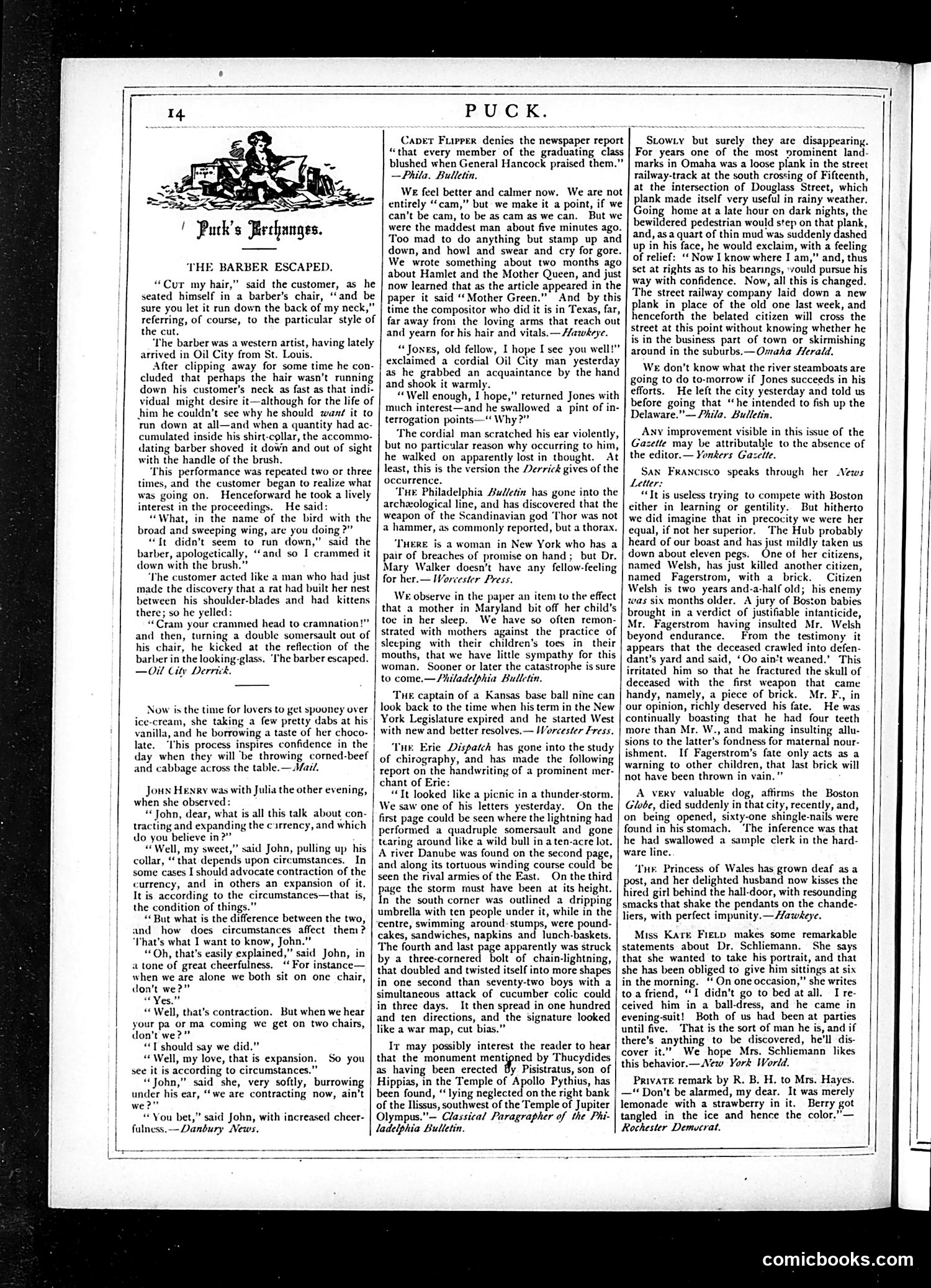
What you’re looking at
This page contains a humorous short story rather than a political cartoon. The narrative describes a barber in an Old City town who, after accidentally cutting a customer's neck, flees town in panic. The customer, initially injured, eventually realizes the wound is minor. The story satirizes overreaction and cowardice—the barber's extreme response to a small mistake. The piece appears designed for comedic effect through exaggeration of consequences and fear. Various editorial snippets and "letters" fill the rest of the page, addressing miscellaneous social topics like river steamboats, a woman in New York, and a valuable Boston dog. This reflects *Puck's* format of combining narrative humor with social commentary rather than relying solely on visual caricature.
📄 Transcribed text from this page (OCR, searchable)
Machine-transcribed from the original scan — historical spelling and the odd misread are preserved.
Puck 3 ‘Broa ‘THE BARBER ESCAPED. “Cur my hair,” said the customer, as he seated himself in a barber’s chair, ‘and be sure you let it run down the back of my neck,” referring, of course, to the particular style of the cut. ‘The barber was a western artist, having lately arrived in Oil City from St. Louis. After clipping away for some time he con- cluded that perhaps the hair wasn’t running down his customer's neck as fast as that indi- vidual might desire it—although for the life of him he couldn’t see why he should want it to run down at all—and when a quantity had ac- cumulated inside his shirt-collar, the accommo- dating barber shoved it down and out of sight with the handle of the brush. ‘This performance was repeated two or three times, and the customer began to realize what was going on. Henceforward he took a lively interest in the proceedings. He said: “What, in the name of the bird with the broad and sweeping wing, are you doing ?” “It didn’t seem to run down,” said the barber, apologetically, “and so 1 crammed it down with the brush.” ‘The customer acted like a man who had just made the discovery that a rat had built her nest between his shoulder-blades and had _ kittens there; so he yelled: “Cram your crammed head to cramnation!” and then, turning a double somersault out of his chair, he kicked at the reflection of the barber in the looking-glass. ‘I'he barber escaped. —Oil City Derrick. Now is the time for lovers to yet spooney over ream, she taking a few pretty dabs at his nd he borrowing a taste of her choco- is process inspires confidence in the day when they will be throwing corned-beef and cabbage across the table.— Mail. Jou Henry was with Julia the other evening, when she observed: “John, dear, what is all this talk about con- | tracting and expanding the currency, and which do you believe in?” “Well, my sweet,” said John, pulling up his collar, ‘that depends upon circumstances. In some cases I should advocate contraction of the currency, and in others an expansion of it. It is according to the circumstances—that is, the condition of thin, “ But what is the difference between the two, and how does circumstances affect them ? ‘That’s what I want to know, Jol “Oh, that’s easily explained,” said John, in a tone of great cheerfulness. ‘‘ For instance— when we are alone we both sit on one chair, don’t we?” “Yes,” “Well, that’s contraction. But when we hear your pa or ma coming we get on two chairs, don’t we?” “‘T should say we did.” “ Well, my love, that is expansion. see it is according to circumstances.” “John,” said she, very softly, burrowing under his ear, ‘we are contracting now, ain’t we?" “You bet,” said John, with increased cheer- fulness. Danbury News. So you PUCK. Caper Furrer denies the newspaper report “that every member of the graduating class blushed when General Hancock praised them.” —Phila. Bulletin. We feel better and calmer now. We are not entirely ‘‘cam,” but we make it a point, if we can’t be cam, to be as cam as we can. But we were the maddest man about five minutes ago. Too mad to do anything but stamp up and down, and howl and swear and cry for gore. We wrote something about two months ago about Hamlet and the Mother Queen, and just now learned that as the article appeared in the paper it said ‘‘Mother Green.” And _ by this time the compositor who did it is in Texas, far, far away from the loving arms that reach out and yearn for his hair and vitals.— Hawéeye. “Joxes, old fellow, L hope I see you well!” exclaimed a cordial Oil City man yesterday as he grabbed an acquaintance by the hand and shook it warmly. “Well enough, I hope,” returned Jones with much interest—and he swallowed a pint of in- terrogation points—‘ Why?” ‘The cordial man scratched his ear violently, but no particular reason why occurring to him, he walked on apparently lost in thought. At least, this is the version the Derrick gives of the occurrence. ‘Tue Philadelphia Budetin has gone into the archological line, and has discovered that the weapon of the Scandinavian god ‘Thor was not a hammer, as commonly reported, but a thorax. ‘Tere is a woman in New York who has a pair of breaches of promise on hand; but Dr. Mary Walker doesn’t have any fellow-fecling for her.— Worcester Press. We observe in the paper an item to the effect that a mother in Maryland bit off her child’s toe in her sleep. We have so often remon- strated with mothers against the practice of sleeping with their children’s toes in their mouths, that we have little sympathy for this woman. Sooner or later the catastrophe is sure to come.—hiladelphia Bulletin. ‘Tue captain of a Kansas base ball nine can look back to the time when his term in the New York Legislature expired and he started West with newand better resolves.— Worcester Fress. ‘Tne. Erie Dispatch has gone into the study of chirography, and has made the following report on the handwriting of a prominent mer- chant of Erie: “It looked like a picnic in a thunder-storm. We saw one of his letters yesterday. On the first page could be seen where the lightning had | performed a quadruple somersault and gone | tearing around like a wild bull in aten-acre lot. A river Danube was found on the second page, and along its tortuous winding course could be seen the rival armies of the East. On the third page the storm must have been at its height. In the south corner was outlined a dripping umbrella with ten people under it, while in the ‘centre, swimming around: stumps, were pound- cakes, sandwiches, napkins and lunch-baskets. ‘The fourth and last page apparently was struck by a three-cornere¢ bolt of chain-lightning, that doubled and twisted itself into more shapes in one second than seventy-two boys with a simultaneous attack of cucumber colic could in three days. It then spread in one hundred and ten directions, and the signature looked like a war map, cut bias.” Ir may possibly interest the reader to hear that the monument mentipned by Thucydides as having been erected By Pisistratus, son of Hippias, in the Temple of Apollo Pythius, has been found, “lying neglected on the right bank of the Ilissus, southwest of the Temple of Jupiter Olympus.”— Classical Paragrapher of the Phi- ladelphia Bulletin. Stowiy but surely they are disappearing. For years one of the most vrominent land- marks in Omaha was a loose plank in the street railway-track at the south crossing of Fifteenth, at the intersection of Douglass Street, which plank made itself very useful in rainy weather. Going home at a late hour on dark nights, the bewildered pedestrian would step on that plank, and, asa quart of thin mud was suddenly dashed up in his face, he would exclaim, with a feeling of relief: ‘‘ Now I know where I am,” and, thus set at rights as to his bearings, ‘vould pursue his way with confidence. Now, all this is changed. The street railway company laid down a new plank in place of the old one last week, and henceforth the belated citizen will cross the street at this point without knowing whether he is in the business part of town or skirmishing around in the suburbs.— Omaha Herald. We don’t know what the river steamboats are going to do to-morrow if Jones succeeds in his efforts. He left the city yesterday and told us before going that “he intended to fish up the Delaware.” — Phila. Bulletin. Avy improvement visible in this issue of the Gazette may be attributable to the absence of the editor.— Yonkers Gazette. San Francisco speaks through her Vews Letter: “Tt is useless trying to compete with Boston either in learning or gentility. But hitherto we did imagine that in precocity we were her equal, if not her superior. ‘The Hub probably heard of our boast and has just mildly taken us down about eleven pegs. One of her citizens, named Welsh, has just killed another citizen, named Fagerstrom, with a brick. Citizen Welsh is two years and-a-half old; his enemy was six months older. A jury of Boston babies brought in a verdict of justifiable intanticide, Mr. Fagerstrom having insulted Mr. Welsh beyond endurance. From the testimony it appears that the deceased crawled into defen- dant’s yard and said, ‘Oo ain't weaned.’ This irritated him so that he fractured the skull of deceased with the first weapon that came handy, namely, a piece of brick. Mr. F., in our opinion, richly deserved his fate. He was continually boasting that he had four teeth more than Mr. W., and making insulting allu- sions to the latter’s fondness for maternal nour- ishment. If Fagerstrom’s fate only acts as a warning to other children, that last brick will not have been thrown in vain.” A very valuable dog, affirms the Boston Globe, died suddenly in that city, recently, and, on being opened, sixty-one shingle-nails were found in his stomach. ‘The inference was that he had swallowed a sample clerk in the hard- ware line. ‘rue Princess of Wales has grown deaf asa post, and her delighted husband now kisses the hired girl behind the hall-door, with resounding smacks that shake the pendants on the chande- liers, with perfect impunity.— Hawkeye. Miss Kare Fietp makes some remarkable statements about Dr. Schliemann. She says that she wanted to take his portrait, and that she has been obliged to give him sittings at six in the morning. ‘ On one occasion,” she writes toa friend, “I didn’t go to bed at all. I re- ceived him in a ball-dress, and he came in evening-suit! Both of us had been at parties until five. ‘That is the sort of man he is, and if there’s anything to be discovered, he'll dis- cover it.” We hope Mrs. Schliemann likes this behavior.—New York World. Private remark by R. B. H. to Mrs. Hayes. — Don’t be alarmed, my dear. It was merely lemonade with a strawberry in it. Berry got tangled in the ice and hence the color.”— Rochester Demucrat. comicbooks.com