
Puck, 1877-07-11 · page 16 of 20
Puck — July 11, 1877 — page 16: what you’re looking at
What you’re looking at
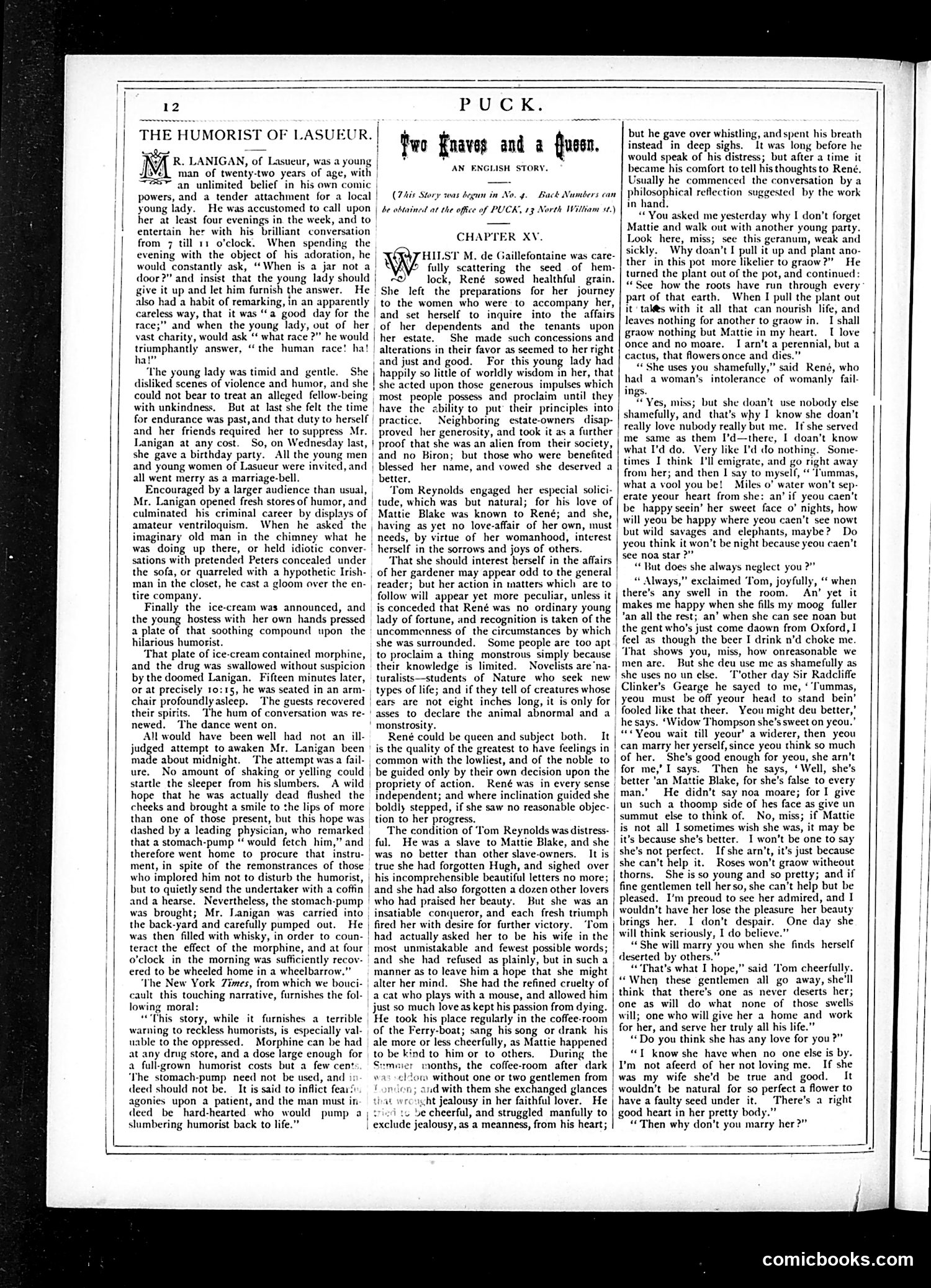
This page from *Puck* magazine contains the beginning of a serialized English short story titled "Two Knaves and a Queen" (Chapter XV), credited to an author identified in the header as writing "for the office of PUCK, 13 North William st." The page is **not a political cartoon or satire**—it's a work of fiction. The story concerns M. de Gaillefontaine and matters of estate management, inheritance, and romantic relationships among nobility. It appears to be a melodramatic narrative typical of serial fiction published in 19th-century American magazines. The text discusses characters like Tom Reynolds, Mattie Blake, and Rene, involving themes of class distinction, unrequited love, and social propriety. This is literary content rather than political commentary.
📄 Transcribed text from this page (OCR, searchable)
Machine-transcribed from the original scan — historical spelling and the odd misread are preserved.
THE HUMORIST OF KS R. LANIGAN, of Lasueur, was a youn man of twenty an unlimited belief in his own comic powers, and a tender attachment for a local young lady. He was accustomed to call upon her at least four evenings in the week, and to entertain her with his brilliant conversation from 7 till 11 o'clock. When spending the evening with the object of his adoration, he would constantly ask, ‘ When i: door?” and insist that the young lady should | give it up and let him furnish the answer. He | also had a habit of remarking, in an apparently careless way, that it was ‘(a good day for the race;” and when the young lady, out of her vast charity, would ask “ what race ?” he would triumphantly answer, “the human race! ha! ‘The young lady was timid and gentle. She disliked scenes of violence and humor, and she wo years of age, with | a jar not a! | and just and good. could not bear to treat an alleged fellow-being | with unkindness. But at last she felt the time for endurance was past, and that duty to herself and her friends required her to suppress Mr. Lanigan at any cost. So, on Wednesday last, she gave a birthday party. All the young men and young women of Lasueur were invited, and all went merry as a marriage-bell. Encouraged by a larger audience than usual, Mr. Lanigan opened fresh stores of humor, and culminated his criminal career by displays of amateur ventriloquis! When he asked the imaginary old man in the chimney what he was doing up there, or held idiotic conver- sations with pretended Peters concealed under the sofa, or quarreled with a hypothetic Irish- man in the closet, he cast a gloom over the en- tire company. Finally the ice-cream was announced, and the young hostess with her own hands pressed a plate of that soothing compound upon the hilarious humorist. ‘That plate of ice-cream contained morphine, and the drug was swallowed without suspicion by the doomed Lanigan. Fifteen minutes later, or at precisely 10:15, he was seated in an arm- chair profoundly asleep. ‘The guests recovered their spirits. The hum of conversation was re- newed. The dance went on. All would have been well had not an ill- judged attempt to awaken Mr. Lanigan been made about midnight. The attempt was a fail- ure. No amount of shaking or yelling could startle the sleeper from his slumbers. A wild hope that he was actually dead flushed the cheeks and brought a smile to the lips of more than one of those present, but this hope was dashed by a leading physician, who remarked that a stomach-pump “would fetch him,” and therefore went home to procure that instru- ment, in spite of the remonstrances of those who implored him not to disturb the humorist, but to quietly send the undertaker with a coffin and a hearse. Nevertheless, the stomach-pump as brought; Mr. Lanigan was carried into the back-yard and carefully pumped out. He was then filled with whisky, in order to coun- teract the effect of the morphine, and at four o'clock in the morning was sufficiently recov- ered to be wheeled home in a wheelbarrow.” ‘The New York Zimes, from which we bouci- cault this touching narrative, furnishes the fol- lowing moral: “This story, while it furnishes a terrible warning to reckless humorists, is especially val- uable to the oppressed. Morphine can be had at any drug store, and a dose large enough for a full-grown humorist costs but a few cent ‘The stomach-pump need not be used, and deed should not be. It is said to inflict fear‘ agonies upon a patient, and the man must in deed be hard-hearted who would slumbering humorist back to life.” | and no Biron; but those who were benefited ‘herself in the sorrows and joys of others. LASUEUR. | | | fired her with desire for further v pump a) | exclude jealousy, as a meanness, from his heart; PUCK. fo fnaves and a fuser. AN ENGLISH STORY. Back Numbers can orth William st.) (This Story was begun in No. 4. be obtained at the office of PUCK, 13! CHAPTER XV. J HI. ST M. de Gaillefontaine was care- WA > fully scattering the seed of hem- lock, René sowed healthful grain. she. left the preparations for her journey to the women who were to accompany her, and set herself to inquire into the affairs of her dependents and the tenants upon her estate. She made such concessions and alterations in their favor as seemed to her right For this young lady had happily so little of worldly wisdom in her, that she acted upon those generous impulses which most people possess and proclaim until they have the ability to put their principles into practice. Neighboring estate-owners disap- proved her generosity, and took it as a further proof that she was an alien from their society, blessed her name, and vowed she deserved a better. ‘Tom Reynolds engaged her especial solici- tude, which was but natural; for his love of Mattie Blake was known to René; and she, having as yet no love-affair of her own, must needs, by virtue of her womanhood, interest That she should interest herself in the affairs of her gardener may appear odd to the general | reader; but her action in matters which are to follow will appear yet more peculiar, unless it is conceded that René was no ordinary young lady of fortune, and recognition is taken of the uncommonness of the circumstances by which she was surrounded. Some people are too apt | to proclaim a thing monstrous simply because their knowledge is limited. Novelists are‘na- turalists—students of Nature who seek new types of life; and if they tell of creatures whose ears are not eight inches long, it is only for asses to declare the animal abnormal and a monstrosity. René could be queen and subject both. It is the quality of the greatest to have feelings in | common with the lowliest, and of the noble to be guided only by their own decision upon the | propriety of action. René was in every sense independent; and where inclination guided she | boldly stepped, if she saw no reasonable objec- tion to her progress. The condition of ‘Tom Reynolds was distress- ful. He was a slave to Mattie Blake, and she | #! was no better than other slave-owners. It is true she had forgotten Hugh, and sighed over his incomprehensible beautiful letters no more; and she had also forgotten a dozen other lovers who had praised her beauty. But she was an insatiable conqueror, and each fresh triumph ‘tory. ‘Tom had actually asked her to be his wife in the most unmistakable and fewest possible words; | and she had refused as plainly, but in such a manner as to leave him a hope that she might alter her mind. She had the refined cruelty of | a cat who plays with a mouse, and allowed him | just so much loveas kept his passion from dying. He took his place regularly in the coffee-room of the Ferry-boat; sang his song or drank his ale more or less cheerfully, as Mattie happened | to be kind to him or to others. During the Srmeier months, the coffee-room after dark | was eldon without one or two gentlemen from | and with them she exchanged glances | <ht jealousy in her faithful lover. He i te be cheerful, and struggled manfully to niden | she can’t help it. | pleased. but he gave over whistling, and spent his breath instead in deep sighs. It was long before he would speak of his distress; but after a time it became his comfort to tell his thoughts to René. Usually he commenced the conversation by a philosophical reflection suggested by the work in hand. “You asked me yesterday why I don’t forget Mattie and walk out with another young party. Look here, miss; see this geranum, weak and sickly. Why doan’t I pull it up and plant ano- ther in this pot more likelier to graow?” He turned the plant out of the pot, and continued : “See how the roots have run through every part of that earth. When I pull the plant out it tals with it all that can nourish life, and leaves nothing for another to graow in. I shall graow nothing but Mattie in my heart. I love once and no moare. I arn’t a perennial, but a cactus, that flowers once and dies.”” “She uses you shamefully,” said René, who had a woman's intolerance of womanly fail- ings. “Yes, miss; but she doan’t use nobody else shamefully, and that’s why I know she doan't really love nubody really but me. If she served me same as them I’d—there, I doan’t know what I'd do. Very like I'd do nothing. Some- times I think I'll emigrate, and go right away from her; and then | say to myself, “‘l'ummas, what a vool you be! Miles 0’ water won't sep- erate yeour heart from she: an’ if yeou caen’t be happy seein’ her sweet face o” nights, how will yeou be happy where yeou caen’t see nowt but wild savages and elephants, maybe? Do yeou think it won’t be night because yeou caen’t see noa star ?” “But does she always neglect you ?” “ Always,” exclaimed ‘Tom, joyfully, “ when there's any swell in the room. An’ yet it makes me happy when she fills my moog. fuller ‘an all the rest; an’ when she can see noan but the gent who's just come daown from Oxford, I feel as though the beer I drink n’d choke me. ‘That shows you, miss, how onreasonable we men are. But she deu use me as shamefully as she uses no un else. ‘I’other day Sir Radcliffe Clinker’s Gearge he sayed to me, ‘‘Tummas, yeou must be off yeour head to stand bein’ fooled like that theer. Yeou might deu better,’ he says. ‘Widow Thompson she’s sweet on yeou.’ “*Yeou wait till yeour’ a widerer, then’ yeou can marry her yerself, since yeou think so much of her. She's good enough for yeou, she arn't for me,’ I says. Then he says, ‘Well, she’s better ‘an Mattie Blake, for she’s false to every man.’ He didn’t say noa moare; for I give un such a thoomp side of hes face as give un summut else to think of. No, miss; if Mattie is not all I sometimes wish she was, it may be because she’s better. I won't be one to say not perfect. Ifshe arn't, it’s just because Roses won't graow witheout thorns. She is so young and so pretty; and if fine gentlemen tell her so, she can’t help but be I’m preoud to see her admired, and I wouldn’t have her lose the pleasure her beauty brings her. I don’t despair. One day she will think seriously, I do believe.” “She will marry you when she finds herself deserted by others.” “That's what I hope,” said ‘Tom cheerfully. “When these gentlemen all go away, she'll | think that there’s one as never deserts her; one as will do what none of those swells will; one who will give her a home and work for her, and serve her truly all his life.”” “Do you think she has any love for you?” “I know she have when no one else is by. ’m not afecrd of her not loving me. If she was my wife she’d be true and good. It wouldn’t be natural for so perfect a flower to have a faulty seed under it. There's a right good heart in her pretty body.” “Then why don't you marry her?” comicbooks.com