
A complete issue · 16 pages · 1877
Puck — June 1877
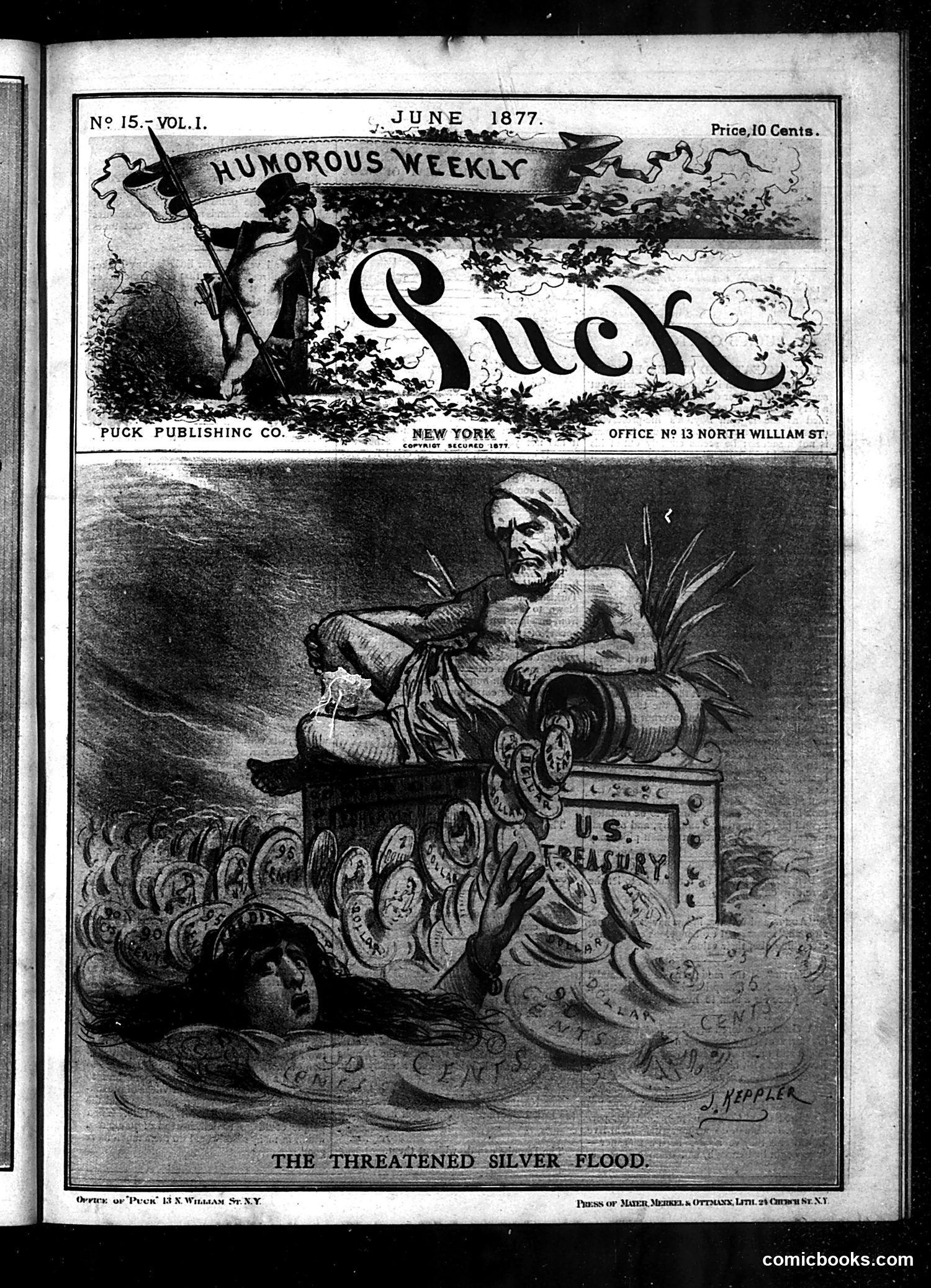
This 1877 Puck cartoon satirizes anxieties about silver coinage. A bearded figure (likely representing the U.S. Treasury or government finances) sits precariously atop a box labeled "U.S. TREASURY," surrounded by an overwhelming flood of silver coins and coins marked "CENT." The cartoon warns of economic danger from excessive silver production or circulation—what contemporaries called the "silver question." During the 1870s, Western silver mining interests pushed for unlimited coinage of silver, while conservative economists feared this would destabilize the currency and drain the Treasury. The figure's precarious position and the swirling mass of coins convey the cartoon's warning that unchecked silver coinage threatened national financial stability. The satire targets ongoing debates over monetary policy that dominated American politics in this era.
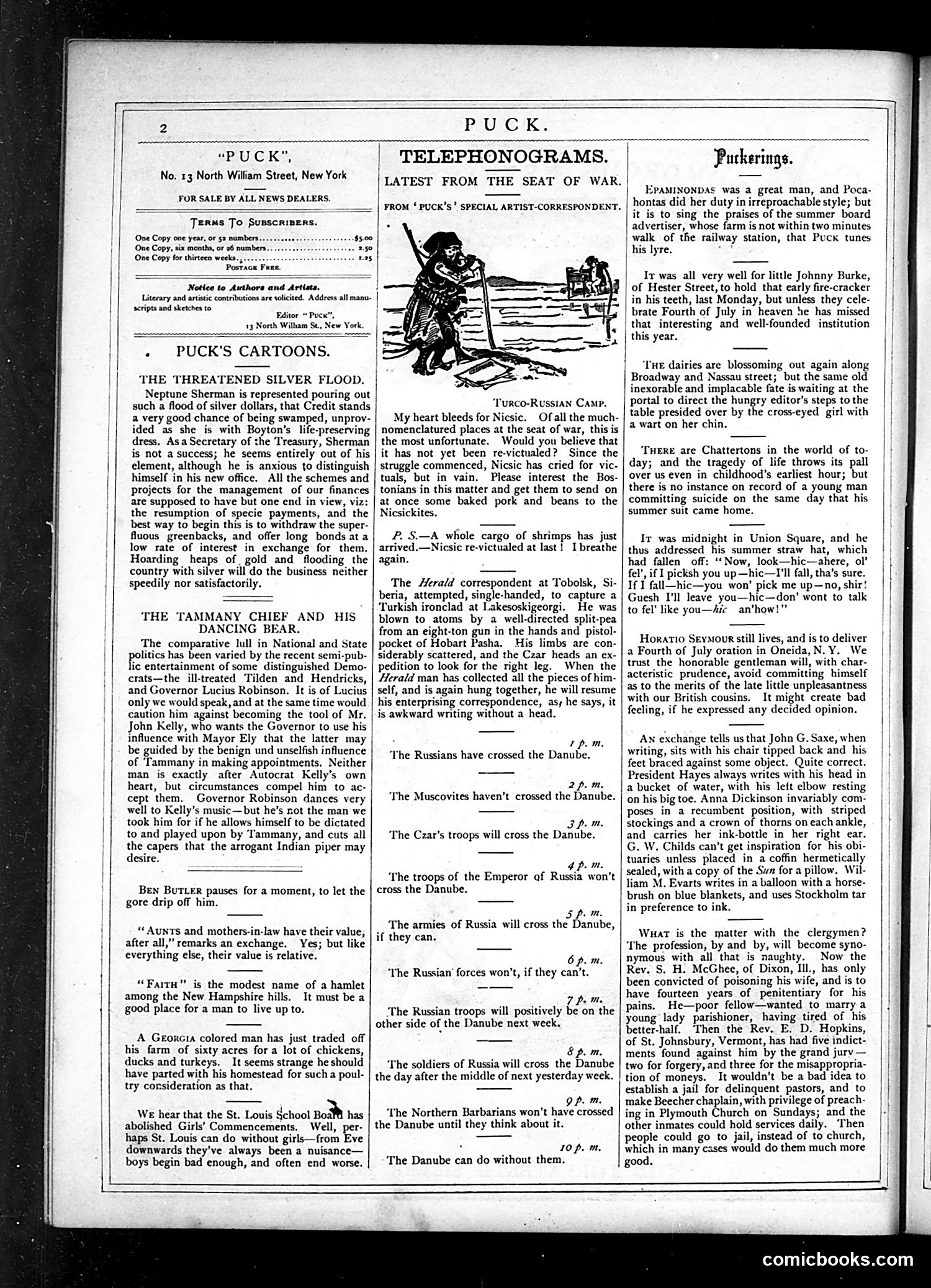
This cartoon depicts the Russo-Turkish War, likely from the 1870s conflict. The image shows a caricatured Turkish soldier crying or grieving over a dead comrade at a military camp, with Russian forces visible in the background. The satire mocks Turkish military incompetence and suffering in the war. The exaggerated facial features reflect period racial stereotyping common to 19th-century American satirical magazines. The accompanying "Telephonograms" section contains mock predictions about Russian military advances crossing the Danube River, satirizing either Russian overconfidence or Turkish military weakness. The overall message appears to criticize Turkish forces while also likely commenting on American political attitudes toward the geopolitical conflict.
This page contains examination papers, educational content, and brief satirical sections rather than a prominent political cartoon. **Key content includes:** - **Grant's Examination Papers**: Satirizes President Grant's fitness for office, suggesting he lacks qualifications and intellectual capacity for the role. - **Dana as a Damper**: Mocks Dana (likely Charles A. Dana, newspaper editor) for his moralizing about American youth and society—suggesting his sanctimonious criticism is misplaced and ineffective. - **Histrionic Bulldozing**: References William R. Floyd's theatrical failures in Boston and his subsequent involvement in dubious business ventures, mocking his dishonesty. - **Summer Resort Notes & Frenzy**: Light, gossipy commentary on vacation destinations and human behavior. The page emphasizes Puck's blend of political critique and social satire aimed at public figures and contemporary attitudes.
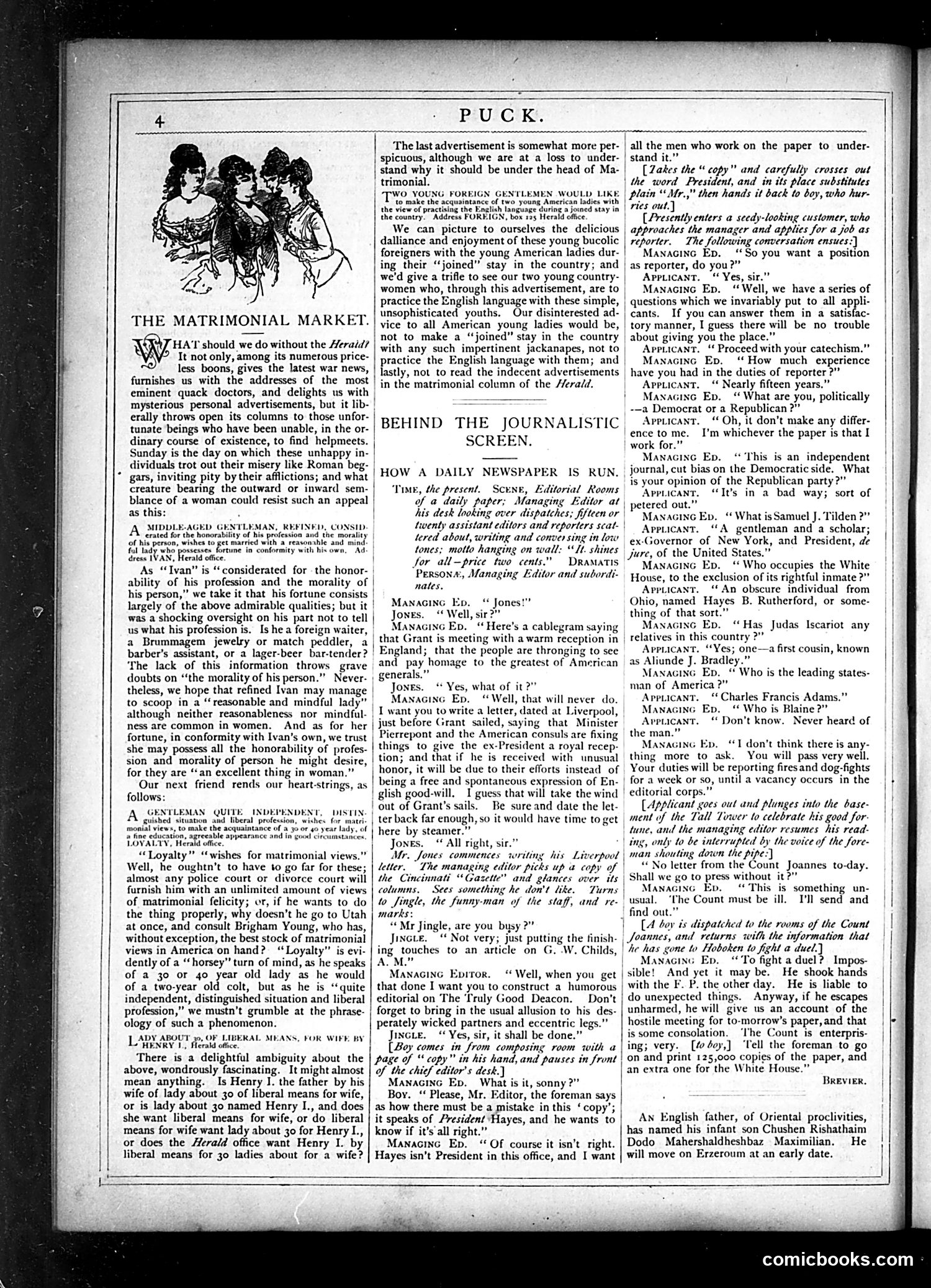
The left illustration depicts three young women and satirizes matrimonial advertisements in the *Herald* newspaper. The accompanying editorial criticizes these ads for promoting English language instruction to "young American ladies" as a means to attract foreign suitors—essentially marketing American women to European men. The satire targets what Puck saw as undignified commodification of marriage, mocking both the advertisements themselves and American women's willingness to participate. The piece argues these ads encourage unsophisticated romantic pursuits and ridicules the implied transactional nature of such unions. This reflects late 19th/early 20th-century anxieties about immigration, international marriage, and women's agency in romantic decisions—positioning matrimonial advertising as a dubious, somewhat scandalous practice.
This page from *Puck* contains three distinct sections: "The Ballad of Lord Ulysses" (a poem satirizing diplomatic relations), "My Relations with England" (prose commentary by Joseph Perkins), and "Our Watering-Place Correspondence" (brief social notes). The main content appears to address Anglo-American relations, likely from the late 19th century. The ballad and Perkins's piece discuss Queen Victoria, the Prince of Wales, and diplomatic tensions between the nations. The satire seems to critique British-American relations and court protocol. "Puck's Personal Intelligence" consists of brief humorous social quips about prominent figures and New York society. Without seeing illustrations clearly, I cannot identify specific caricatures, but the text indicates political commentary on transatlantic relations and contemporary social figures.
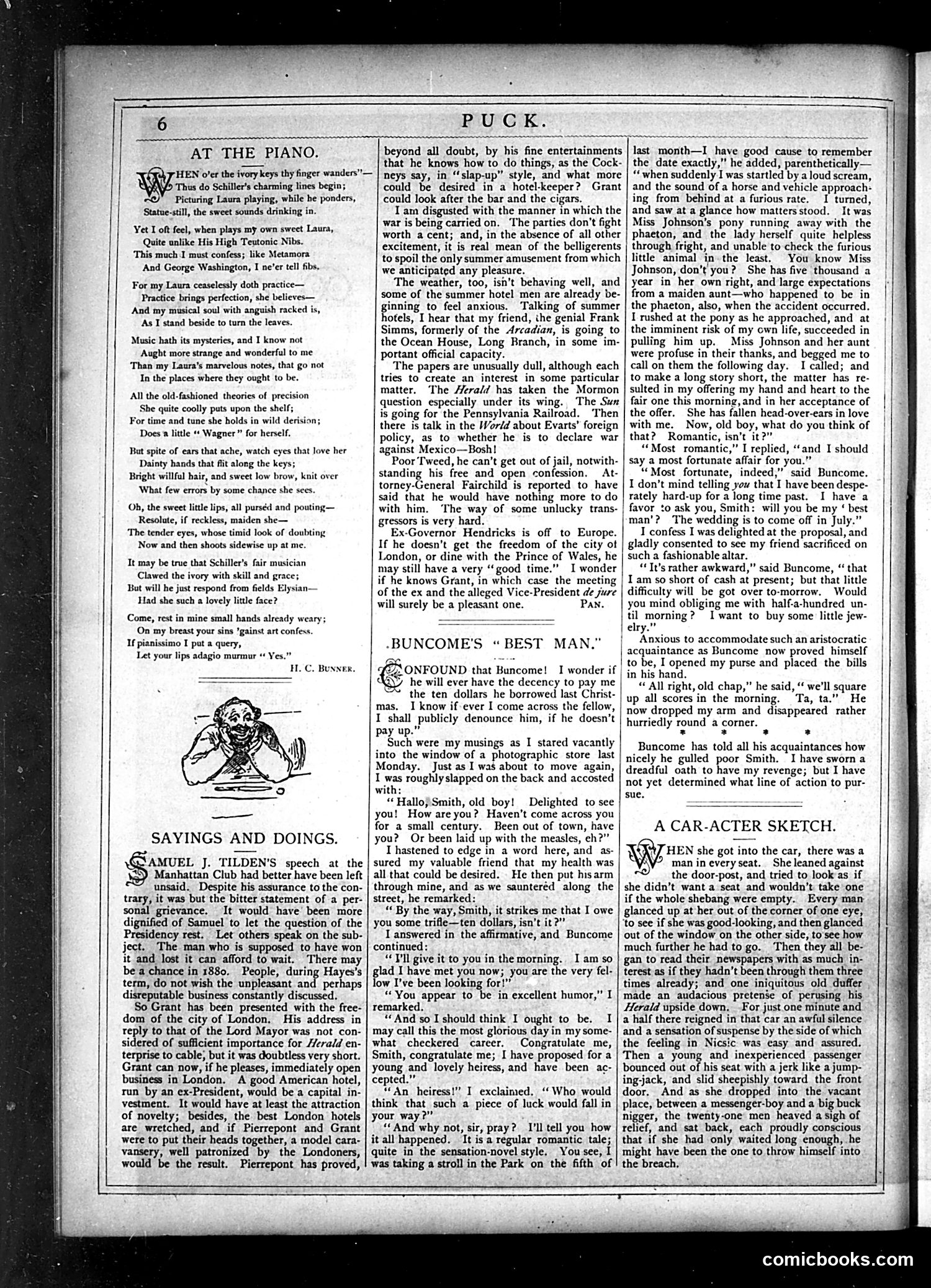
This page contains three separate articles/sections rather than political cartoons: 1. **"At the Piano"** - A poem about Laura, apparently a pianist, with romantic/domestic themes. 2. **"Sayings and Doings"** - A brief satirical piece about the Manhattan Club supposedly left in financial distress, with commentary on London clubs and their management. 3. **"Buncome's 'Best Man'"** and **"A Car-Actor Sketch"** - Two humorous anecdotes: one about borrowing money at Christmas, the other about awkward silence in a car ride. The cartoon illustration shows a man at a desk, seemingly distressed or contemplative, likely accompanying the monetary anecdote. These are general-interest humor pieces rather than political satire, typical of Puck's mix of social commentary and lighthearted entertainment content.
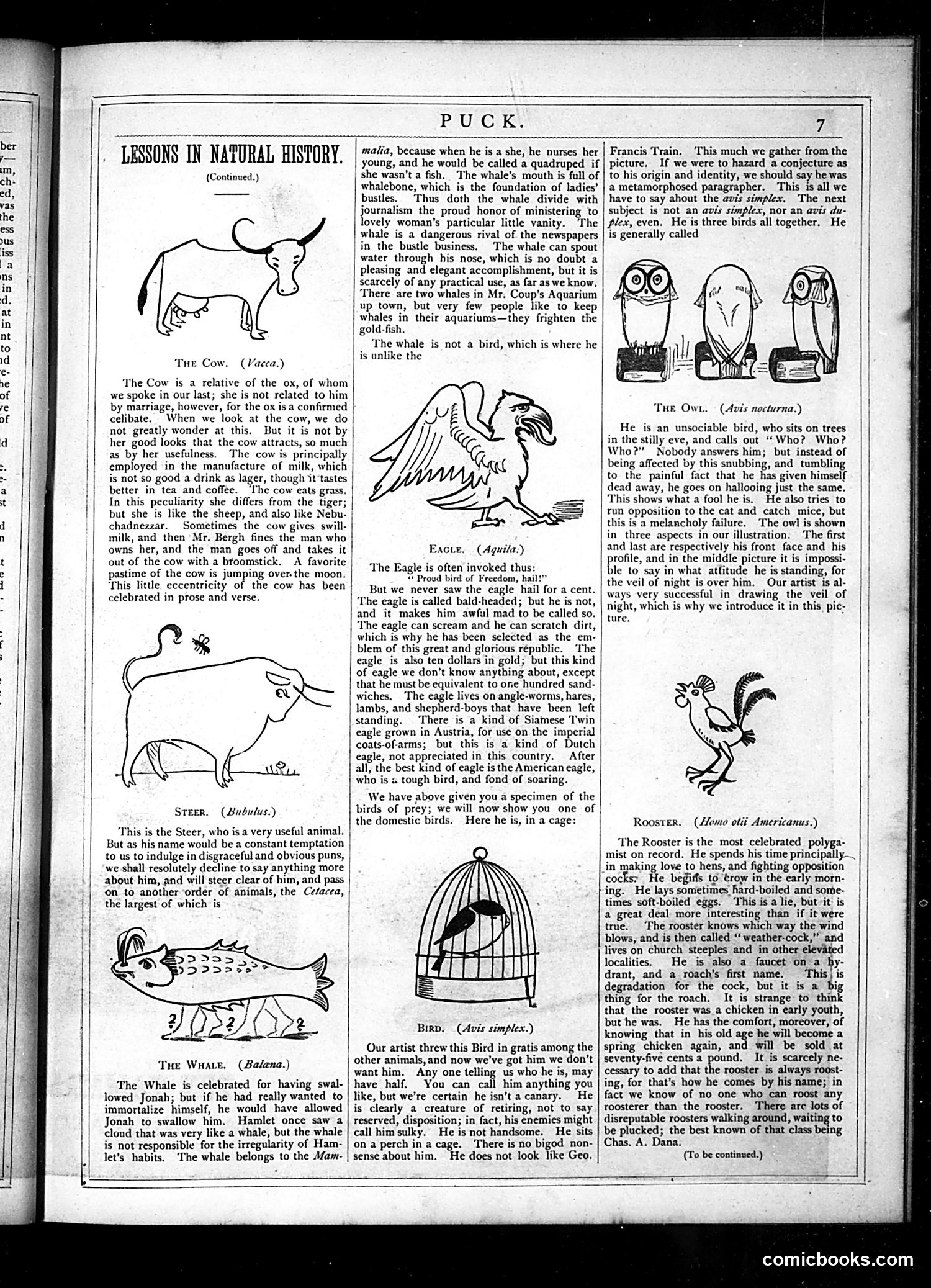
This is a humorous educational feature, not political satire. The page presents illustrated lessons about animals with tongue-in-cheek descriptions: - **The Cow**: Portrayed as useful but unintelligent, employed mainly in milk manufacture - **The Steer**: Described as "very useful" but name-wise problematic - **The Whale**: Satirized for its impracticality and comparison to newspapers - **The Eagle**: Mocked as overrated ("ten dollars in gold") and ineffective - **The Owl**: Criticized as unsociable and poor at catching mice - **The Rooster**: Celebrated as a polygamist with noisy habits; noted as originally a chicken The satire targets both animal characteristics and human attitudes toward them—deflating romantic notions (like the eagle as a "glorious republic" symbol) while finding humor in overlooked or underappreciated creatures. It's social commentary wrapped in natural history.
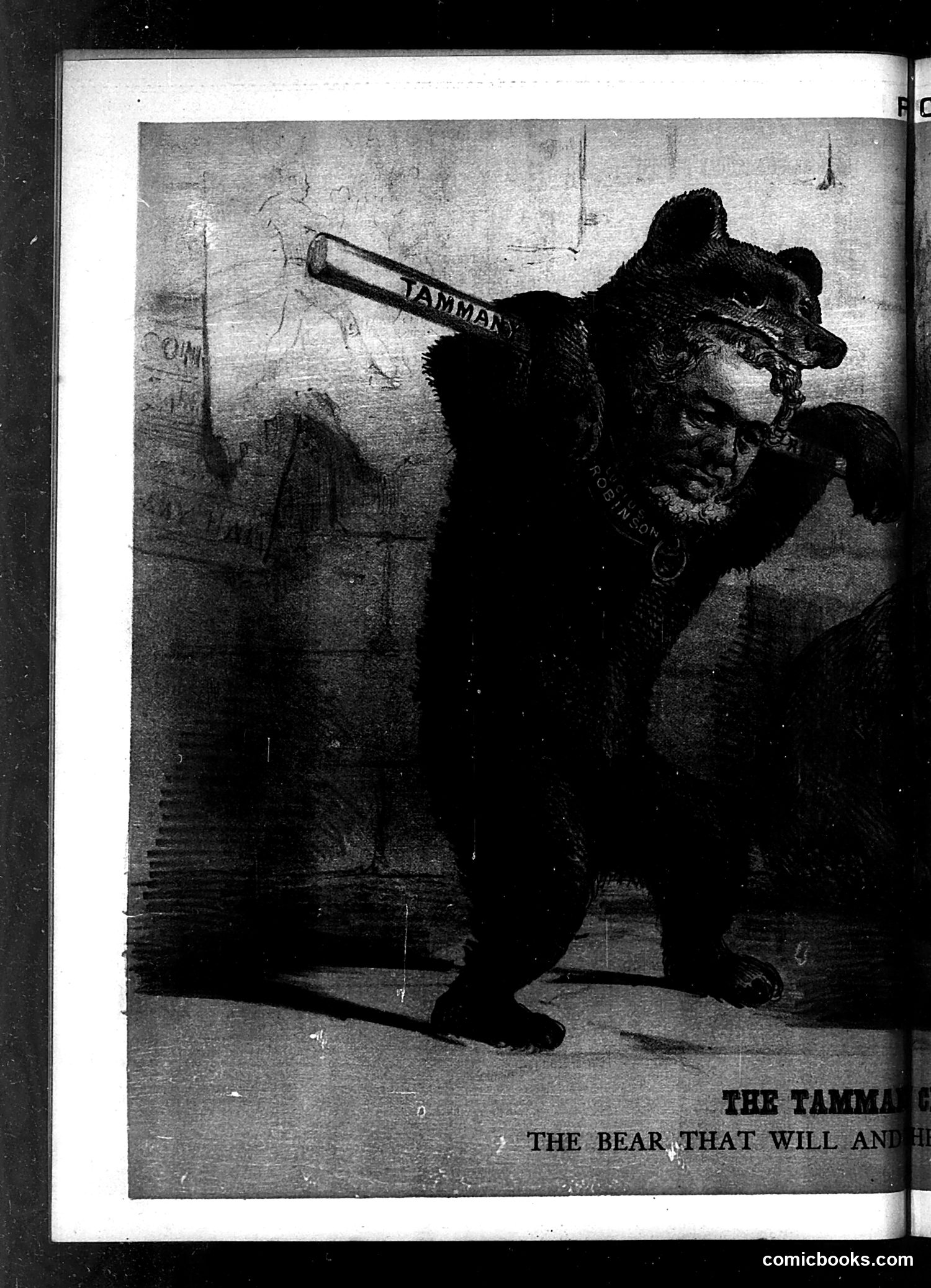
This political cartoon depicts a bear in formal dress with a collar labeled "TAMMA" (likely Tammany Hall, the infamous New York City Democratic political machine). The bear appears aggressive or threatening, wielding what looks like a club or pipe. The satire targets Tammany Hall's political corruption and strongarm tactics. The bear—a common symbol for Russia in 19th-century American political cartoons—suggests either Russian imperial influence or simply uses the bear metaphor for crude, aggressive power. The formal attire ironically contrasts with the brutish weapon, highlighting the hypocrisy of corrupt politicians dressed in respectability while employing violence and intimidation. The incomplete caption prevents full interpretation of the specific message.
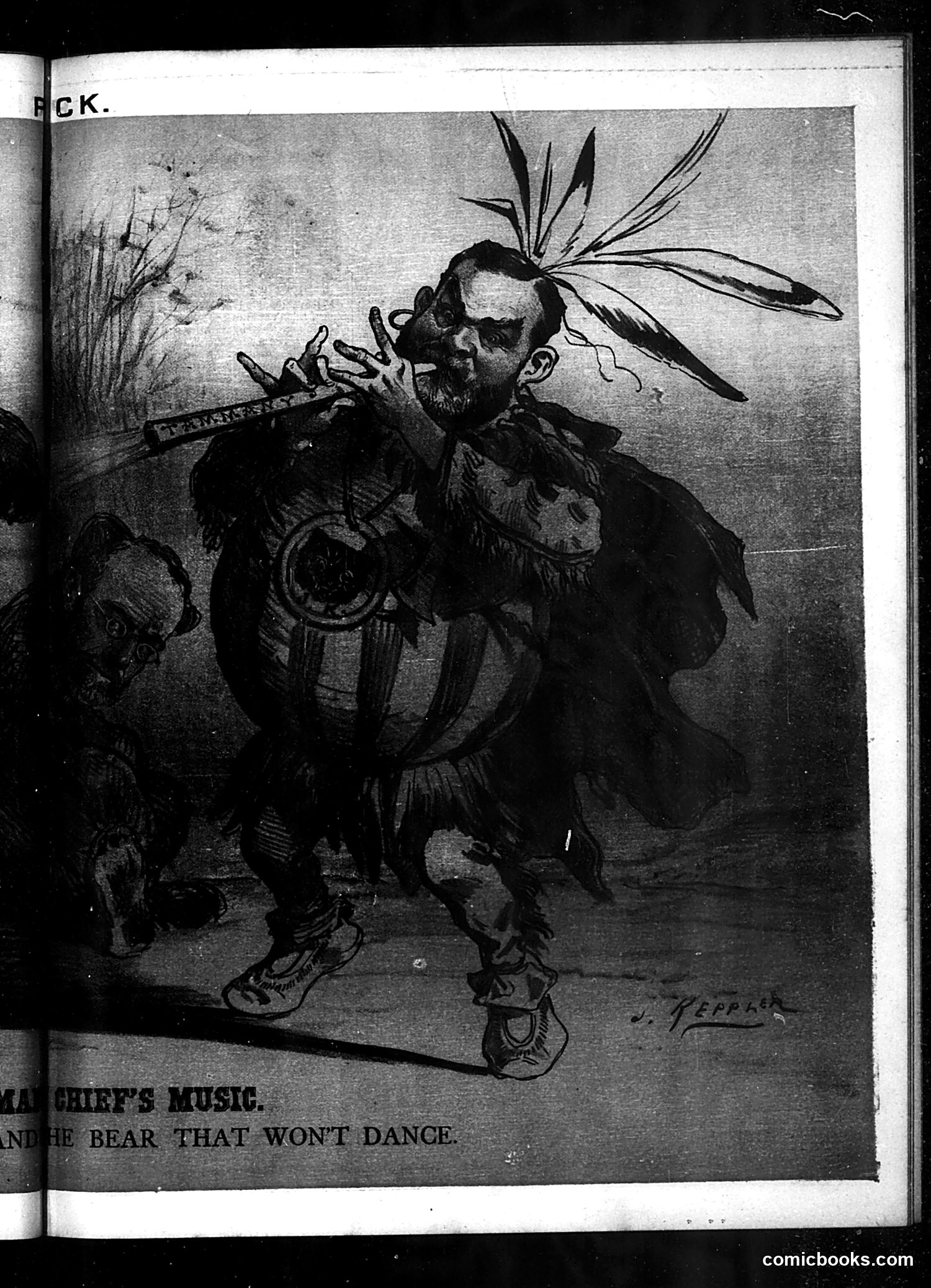
This Puck cartoon depicts a bearded man playing a pipe or flute while a bear refuses to dance. The title suggests political allegory: the "Chief" (likely a political leader) attempts to control or manipulate the "Bear" (possibly representing Russia or another nation) through persuasion or coercion, but the bear stubbornly resists. The image satirizes diplomatic efforts or political pressure that prove ineffective. The man's frustrated expression and the bear's defiant posture emphasize the futility of the situation. The surrounding creatures and decorative elements add whimsical detail to what is fundamentally a commentary on failed political negotiations or an intractable international conflict. The cartoon critiques either leadership incompetence or the impossibility of controlling an unwilling party.
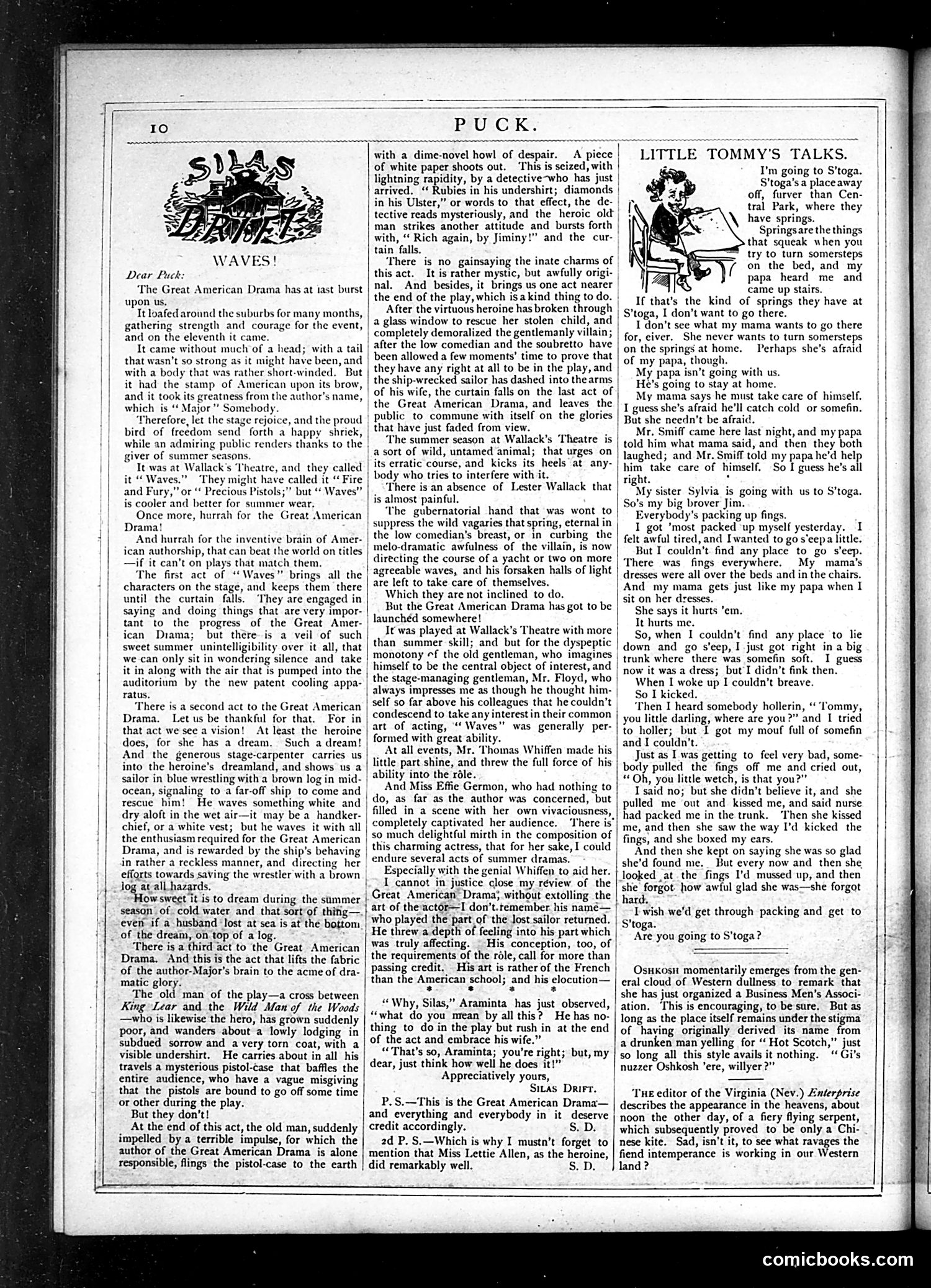
This page contains two distinct sections: **Left: "Waves!" Letter to the Editor** A theatrical review praising "The Great American Drama" at Wallack's Theatre. The writer celebrates the play's inventiveness and its actors—particularly praising Mr. Floyd's performance and Miss Effie Germmon's captivating portrayal. The piece critiques the play's melodramatic plot while admiring its technical execution and emotional depth. This appears to be genuine theater criticism rather than satire. **Right: "Little Tommy's Talks"** A humorous column featuring a child's complaints about everyday situations—refusing to visit Stoga Park, disliking spring cleaning, resisting bedtime. The child's reasoning is presented with innocent logic that adults would find amusing. Neither section appears to be overtly political satire, focusing instead on entertainment and domestic humor typical of Puck's lighter content.
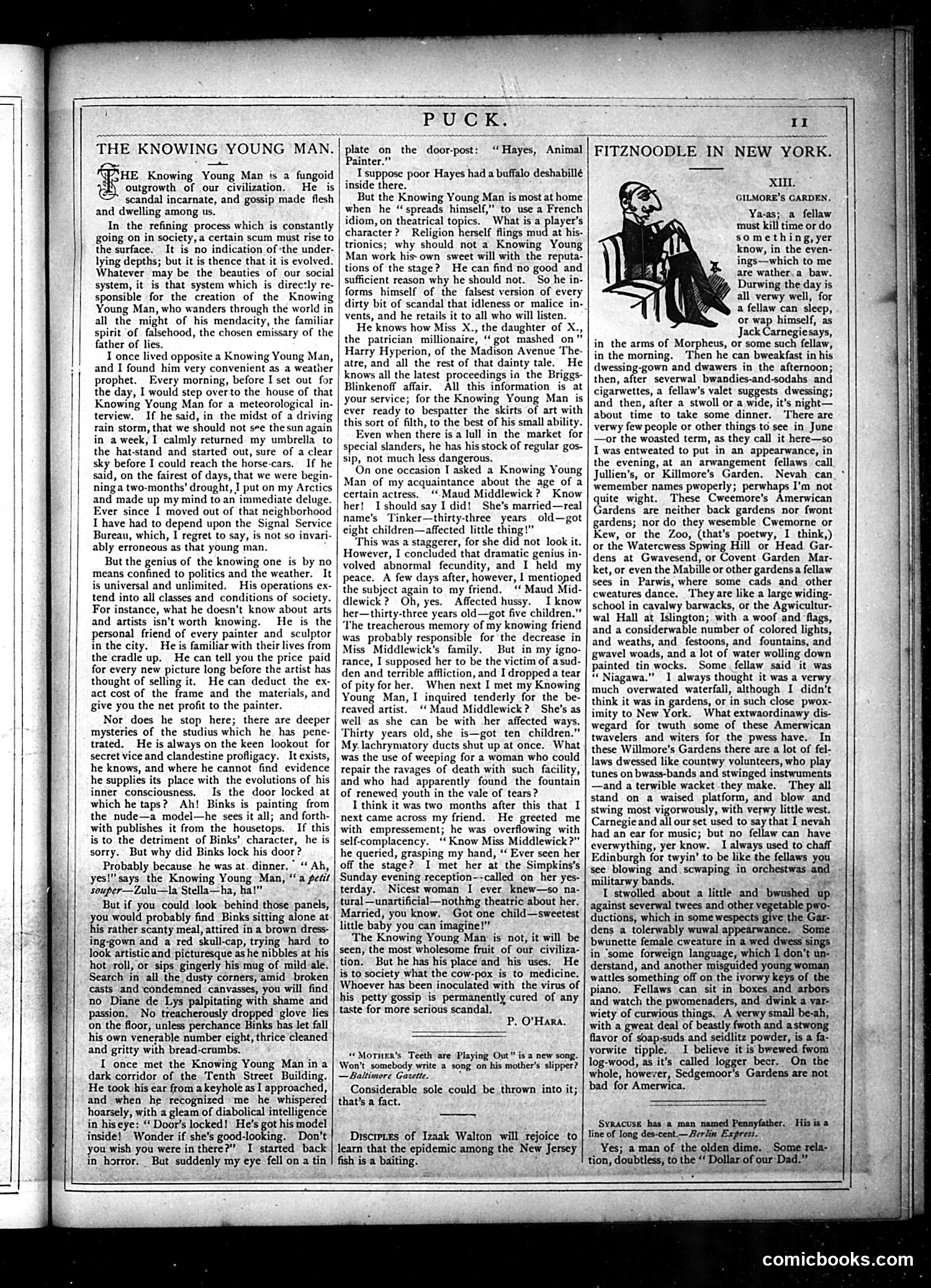
This is a satirical essay (not a cartoon) mocking the "Knowing Young Man" — a type of pretentious urban dandy who affects worldly sophistication while being fundamentally shallow and morally corrupt. The author critiques how such men exploit high society, seduce women, and spread gossip while masquerading as cultured gentlemen. The piece uses specific examples (including a reference to "Maud Middlewick") to show how the "Knowing Young Man" causes real social damage — broken families, ruined reputations — yet faces no consequences because his superficial charm and fashionable appearance protect him from judgment. The satire targets Gilded Age social hypocrisy: society tolerates destructive behavior from well-dressed men in good standing, regardless of their actual character or ethics.
This page contains Chapter XII of a serialized story rather than a political cartoon. The narrative involves **Monsieur and Madame de Gaillefontaine** and concerns a disputed inheritance or property matter. The story depicts genteel social conflict: a character named **Mr. Fox** appears to be a dishonest figure involved in some scheme, while **Gregory Biron** and **Miss Hiron** factor into negotiations over property and justice. The dialogue emphasizes themes of deception, class distinctions, and moral rectitude typical of Puck's satirical fiction. Without the story's beginning or broader context, the specific political or social satire remains unclear, though the title's reference to "two knaves and a queen" suggests commentary on dishonesty among the upper classes.
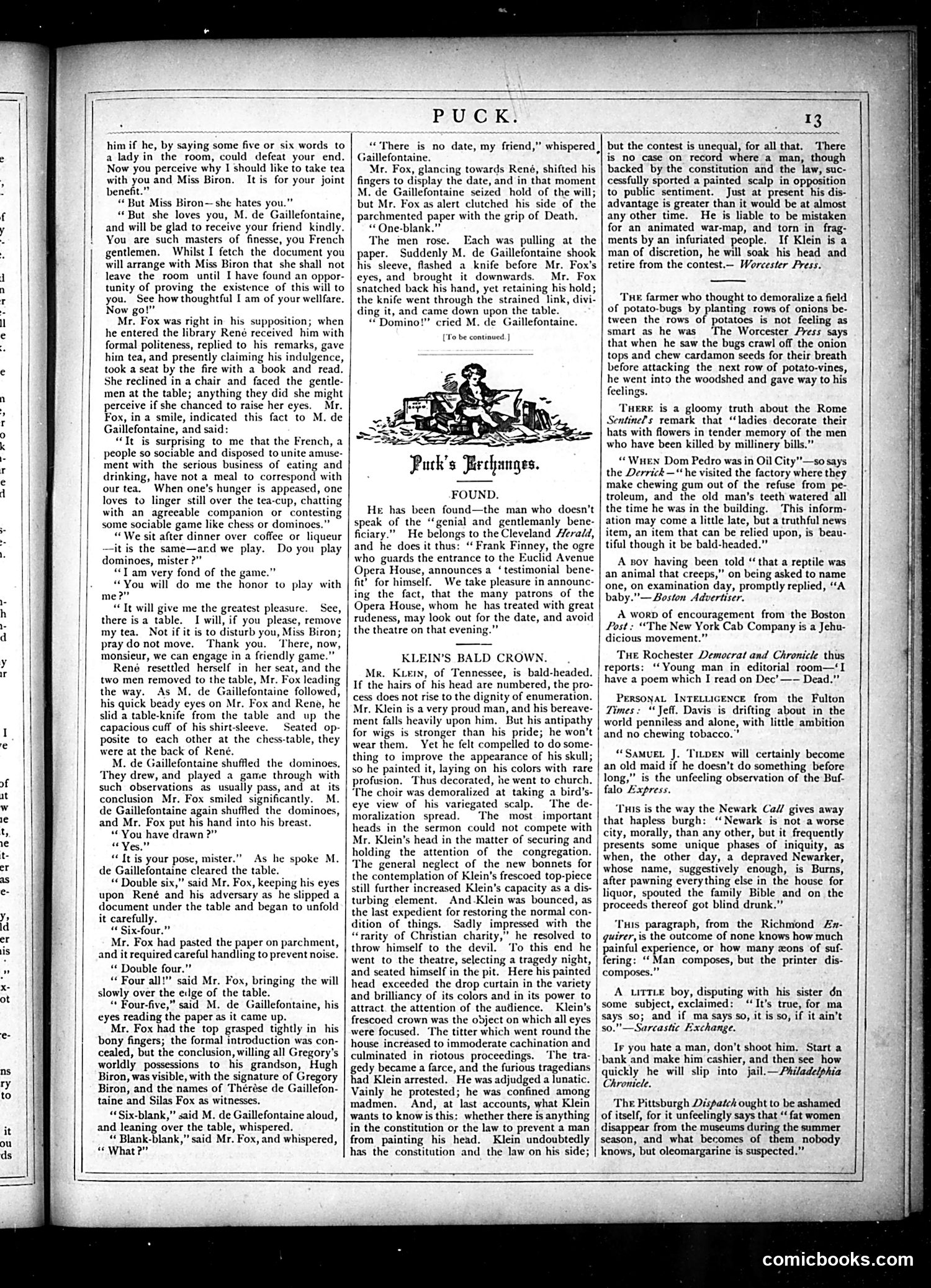
This page contains primarily **text-based humor columns** rather than political cartoons. The main sections include: **"Puck's Exchanges"** - A humor column featuring brief anecdotes and observations, including jokes about politics, society, and daily life. **"Klein's Bald Crown"** - A satirical piece mocking a Tennessee man named Klein who is bald-headed. The satire appears to criticize his vanity and attempts to hide his baldness, suggesting he's overly concerned with appearance despite claiming moral superiority. The remaining sections contain miscellaneous short jokes and social commentary typical of Puck's satirical style, targeting pretension, hypocrisy, and absurd human behavior rather than specific political figures or events. The page emphasizes **written satire** over visual caricature.
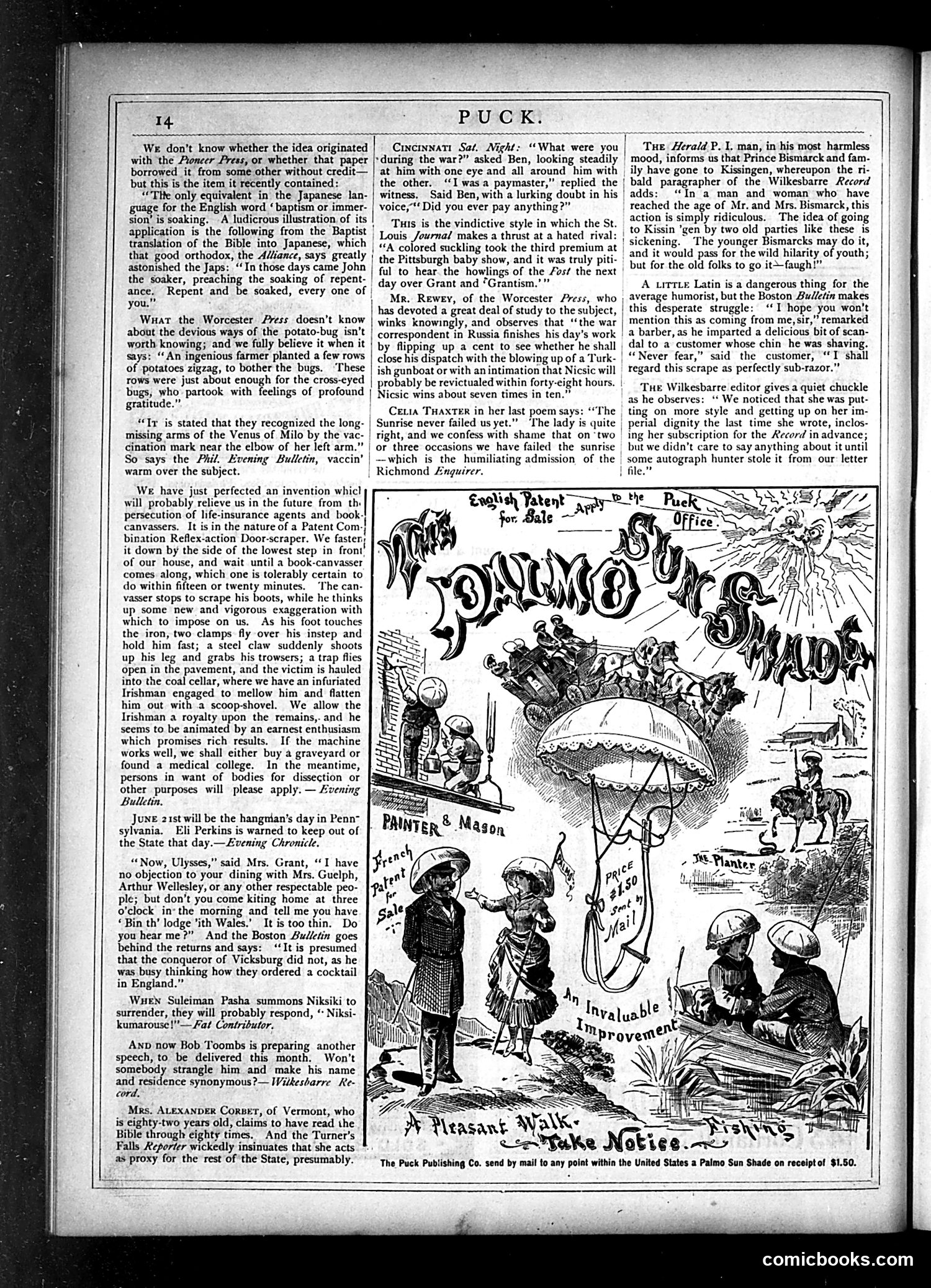
This page consists primarily of **advertisements and patent notices** rather than political satire. The main visual element is a large illustrated advertisement promoting various inventions and patent products, including: - "Pollock's Saddlery" - "Printer & Mason" (tools/equipment) - "An Invaluable Improvement" (unclear device) - "A Pleasant Walk" and "Fishing" (recreational activities) The text columns contain brief gossip items and social commentary typical of Puck's satirical magazine format, referencing contemporary figures like Ben (possibly a newsboy), Grant, and various local incidents. However, **without clearer identification of specific political figures or events referenced in the OCR'd text, the precise satirical targets remain unclear**. The page appears to be a typical late 19th-century magazine layout mixing advertising with light social commentary.
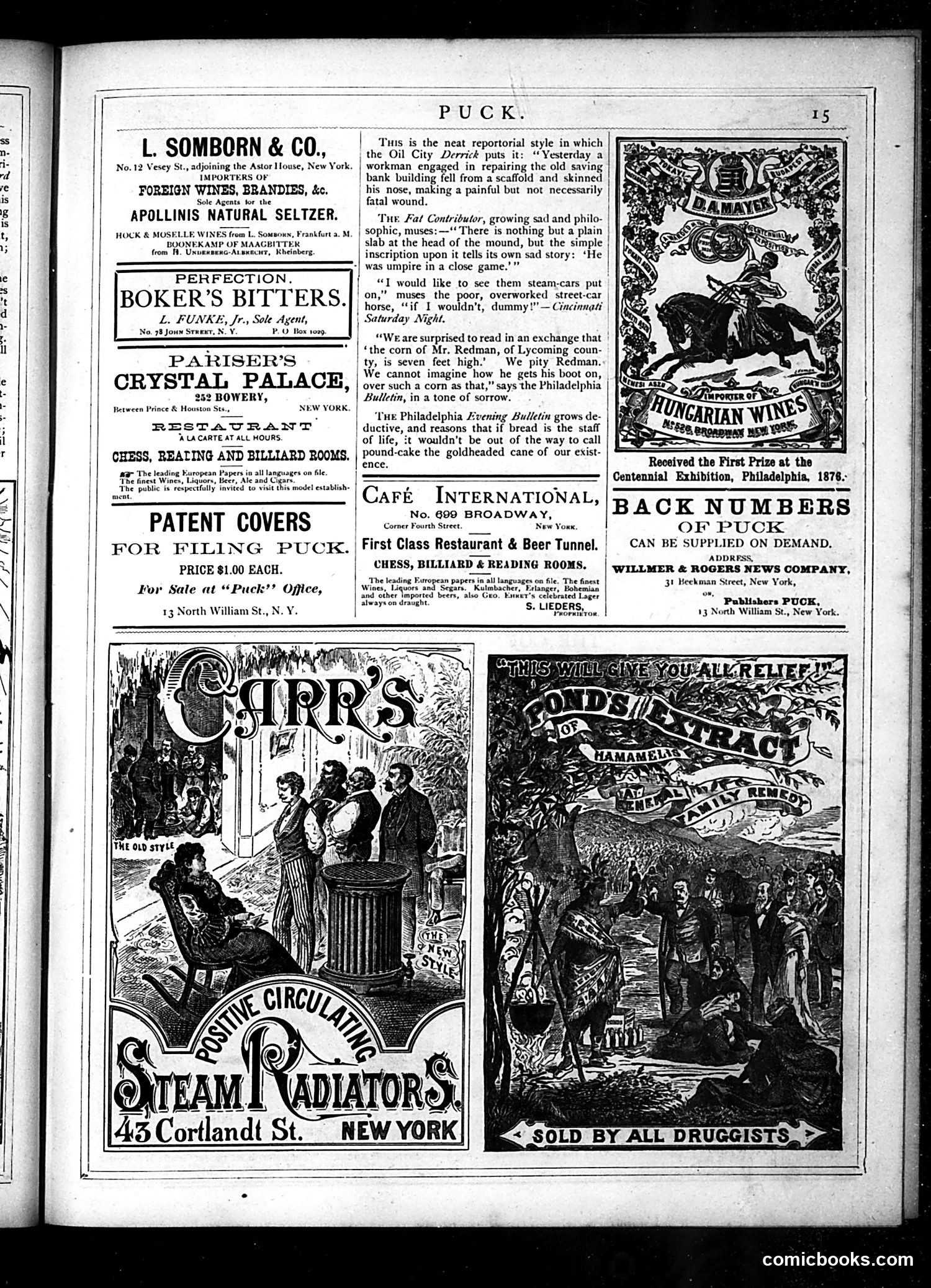
This page is primarily **advertisements and back matter** from Puck magazine, not political satire. The visible content includes: - Wine and spirits importers (L. Somborn & Co.) - Restaurant advertisements (Crystal Palace, Café International) - Patent filing covers for Puck - Two product advertisements with illustrated engravings: Carr's Steam Radiators and "Gold's Stomach Bitters" The page contains **no clearly identifiable political cartoons or caricatured figures** of note. The engravings are commercial advertisements—one showing people around a heating system, the other promoting a patent medicine with dramatic scenery. This represents typical 19th-century magazine filler: ads subsidizing the publication's cost while filling unused space between editorial content.
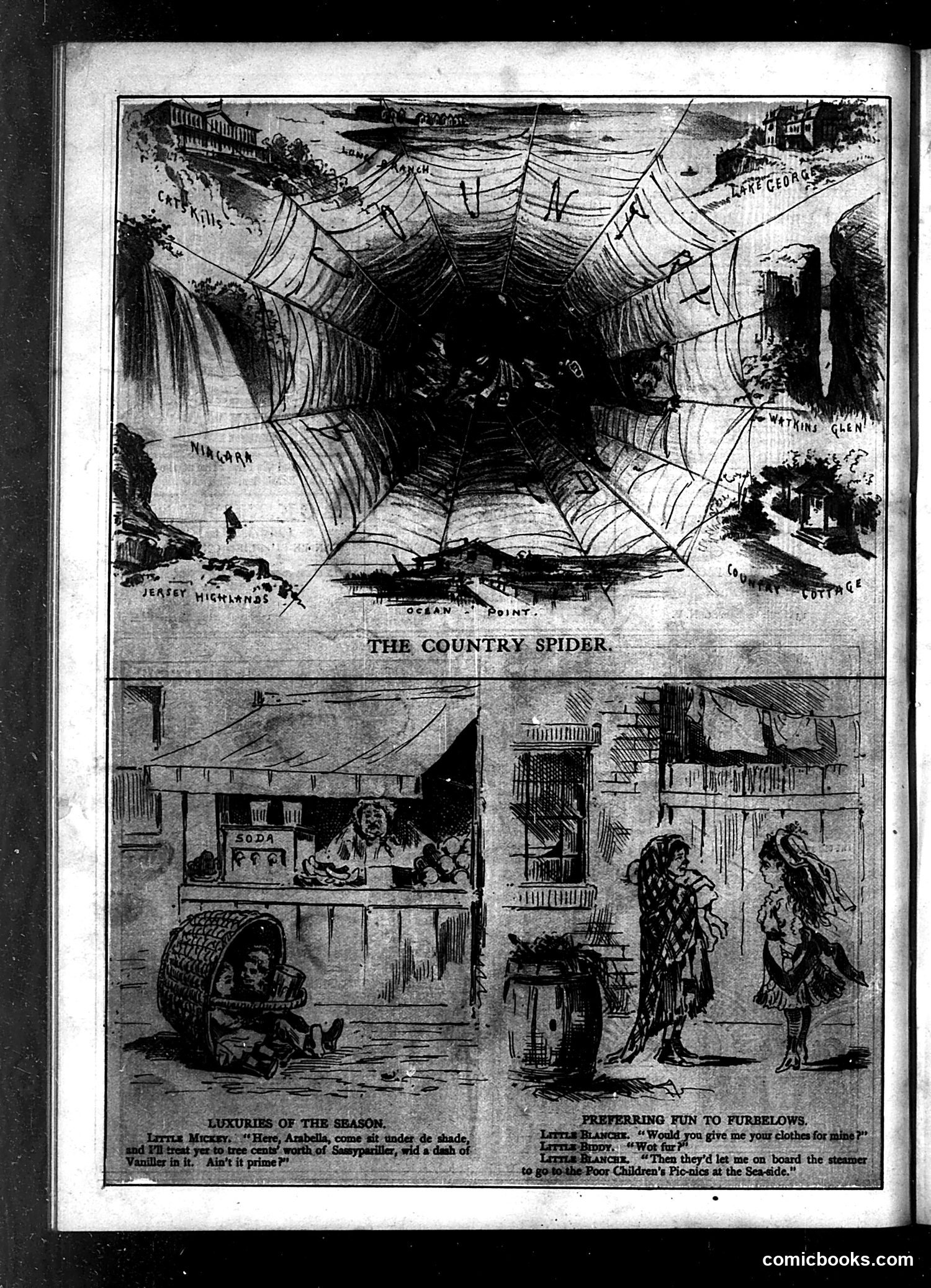
The top illustration depicts a giant spider web superimposed over a map of the English countryside, with locations like "Cat Kills," "Lake George," "Jersey Highlands," and "Ocean Point" marked around its edges. This represents predatory forces—likely wealthy industrialists or speculators—ensnaring rural communities in their web. The bottom panels show "Luxuries of the Season" and "Preparing Fun to Furbelows," depicting working-class or poor families in domestic scenes, apparently unable to afford seasonal goods or entertainment. The satire likely critiques how large economic forces ("the spider") trap rural and working-class communities, preventing them from enjoying life's comforts that wealthier classes take for granted. The spider web visually represents interconnected exploitation spanning geographic regions.