
Puck, 1877-06 · page 12 of 16
Puck — June 1877 — page 12: what you’re looking at
What you’re looking at
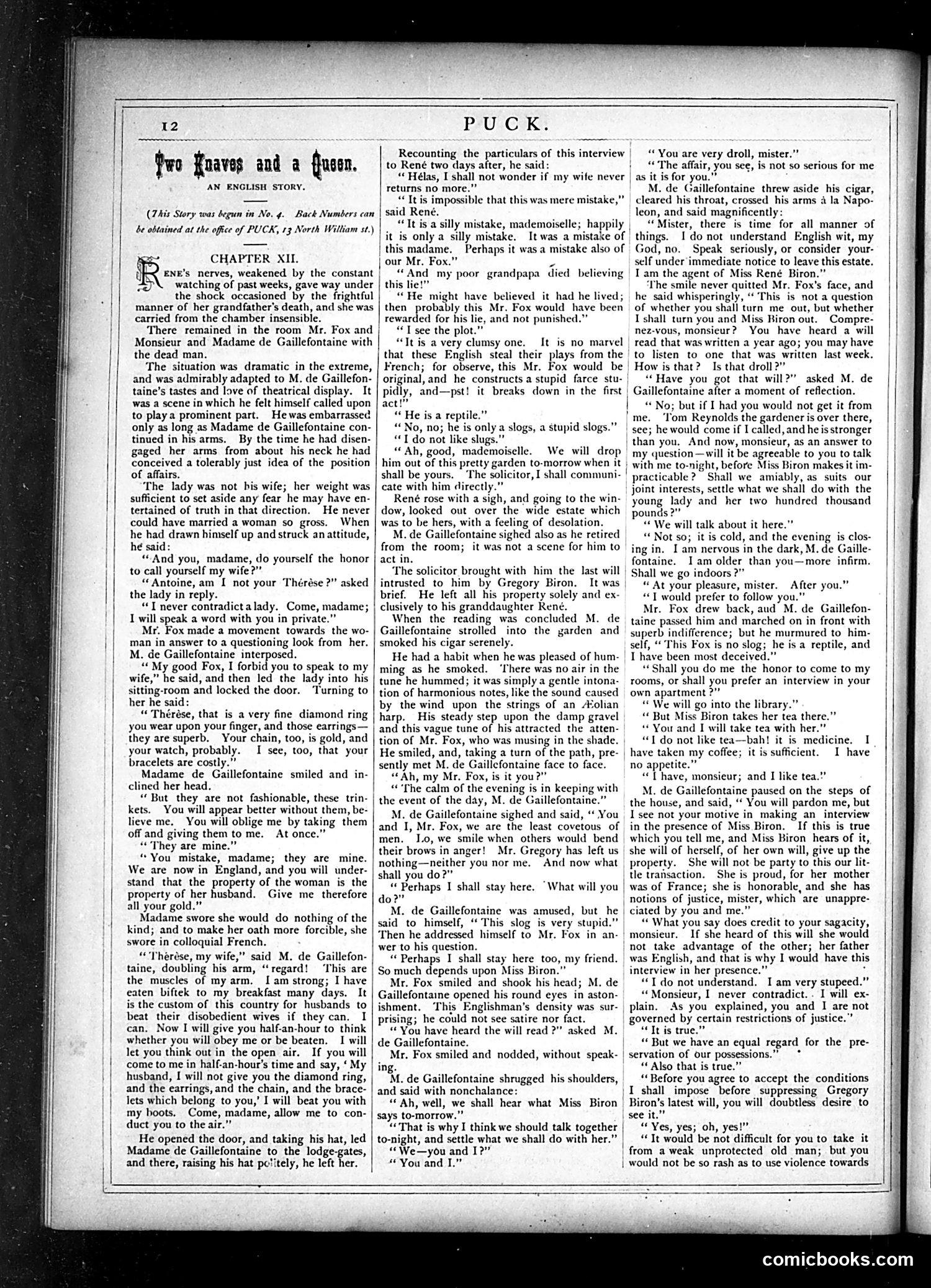
This page contains Chapter XII of a serialized story rather than a political cartoon. The narrative involves **Monsieur and Madame de Gaillefontaine** and concerns a disputed inheritance or property matter. The story depicts genteel social conflict: a character named **Mr. Fox** appears to be a dishonest figure involved in some scheme, while **Gregory Biron** and **Miss Hiron** factor into negotiations over property and justice. The dialogue emphasizes themes of deception, class distinctions, and moral rectitude typical of Puck's satirical fiction. Without the story's beginning or broader context, the specific political or social satire remains unclear, though the title's reference to "two knaves and a queen" suggests commentary on dishonesty among the upper classes.
📄 Transcribed text from this page (OCR, searchable)
Machine-transcribed from the original scan — historical spelling and the odd misread are preserved.
AN ENGLISH STORY. (This Story was begun in No. 4. Back Numbers can be obtained at the office of PUCK, 13 North William st.) R 2 CHAPTER XII. ENE’s nerves, weakened by the constant watching of past weeks, gave way under the shock occasioned by the frightful manner of her grandfather's death, and she was carried from the chamber insensible. There remained in the room Mr. Fox and Monsieur and Madame de Gaillefontaine with the dead man. The situation was dramatic in the extreme, and was admirably adapted to M. de Gaillefon- taine’s tastes and love of theatrical display. It was a scene in which he felt himself called upon to playa prominent part. Hewas embarrassed only as long as Madame de Gaillefontaine con- tinued in his arms. By the time he had disen- gaged her arms from about his neck he had conceived a tolerably just idea of the position of affairs. The lady was not his wife; her weight was sufficient to set aside any fear he may have en- tertained of truth in that direction. He never could have married a woman so gross. When he had drawn himself up and struck an attitude, he said: “And you, madame, do yourself the honor to call yourself my wife?” “Antoine, am I not your Th the lady in reply. “T never contradict alady. Come, madame; I will speak a word with you in private.” Mr. Fox made a movement towards the wo- man in answer to a questioning look from her. M. de Gaillefontaine interposed. “My good Fox, I forbid you to speak to my wife,” he said, and then led the lady into his sitting-room and locked the door. Turning to her he said: “ Thérése, that is a very fine diamond ring you wear upon your finger, and those earrings— they are superb. Your chain, too, is gold, and your watch, probably. I see, too, that your bracelets are costly.” Madame de Gaillefontaine smiled and in- clined her head. “But they are not fashionable, these trin- kets. You will appear better without them, be- lieve me. You will oblige me by taking them off and giving them to me. At once.” “They are mine.” “You mistake, madame; they are mine. e ?” asked We are now in England, and you will under- | stand that the property of the woman is the property of her husband. Give me therefore all your gold.” Madame swore she would do nothing of the kind; and to make her oath more forcible, she swore in colloquial French. “Therése, my wife,” said M. de Gaillefon- taine, doubling his arm, “ regard! the muscles of my arm. I am strong; I have eaten biftek to my breakfast many days. It is the custom of this country for husbands to beat their disobedient wives if they can. I can. Now I will give you half-an-hour to think whether you will obey me or be beaten, I will let you think out in the open air. come to me in half-an-hour’s time and say, ‘ My husband, I will not give you the diamond ring, and the earrings, and the chain, and the brace- lets which belong to you,’ I will beat you with my boots. Come, madame, allow me to con- duct you to the air.” He opened the door, and taking his hat, led Madame de Gaillefontaine to the lodge-gates, and there, raising his hat po''tely, he left her. This are | If you will | PUCK. Recounting the particulars of this interview to René two days after, he said: { “Has, I shall not wonder if my wife never | returns no mo! | ible that this was mere mistake,” | said René. “Tt is a silly mistake, mademoiselle; happily , is only a silly mistake, It was a mistake of Perhaps it was a mistake also of it | this madame. | our Mr. Fox.” os “And my poor grandpapa died believing this lie!” “He might have believed it had he lived; then probably this Mr. Fox would have been rewarded for his lie, and not punished.” “T see the plot.” “Tt is a very clumsy one. It is no marvel that these English steal their plays from the French; for observe, this Mr. Fox would be original, and he constructs a stupid farce stu- pidly, and—pst! it breaks down in the first act!” | “ He is a reptile.” } “No, no; he is only a slogs, a stupid slogs.” “‘T do not like slugs.” “Ah, good, mademoiselle. We will drop him out of this pretty garden to-morrow when it shall be yours. ‘The solicitor, I shall communi- cate with him directly.” René rose with a sigh, and going to the win- dow, looked out over the wide estate which was to be hers, with a feeling of desolation. M. de Gaillefontaine sighed also as he retired from the room; it was not a scene for him to act in. The solicitor brought with him the last will intrusted to him by Gregory Biron. It was brief. He left all his property solely and ex- clusively to his granddaughter René. When the reading was concluded M. de Gaillefontaine strolled into the garden and smoked his cigar serenely. He had a habit when he was pleased of hum- ming as he smoked. ‘There was no air in the tune he hummed; it was simply a gentle intona- tion of harmonious notes, like the sound caused by the wind upon the strings of an Aolian harp. His steady step upon the damp gravel and this vague tune of his attracted the atten- tion of Mr. Fox, who was musing in the shade. He smiled, and, taking a turn of the path, pre- sently met M. de Gaillcfontaine face to face. “Ah, my Mr. Fox, is it you?” “The calm of the evening is in keeping with the event of the day, M. de Gaillefontaine. M. de Gaillefontaine sighed and said, “ You and I, Mr. Fox, we are the least covetous of men. Io, we smile when others would bend their brows in anger! Mr. Gregory has left us nothing—neither you nor me. And now what shall you do?” : “ Perhaps I shall stay here. “What will you do?” M. de Gaillefontaine was amused, but he said to himself, ‘This slog is very stupid.” Then he addressed himself to Mr. Fox in an- wer to his question. “ Perhaps I shall stay here too, my friend. So much depends upon Miss Biron.” Mr. Fox smiled and shook his head; M. de Gaillefontaine opened his round eyes in aston- ishment. ‘This Englishman's density was sur- prising; he could not see satire nor fact. “You have heard the will read ?” asked M. de Gaillefontaine. Mr. Fox smiled and nodded, without speak- | ing. M. de Gaillefontaine shrugged his shoulders, and said with nonchalance: “Ah, well, we shall hear what Miss Biron says to-morrow.” “That is why I think we should talk together | to-night, and settle what we shall do with her.” | “We-—you and 1?” “You and I.” | “You are very droll, mister.” “The affair, you see, is not so serious for me as it is for you.” M. de Gaillefontaine threw aside his cigar, cleared his throat, crossed his arms a la Napo- leon, and said magnificently: “Mister, there is time for all manner of things. I do not understand English wit, my God, no. Speak seriously, or consider your- self under immediate notice to leave this estate. I am the agent of Miss René Biron.” ‘The smile never quitted Mr. Fox's face, and he said whisperingly, “This is not a question of whether you shall turn me out, but whether I shall turn you and Miss Biron out. Compre- nez-vous, monsieur? You have heard a will read that was written a year ago; you may have to listen to one that was written last week. How is that? Is that droll “‘Have you got that will?” asked M. de Gaillefontaine after a moment of reflection. “No; but if I had you would not get it from me. ‘Tom Reynolds the gardener is over there, see; he would come if I called, and he is stronger than you. And now, monsieur, as an answer to my question —will it be agreeable to you to talk with me to-night, before Miss Biron makes it im- practicable?» Shall we amiably, as suits our joint interests, settle what we shall do with the young lady and her two hundred thousand pounds ?” “We will talk about it here.” “Not so; it is cold, and the evening is clos- ing in. I am nervous in the dark, M. de Gaille- fontaine. I am older than you—more infirm. Shall we go indoors ?” “ At your pleasure, mister. After you.” “1 would prefer to follow you.” Mr. Fox drew back, aud M. de Gaillefon- taine passed him and marched on in front with superb indifference; but he murmured to him- self, “This Fox is no slog; he is a reptile, and I have been most deceived.” “Shall you do me the honor to come to my rooms, or shall you prefer an interview in your own apartment 2” « We will go into the library.” “But Miss Biron takes her tea there.”” “You and I will take tea with her.” “I do not like tea—bah! it is medicine. I have taken my coffee; it is sufficient. I have no appetite.” “T have, monsieur; and I like tea.”” M. de Gaillefontaine paused on the steps of the house, and said, “ You will pardon me, but Isee not your motive in making an interview in the presence of Miss Biron. If this is true which you tell me, and Miss Biron hears of it, she will of herself, of her own will, give up the property. She will not be party to this our lit- tle transaction. She is proud, for her mother was of France; she is honorable, and she has notions of justice, mister, which are unappre- ciated by you and me.” “What you say does credit to your sagacity, monsieur. If she heard of this will she would not take advantage of the other; her father was English, and that is why I would have this interview in her presence.” ; “‘T do not understand. I am very stupeed.”” “Monsieur, I never contradict. . I will ex- plain. As you explained, you and I are not governed by certain restrictions of justice.” “Tt is true.” “ But we have an equal regard for the pre- servation of our possessions.” * “Also that is true.” “Before you agree to accept the conditions I shall impose before suppressing Gregory Biron’s latest will, you will doubtless desire to see it.” “Yes, yes; oh, yes!” “Tt would be not difficult for you to take it from a weak unprotected old man; but you would not be so rash as to use violence towards comicbooks.com