
Puck, 1877-06 · page 13 of 16
Puck — June 1877 — page 13: what you’re looking at
What you’re looking at
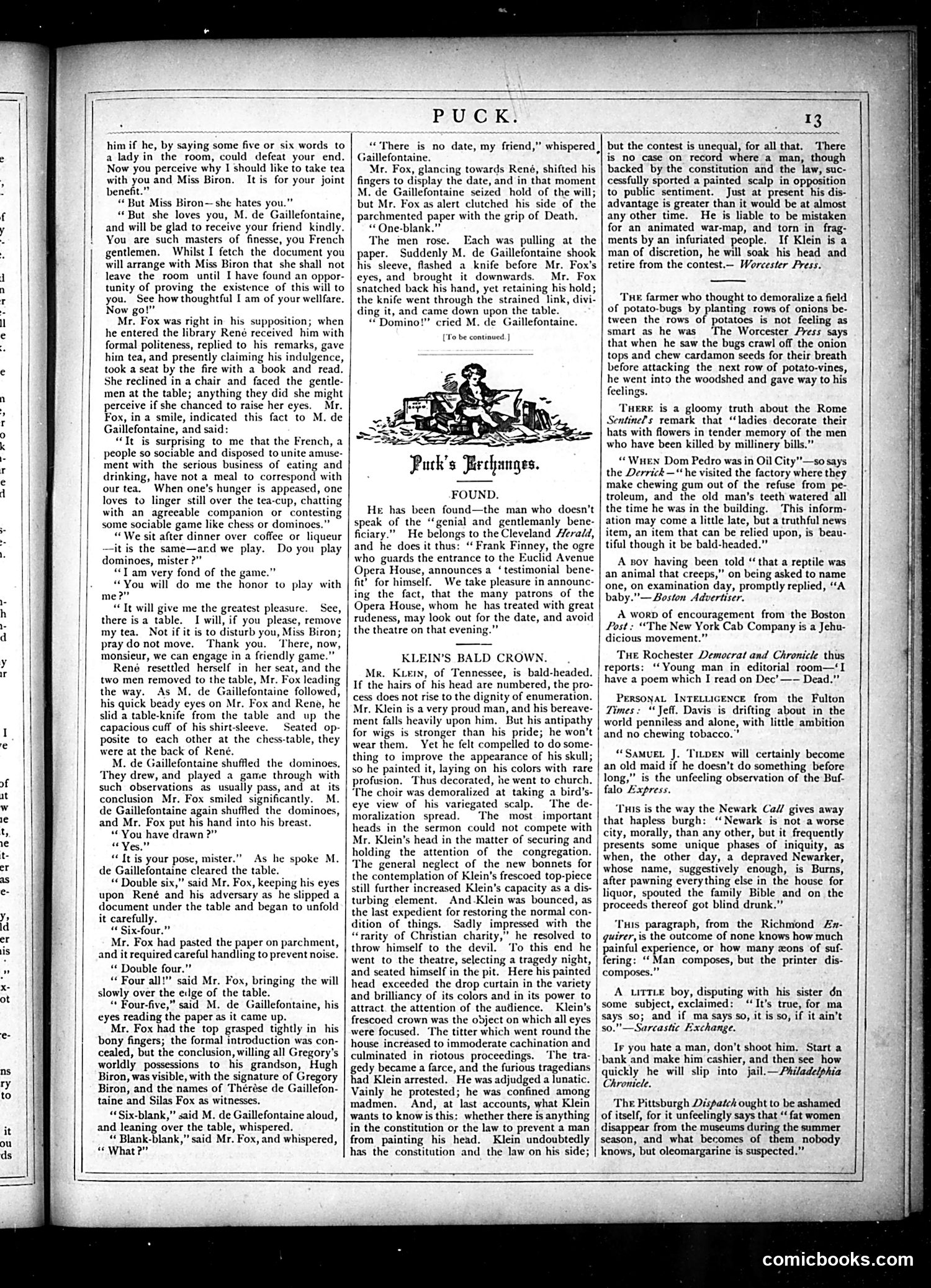
This page contains primarily **text-based humor columns** rather than political cartoons. The main sections include: **"Puck's Exchanges"** - A humor column featuring brief anecdotes and observations, including jokes about politics, society, and daily life. **"Klein's Bald Crown"** - A satirical piece mocking a Tennessee man named Klein who is bald-headed. The satire appears to criticize his vanity and attempts to hide his baldness, suggesting he's overly concerned with appearance despite claiming moral superiority. The remaining sections contain miscellaneous short jokes and social commentary typical of Puck's satirical style, targeting pretension, hypocrisy, and absurd human behavior rather than specific political figures or events. The page emphasizes **written satire** over visual caricature.
📄 Transcribed text from this page (OCR, searchable)
Machine-transcribed from the original scan — historical spelling and the odd misread are preserved.
him if he, by saying some five or six words to a lady in the room, could defeat your end. Now you perceive why I should like to take tea with you and Miss Biron. It is for your joint benefit.” “ But Miss Biron—she hates you.” “But she loves you, M. de Gaillefontaine, and will be glad to receive your friend kindly. You are such masters of finesse, you French gentlemen. Whilst I fetch the document you will arrange with Miss Biron that she shall not leave the room until I have found an oppor- tunity of proving the existence of this will to you. See how thoughtful I am of your welfare. Now go!” Mr. Fox was right in his supposition; when he entered the library René received him with formal politeness, replied to his remarks, gave him tea, and presently claiming his indulgence, took a seat by the fire with a book and read. She reclined in a chair and faced the gentle- men at the table; anything they did she might perceive if she chanced to raise her eyes. Mr. Fox, in a smile, indicated this fact to M. de Gaillefontaine, and said: “Tt is surprising to me that the French, a people so sociable and disposed to unite amuse- ment with the serious business of eating and drinking, have not a meal to correspond with our tea. When one’s hunger is appeased, one loves to linger still over the tea-cup, chatting with an agreeable companion or contesting some sociable game like chess or dominoes.”” “We sit after dinner over coffee or liqueur —it is the same—ard we play. Do you play dominoes, mister ?” “Tam very fond of the game.” “You will do me the honor to play with me?” “Tt will give me the greatest pleasure. See, there isa table. I will, if you please, remove my tea. Not if it is to disturb you, Miss Biron; pray do not move. Thank you. ‘There, now, monsieur, we can engage in a friendly game.” René resettled herself in her seat, and the two men removed to the table, Mr. Fox leading the w s M. de Gaillefontaine followed, his quicl beady yes on Mr. Fox and Rene, he slid a table-knife from the table and up the capacious cuff of his shirt-sleeve. Seated op- posite to each other at the chess-table, they were at the back of René. M. de Gaillefontaine shuffled the dominoes, ‘They drew, and played a game through with such observations as usually pass, and at its conclusion Mr. Fox smiled significantly. de Gaillefontaine again shuffled the dominoes, and Mr. Fox put his hand into his breast. “You have drawn ?” “ Yes," “ It is your pose, mister.” As he spoke M. de Gaillefontaine cleared the table. “Double six,” said Mr. Fox, keeping his eyes upon René and his adversary as he slipped a document under the table and began to unfold it carefully. “ Si: Mr. sie had pasted the paper on parchment, and it required careful handling to prevent noise. “ Double four.” “ Four all!” said Mr. Fox, bringing the will slowly over the edge of the table. “ Four-five,” said M. de Gaillefontaine, his eyes reading the paper as it came up. Mr. Fox had the top grasped tightly in his bony fingers; the formal introduction was con- cealed, but the conclusion, willing all Gregory's worldly possessions to his grandson, Hugh Biron, was visible, with the signature of Gregory Biron, and the names of Thérése de Gaillefon- taine and Silas Fox as witnesses. “Six-blank,” said M. de Gaillefontaine aloud, and leaning over the table, whispered. “ Blank-blank,” said Mr. Fox, and whispered, “© What ?”” PUCK. “There is no date, my friend,” .” whispered | Gaillefontaine. Mr. Fox, glancing towards René, shifted his fingers to display the date, and in that moment M. de Gaillefontaine seized hold of the will; but Mr. Fox as alert clutched his side of the parchmented paper with the grip of Death. “One-blank.” The men rose. Each was pulling at the paper. Suddenly M. de Gaillefontaine shook his sleeve, flashed a knife before Mr. Fox's eyes, and brought it downwards. Mr. Fox snatched back his hand, yet retaining his hol the knife went through the strained link, divi- ding it, and came down upon the table. “Domino!” cried M. de Gaillefontaine. [To be continued. } Pack’ 8 Benge FOUND. He has been found—the man who doesn't speak of the “genial and gentlemanly bene- ficiary.” He belongs to the Cleveland Herald, and he does it thus: “Frank Finney, the ogre who guards the entrance to the Euclid Avenue Opera House, announces a ‘testimonial bene- fit? for himself. We take pleasure in announc- ing the fact, that the many patrons of the Opera House, whom he has treated with great rudeness, may look out for the date, and avoid the theatre on that evening.”” KLEIN’S BALD CROWN. Mr. Kern, of Tennessee, is bald-headed. If the hairs of his head are numbered, the pro- cess does not rise to the dignity of enumeration. Mr. Klein is a very proud man, and his bereave- ment falls heavily upon him. But his antipathy for wigs is stronger than his pride; he won't wear them. Yet he felt compelled to do some- thing to improve the appearance of his skull; so he painted it, laying on his colors with rare profusion. Thus decorated, he went to church. | ‘The choir was demoralized at taking a bird’s- eye view of his vari ‘The de- moralization spread. most important heads in the sermon could not compete with Mr. Klein’s head in the matter of securing and | holding the attention of the congregation. The general neglect of the new bonnets for the contemplation of Klein's frescoed top-piece still further increased Klein’s capacity as a dis- turbing element. And-Klein was bounced, as the last expedient for restoring the normal con- dition of things. Sadly impressed with the “rarity of Christian charity,” he resolved to throw himself to the dev: To this end he went to the theatre, selecting a tragedy night, and seated himself in the pit. Here his painted head exceeded the drop curtain in the variety and brilliancy of its colors and in its power to attract. the attention of the audience. Klein’s frescoed crown was the object on which all eyes were focused. The titter which went round the house increased to immoderate cachination and culminated in riotous proceedings. ‘The tra- gedy became a farce, and the furious tragedians had Klein arrested. He was adjudged a lunatic. Vainly he protested; he was confined among madmen. And, at last accounts, what Klein wants to know is this: whether there is anything in the constitution or the law to prevent a man from painting his head. Klein undoubtedly has the constitution and the law on his side; 13 but the contest is unequal, for all that. There is no case on record where a man, though backed by the constitution and the law, suc- cessfully sported a painted scalp in opposition to public sentiment. Just at present his dis- advantage is greater than it would be at almost any other time. He is liable to be mistaken for an animated war-map, and torn in frag- ments by an infuriated people. If Klein is a man of discretion, he will soak his head and retire from the contest.— Worcester Press. ‘Tne farmer who thought to demoralize a field of potato-bugs by planting rows of onions be- tween the rows of potatoes is not feeling as smart as he was ‘The Worcester Press says that when he saw the bugs crawl off the onion tops and chew cardamon seeds for their breath before attacking the next row of potato-vines, he went into the woodshed and gave way to his feelings. Tuere is a gloomy truth about the Rome Sentinels remark that ‘ladies decorate their hats with flowers in tender memory of the men who have been killed by millinery bills.” “Wuen Dom Pedro was in Oil City""—so says the Derrick —‘‘he visited the factory where they make chewing gum out of the refuse from pe- troleum, and the old man’s teeth watered all the time he was in the building. This inform- ation may come a little late, but a truthful news item, an item that can be relied upon, is beau- tiful though it be bald-headed.” A soy having been told ‘that a reptile was an animal that creeps,” on being asked to name one, on examination day, promptly replied, “A baby.”— Boston Advertiser. A worp of encouragement from the Boston Post: “The New York Cab Company is a Jehu- dicious movement.” Tue Rochester Democrat and Chronicle thus reports: “Young man in editorial room—‘I have a poem which I read on Dec’—— Dead.” Personal INTELLIGENCE from the Fulton Times: “Jeff. Davis is drifting about in the world penniless and alone, with little ambition and no chewing tobacco.” “Samvuet J. ‘Titpen will certainly become an old maid if he doesn’t do something before long,” is the unfeeling observation of the Buf- falo Express. ‘Tnis is the way the Newark Cad! gives away that hapless burgh: ‘Newark is not a worse city, morally, than any other, but it frequently presents some unique phases of iniquity, as when, the other day, a depraved Newarker, whose name, suggestively enough, is Burns, after pawning everything else in the house for liquor, spouted the family Bible and on the proceeds thereof got blind drunk.” ‘Tus paragraph, from the Richmond En- guirer, is the outcome of none knows how much painful experience, or how many cons of suf- fering: “Man composes, but the printer dis- composes.” A LitTLEe boy, disputing with his sister dn some subject, exclaimed: ‘It’s true, for ma says so; and if ma says so, it is so, if it ain’t so." —Sarcastic Exchange. Ir you hate a man, don’t shoot him. Start a bank and make him cashier, and then see how quickly he will slip into jail.—Philadelphia Chronicle. The Pittsburgh Dispatch ought to be ashamed of itself, for it unfeelingly says that ‘fat women disappear from the museums during the summer season, and what becomes of them nobody knows, but oleomargarine is suspected.” za comicbooks.com