
Puck, 1877-06 · page 5 of 16
Puck — June 1877 — page 5: what you’re looking at
What you’re looking at
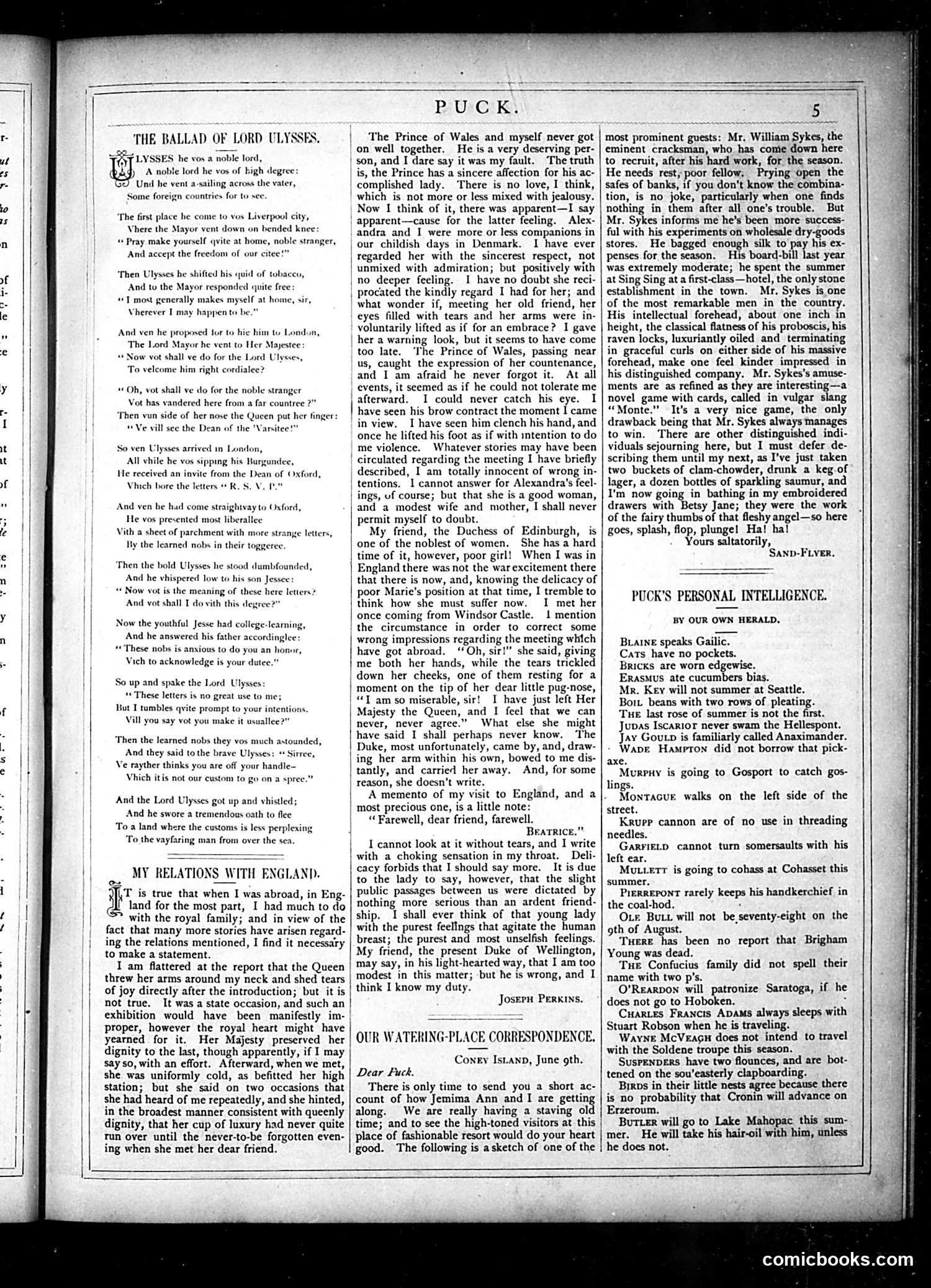
This page from *Puck* contains three distinct sections: "The Ballad of Lord Ulysses" (a poem satirizing diplomatic relations), "My Relations with England" (prose commentary by Joseph Perkins), and "Our Watering-Place Correspondence" (brief social notes). The main content appears to address Anglo-American relations, likely from the late 19th century. The ballad and Perkins's piece discuss Queen Victoria, the Prince of Wales, and diplomatic tensions between the nations. The satire seems to critique British-American relations and court protocol. "Puck's Personal Intelligence" consists of brief humorous social quips about prominent figures and New York society. Without seeing illustrations clearly, I cannot identify specific caricatures, but the text indicates political commentary on transatlantic relations and contemporary social figures.
📄 Transcribed text from this page (OCR, searchable)
Machine-transcribed from the original scan — historical spelling and the odd misread are preserved.
THE BALLAD OF LORD ULYSSES. STAT LYSSES he vos a noble lord, 1) ‘A noble lord he vos of high degre GO Und he vent a-sailing across the Some foreign countries for to ‘The first place he come to vos Liverpool city, Vhere the Mayor vent down on bended kn « Pray make yourself qvite at home, noble stranger, And accept the freedom of our citee!” ‘Then Ulysses he shifted his quid of tobacco, And to the Mayor responded quite free «T most generally makes myself at home, sir, Vherever I may happen to be.” And ven he proposed tor to hie him tu London, The Lord Mayor he vent to Her Mayestee + Now vot shall ve do for the Lord Ulysses, To velcome him right cordialee? «Oh, vot shall ve do for the noble stranger Vot has vandered here from a far countree 2” ‘Then vun side of her nose the Queen put her finger: Ve vill see the Dean of the ’Varsitee!” So ven Ulysses arrived in London, Alll vhile he vos sipping his Burgundee, He received an invite from the D Oxford, Vhich bore the letters *R.S.V. And ven he had come straightay to Oxford, He vos presented most liberallee Vith a sheet of parchment with more strange letters, ly the learned nobs in their toggeree: ‘Then the bold Ulysses he stood dumbfounded, And he vhispered low to his son Jessee “« Now vot is the meaning of these here le And vot shall T do vith this degree?” Now the youthful Jesse had college-learning, And he answered his father accordinglee «These nobs is anxious to do you an honor, Vich to acknowledge is your dutee.” So up and spake the Lord Ulysses « These letters is no great use to me; But I tumbles qvite prompt to your intentions. Vill you say vot you make it usuallee?” Then the learned nobs they vos much astounded, And they said tothe brave Ulysses: “ Sitree, Ve rayther thinks you are off your handle- Vhich itis not our custom to go on a spree.” And the Lord Ulysses got up and vhistled; And he swore a tremendous oath to flee To a land where the customs is less perplexing To the vayfaring man from over the sea. MY RELATIONS WITH ENGLAND. oe aK, is true that when I was abroad, in Eng- land for the most part, I had much to do with the royal family; and in view of the fact that many more stories have arisen regard- ing the relations mentioned, I find it necessary to make a statement. 1 am flattered at the report that the Queen threw her arms around my neck and shed tears of joy directly after the introduction; but it is not true. It was a state occasion, and such an exhibition would have been manifestly im- | Proper, however the royal heart might have yearned for it. dignity to the last, though apparently, if I may say so, with an effort. Afterward, when we met, she was uniformly cold, as befitted her high station; but she said on two occasions that she had heard of me repeatedly, and she hinted, in the broadest manner consistent with queenly dignity, that her cup of luxury had never quite Tun over until the never-to-be forgotten even- ing when she met her dear friend. | tantly, and carried her away. Her Majesty preserved her | PUCK. The Prince of Wales and myself never got on well together. He is a very deserving per- son, and I dare say it was my fault. ‘The truth | is, the Prince has a sincere affection for his ac- | complished lady. There is no love, I think, which is not more or less mixed with jealousy. Now I think of it, there was apparent—I say apparent—cause for the latter feeling. Alex- andra and I were more or less companions in our childish days in Denmark. I have ever regarded her with the sincerest respect, not unmixed with admiration; but positively with no deeper feeling. I have no doubt she reci- procated the kindly regard I had for her; and what wonder if, meeting her old friend, her eyes filled with tears and her arms were in- voluntarily lifted as if for an embrace? I gave her a warning look, but it seems to have come too late. The Prince of Wales, passing near us, caught the expression of her countenance, and I am afraid he never forgot it. At all events, it seemed as if he could not tolerate me afterward. I could never catch his eye. I have seen his brow contract the moment I came in view. I have seen him clench his hand, and once he lifted his foot as if with intention to do me violence. Whatever stories may have been | circulated regarding the mecting I have briefly described, I am totally innocent of wrong in- tentions. I cannot answer for Alexandra's feel- ings, uf course; but that she is a good woman, and a modest wife and mother, I shall never permit myself to doubt. My friend, the Duchess of Edinburgh, is one of the noblest of women. She has a hard time of it, however, poor girl! When I was in England there was not the war excitement there that there is now, and, knowing the delicacy of poor Marie's position at that time, I tremble to think how she must suffer now. I met her once coming from Windsor Castle. 1 mention the circumstance in order to correct some wrong impressions regarding the meeting which have got abroad. ‘Oh, sir!” she said, giving me both her hands, while the tears trickled down her cheeks, one of them resting for a moment on the tip of her dear little pug-nose, “T am so miserable, sir! I have just left Her Majesty the Queen, and I feel that we can never, never agree.” What else she might have said I shall perhaps never know, The Duke, most unfortunately, came by, and, draw- ing her arm within his own, bowed to me dis- And, for some reason, she doesn’t write. A memento of my visit to England, and a | most precious one, is a little note: “Farewell, dear friend, farewell. BEATRICE.” I cannot look at it without tears, and I write with a choking sensation in my throat. Deli- cacy forbids that I should say more. It is due to the lady to say, however, that the slight public passages between us were dictated by nothing more serious than an ardent friend- ship. I shall ever think of that young lady with the purest feelings that agitate the human breast; the purest and most unselfish feelings. My friend, the present Duke of Wellington, may say, in his light-hearted way, that I am too modest in this matter; but he is wrong, and I think I know my duty. Joseru Perkins. OUR WATERING-PLACE CORRESPONDENCE. Coney Ist.anp, June gth. Dear Fuck. There is only time to send you a short ac- count of how Jemima Ann and I are getting along. We are really having a staving ol time; and to see the high-toned visitors at this | place of fashionable resort would do your heart good. The following is asketch of one of the most prominent guests: Mr. William Sykes, the eminent cracksman, who has conte down here to recruit, after his hard work, for the season. He needs rest; poor fellow, Prying open the safes of banks, if you don’t know the combina- tion, is no joke, particularly when one finds nothing in them after all one’s trouble. But Mr. Sykes informs me he’s been more success- ful with his experiments on wholesale dry- stores. He bagged enough silk to pay his ex- penses.for the season. His board-bill last year was extremely moderate; he spent the summer at Sing Sing at a first-class—hotel, the only stone establishment in the town. Mr, Sykes is one of the most remarkable men in the country. His intellectual forehead, about one inch in height, the classical flatness of his proboscis, his raven locks, luxuriantly oiled and terminating in graceful curls on either side of his massive forehead, make one feel kinder impressed in his distinguished company. Mr. Sykes's amuse- ments are as refined as they are interesting—a novel game with cards, called in vulgar slang “Monte.” It's a very nice game, the only drawback being that Mr. Sykes always manages to win. There are other distinguished indi- viduals sejourning here, but I must defer de- scribing them until my next, as I’ve just taken two buckets of clam-chowder, drunk a keg of lager, a dozen bottles of sparkling saumur, an I'm now going in bathing in my embroidered drawers with Betsy Jane; they were the work of the fairy thumbs of that fleshy angel—so here goes, splash, flop, plunge! Ha! hal Yours saltatorily, Sanp-FLYER. PUCK’S PERSONAL INTELLIGENCE. BY OUR OWN HERALD. Biaine speaks Gailic. Cats have no pockets. Bricks are worn edgewise. Erasmus ate cucumbers bias. Mr. Key will not summer at Seattle. Boi beans with two rows of pleating. ‘THE last rose of summer is not the first. Jupas Iscarior never swam the Hellespont. Jay Goutp is familiarly called Anaximander. Wave Hampton did not borrow that pick- axe. Murpny is going to Gosport to catch gos- lings. Montacue walks on the left side of the street. Krupp cannon are of no use in threading needles. GarFiELD cannot turn somersaults with his left ear. Muttetr is going to cohass at Cohasset this summer. Prerreront rarely keeps his handkerchief in the coal-hod. ‘ Orr Butt will not be,seventy-eight on the oth of August. Tuere has been no report that Brigham Young was dead. Tue Confucius family did not spell their name with two p's. O'REaRDON will patronize Saratoga, if he does not go to Hoboken. % Cuartes Francis ApaMs always sleeps with Stuart Robson when he is traveling. Wayne McVEaGH does not intend to travel with the Soldene troupe this season. SusPENDERS have two flounces, and are bot- tened on the sou’easterly clapboarding. Birps in their little nests agree because there is no probability that Cronin will advance on Erzeroum. $ Butter will go to Lake Mahopac this sum- mer. He will take his hair-oil with him, unless he does not. comicbooks.com