
Puck, 1877-06 · page 10 of 16
Puck — June 1877 — page 10: what you’re looking at
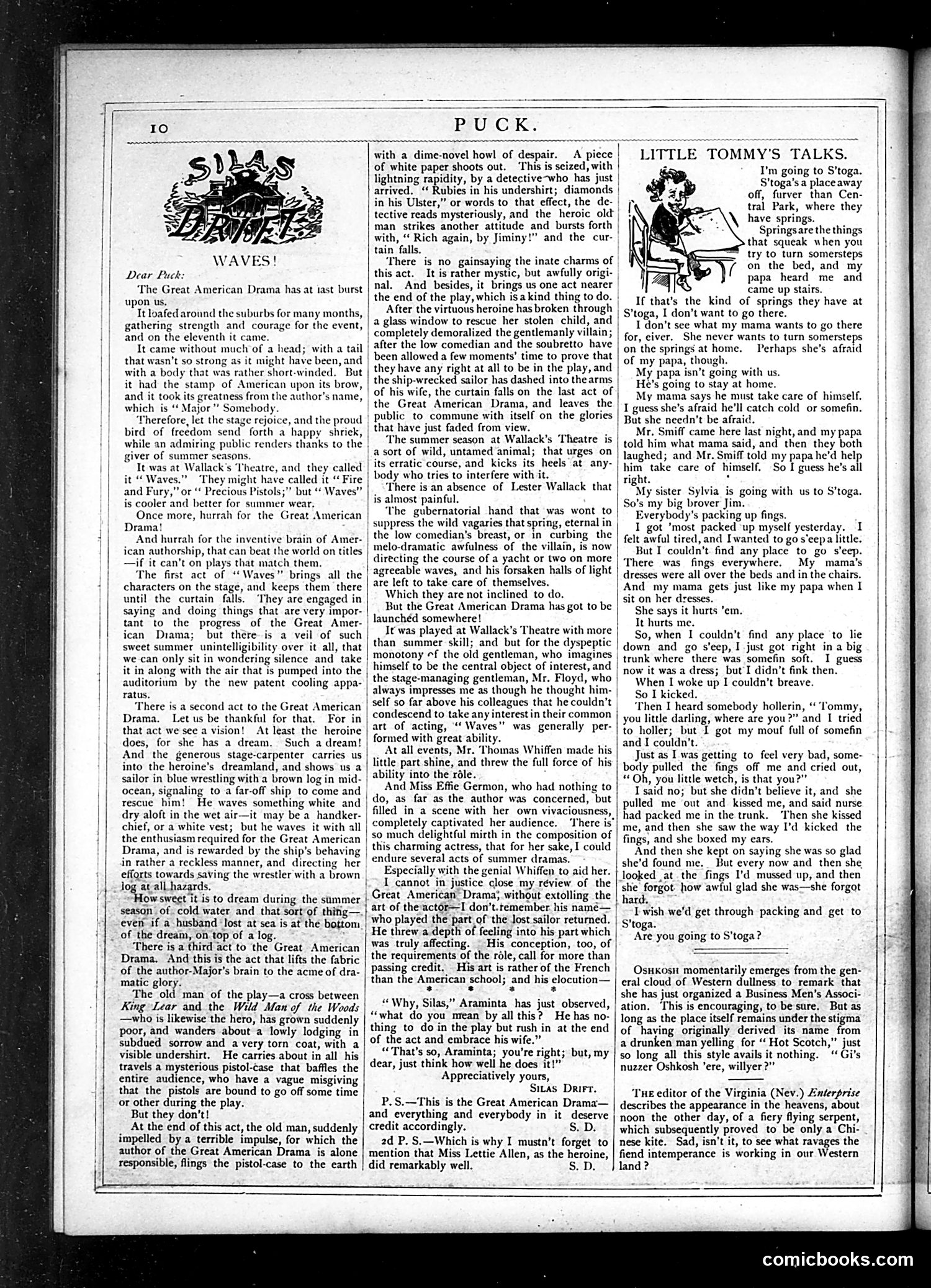
What you’re looking at
This page contains two distinct sections: **Left: "Waves!" Letter to the Editor** A theatrical review praising "The Great American Drama" at Wallack's Theatre. The writer celebrates the play's inventiveness and its actors—particularly praising Mr. Floyd's performance and Miss Effie Germmon's captivating portrayal. The piece critiques the play's melodramatic plot while admiring its technical execution and emotional depth. This appears to be genuine theater criticism rather than satire. **Right: "Little Tommy's Talks"** A humorous column featuring a child's complaints about everyday situations—refusing to visit Stoga Park, disliking spring cleaning, resisting bedtime. The child's reasoning is presented with innocent logic that adults would find amusing. Neither section appears to be overtly political satire, focusing instead on entertainment and domestic humor typical of Puck's lighter content.
📄 Transcribed text from this page (OCR, searchable)
Machine-transcribed from the original scan — historical spelling and the odd misread are preserved.
Dear Puck: The Great American Drama has at tast burst upon us. It loafed around the suburbs for many months, | gathering strength and courage for the event, | and on the eleventh it came. It came without much of a head; with a tail that wasn’t so strong as it might have been, and with a body that was rather short-winded. But | it had the stamp of American upon its brow, and it took its greatness from the author's name, which is “ Maj omebody. ‘Therefore, let the stage rejoice, and the proud bird of freedom send’ forth a happy. shriek, while an admiring public renders thanks to the giver of summer seasons. It was at Walla Theatre, and they called it “ Waves.” They might h. called it ‘ Fire | and Fury,” or “ Precious Pistols; but Waves” | is cooler and better for summer wear, Once more, hurrah for the Great American Drama! And hurrah for the inventive brain of Amer- ican authorship, that can beat the world on titles | —if it can’t on plays that match them. | The first act of ‘‘ Waves” brings all the characters on the stage, and keeps them there until the curtain fails. ‘They are engaged in saying and doing things that are very impor- tant to the progress of the Great Amer- ican Drama; but there is a veil of such | sweet summer unintelligibility over it all, that we can only sit in wondering silence and take it in along with the air that is pumped into the | auditorium by the new patent cooling appa- ratus. ‘There is a second act to the Great American Drama. Let us be thankful for that. For in that act we see a vision! At least the heroine does, for she has a dream. Such a dream! And the generous stage-carpenter carries us into the heroine’s dreamland, and shows us a sailor in blue wrestling with a brown log in mid- | ocean, signaling to a far-off ship to come and rescue him! He waves something white and dry aloft in the wet air—it may be a_handker- chief, or a white vest; but he waves it with all the enthusiasm required for the Great American Drama, and is rewarded by the ship's behaving in rather a reckless manner, and directing her efforts towards saving the wrestler with a brown Jog at alL_hazards. I low sweet it is to dream during the summer season of. cold water and that sort‘of thiig—. even if a husband ‘lost at sea is at the bottom. | _ of the dream, ontop of a log. | ‘There is a third act to the Great American Drama. And this is the act that lifts the fabric of the author-Major’s brain to the acme of dra- matic glory. The old man of the play—a cross between King Lear and the Wild Man of the Woods | —who is likewise the hero, has grown suddenly poor, and wanders about a lowly lodging in subdued sorrow and a very torn coat, with a visible undershirt. He carries about in all his travels a mysterious pistol-case that baffles the entire audience, who have a vague misgiving that the pistols are bound to go off some time or other during the play. But they don’t! At the end of this act, the old man, suddenly impelled bya terrible impulse, for which the author of the Great American Drama is alone | body who tries to interfere with it. | this charming actress, that for her sake, I could PUCK. with a dime-novel how! of despair. A piece | of white paper shoots out. ‘This is sized, with | lightning rapidity, by a detective-who has just | arrived. ‘ Rubies in his undershirt; diamonds | in his Ulster,” or words to that effect, the de- | tective reads mysteriously, and the heroic old | man strikes another attitude and bursts forth | with, “ Rich again, by Jiminy!” and the cur- tain falls. ‘There is no gainsaying the inate charms of this act. It is rather mystic, but awfully origi- nal. And besides, it brings us one act nearer the end of the play, which isakind thing to do. | After the virtuous heroine has broken through a glass window to rescue her stolen child, and completely demoralized the gentlemanly villain; after the low comedian and the soubretto have been allowed a few moments’ time to prove that they have any right at all to be in the play, and the ship-wrecked sailor has dashed into the arms of his wife, the curtain falls on the last act of | the Great American Drama, and leaves the public to commune with itself on the glories that have just faded from view. ‘The summer season at Wallack’s Theatre is | a sort of wild, untamed animal; that urges on its erratic course, and kicks its heels at any- There is an absence of Lester Wallack that | is almost painful. ‘The gubernatorial hand that was wont to | suppress the wild vagaries that spring, eternal in the low comedian's breast, or in curbing the | melo-dramatic awfulness of the villain, is now | directing the course of a yacht or two on more | agreeable waves, and his forsaken halls of light | are left to take care of themselves. | Which they are not inclined to do. But the Great American Drama has got to be | launchéd somewhere! | It was played at Wallack’s Theatre with more | than summer skill; and but for the dyspeptic monotony ef the old gentleman, who imagines himself to be the central object of interest, and the stage-managing gentleman, Mr. Floyd, who always impresses me as though he thought him- self so far above his colleagues that he couldn’t condescend to take any interest in their common | art of acting, “Waves” was generally per- formed with great ability. At all events, Mr. Thomas Whiffen made his little part shine, and threw the full force of his | bility into the réle. And Miss Effie Germon, who had nothing to do, as far as the author was concerned, but filled in a scene with her own vivaciousness, completely captivated her audience. ‘There is’ so much delightful mirth in the composition of endure several acts of summer dramas. Especially with the genial Whiffen to aid her. I cannot in justice close my réview of the Great American” Drama; without extolling the art of theactor—I don’t.remember. his namé— | who played the part of the Jost sailor returned. He threw a depth of feeling into his part which was truly affecting. _ His conception, too, of the requirements of the rdle, call for more than passing credit. His art is rather of the French than the ‘American, (School; and his relocation = “Why, Silas,” Araminta has just observed, | “what do you mrean by all this? He has no- thing to do in the play but rush in at the end of the act and embrace his wife.” “That's so, Araminta; you're right; but, my dear, just think how well he does it!” Appreciatively yours, Sitas Drirt. P.S.—This is the Great American Drama— and everything and everybody in it deserve credit accordingly. S. D. 2d P. S.—Which is why I mustn’t forget to responsible, flings the pistol-case to the earth | mention that Miss Lettie Allen, as the heroine, did remarkably well. S. D. TOMMY'S TALKS. I'm going to S’toga. S'toga’s a placeaway off, furver than Cen- tral Park, where they have springs. Springsare the things that squeak when you try to turn somersteps on the bed, and my papa heard’ me and q came up stairs. If that’s the kind of springs they have at S'toga, I don’t want to go there. I don’t see what my mama wants to go there for, ceiver. She never wants to turn somersteps on the springs at home. Perhaps she’s afraid of my papa, though. My papa isn’t going with us He’s going to stay at home. My mama says he must take care of himself. I guess she’s afraid he'll catch cold or somefin. But she needn't be afraid. Mr. Smiff came here last night, and my papa told him what mama said, and then they both laughed; and Mr. Smif told my papa he'd help him take care of himself. So I guess he’s all right. : My sister Sylvia is going with us to S'toga. So's my big brover Jim. Everybody's packing up fings. I got ‘most packed ‘up myself yesterday. I felt awful tired, and Iwanted to go s‘eepa little. But I couldn't find any place to go s'eep. There was fings everywhere. My mama's dresses were all over the beds and in the chairs. LITTL | And my mama gets just like my papa when I sit on her dresses. She says it hurts ’em. It hurts me. So, when I couldn’t find any place to lie | down and go s'eep, I just got right in a big trunk where there was somefin soft. I guess now it was a dress;_but'I didn’t fink then. When I woke up I couldn’t breave. So I kicked. ‘Then I heard somebody hollerin, “‘fommy, you little darling, where are you?” and I tried to holler; but I got my mouf full of somefin and I couldn't. Just as I was getting to feel very bad, some- body pulled the fings off me and cried out, “Oh, you little wetch, is that you?” I said no; but she didn’t believe it, and she pulled me out and kissed me, and said nurse had packed me in the trunk. ‘Then she kissed me, and then she saw the way I'd kicked the fings, and she boxed my ears. And then she kept on saying she was so glad she'd found me. But every now and then she looked ,at the fings I'd mussed up, and then she forgot. how awful glad she was—she forgot hard. I wish we'd get through packing and get to S'toga. Are you going to S’toga? Osuxkosi momentarily emerges from the gen- eral cloud of Western dullness to remark that she has just organized a Business Men’s Associ- ation. This is encouraging, to be sure, But as long as the place itself remains under the stigma of haying originally derived its name from a drunken man yelling for “ Hot Scotch,” just so long all this style avails it nothing.“ Gi's nuzzer Oshkosh ‘ere, willyer ?” ‘Tne editor of the Virginia (Nev.) Enterprise describes the appearance in the heavens, about noon the other day, of a fiery flying serpent, which subsequently proved to be only a Chi- ese kite. Sad, isn’t it, to see what ravages the fiend intemperance is working in our Western land ? Pes comicbooks.com