
Puck, 1877-06 · page 7 of 16
Puck — June 1877 — page 7: what you’re looking at
What you’re looking at
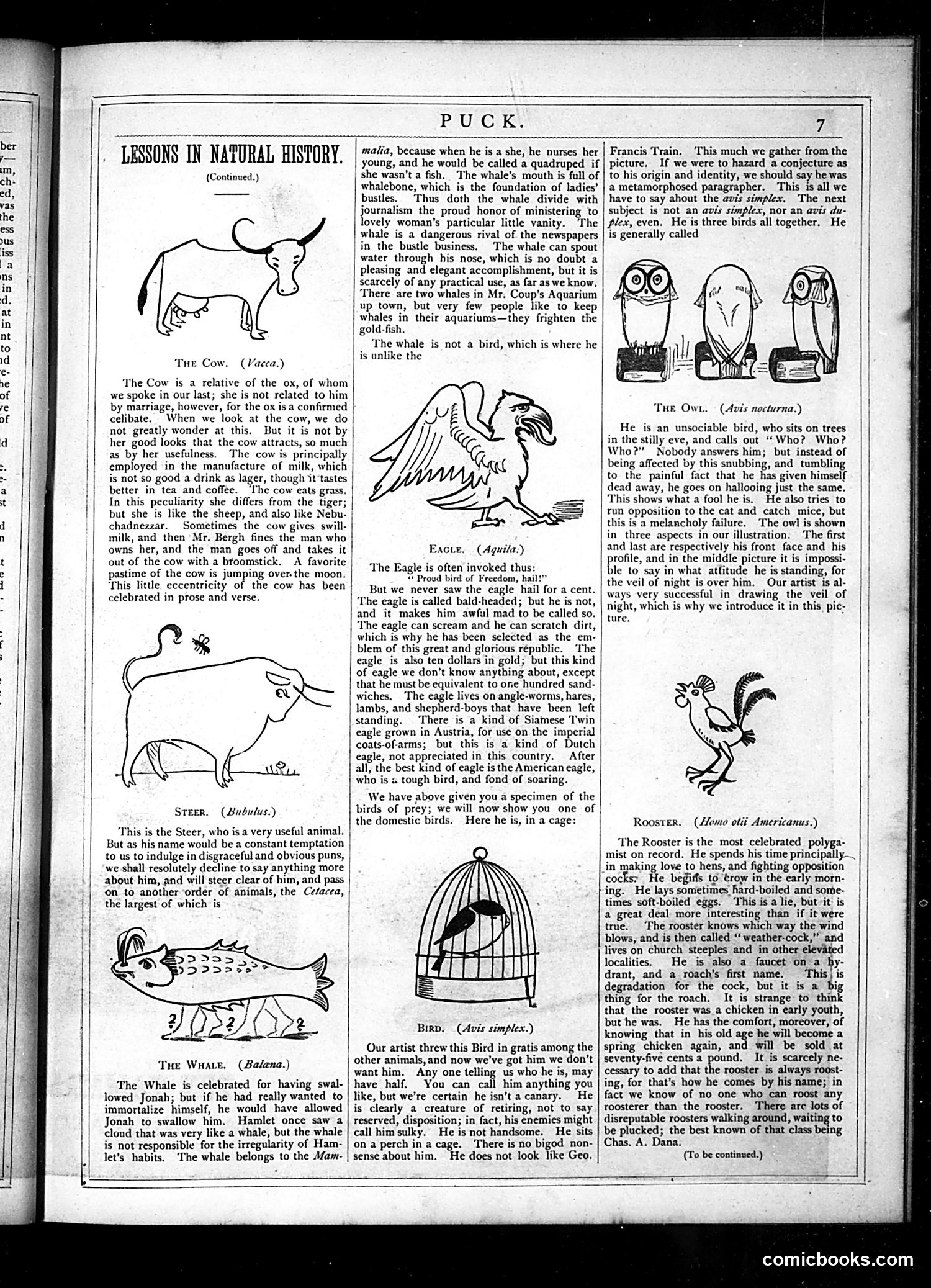
This is a humorous educational feature, not political satire. The page presents illustrated lessons about animals with tongue-in-cheek descriptions: - **The Cow**: Portrayed as useful but unintelligent, employed mainly in milk manufacture - **The Steer**: Described as "very useful" but name-wise problematic - **The Whale**: Satirized for its impracticality and comparison to newspapers - **The Eagle**: Mocked as overrated ("ten dollars in gold") and ineffective - **The Owl**: Criticized as unsociable and poor at catching mice - **The Rooster**: Celebrated as a polygamist with noisy habits; noted as originally a chicken The satire targets both animal characteristics and human attitudes toward them—deflating romantic notions (like the eagle as a "glorious republic" symbol) while finding humor in overlooked or underappreciated creatures. It's social commentary wrapped in natural history.
📄 Transcribed text from this page (OCR, searchable)
Machine-transcribed from the original scan — historical spelling and the odd misread are preserved.
PUCK. LESSONS IN NATURAL HISTORY. (Continued.) | | | THe Cow. (Vaeca.) ‘The Cow is a relative of the ox, of whom we spoke in our last; she is not related to him by marriage, however, far the ox is a confirmed | celibate. When we look at the cow, we do not greatly wonder at this. But it is not by her good looks that the cow attracts, so much as by her usefulness. The cow is principally employed in the manufacture of milk, which is not so good a drink as lager, though it tastes better in tea and coffee. ‘Ihe cow eats grass. In this peculiarity she differs from the tiger; but she is like the sheep, and also like Nebu- chadnezzar. Sometimes the cow gives swill- milk, and then Mr. Bergh fines the man who | owns her, and the man goes off and takes it out of the cow with a broomstick. A favorite pastime of the cow is jumping over-the moon. ‘This little eccentricity of the cow has been celebrated in prose and verse. » S a (Bubulus.) ‘This is the Steer, who is a very useful animal. But as his name would be a constant temptation | to us to indulge in disgraceful and obvious puns, we shall resolutely decline to say anything more about him, and will steer clear of him, and pass on to another ‘order of animals, the Cefacea, | the largest of which is STEER. THe Wxate. (Balena.) The Whale is celebrated for having swal- lowed Jonah; but if he had really wanted to immortalize himself, he would have allowed Jonah to swallow him. Hamlet once saw a cloud that was very like a whale, but the whale is not responsible for the irregularity of Ham- let's habits. The whale belongs to the Afam- | | in the bustle business. | water through his nose, which is no doubt a | standing. malia, because when he is a she, he nurses her young, and he would be called a quadruped if she wasn't a fish. The whale's mouth is full of whalebone, which is the foundation of ladies’ bustles. ‘Thus doth the whale divide with journalism the proud honor of ministering to lovely woman’s particular little vanity. ‘The whale is a dangerous rival of the newspapers The whale can spout pleasing and elegant accomplishment, but it is scarcely of any practical use, as far as we know. ‘There are two whales in Mr. Coup’s Aquarium up town, but very few people Tike to keep whales in their aquariums—they frighten the gold-fish. ‘The whale is not a bird, which is where he | is unlike the Eacie. (Aguila:) The Eagle is often invoked thu: * Proud bird of Freedom, hi But we never saw the cagle h ‘The eagle is called bald-headed; but he is not, | and it makes him awful mad to be called so. ‘The eagle can scream and he can scratch dirt, which is why he has been selected as the em- blem of this great and glorious republic. ‘The eagle is also ten dollars in gold; but this kind of eagle we don’t know anything about, except that he must be equivalent to one hundred sand- wiches. ‘The eagle lives on angle-worms, hares, lambs, and shepherd-boys that have been left There is a kind of Siamese Twin eagle grown in Austria, for use on the imperial coats-of-arms; but this is a kind of Dutch eagle, not appreciated in this country. After all, the best kind of eagle is the American eagle, who is « tough bird, and fond of soaring. We have above given you a specimen of the birds of prey; we will now show you one of the domestic birds, Here he is, in a cage: Birp. (Avis simplex.) Our artist threw this Bird in gratis among the other animals, and now we've got him we don’t want him, Any one telling us who he is, may have half. You can call him anything you like, but we're certain he isn't a canary. He is clearly a creature of retiring, not to say reserved, disposition; in fact, his enemies might call him sulky. He is not handsome. He sits on a perch in a cage. There is no bigod non- sense about him. He does not look like Geo. Francis Train. for a cent. | 7 ‘This much we gather from the picture. If we were to hazard a conjecture as to his origin and identity, we should say he was a metamorphosed paragrapher. This is all we have to say ahout the avis simplex. The next subject is not an avis simplex, nor an avis du- plex, even. He is three birds all together. He is generally called THe Own. (Avis nocturna.) He is an unsociable bird, who sits on trees in the stilly eve, and calls out ‘Who? Who? Who?" Nobody answers him; but instead of being affected by this snubbing, and tumbling to the painful fact that he has given himself dead away, he goes on hallooing just the same. This shows what a fool he is. He also tries to run opposition to the cat and catch mice, but this is a melancholy failure. The owl is shown in three aspects in our illustration. The first and last are respectively his front face and his profile, and in the middle picture it is impossi- ble to say in what attitude he is standing, for the veil of night is over him. Our artist is al- ways very successful in drawing the veil of night, which is why we introduce it in this. pic- ture. Rooster. (Homo otit Americanus.) ‘The Rooster is the most celebrated polyga- mist on record. He spends his time principally | |in making love to hens, and fighting opposition cocks: He bejitfs to trow in the early morn- ing. He lays sometimes hard-boiled and some- times soft-boiled eggs. ‘This is a lie, but ‘it: is a great deal more interesting than if it were true. The rooster knows which way the wind blows, and is then called “‘ weather-cock,” and lives on church steeples and in other elevated localities. He is also a faucet on a hy- drant, and a roach’s first name. This} is degradation for the cock, but it is a big thing for the roach. It is strange to think that the rooster was_a chicken in early youth, but he was. He has the comfort, moreover, of knowing that in his old age he will become a spring chicken again, and will be sold at seventy-five cents a pound. It is scarcely ne- cessary to add that the rooster is always roost- ing, for that’s how he comes by his name; in fact we know of no one who can roost any roosterer than the rooster. There arc lots of disreputable roosters walking around, waiting to be plucked; the best known of that class being Chas. A. Dana. (To be continued.) comicbooks.com