
A complete issue · 16 pages · 1877
Puck — June 1877
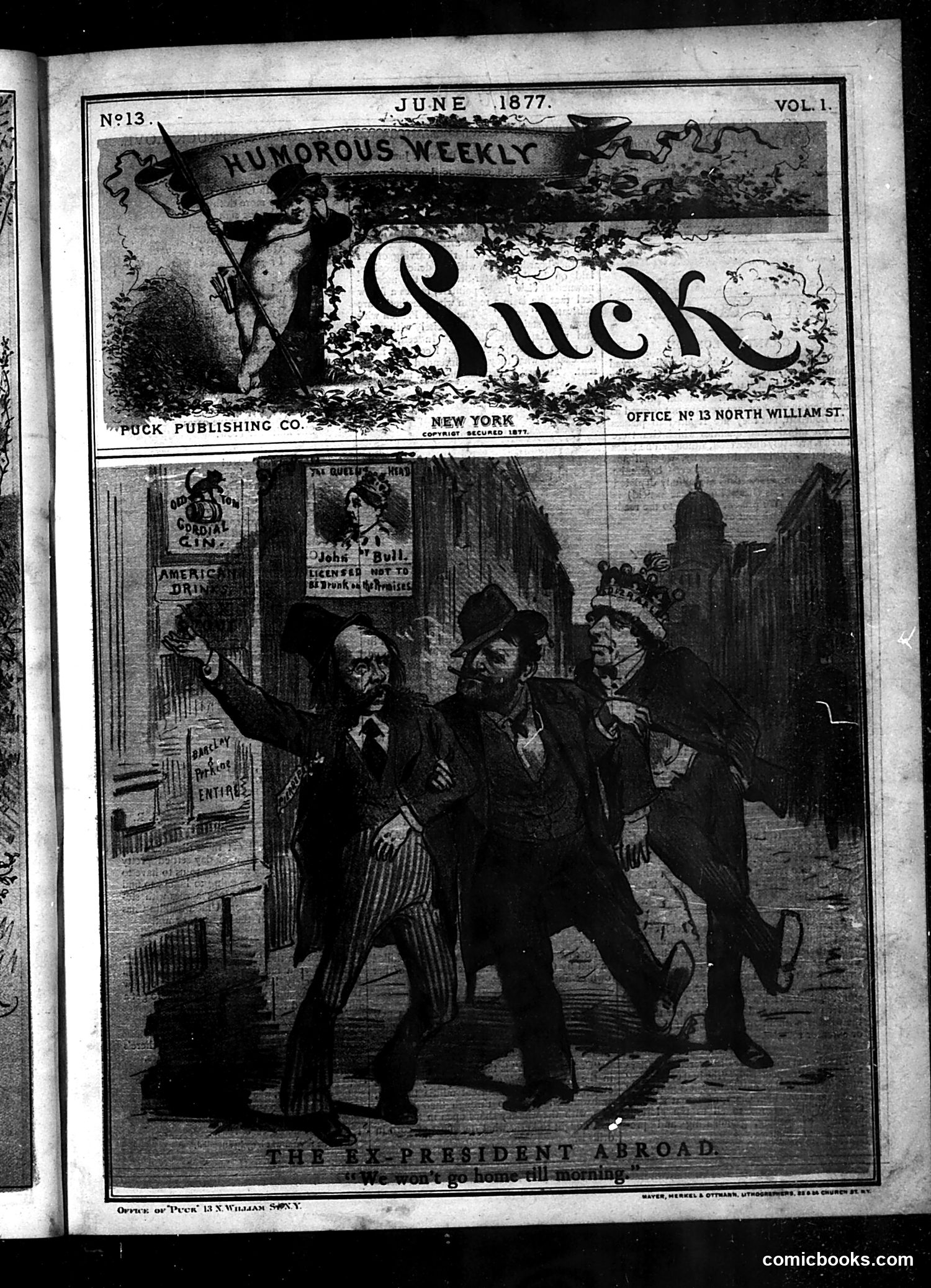
This June 1877 *Puck* cartoon satirizes an unnamed former U.S. president traveling in Europe. The caption "We wish him morning glory" appears to be a bitter send-off. Three caricatured figures in a European street scene gesture dismissively at a departing political figure, suggesting ridicule or mockery of his exile. The timing (1877) and "ex-president" reference likely indicate Andrew Johnson, whose presidency ended in 1869 and who did travel abroad during this period. The cartoon reflects contemporary political hostility—Johnson remained a controversial Reconstruction-era figure. The satire mocks his departure as if removing him from American politics was cause for celebration, embodying the era's deep post-Civil War political divisions.
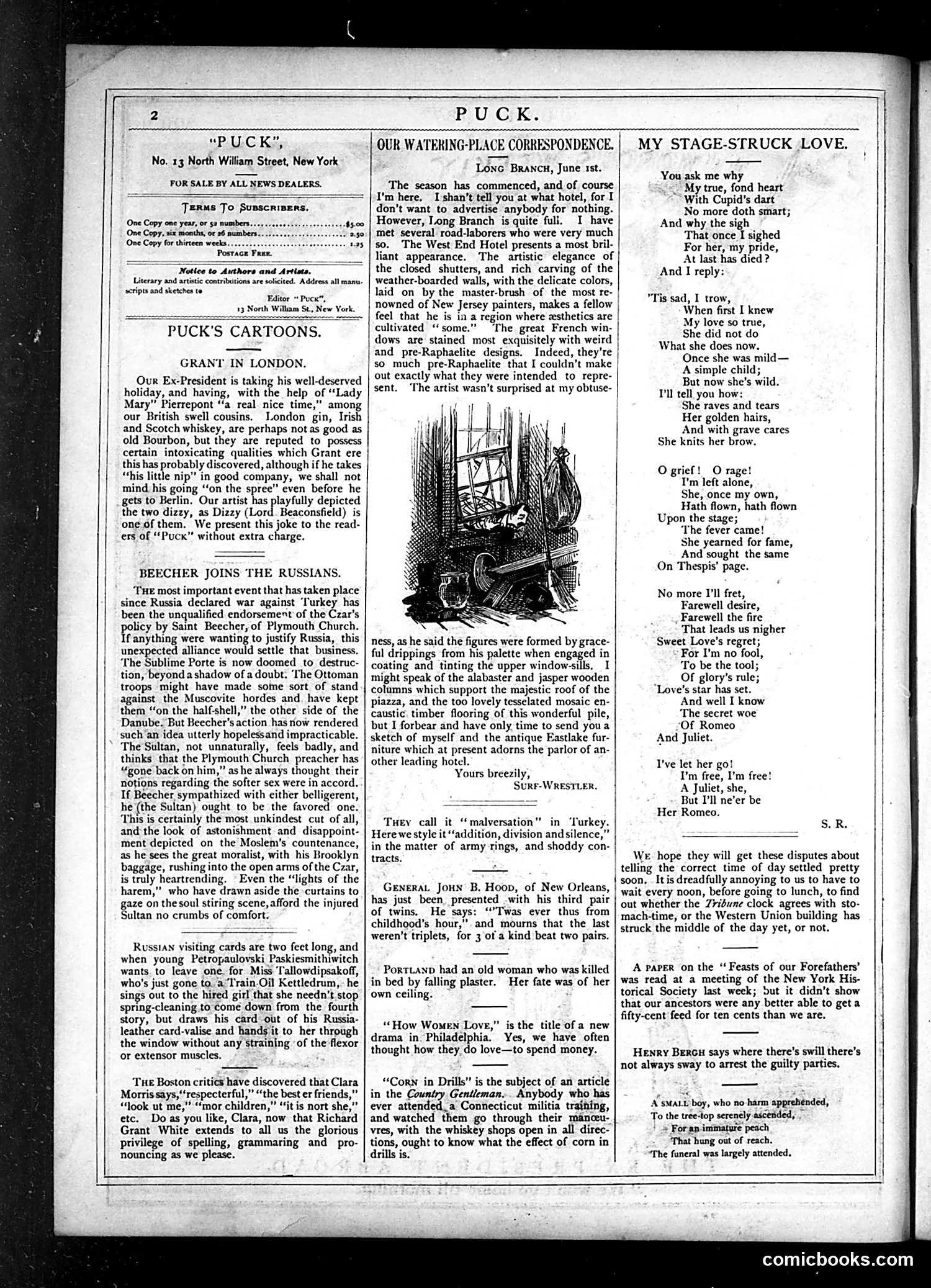
This page contains primarily **text content rather than political cartoons**—it features editorial commentary, correspondence, and poetry rather than satirical illustrations. The visible cartoon ("Grant in London") appears to reference **President Ulysses S. Grant's travels abroad**, suggesting satirical commentary on his leisure activities while serving as president. Other editorial items discuss: - **Saint Beecher's alliance with Russians** (likely referencing Henry Ward Beecher, prominent clergyman) - **Turkish military matters** - **General John B. Hood** receiving military honors The right column contains romantic poetry titled "My Stage-Struck Love," unrelated to political satire. **Overall**: This is a mixed-content page typical of 19th-century magazine layout, combining gossip, commentary, and light verse rather than sustained satirical cartooning. Without clearer images or fuller context, precise historical references remain uncertain.
This page contains three distinct sections of satirical content: 1. **"Puckerings"** - A humor column with brief jokes and observations about contemporary society, including references to Koran teachings, watch-winding, Philadelphia detectives, and New England politicians. 2. **"Summer Resort Jottings"** - Social commentary on wealthy vacationers at Atlantic City and Shelter Island, satirizing their pretensions and behaviors. 3. **"A Stray Hair"** and **"Making Black White"** - Two longer articles. The first discusses a woman finding a stray hair and obsessing over its origin. The second critiques Richard Grant White's newspaper columns, suggesting his writing is overly pedantic and that he gives unsound advice about grammar and proper behavior. The satire targets social affectation, class pretension, and intellectual pomposity among the urban elite.
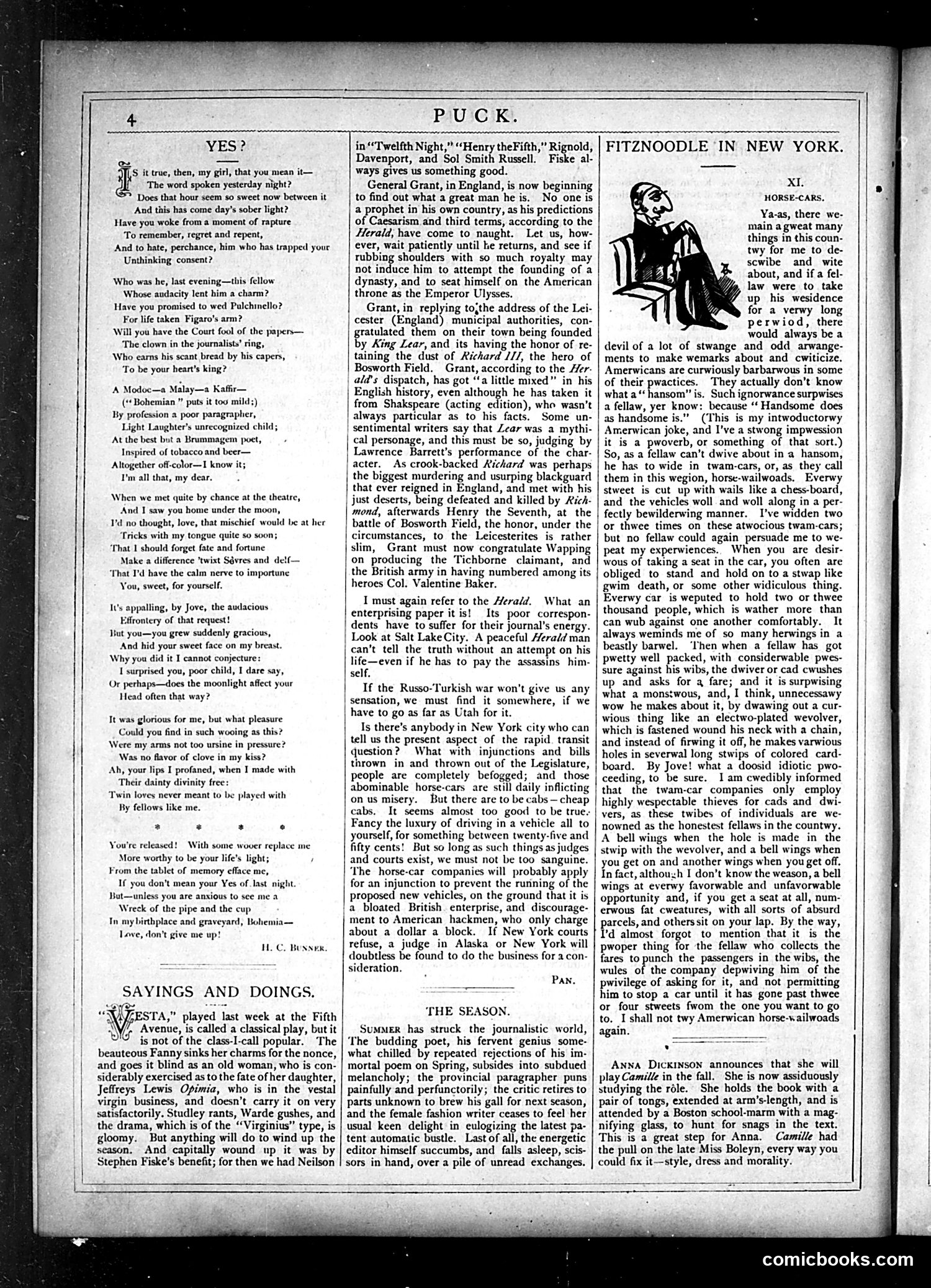
This cartoon and accompanying article satirize **horse-drawn streetcars (horse-cars)** in New York City. The illustration shows a man (Fitznoodle, apparently a recurring Puck character) commenting on the barbarous behavior of Americans regarding public transportation. The text ridicules how Americans—described as "curiously barbarous"—tolerate the discomforts of crowded horse-cars. It mocks the practice of forcing passengers into vehicles designed for far fewer people, and critiques the companies' profit-driven indifference to passenger welfare. The piece argues that judges and courts should regulate these abuses, and suggests New York courts might eventually intervene in the dispute, as Alaska courts apparently did. The satire targets both American tolerance of poor service and corporate exploitation.
This page contains three distinct pieces of satire: 1. **"The Hand-Shaking Farce"** criticizes the abolition of handshake ceremonies, arguing that while society progresses, eliminating this custom removes dignity from individuals. The author defends handshaking as meaningful ritual. 2. **"On Making War-Map Puns"** mocks newspapers' excessive punning about the Russo-Turkish War, particularly involving place names like "Kars" and "Constantinople." The satire ridicules journalists for creating tortured wordplay around military geography. 3. **"Puck's Personal Intelligence"** is a gossip column featuring brief, humorous anecdotes about public figures and society scandals (Victoria, Whitclaw Reid, etc.). The page reflects late 19th-century concerns about journalistic excess and social custom debates.
This page contains two main sections: "A June 'Idyll'" (a sentimental poem) and "Schliemann as an Excavator" (the main satirical content). The excavator piece mocks Dr. Heinrich Schliemann, a prominent archaeologist of the era. The satire appears to mock his methods and interpretations of ancient Troy excavations. The text includes humorous "translations" of archaeological findings presented as dialogue, suggesting Schliemann imposed questionable interpretations on ambiguous artifacts—claiming to identify specific ancient items based on minimal evidence. The accompanying sections reference various historical figures and sites (Laocoon, Castor, Trojan artifacts), using them as comedic fodder to ridicule overzealous or speculative archaeological conclusions. The overall point: legitimate science can become absurd when practitioners make unfounded leaps from fragmentary evidence. The page also includes "French Etiquette," brief social satire on manners.
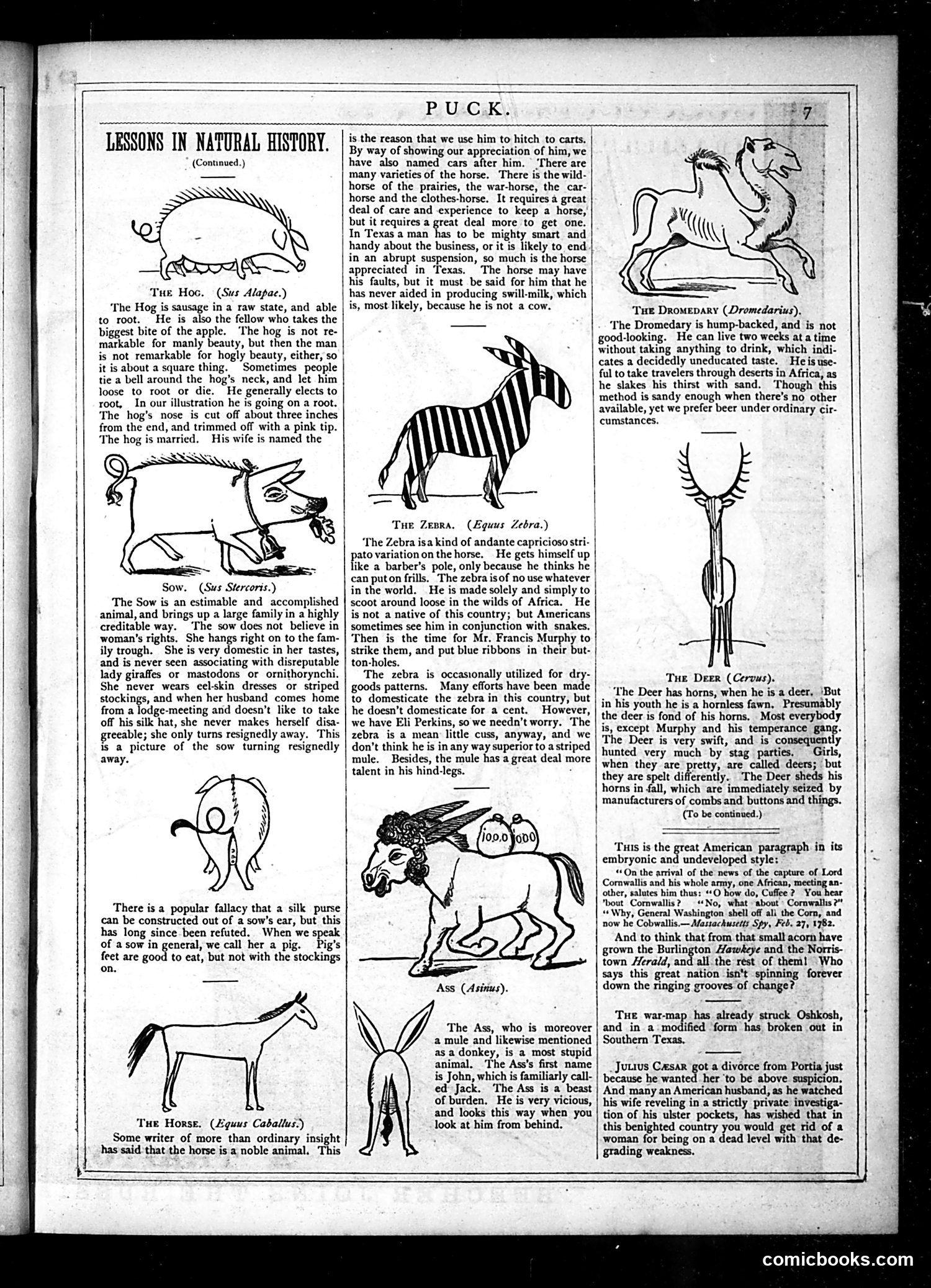
This page is primarily **educational content rather than political satire**. It presents illustrated natural history lessons about various animals: the hog, sow, horse, zebra, dromedary, deer, ass, and others. Each animal receives a brief descriptive text and accompanying sketch. The writing employs gentle, humorous tone typical of Puck's lighter content—for example, describing the zebra as "a mean little cuss" and noting the ass is "a most stupid animal." The page includes one apparent **social commentary**: a paragraph about Lord Cornwallis and American patriotism, referencing Revolutionary War history and critiquing those who prioritize wealth over national pride. Overall, this represents Puck's mixed editorial approach—combining educational humor with occasional patriotic messaging for middle-class readers.
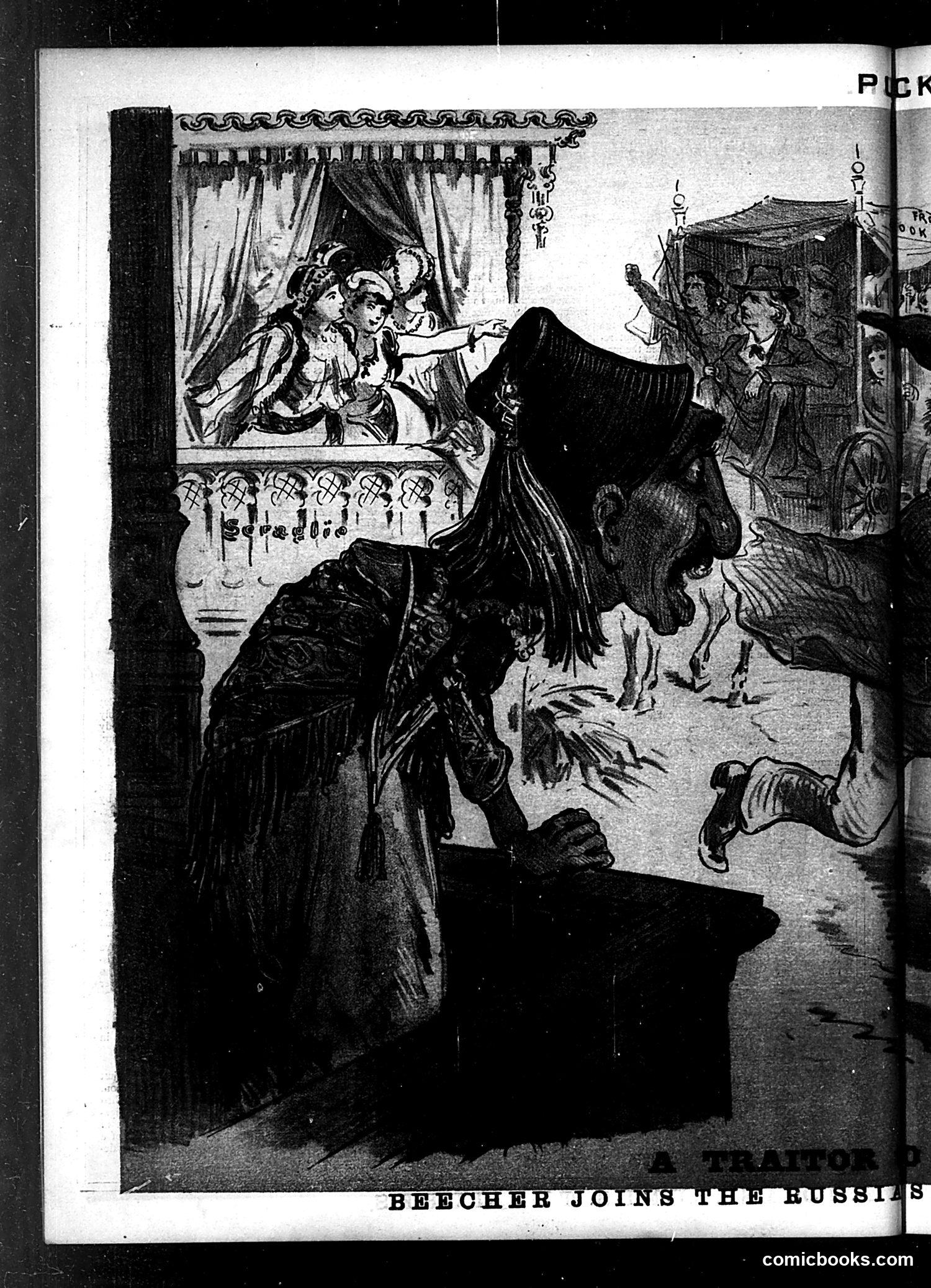
This cartoon satirizes **Henry Ward Beecher**, a prominent 19th-century clergyman, joining Russian interests or causes. The image shows a figure in dark robes (representing Russia, likely through Cossack-style clothing) gesturing toward what appears to be a theatrical or public setting where elegantly-dressed figures occupy a balcony or window. The satire likely mocks Beecher's public positions or associations—possibly his support for certain Russian policies or his involvement in controversial social movements that critics framed as un-American or radical. The theatrical staging suggests the "performance" or spectacle of such an alliance. Without the full article text, the specific political controversy remains unclear, but it represents typical Puck-style ridicule of prominent public figures perceived as betraying American interests.
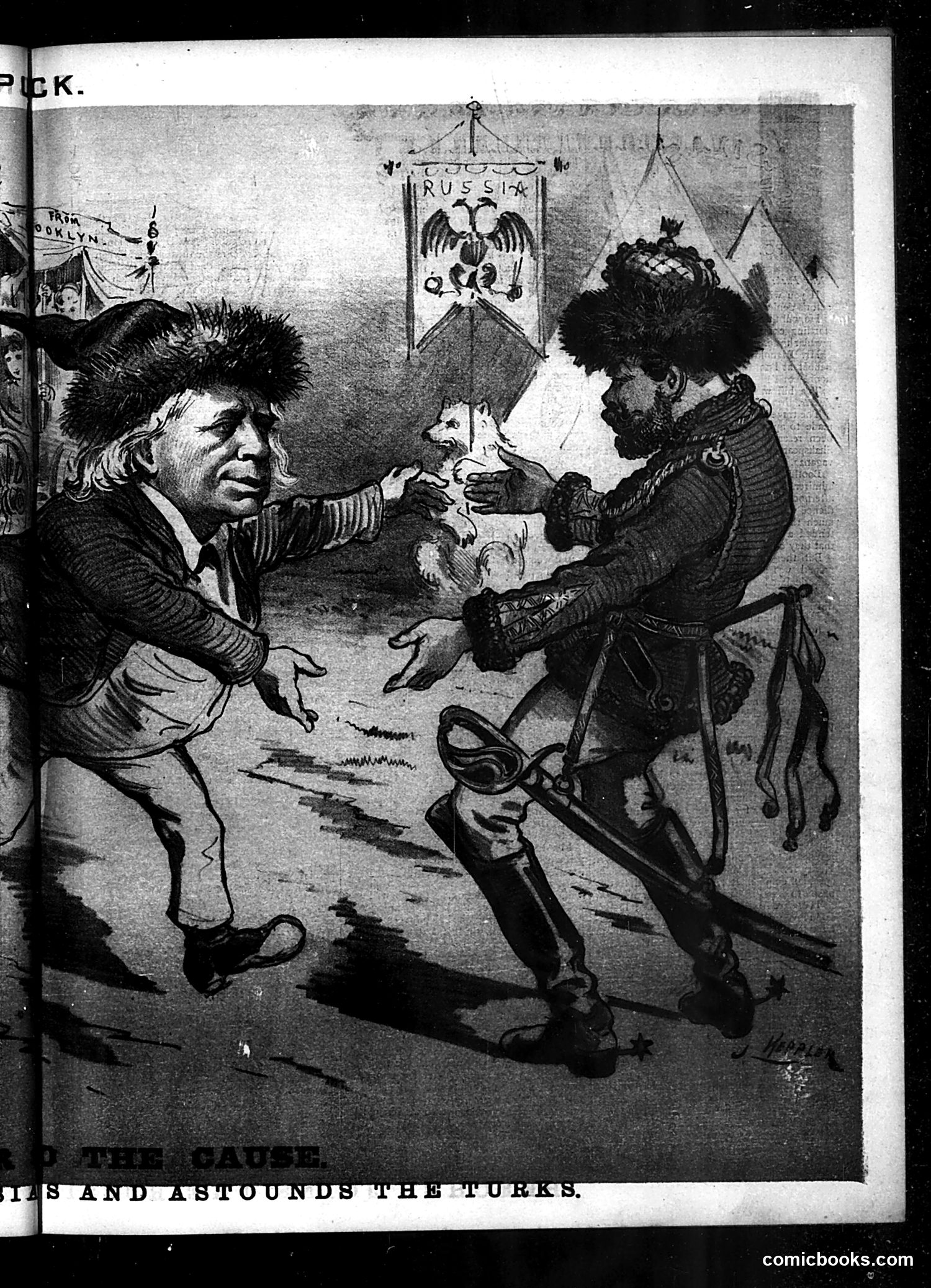
This political cartoon depicts two caricatured figures—likely representing European or American political leaders—in an exaggerated confrontation. The figure on the left appears distressed or animated, while the one on the right holds what looks like a white animal (possibly a cat or dog), with a sword visible in the scene. A banner bearing an eagle and "RUSSIA" hangs prominently in the background, suggesting Russian involvement in the satirized situation. The caption references "Turks," indicating this cartoon comments on international relations involving the Ottoman Empire. Without additional context, the specific political incident or dispute being mocked—and the identities of the caricatured figures—remains unclear from the image alone.
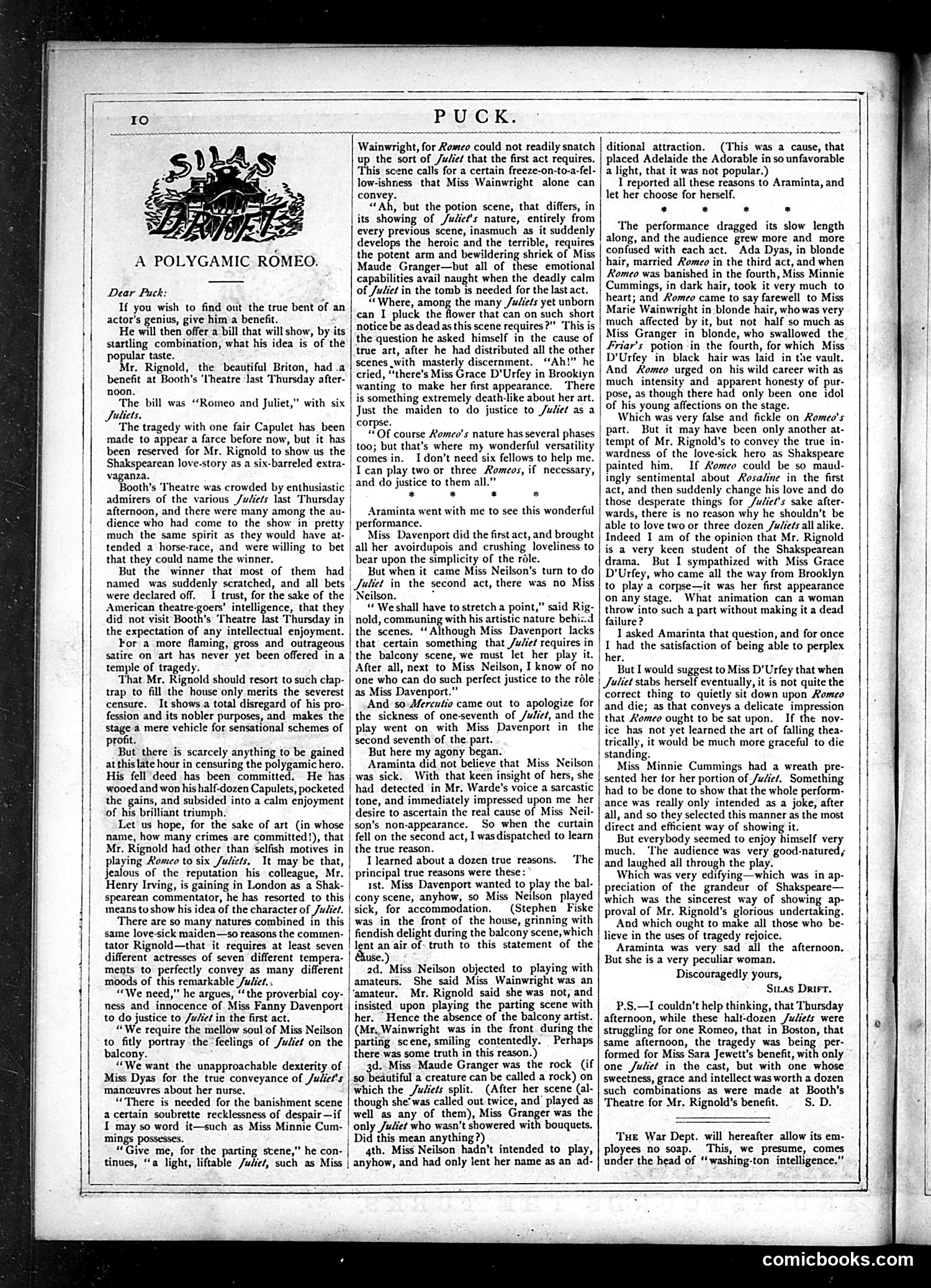
This page contains a theater review by "Silas Dirk" (likely a pseudonym) critiquing a production of Shakespeare's "Romeo and Juliet." The satire targets actor Mr. Rigold's casting choices and directorial decisions regarding the play's performance. The review mockingly discusses how Rigold allegedly cast multiple actresses across different acts to play Juliet—a "polygamic" approach to the role. The critic sardonically praises this unconventional strategy while highlighting its absurdity, suggesting Rigold prioritized showcasing different performers over maintaining dramatic coherence or emotional authenticity. The satire aims at both theatrical vanity and the era's debate over proper Shakespearean interpretation, ridiculing producers who valued star power over artistic integrity.
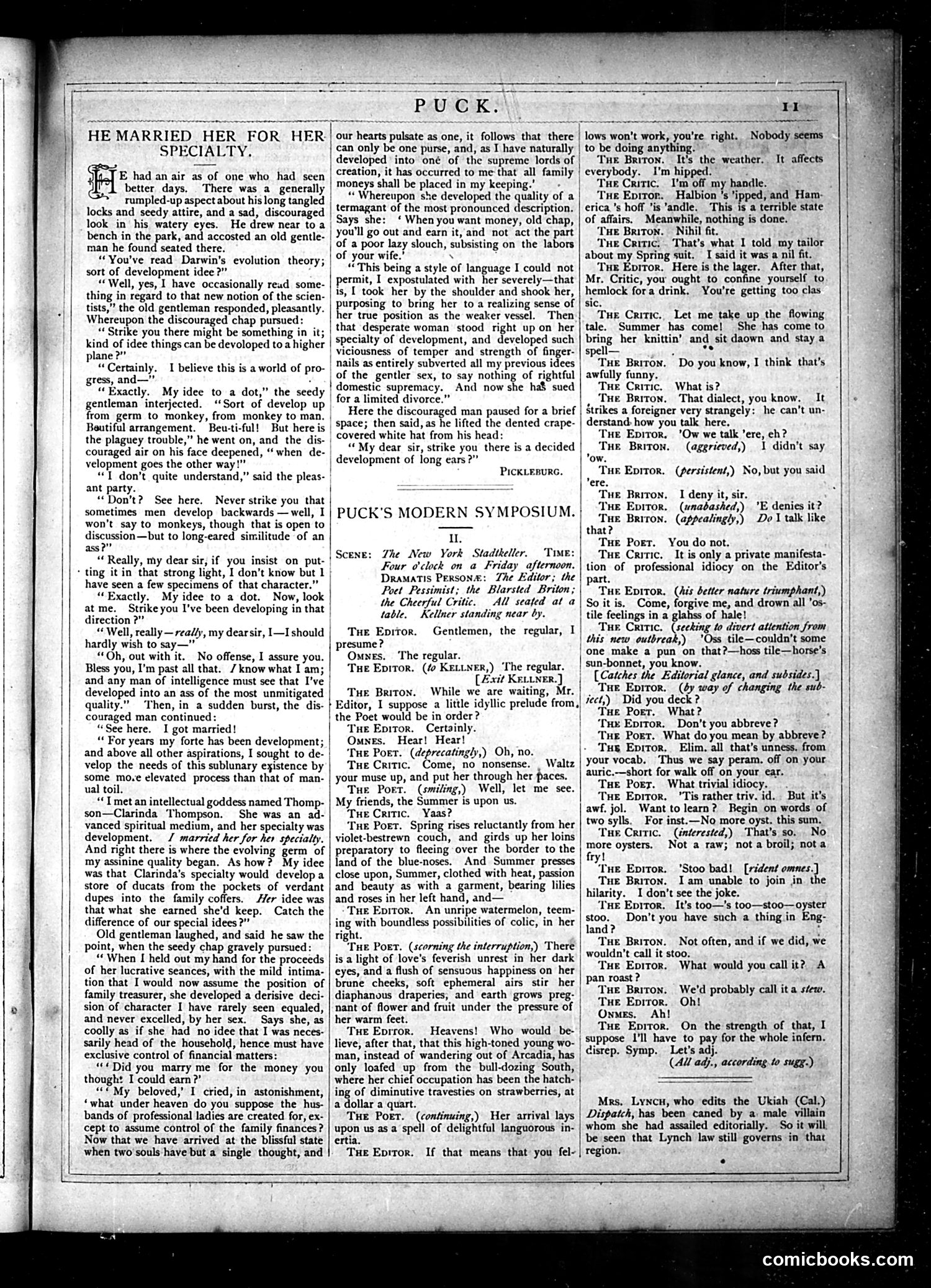
This page presents a dialogue-based satirical piece rather than a cartoon. The debate centers on marriage and women's roles, with characters including "The Editor," "The Barton" (likely a misspelling), "The Critic," and "The Port." The satire mocks intellectualized discussion of gender dynamics—specifically, arguments that wives should be "weaker vessels" developing strength through hardship, contrasted with calls for equality. A character recounts marrying a woman named Clarinda Thompson for her "intellectual goddessness," only to discover domestic reality differs from romantic ideals. The piece satirizes both sentimental Victorian marriage ideology and pretentious intellectual posturing about women's development and equality. Modern readers would recognize it as commentary on late-19th/early-20th century debates about women's education, marriage, and social roles.
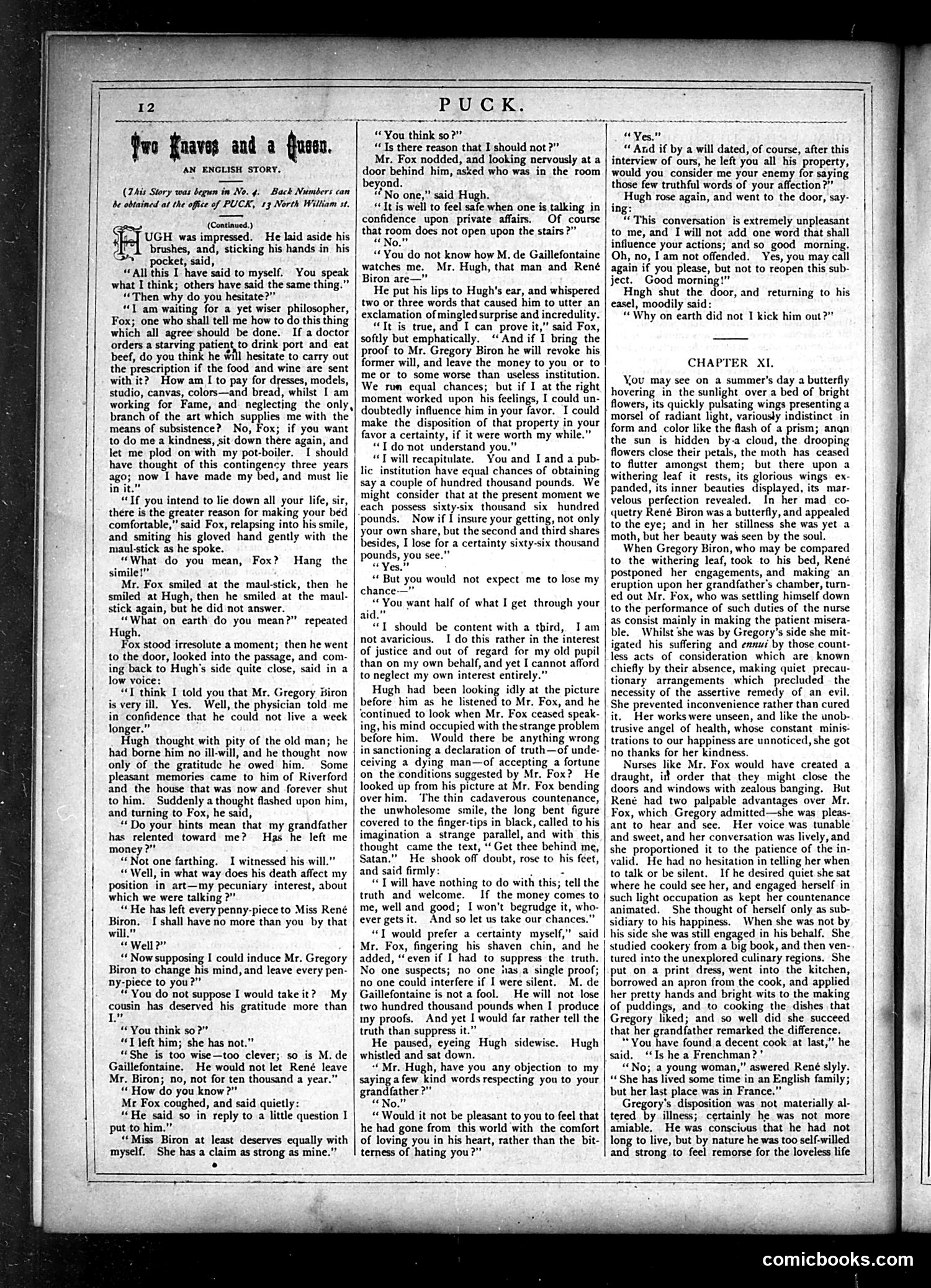
This page contains serialized fiction rather than political satire. The story depicts an English domestic drama involving disputes over property and inheritance among characters including Mr. Fox, Mr. Hugh, and Mr. Gregory Biron. The narrative centers on Fox attempting to manipulate Hugh into signing away property rights, with dialogue about "a couple of hundred thousand pounds" and competing financial claims. A woman (likely the "Queen" of the title) appears to be a point of contention—references mention her engagement and her role as a servant/nurse. The story appears to be melodramatic Victorian-era fiction exploring themes of greed, deception, and class conflict rather than contemporary political commentary. Without identifying specific historical figures or events, the text focuses on personal intrigue and moral questions about honesty and justice.
This page contains three separate satirical pieces rather than a unified cartoon: 1. **"The Superannuated O.G."** - A lengthy dialogue mocking an elderly woman who repeatedly misidentifies or confuses common objects (a fuss/white handkerchief, bananas). The satire targets aging and mental decline, using the woman's confused responses for comedic effect. 2. **"A Little Behind on the News"** - A brief exchange where a mountaineer, isolated from current events, asks what's happening. The stranger mentions Richmond and Constantinople, suggesting Civil War-era references (unclear which specific conflict). 3. **Miscellaneous news items** - Including jokes about physicians, a Cincinnati correspondent claiming to be a teetotaler, and notices about college brass bands and aggressiveness of green-apple colic. The page emphasizes humor through character stereotypes and confusion rather than focused political satire.
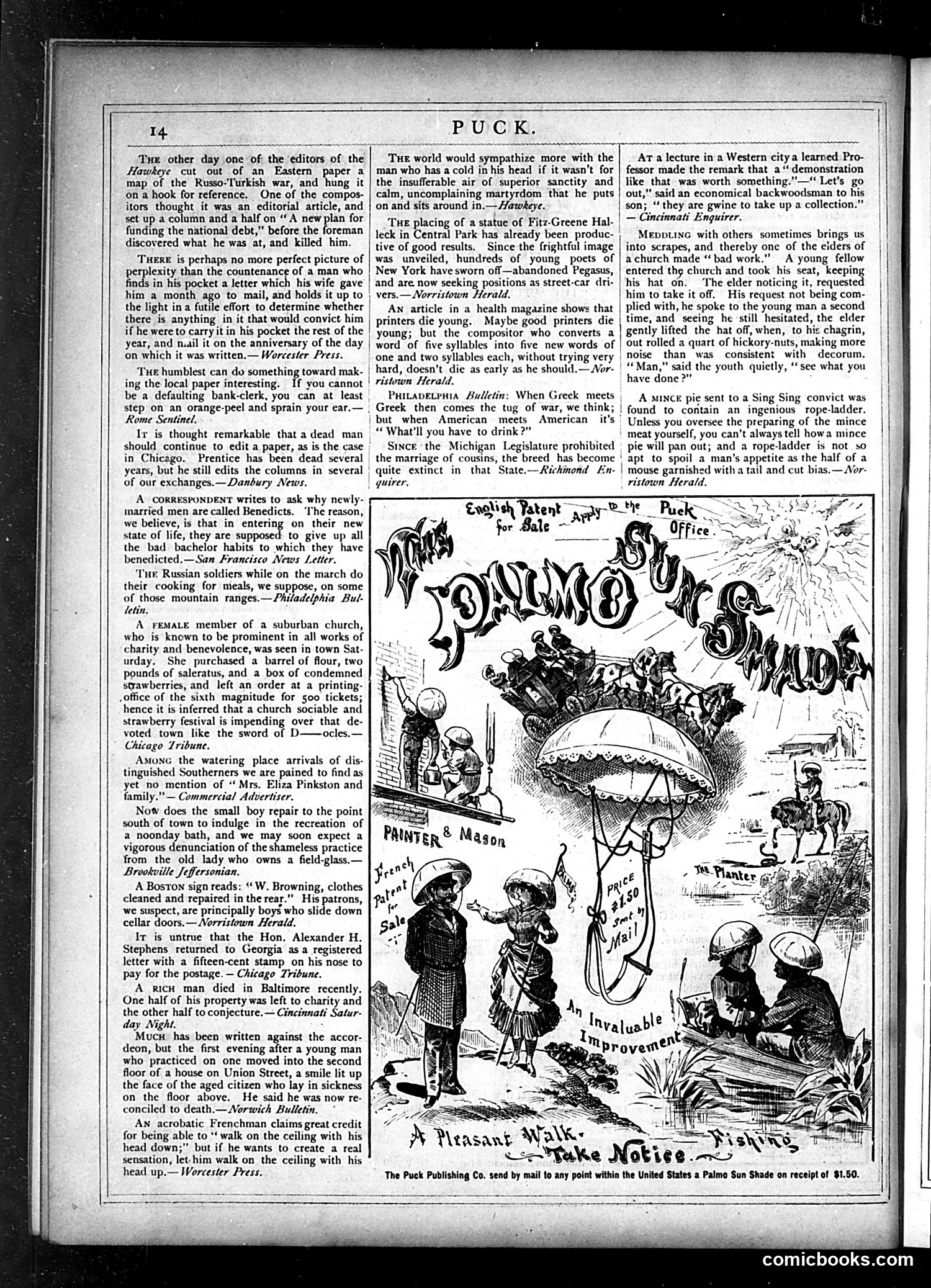
This page contains satirical text snippets and advertisements rather than a single unified political cartoon. The central illustration appears to be titled "Donning the Halo" and depicts various scenes of what seems to be social hypocrisy—figures in formal dress alongside working-class characters, suggesting commentary on false piety or pretense. Other visible sketches ("A Pleasant Walk," "Take Notice") appear to be small social commentary cartoons, though their specific targets aren't entirely clear from the image quality. The text column on the left contains brief satirical items mocking various social behaviors: newly-married men called "benedicts," Russian soldiers, a church woman's charitable hypocrisy, and various local scandals. Without clearer identification of specific figures or dates, the precise political targets remain unclear, though the general theme critiques social pretension and hypocrisy among various classes.
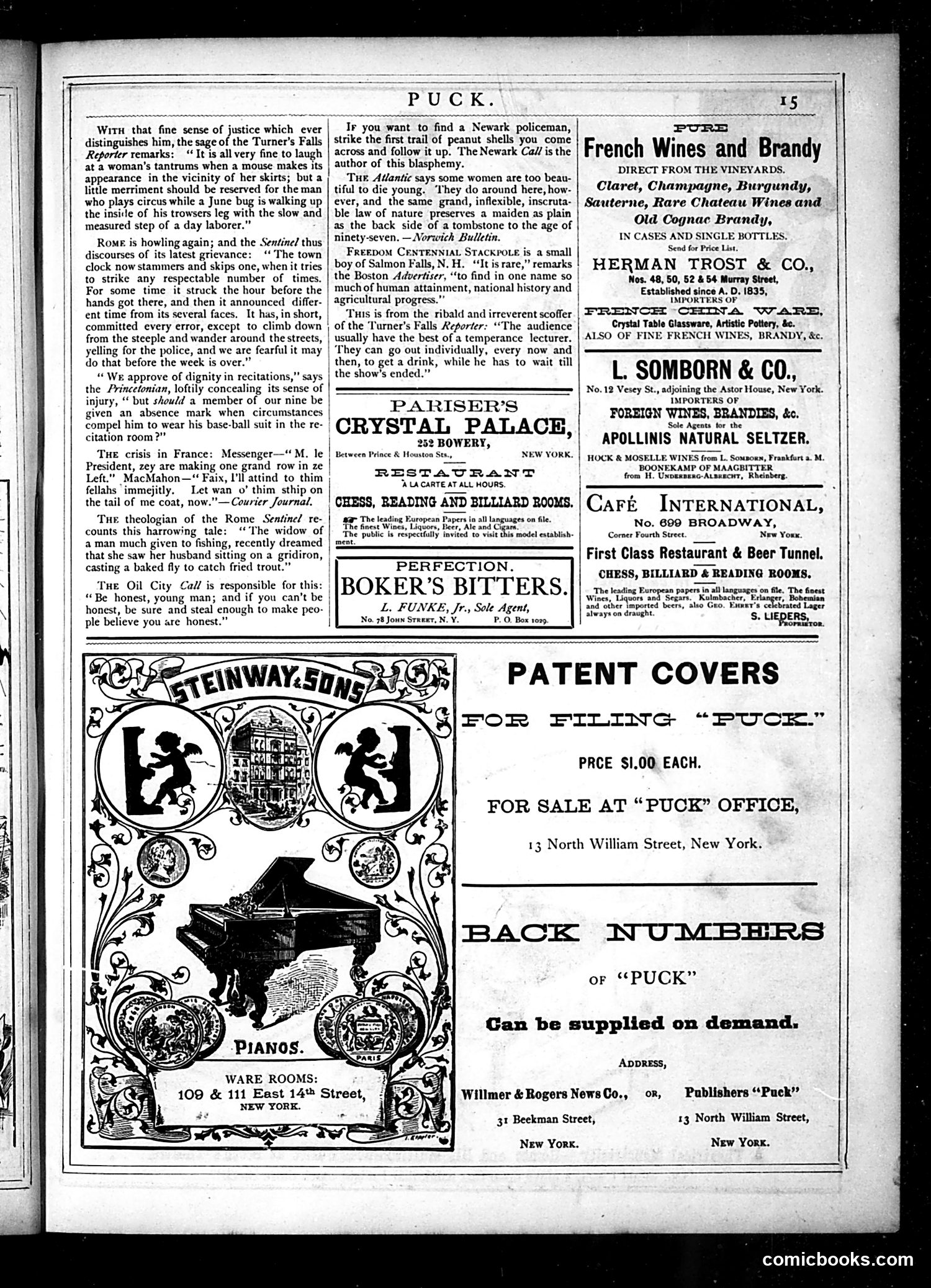
This is primarily an **advertising page** from Puck magazine, page 15. The left column contains brief satirical commentary on current events (including references to Turner's Falls, Newark police, and France), but these are fragmented snippets without accompanying cartoons. The dominant content is commercial advertising for: - French wines and brandy (Herman Trost & Co.) - A French restaurant (Pariser's Crystal Palace) - Chess, billiards, and reading rooms - Boker's Bitters - **Steinway & Sons pianos** (featuring an ornate advertisement with cherubs and a grand piano) The Steinway ad is the page's most visually prominent element. There's also an advertisement for Puck patent covers ($1.00 each) and information about back numbers availability. This reflects Puck's business model: combining satirical content with upscale consumer advertising targeting wealthy urban readers.
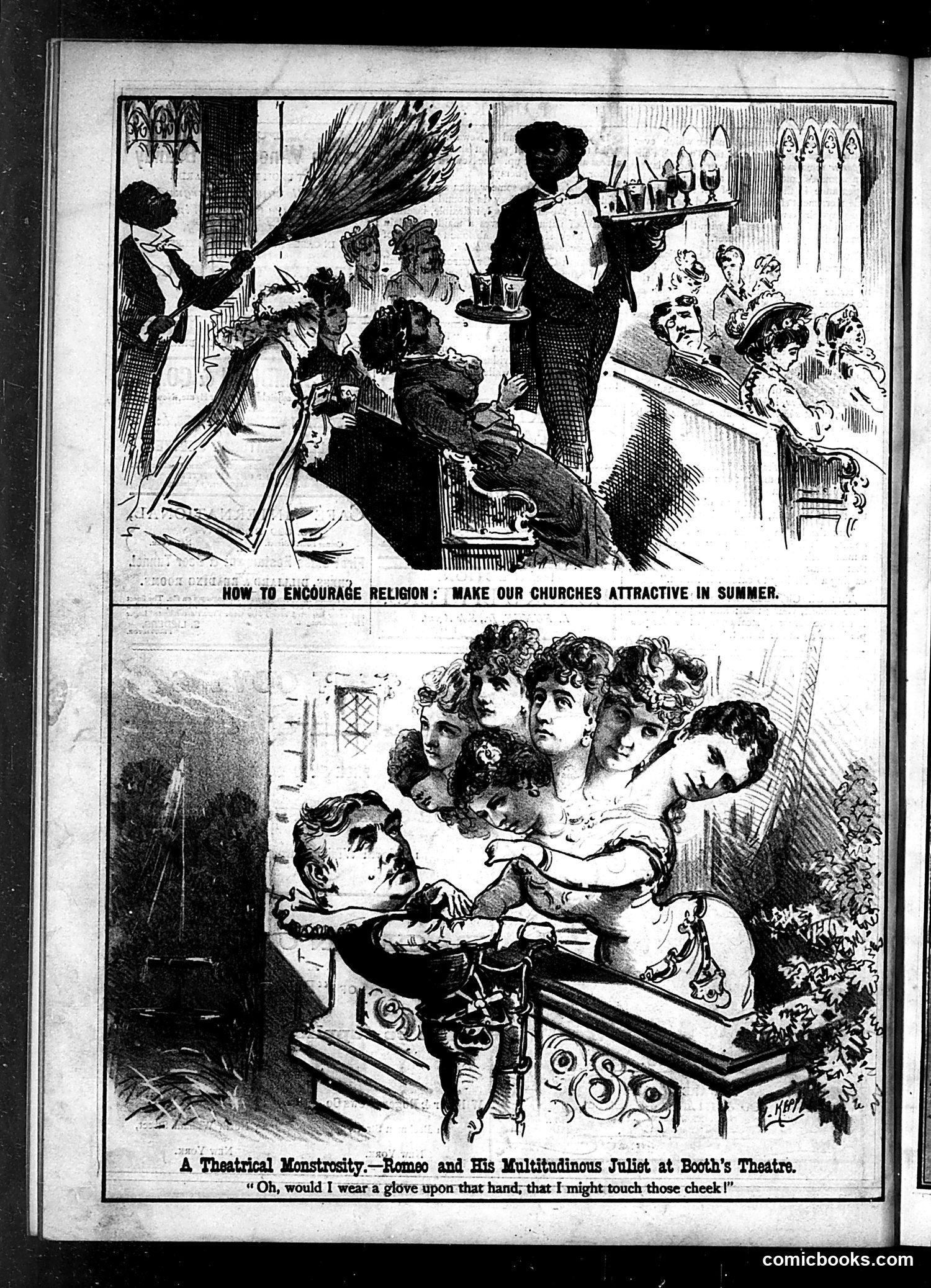
This page contains two satirical cartoons mocking different subjects: **Top cartoon:** Titled "How to Encourage Religion: Make Our Churches Attractive in Summer," it satirizes churches attempting to attract summer congregants through worldly entertainment rather than spiritual content. Waiters serve refreshments to fashionably-dressed attendees, suggesting churches are becoming social venues rather than places of worship. **Bottom cartoon:** Titled "A Theatrical Monstrosity—Homo and His Multitudinous Juliet at Booth's Theatre," it appears to ridicule an unconventional theatrical production of Romeo and Juliet. The quote references the famous "glove" soliloquy. The cartoon seems to mock either bizarre casting choices or an absurdist interpretation of Shakespeare. Both cartoons use exaggeration and grotesque imagery typical of Puck's satirical style to critique social and cultural trends.