
Puck, 1877-06 · page 13 of 16
Puck — June 1877 — page 13: what you’re looking at
What you’re looking at
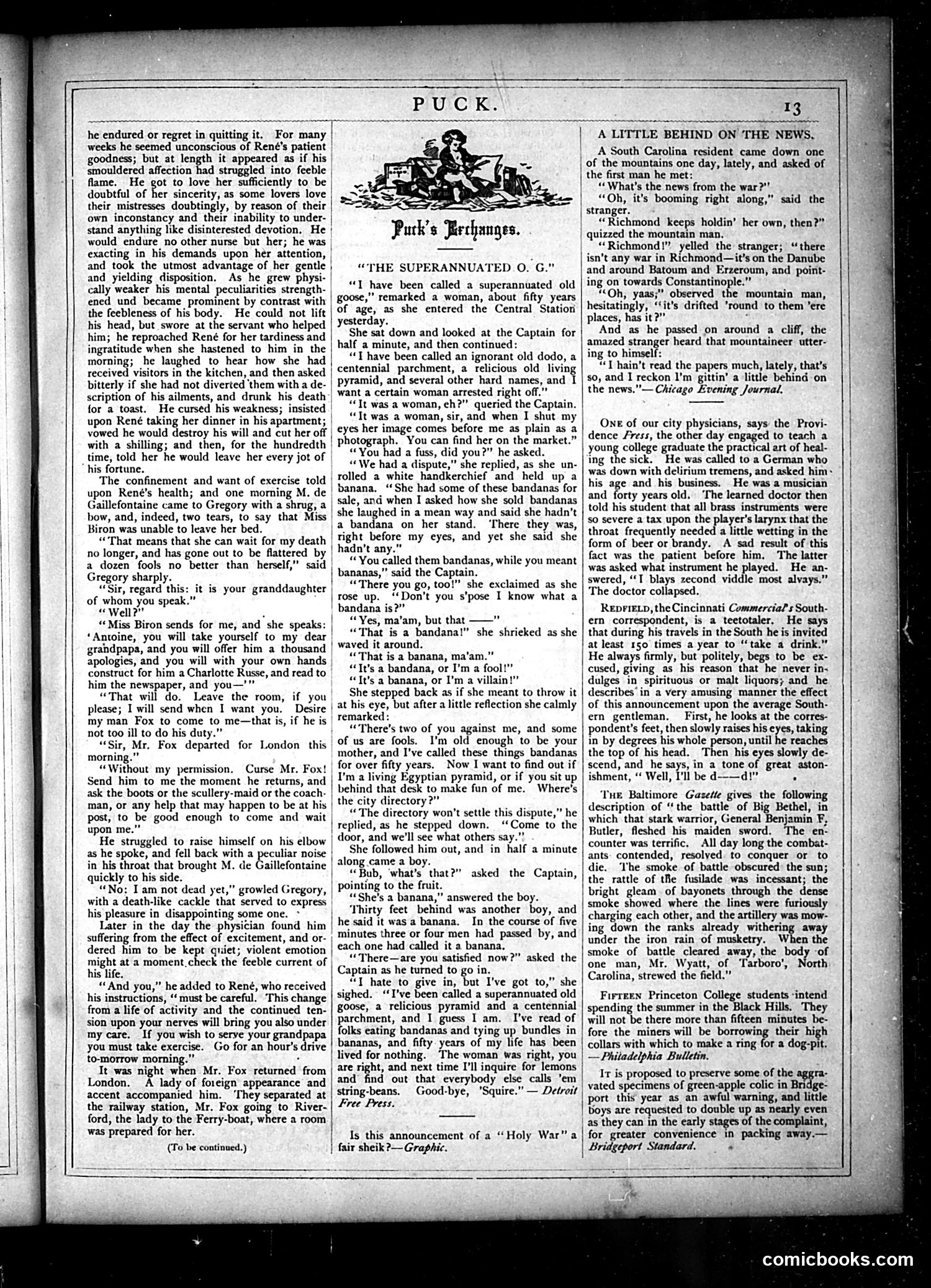
This page contains three separate satirical pieces rather than a unified cartoon: 1. **"The Superannuated O.G."** - A lengthy dialogue mocking an elderly woman who repeatedly misidentifies or confuses common objects (a fuss/white handkerchief, bananas). The satire targets aging and mental decline, using the woman's confused responses for comedic effect. 2. **"A Little Behind on the News"** - A brief exchange where a mountaineer, isolated from current events, asks what's happening. The stranger mentions Richmond and Constantinople, suggesting Civil War-era references (unclear which specific conflict). 3. **Miscellaneous news items** - Including jokes about physicians, a Cincinnati correspondent claiming to be a teetotaler, and notices about college brass bands and aggressiveness of green-apple colic. The page emphasizes humor through character stereotypes and confusion rather than focused political satire.
📄 Transcribed text from this page (OCR, searchable)
Machine-transcribed from the original scan — historical spelling and the odd misread are preserved.
he endured or regret in quitting For many | weeks he seemed unconscious of René's patient goodness; but at length it appeared as if his smouldered affection had struggled into feeble flame. He got to love her sufficiently to be doubtful of her sincerity, as some lovers love | their mistresses doubtingly, by reason of their own inconstancy and their inability to under- | stand anything like disinterested devotion. He | would endure no other nurse but her; he was exacting in his demands upon her attention, and took the utmost advantage of her gentle | and yielding disposition, As he grew physi- cally weaker his mental peculiarities strength- ened und became prominent by contrast with the feebleness of his body. He could not lift | his head, but swore at the servant who helped | him; he reproached René for her tardiness and | ingratitude when she hastened to him in the morning; he laughed to hear how she had | received visitors in the kitchen, and then asked | bitterly if she had not diverted ‘them with a de- | scription of his ailments, and drunk his death for a toast. He cursed his weakness; insisted upon René taking her dinner in his apartment; vowed he would destroy his will and cut her off with a shilling; and then, for the hundredth time, told her he would leave her every jot of his fortune. The confinement and want of exercise told upon René’s health; and one morning M. de Gaillefontaine came to Gregory with a shrug, a bow, and, indeed, two tears, to say that Miss Biron was unable to leave her bed. | “That means that she can wait for my death no longer, and has gone out to be flattered by a dozen fools no better than herself,” said Gregory sharply. “Sir, regard this: it is your granddaughter | of whom you speak.” | “Well?” : | ‘Miss Biron sends for me, and she speaks: | “Antoine, you will take yourself to my dear grandpapa, and you will offer him a thousand apologies, and you will with your own hands construct for him a Charlotte Russe, and read to him the newspaper, and you—’” “That will do. Leave the room, if you please; I will send when I want you. Desire | my man Fox to come to me—that is, if he is not too ill to do his duty.” | “Sir, Mr. Fox departed for London this mori et “Without my permission. Curse Mr. Fox! Send him to me the moment he returns, and | ask the boots or the scullery-maid or the coach- | man, or any help that may happen to be at his | post, to be good enough to come and wait upon me." | He struggled to raise himself on his elbow as he spoke, and fell back with a peculiar noise | in his throat that brought M. de Gaillefontaine quickly to his side. | “No: I am not dead yet,” growled Gregory, with a death-like cackle that served to express his pleasure in disappointing some one. * | Later in the day the physician found him | suffering from the effect of excitement, and or- dered him to be kept quiet; violent emotion | might at a moment,check the feeble current of his life. | “And you,” he added to René, who received his instructions, ‘“ must be careful. This change from a life of activity and the continued ten- sion upon your nerves will bring you also under my care. If you wish to serve your grandpapa you must take exercise. Go for an hour’s drive | to-morrow morning.” - | It was night when Mr. Fox returned from | London. A lady of foreign appearance and accent accompanied him. ‘They separated at the railway station, Mr. Fox going to River- ford, the lady to the Ferry-boat, where a room was prepared for her. | (To be continued.) | | string-beans. Bees 13° | Park's Zechanges. “THE SUPERANNUATED 0. G.” “T have been called a superannuated old | goose,” remarked a woman, about fifty years | of age, as she entered the Central Statiori yesterday. She sat down and looked at the Captain for | half a minute, and then continued: “T have been called an ignorant old dodo, a centennial parchment, a relicious old livin; pyramid, and several other hard names, and want a certain woman arrested right off.” “Tt was a woman, eh “Jt was a woman, sir, and when I shut my eyes her image comes before me as plain as a| | photograph. You can find her on the market.” | “You had a fuss, did you?” he asked. “We had a dispute,” she replied, as she un- rolled a white handkerchief and held up a banana. ‘She had some of these bandanas for sale, and when I asked how she sold bandanas she laughed in a mean way and said she hadn't a bandana on her stand. ‘There they was, right before my eyes, and yet she said she hadn’t any.” “You called them bandanas, while you meant bananas,” said the Captain. “There you go, too!” she exclaimed as she rose up. ‘Don’t you s’pose I know what a bandana is?” “Yes, ma’am, but that ——” “That is a bandana!” she shrieked as she waved it around. “That is a banana, ma'am.” “Tt’s a bandana, or I’m a fool “It’s a banana, or I'm a villain!” She stepped back as if she meant to throw it at his eye, but after a little reflection she calmly remarked: “There's two of you against me, and some of us are fools. I’m old enough to be your mother, and I've called these things bandanas for over fifty years. Now I want to find out if I'm a living Egyptian pyramid, or if you sit up behind that desk to make fun of me. Where's the city directory?” “The directory won't settle this dispute,” he replied, as he stepped down. ‘Come to the | door, and we'll see what others say.”” She followed him out, and in half a minute along came a boy. “Bub, ‘what's that?” asked the Captain, pointing to the fruit. “She's a banana,” answered the boy. ‘Thirty feet behind was another boy, and he said it was a banana. In the course of five minutes three or four men had passed by, and each one had called it a banana, “There—are you satisfied now?” asked the Captain as he turned to go in. “T hate to give in, but I’ve got to,” she sighed. ‘I’ve been called a superannuated old goose, a relicious pyramid and a centennial parchment, and I guess I am. I’ve read of folks eating bandanas and tying up bundles in bananas, and fifty years of my life has been lived for nothing. The woman was right, you are right, and next time I'll inquire for lemons and’ find out that everybody else calls ‘em Good-bye, ’Squire.” — Detroit Free Press. Is this announcement of a ‘Holy War” a fair sheik?— Graphic. ”* queried the Captain. | | A LITTLE BEHIND ON THE NEWS, A South Carolina resident came down one | of the mountains one day, lately, and asked of | the first man he met: “‘ What's the news from the war?"’ | “Oh, it's booming right along,” said the | stranger. “Richmond keeps holdin’ her own, then?” quizzed the mountain man. “Richmond!” yelled the stranger; “there | isn’t any war in Richmond—it’s on the Danube | and around Batoum and Erzeroum, and point- ing on towards Constantinople.” “Oh, yaas;” observed the mountain man, hesitatingly, 's drifted ‘round to them ’ere places, has it 3 And as he passed on around a cliff, the amazed stranger heard that mountaineer utter- ing to himself: “T hain’t read the papers much, lately, that’s so, and I reckon I'm gittin’ a little behind on the news.” —Chicago Evening Journal, One of our city physicians, says the Provi- dence Fress, the other day engaged to teach a young college graduate the practical art of heal- ing the sick. He was called to a German who was down with delirium tremens, and asked him his age and his business. He was a musician and forty years old, The learned doctor then told his student that all brass instruments were so severe a tax upon the player’s larynx that the throat frequently needed a little wetting in the form of beer or brandy. A sad result of this fact was the patient before him, The latter was asked what instrument he played. He an- swered, “I blays zecond viddle most alvays.”” ‘The doctor collapsed. Repriexp, the Cincinnati Commercia?s South- ern correspondent, is a teetotaler, He says that during his travels in the South he is invited at least 150 times a year to “take a drink.” He always firmly, but politely, begs to be ex- cused, giving as his reason that he never in dulges in spirituous or malt liquors; and he describes‘ in a very amusing manner the effect of this announcement upon the average South- |ern gentleman. First, he looks at the corres- pondent's feet, then slowly raises his eyes, taking in by degrees his whole person, until he reaches the top of his head. ‘Then his eyes slowly de- scend, and he says, in a tone of great aston- ishment, “‘ Well, I'll be d——d!” . ‘Tue Baltimore Gazelle gives the following description of ‘the battle of Big Bethel, in which that stark warrior, General Benjamin F, Butler, fleshed his maiden sword. The en- counter was terrific, All day long the combat- ants: contended, resolved to conquer or to die. ‘he smoke of battle obscured: the sun; the rattle of the fusilade was incessant; the bright gleam. of bayonets through the dense smoke showed where the lines were furiously charging each other, and the artillery was mow- ing down the ranks already mitberiag semny. under the iron rain of musketry. When the smoke of battle cleared away, the body of one man, Mr. Wyatt, of ‘Tarboro’, North Carolina, strewed the field.” Firtgen Princeton College students -intend spending the summer in the Black Hills. They will not be there more than fifteen minutes be- fore the miners will be borrowing their high collars with which to make a ring for a dog-pit. —Phitadelphia Bulletin. Ir is proposed to preserve some of the | vated specimens of green-apple colic in Bni port this year as an awful warning, and little Boys are requested to double up as nearly even | as they can in the early stages of the complaint, for greater convenience in packing away.— Bridgeport Standard, comicbooks.com