
Puck, 1877-06 · page 7 of 16
Puck — June 1877 — page 7: what you’re looking at
What you’re looking at
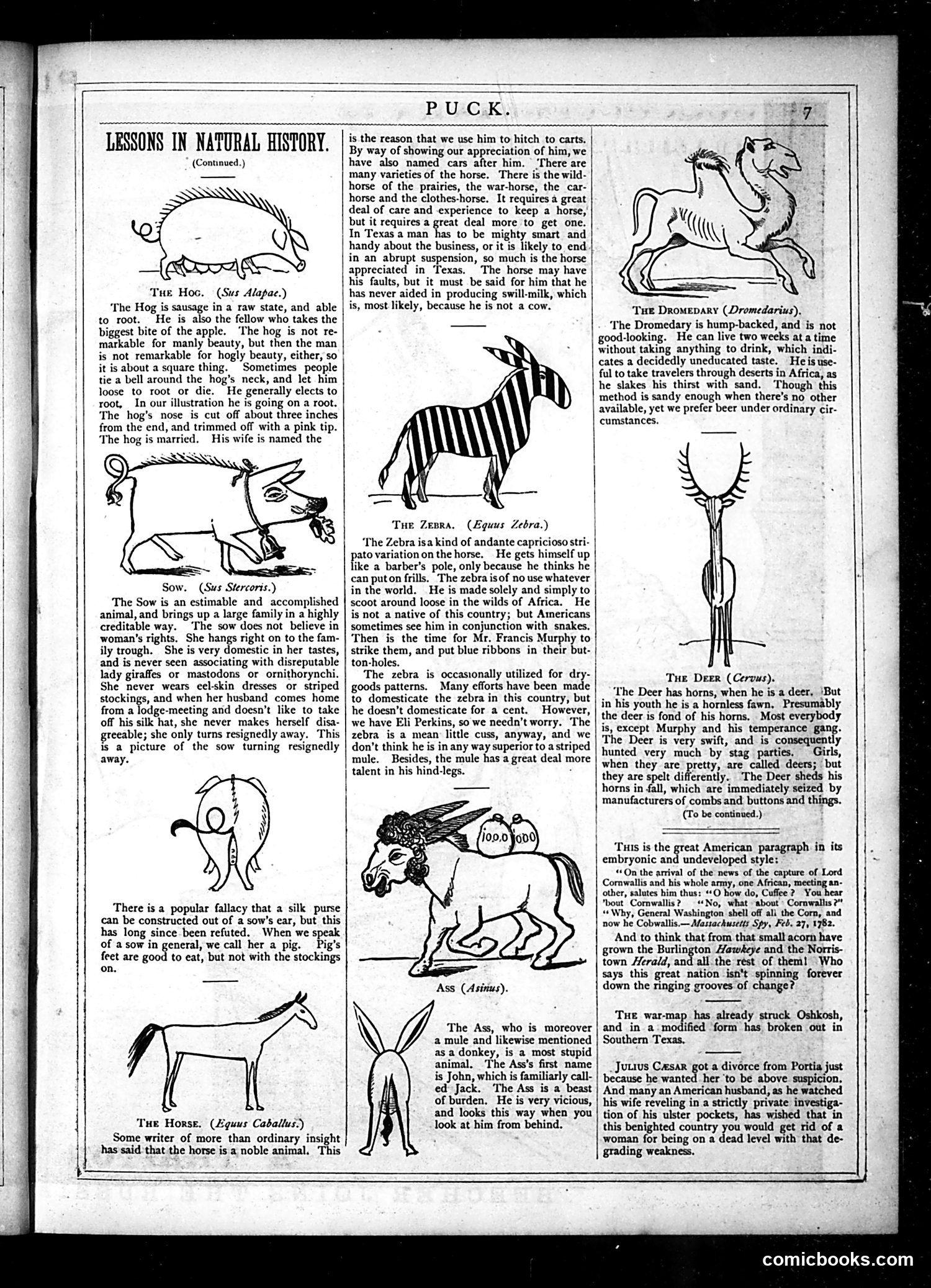
This page is primarily **educational content rather than political satire**. It presents illustrated natural history lessons about various animals: the hog, sow, horse, zebra, dromedary, deer, ass, and others. Each animal receives a brief descriptive text and accompanying sketch. The writing employs gentle, humorous tone typical of Puck's lighter content—for example, describing the zebra as "a mean little cuss" and noting the ass is "a most stupid animal." The page includes one apparent **social commentary**: a paragraph about Lord Cornwallis and American patriotism, referencing Revolutionary War history and critiquing those who prioritize wealth over national pride. Overall, this represents Puck's mixed editorial approach—combining educational humor with occasional patriotic messaging for middle-class readers.
📄 Transcribed text from this page (OCR, searchable)
Machine-transcribed from the original scan — historical spelling and the odd misread are preserved.
PUCK. LESSONS IN NATURAL HISTORY. (Continued.) Tue Hoc. (Sus Alapae.) ‘The Hog is sausage in a raw state, and able | to root. He is also the fellow who takes the biggest bite of the apple. ‘The hog is not re- markable for manly beauty, but then the man is not remarkable for hogly beauty, either, so it is about a square thing. Sometimes people tie a bell around the hog’s neck, and let him loose to root or die. He generally elects to root, In our illustration he is going on a root. ‘The hog’s nose is cut off about three inches from the end, and trimmed off with a pink tip. The hog is married. His wife is named the The Sow is an estimable and accomplished animal, and brings up a large family in a highly creditable way. The sow does not believe in woman's rights. She hangs right on to the fam- ily trough. She is very domestic in her tastes, and is never seen associating with disreputable lady giraffes or mastodons or ornithorynchi. She never wears eel-skin dresses or striped stockings, and when her husband comes home from a lodge-meeting and doesn’t like to take off his silk hat, she never makes herself disa- gteeable; she only turns resignedly away. This is a picture of the sow turning resignedly away. Oy Q f There is a popular fallacy that a silk purse can be constructed out of a sow’s ear, but this has long since been refuted. When we speak of a sow in general, we call her a pig. _Pig’s feet are good to eat, but not with the stockings on, ‘Tue Horse. (Zguus Caballus.) | In Texas a man Some writer of more than ordinary insight has said that the horse isa noble animal. This is the reason that we use him to hitch to carts. | By way of showing our appreciation of him, we have also named cars after him. ‘There are many varieties of the horse. There is the wild- horse of the prairies, the war-horse, the car- horse and the clothes-horse. It requires a great deal of care and experience to keep a horse, but it requires a great deal more to get one. to be mighty smart and handy about the business, or it is likely to end in an abrupt suspension, so much is the horse appreciated in ‘Texas. ‘The horse may have his faults, but it must be said for him that he has never aided in producing swill-milk, which is, most likely, because he is not a cow. Tue Zenra. (Equus Zebra.) ‘The Zebra isa kind of andante capricioso stri- pato variationon the horse. He gets himself up like a barber’s pole, only because he thinks he | can puton frills. The zebra isof no use whatever | in the world. He is made solely and simply to scoot around loose in the wilds of Africa. He is not a native of this country; but Americans sometimes see him in conjunction with snakes. Then is the time for Mr. Francis Murphy to | strike them, and put blue ribbons in their but- ton-holes. The zebra is occasionally utilized for dry- goods patterns. Many efforts have been made to domesticate the zebra in this country, but he doesn’t domesticate for a cent. However, we have Eli Perkins, so we needn't worry. The zebra is a mean’ little cuss, anyway, and we don’t think he is in any way superior to astriped mule. Besides, the mule has a great deal more talent in his hind-legs. id ‘Ass (Asirius). The Ass, who is moreover a mule and likewise mentioned as a donkey, is a most stupid animal. The Ass’s first name is John, which is familiarly call- ed Jack. ‘The Ass is a beast of burden. He is very vicious, and looks this way when you look at him from behind. ‘Tue Dromepary (Dromedarius). ‘The Dromedary is hump-backed, and is not good-looking. He can live two weeks at a time without taking anything to drink, which indi- cates a decidedly uneducated taste. He is use- ful to take travelers through deserts in Africa, as he slakes his thirst with sand. Though this method is sandy enough when there’s no other available, yet we prefer beer under ordinary cir- cumstances. Tue Deer (Cervus). ‘The Deer has horns, when he is a deer, /But in his youth he is a hornless fawn, Presumably the deer is fond of his horns. Most everybody is, except Murphy and his temperance gang. The Deer is very swift, and is consequently hunted very much by stag parties. Girls, when they are pretty, are called deers; but they are spelt differently. ‘The Deer sheds his horns in fall, which are immediately seized by manufacturers of combs and buttons and things. (To be continued.) Tuis is the great American paragraph in its embryonic and undeveloped style: “On the arrival of the news of the capture of Lord Cornwallis and his whole army, one African, meeting an- other, salutes him thus: ««O how do, Cuffee ? You hear "bout Cornwallis? «No, what about Cornwallis 2” “Why, General Washington shell off all the Corn, and now he Cobwallis.— Massachusetts Spy, Feb. 27, 1782. And to think that from that small acorn have grown the Burlington Hawezye and the Norris- town Herald, and all the rést of them! “Who says this great nation isn't spinning forever down the ringing grooves of change? Tue war-map has already struck Oshkosh, and in a.modified ‘form has broken out in Southern Texas, _Jutius Casar because he wante bie a divorce from Portia just her ‘to be above suspicion. And many an American husband, as he watched his wife reveling in a strictly private investiga- tion of his ulster pockets, has wished that in this benighted country yen would get rid of a woman for being on a dead level with that de- grading weakness. comicbooks.com