
Puck, 1877-06 · page 10 of 16
Puck — June 1877 — page 10: what you’re looking at
What you’re looking at
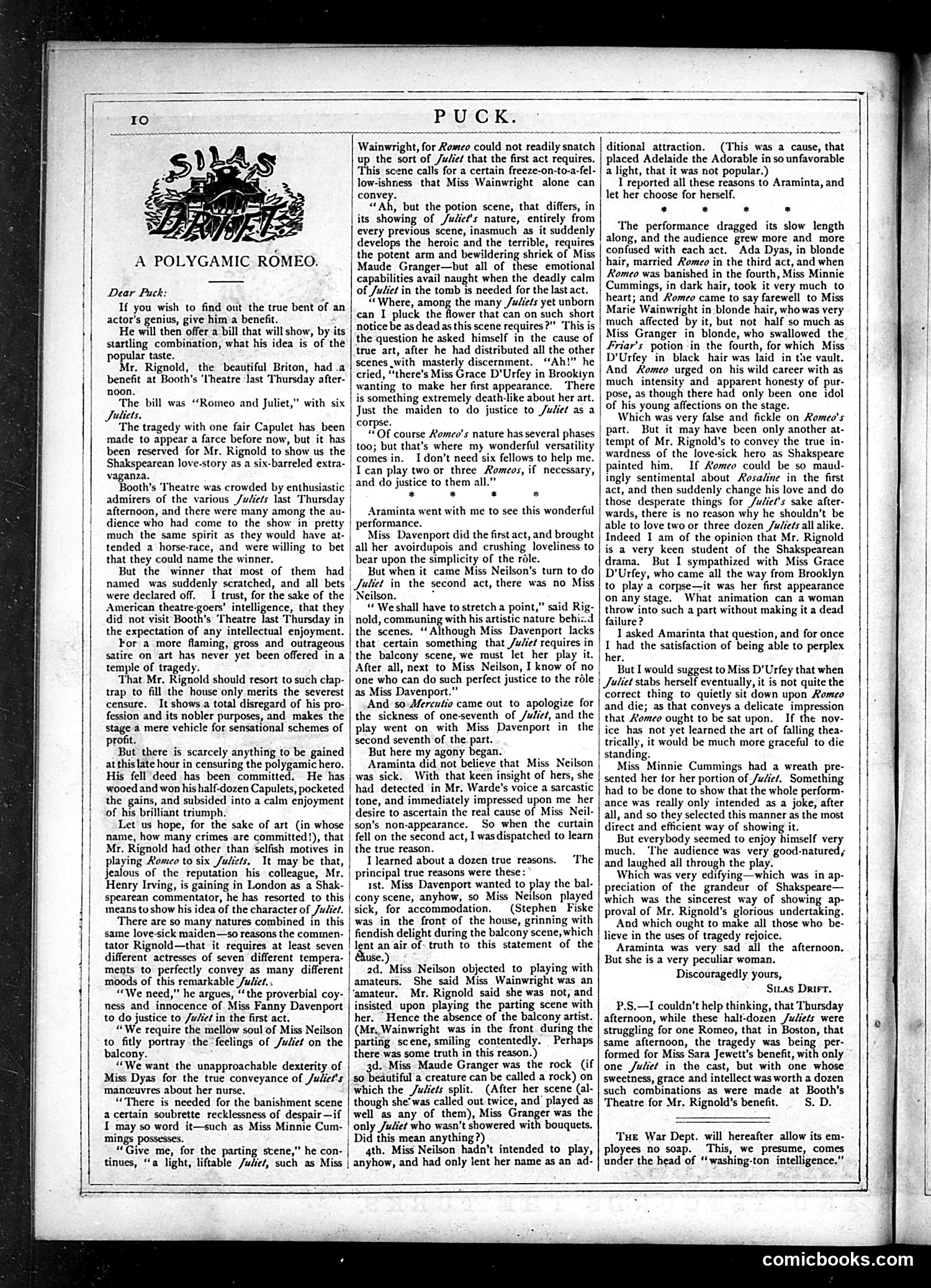
This page contains a theater review by "Silas Dirk" (likely a pseudonym) critiquing a production of Shakespeare's "Romeo and Juliet." The satire targets actor Mr. Rigold's casting choices and directorial decisions regarding the play's performance. The review mockingly discusses how Rigold allegedly cast multiple actresses across different acts to play Juliet—a "polygamic" approach to the role. The critic sardonically praises this unconventional strategy while highlighting its absurdity, suggesting Rigold prioritized showcasing different performers over maintaining dramatic coherence or emotional authenticity. The satire aims at both theatrical vanity and the era's debate over proper Shakespearean interpretation, ridiculing producers who valued star power over artistic integrity.
📄 Transcribed text from this page (OCR, searchable)
Machine-transcribed from the original scan — historical spelling and the odd misread are preserved.
A POLYGAMIC ROMEO. | Dear Puck: If you wish to find out the true bent of an actor’s genius, give him a benefit. He will then offer a bill that will show, by its startling combination, what his idea is of the popular taste. Mr. Rignold, the beautiful Briton, had .a benefit at Booth’s ‘Vheatre ‘last Thursday after- noon. The bill was ‘Romeo and Juliet,” with six Juliets. The tragedy with one fair Capulet has been made to appear a farce before now, but it has been reserved for Mr. Rignold to show us the Shakspearean love-story as a six-barreled extra- vaganza. Booth’s Theatre was crowded by enthusiastic | admirers of the various /uéiefs last Thursday afternoon, and there were many among the au- dience who had come to the show in pretty much the same spirit as they would have at- tended a horse-race, and were willing to bet | that they could name the winner. But the winner that most of them had | named was suddenly scratched, and all bets were declared off. 1 trust, for the sake of the American theatre-goers’ intelligence, that they | did not visit Booth’s ‘Theatre last Thursday in the expectation of any intellectual enjoyment. For a more flaming, gross and outrageous satire on art has never yet been offered in a temple of tragedy. That Mr. Rignold should resort to such clap- trap to fill the house only merits the severest censure, It shows a total disregard of his pro- fession and its nobler purposes, and makes the stage a mere vehicle for sensational schemes of profit. But there is scarcely anything to be gained | at this late hour in censuring the polygamic hero. | His fell deed has been committed. He has | wooed and won his half-dozen Capulets, pocketed | the gains, and subsided into a calm enjoyment of his brilliant triumph. Let us hope, for the sake of art (in whose | name, how many crimes are committed!), that | Mr. Rignold had other than ‘selfish motives in playing Romeo to six Juliets, It may be that, | jealous of the reputation his colleague, Mr. | Henry Irving, is gaining in London as a Shak- | spearean commentator, he has resorted to | means to show his idea of the character of Ju/ie?. | There are so many natures combined in this same love-sick maiden—so reasons the commen- tator Rignold—that it requires at least seven different actresses of seven different tempera- | ments to perfectly convey as many different | moods of this remarkable /u/iet.. | “We need,” he argues, “the proverbial coy- | ness and innocence of Miss Fanny Davenport to do justice to /u/ie¢ in the first act. “We require the mellow soul of Miss Neilson to fitly portray the feelings of Juliet on the balcony. ‘We want the unapproachable dexterity of | Miss Dyas for the true conveyance of /ulict’s manceuvres about her nurse. “There is needed for the banishment scene acertain soubrette recklessness of despair—if I may so word it—such as Miss Minnie Cum- mings possesses. “Give me, for the parting stene," he con- tinues, “a light, liftable /u/te/, such as Miss | PUCK. Wainwright, for Romeo could not readily snatch up the sort of /u/ieé that the first act requires. This scene calls for a certain freeze-on-to-a-fel- low-ishness that Miss Wainwright alone can convey. “Ah, but the potion scene, that differs, in its showing of /u/ief’s nature, entirely from every previous scene, inasmuch as it suddenly develops the heroic and the terrible, requires the potent arm and bewildering shriek of Miss Maude Granger—but all of these emotional capabilities avail naught when the deadly calm of Juliet in the tomb is needed for the last act. “Where, among the many /uéiets yet unborn can I pluck the flower that can on such short notice be as dead as this scene requires?” This is the question he asked himself in the cause of true art, after he had distributed all the other scenes with masterly discernment. ‘Ah!” he cried, “there's Miss Grace D'Urfey in Brooklyn wanting to make her first appearance. There is something extremely death-like about her art. Just the maiden to do justice to Juliet as a corpse. “Of course Romeo's nature has several phases too; but that’s where my wonderful versatility comes in. I don’t need six fellows to help me. | I can play two or three Romeos, if necessary, and do justice to them all.” * * * = Araminta went with me to see this wonderful performance. Miss Davenport did the first act, and brought all her avoirdupois and crushing loveliness to | bear upon the simplicity of the role. But when it came Miss Neilson’s turn to do | Juliet in the second act, there was no Miss Neilson. “« We shall have to stretch a point,” said Rig- nold, communing with his artistic nature behi:.d the scenes, “ ‘though Miss Davenport lacks that certain something that /u/iet requires in the balcony scene, we must let her play it. After all, next to Miss Neilson, I know of no one who can do such perfect justice to the réle as Miss Davenport.” And so-Mercutio came out to apologize for the sickness of one-seventh of /uliet, and the play went on with Miss Davenport in the second seventh of the part. But here my agony began. Araminta did not believe that Miss Neilson was sick. With that keen insight of hers, she had detected in Mr. Warde’s voice a sarcastic tone, and immediately impressed upon me her desire to ascertain the real cause of Miss Neil- son’s non-appearance. So when the curtain fell on the second act, I wasdispatched to learn the true reason. I learned about a dozen true reasons. principal true reasons were these: 1st. Miss Davenport wanted to play the bal- cony scene, anyhow, so Miss Neilson played sick, for accommodation. (Stephen Fiske was in the front of the house, grinning with fiendish delight during the balcony scene, which lent an air of- truth to this statement of the Siuse.) | ad. Miss Neilson objected to playing with amateurs. She said Miss Wainwright was an ‘amateur. Mr. Rignold said she was not, and insisted upon playing the parting scene with her. Hence the absence of the balcony artist. (Mr, Wainwright was in the front during the parting scene, smiling contentedly. Perhaps there was some truth in this reason.) d.. Miss Maude Granger was the rock (if so beautiful a creature can be called a rock) on which the Ju‘iets split. (After her scene (al- though she“was called out twice, and’ played as well as any of them), Miss Granger was the only /udiet who wasn't showered with bouquets. Did this mean anything?) 4th. Miss Neilson hadn’t intended to play, anyhow, and had only lent her name as an ad- The ditional attraction. (This was a cause, that placed Adelaide the Adorable in so unfavorable a light, that it was not popular.) I reported all these reasons to Araminta, and let her choose for herself. * * * ® ‘The performance dragged its slow length along, and the audience grew more and more confused with each act. Ada Dyas, in blonde hair, married Romeo in the third act, and when Romeo was banished in the fourth, Miss Minnie Cummings, in dark hair, took it very much to heart; and Xomeo came to say farewell to Miss Marie Wainwright in blonde hair, whowas very | much affected by it, but not half so much as Miss Granger in blonde, who swallowed the Friar’s potion in the fourth, for which Miss D'Urfey in black hair was laid in the vault. And Xomeo urged on his wild career with as much intensity and apparent honesty of pur- pose, as though there had only been one idol of his young affections on the stage. Which was very false and fickle on Romeo's | part. But it may have been only another at- | tempt of Mr. Rignold’s to convey the true in- | wardness of the love-sick hero as Shakspeare painted him. If Xomeo could be so maud- ingly sentimental about Rosaéine in the first act, and then suddenly change his love and do those desperate things for /u/iet's sake after- | wards, there is no reason why he shouldn’t be able to love two or three dozen /uéie¢s all alike. Indeed I am of the opinion that Mr. Rignold is a very keen student of the Shakspearean drama, But I sympathized with Miss Grace D'Urfey, who came all the way from Brooklyn to play a corpse—it was her first appearance on any stage. What animation can a woman throw into such a part without making it a dead failure? I asked Amarinta that question, and for once I had the satisfaction of being able to perplex | her. | _ But I would suggest to Miss D’Urfey that when | Juliet stabs herself eventually, it is not quite the correct thing to quietly sit down upon Romeo and die; as that conveys a delicate impression that Komeo ought to be sat upon. If the nov- ice has not yet learned the art of falling thea- trically, it would be much more graceful to die standing. Miss Minnie Cummings had a wreath pre- sented her for her portion of /u/iet, Something had to be done to show that the whole perform- ance was really only intended as a joke, after all, and so they selected this manner as the most direct and efficient way of showing it. But everybody seemed to enjoy himself very much. ‘The audience was very good-natured, and laughed all through the play. Which was very edifying—which was in ap- preciation of the grandeur of Shakspeare— which was the sincerest way of showing ap- proval of Mr. Rignold’s glorious undertaking. And which ought to make all those who be- lieve in the uses of tragedy rejoice. Araminta was very sad all the afternoon. But she is a very peculiar woman. Discouragedly yours, Stas Drirt. P.S.—I couldn’t help thinking, that Thursday afternoon, while these half-dozen /Judieés were struggling for one Romeo, that in Boston, that same afternoon, the tragedy was being per- formed for Miss Sara Jewett’s benefit, with only one Juliet in the cast, but with one whose sweetness, grace and intellect was worth a dozen such combinations as were made at Booth’s Theatre for Mr, Rignold’s benefit. Ss. D. Tue War Dept. will hereafter allow its em- ployees no soap. This, we presume, comes under the head of ‘‘washing-ton intelligence.” on) comicbooks.com