
Puck, 1877-06 · page 4 of 16
Puck — June 1877 — page 4: what you’re looking at
What you’re looking at
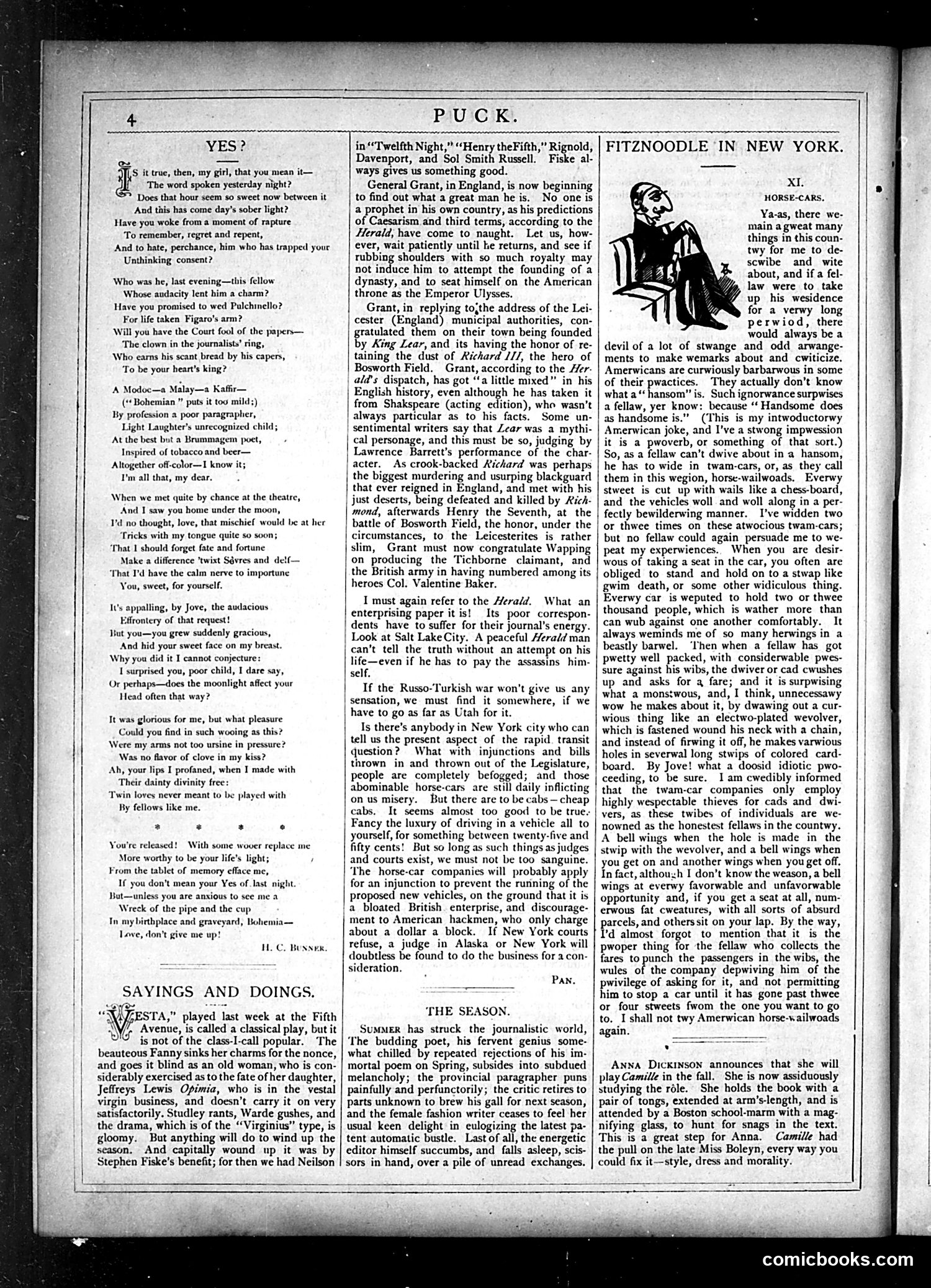
This cartoon and accompanying article satirize **horse-drawn streetcars (horse-cars)** in New York City. The illustration shows a man (Fitznoodle, apparently a recurring Puck character) commenting on the barbarous behavior of Americans regarding public transportation. The text ridicules how Americans—described as "curiously barbarous"—tolerate the discomforts of crowded horse-cars. It mocks the practice of forcing passengers into vehicles designed for far fewer people, and critiques the companies' profit-driven indifference to passenger welfare. The piece argues that judges and courts should regulate these abuses, and suggests New York courts might eventually intervene in the dispute, as Alaska courts apparently did. The satire targets both American tolerance of poor service and corporate exploitation.
📄 Transcribed text from this page (OCR, searchable)
Machine-transcribed from the original scan — historical spelling and the odd misread are preserved.
PUCK. YES? $ it true, then, my girl, that you mean it— ‘The word spoken yesterday night? Does that hour seem so sweet now between it And this has come day's sober light? Have you woke from a moment of rapture To remember, regret and repent, ‘And to hate, perchance, him who has trapped your Unthinking consent? Who was he, last evening—this fellow Whose audacity lent him a charm? Have you promised to wed Pulchinello? For life taken Figaro’s arm? Will you have the Court fool of the papers— ‘The clown in the journalists’ ring, Who earns his scant bread by his capers, To be your heart's king? ‘A Modoc—a Malay—a Kaffir— | (“Bohemian ” puts it too mi By profession a poor paragrapher, Light Laughter’s unrecognized child; At the best but a Brummagem poet, + | Inspired of tobacco and beer— | Altogether off-color—I know it; I’m all that, my dear. | | When we met quite by chance at the theatre, And I saw you home under the moon, V’d no thought, love, that mischief would be at her ‘Tricks with my tongue quite so soon; ‘That 1 should forget fate and fortune Make a difference ‘twixt Sévres and de!f— ‘That I'd have the calm nerve to importune You, sweet, for yourself. I's appalling, by Jove, the audacious Effrontery of that request! Hut you—you grew suddenly gracious, And hid your sweet face on my breast. Why you did it I cannot conjecture: I surprised you, poor child, I dare say, Or pethaps—does the moonlight affect your | Head often that way? It was glorious for me, but what pleasure Could you find in such wooing as this? Were my arms not too ursine in pressure? Was no flavor of clove in my kiss? Ah, your lips I profaned, when I made with ‘Their dainty divinity free: in loves never meant to be played with Ry fellows like me. | 2 * * e | You're released! With some wover replace ine More worthy to be your life’s light; , From the tablet of memory efface me, | If you don’t mean your Yes of last night. But—unless you are anxious to sce me a Wreck of the pipe and the cup | In mybirthplace and grav. Lave, don't give me up! J, Bohemia— H.C. Bosse. SAYINGS AND DOINGS. 5 peas AYZESTA,” played last week at the Fifth [j- Avenue, is called a classical play, but it is not of the class-I-call popular. ‘The beauteous Fanny sinks her charms for the nonce, and goes it blind as an old woman, who is con- siderably exercised as to the fate ofher daughter, Jeffreys Lewis Opimia, who is in the vestal virgin business, and doesn’t carry it on very satisfactorily. Studley rants, Warde gushes, and the drama, which is of the “‘Virginius” type, is gloomy. But anything will do to wind up the season, And capitally wound up it was by in‘‘Twelfth Night,” ‘Henry theFifth,” Rignold, Davenport, and Sol Smith Russell. Fiske al- ways gives us something good. General Grant, in England, is now beginning to find out what a great man he is. No one is a prophet in his own country, as his predictions of Caesarism and third terms, according to the Herald, have come to naught. Let us, how- ever, wait patiently until he returns, and see if rubbing shoulders with so much royalty may not induce him to attempt the founding of a dynasty, and to seat himself on the American throne as the Emperor Ulysses. Grant, in replying tothe address of the Lei- cester (England) municipal authorities, con- gratulated them on their town being founded by King Lear, and its having the honor of re- taining the dust of Richard ///, the hero of Bosworth Field. Grant, according to the Her- ald’s dispatch, has got ‘‘a little mixed” in his English history, even although he has taken it from Shakspeare (acting edition), who wasn’t always particular as to his facts. Some un- sentimental writers say that Lear was a mythi- cal personage, and this must be so, judging by Lawrence Barrett’s performance of the char- acter. As crook-backed Richard was perhaps the biggest murdering and usurping blackguard that ever reigned in England, and met with his | just deserts, being defeated and killed by Rich- mond, afterwards Henry the Seventh, at the battle of Bosworth Field, the honor, under the | circumstances, to the Leicesterites is rather slim, Grant must now congratulate Wapping |on producing the Tichborne claimant, and the British army in having numbered among its heroes Col. Valentine Baker. I must again refer to the Hera/d. What an enterprising paper it is! Its poor correspon- dents have to suffer for their journal’s energy. | Look at Salt LakeCity. A peaceful Hera/d man | can’t tell the truth without an attempt on his life—even if he has to pay the assassins him- self. If the Russo-Turkish war won't give us any sensation, we must find it somewhere, if we | have to go as far as Utah for it. Is there’s anybody in New York city who can | tell us the present aspect of the rapid. transit question? What with injunctions and bills thrown in and thrown out of the Legislature, people are completely befogged; and_ those abominable horse-cars are still daily inflicting on us misery. But there are to be cabs — cheap cabs. It seems almost too good to be true. Fancy the luxury of driving in a vehicle all to yourself, for something between twenty-five and fifty cents! But so long as such things as judges and courts exist, we must not be too sanguine. ‘The horse-car companies will probably apply for an injunction to prevent the running of the proposed new vehicles, on the ground that it is a bloated British. enterprise, and discourage- ment to American hackmen, who only charge about a dollar a block. If New York courts refuse, a judge in Alaska or New York will doubtless be found to do the business for a con- sideration. Pan. THE SEASON. SuMMER has struck the journalistic world, ‘The budding poet, his fervent genius some- what chilled by repeated rejections of his im- mortal poem on Spring, subsides into subdued melancholy; the provincial paragrapher puns painfully and perfunctorily; the critic retires to parts unknown to brew his gall for next season, and the female fashion writer ceases to feel her usual keen delight in eulogizing the latest pa- tent automatic bustle. Last of all, the energetic editor himself succumbs, and falls asleep, scis- Stephen Fiske’s benefit; for then we had Neilson sors in hand, over a pile of unread exchanges. FITZNOODLE IN NEW YORK. XI. HORSE-CARS. Ya-as, there we- main a gweat many things in this coun- twy for me to de- scwibe and wite about, and if a fel- law were to take up his wesidence for a verwy long perwiod, there would always be a devil of a lot of stwange and odd arwange- ments to make wemarks about and cwiticize. Amerwicans are curwiously barbarwous in some of their pwactices. They actually don’t know what a" hansom’'is, Such ignorwance surpwises a fellaw, yer know: because ‘‘ Handsome does as handsome is.” (This is my intwoductorwy Amerwican joke, and I’ve a stwong impwession it is a pwoverb, or something of that sort.) So, as a fellaw can’t dwive about in a hansom, he has to wide in twam-cars, or, as they call them in this wegion, horse-wailwoads. Everwy stweet is cut up with wails like a chess-board, and the vehicles woll and woll along in a per- fectly bewilderwing manner. I've widden two or thwee times on these atwocious twam-cars; but no fellaw could again persuade me to we- peat my experwiences.. When you are desir- wous of taking a seat in the car, you often are obliged to stand and hold on to a stwap like gwim death, or some other widiculous thing. Everwy car is weputed to hold two or thwee thousand people, which is wather more than can wub against one another comfortably. It always weminds me of so many herwings in a beastly barwel. ‘hen when a fellaw has got pwetty well packed, with considerwable pwes- sure against his wibs, the dwiver or cad cwushes up and asks for a fare; and it is surpwising what a monstwous, and, I think, unnecessawy wow he makes about it, by dwawing out a cur- wious thing like an electwo-plated wevolver, which is fastened wound his neck with a chain, and instead of firwing it off, he makes varwious holes in severwal long stwips of colored card- board. By Jove! what a doosid idiotic pwo- ceeding, to be sure. 1 am cwedibly informed that the twam-car companies only employ highly wespectable thieves for cads and dwi- vers, as these twibes of individuals are we- nowned as the honestest fellaws in the countwy. A bell wings when the hole is made in the stwip with the wevolver, and a bell wings when you get on and another wings when you get off. In fact, althouzh I don’t know the weason, a bell wings at everwy favorwable and unfavorwable opportunity and, if you get a scat at all, num- erwous fat cweatures, with all sorts of absurd arcels, and others sit on your lap. By the way, ’d almost forgot to mention that it is the pwoper thing for the fellaw who collects the fares to punch the passengers in the wibs, the wrules of the company depwiving him of the pwivilege of asking for it, and not permitting him to stop a car until it has gone past thwee or four stweets fwom the one you want to go to. I shall not twy Amerwican horse-wailwoads again. Anna Dickinson announces that she will play Camille in the fall. She is now assiduously studying the réle. She holds the book with a pair of tongs, extended at arm’s-length, and is attended by a Boston school-marm with a mag- nifying glass, to hunt for snags in the text. This is a great step for Anna. Camille had the pull on the late Miss Boleyn, every way you could fix it—style, dress and morality. comicbooks.com