
Puck, 1877-06 · page 12 of 16
Puck — June 1877 — page 12: what you’re looking at
What you’re looking at
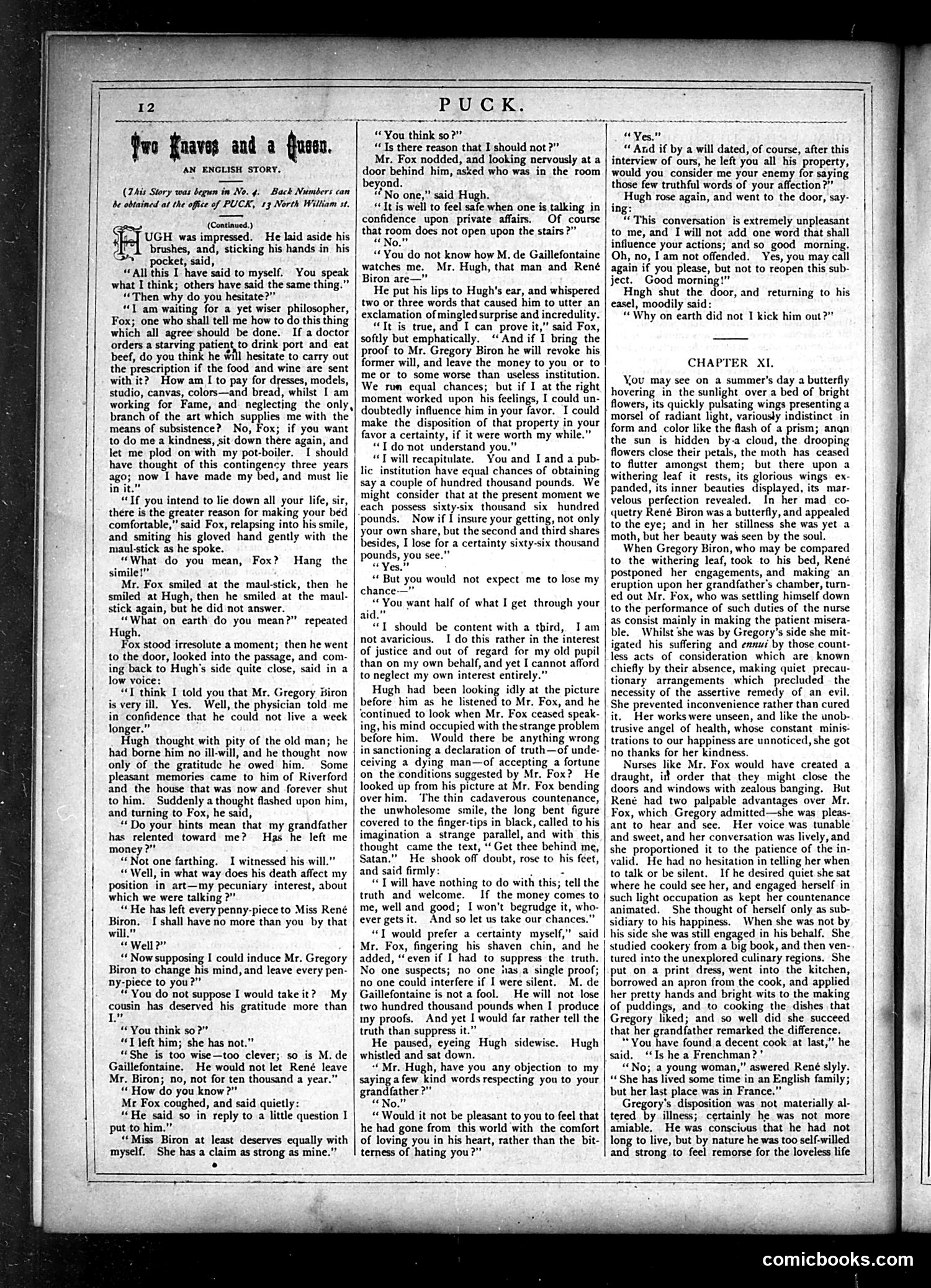
This page contains serialized fiction rather than political satire. The story depicts an English domestic drama involving disputes over property and inheritance among characters including Mr. Fox, Mr. Hugh, and Mr. Gregory Biron. The narrative centers on Fox attempting to manipulate Hugh into signing away property rights, with dialogue about "a couple of hundred thousand pounds" and competing financial claims. A woman (likely the "Queen" of the title) appears to be a point of contention—references mention her engagement and her role as a servant/nurse. The story appears to be melodramatic Victorian-era fiction exploring themes of greed, deception, and class conflict rather than contemporary political commentary. Without identifying specific historical figures or events, the text focuses on personal intrigue and moral questions about honesty and justice.
📄 Transcribed text from this page (OCR, searchable)
Machine-transcribed from the original scan — historical spelling and the odd misread are preserved.
Guo faaves aud a ffusen. AN ENGLISH STORY. (This Story was begun in No. 4. Back Numbers can be obtained at the office of PUCK, 13 North William st. (Continued,) I UGH was impressed, He laid aside his d brushes, and, sticking his hands in. his > pocket, said, “All this I have said to myself. You speak what I think; others have said the same thing.”” “Then why do you hesitate?” “1 am waiting for a yet wiser philosopher, Fox; one who shall tell me how to do this thing which all agree should be done. If a doctor orders a starving pee to drink port and eat beef, do you think he will hesitate to carry out the prescription if the food and wine are sent with it? How am I to pay for dresses, models, studio, canvas, colors—and bread, whilst I am working for Fame, and. neglecting the only, branch of the art which supplies me with the means of subsistence? No, Fox; if you want to do me a kindness, sit down there again, and let me plod on with’ my pot-boiler. I should have thought of this Contingency three years ago; now I have made my bed, and must lie in it.” “If you intend to lie down all your life, sir, there is the greater reason for making your bed comfortable,” said Fox, relapsing into his smile, and smiting his gloved hand gently with the maul-stick as he spoke. “What do you mean, Fox? simile!” Mr. Fox smiled at the maul-stick, then he smiled at Hugh, then he smiled at the maul- stick again, but he did not answer. “What on earth do you mean?” repeated Hugh, Fox stood irresolute a moment; then he went to the door, looked into the passage, and com- Hang the ing back to Hugh's side quite close, said in a low voice: “I think I told you that Mr. Gregory Biron is very ill. Yes. Well, the physician told me | in confidence that he could not live a week longer.” Hugh thought with pity of the old man; he had borne him no ill-will, and he thought now only of the gratitude he owed him. Some pleasant memories came to him of Riverford and the house that was now and forever shut to him. Suddenly a thought flashed upon him, and turning to Fox, he said, “Do your hints mean that my grandfather has relented toward me? Has he left me money 2?” “Not one farthing. I witnessed his will.” “Well, in what way does his death affect my position in art—my pecuniary interest, about which we were talking ?” “He has left every penny-piece to Miss René Biron. I shall have no more than you by that “Well?” “ Now supposing I could induce Mr. Gregory Biron to change his mind, and leave every pen- ny-piece to you?” “You do not suppose I would take it? My cousin has deserved his gratitude more than Le “You think so?” “T left him; she has not.” “She is too wise—too clever; so is M. de Gaillefontaine. He would not let René leave Mr. Biron; no, not for ten thousand a year.” “ How do you know?” Mr Fox coughed, and said quietly: “He said so in reply to a little question I put to him.’”’ “Miss Biron at least deserves equally with myself. She has a claim as strong as mine.” . “You think so?” “Ts there reason that I should not ?”” Mr. Fox nodded, and looking nervously at a door behind him, asked who was in the room beyond. “No one,” said Hugh. “It is well to feel safe when one is talking in confidence upon private affairs. Of course that room does not open upon the stairs?” “No,” ‘You do not know how M. de Gaillefontaine watches me. Mr. Hugh, that man and René Biron are—” He put his lips to Hugh's ear, and whispered two or three words that caused him to utter an exclamation of mingled surprise and incredulity. “It is true, and I can prove it,” said Fox, softly but emphatically. “And if I bring the proof to Mr. Gregory Biron he will revoke his former will, and leave the money to you or to me or to some worse than useless institution. We run equal chances; but if I at the right moment worked upon his feelings, I could un- doubtedly influence him in your vor. I could make the disposition of that property in your favor a certainty, if it were worth my while.” “T do not understand you.” “Twill recapitulate. You and I and a pub- lic institution have equal chances of obtaining say a couple of hundred thousand pounds. We might consider that at the present moment we each possess sixty-six thousand six hundred ‘pounds. Now if { insure your getting, not only your own share, but the second and third shares besides, I lose for a certainty sixty-six thousand pounds, you see.” “Yes.” “ But you would not expect me to lose my chance-—” “You want half of what I get through your aid.” “T should be content with a third, I am not avaricious. I do this rather in the interest of justice and out of regard for my old pupil to neglect my own interest entirely.” Hugh had been looking idly at the picture before him as he listened to Mr. Fox, and he ‘continued to look when Mr. Fox ceased speak- ing, his mind occupied with the strange problem before him. Would there be anything wrong in sanctioning a declaration of truth—of unde- | ceiving a dying man—of accepting a fortune on the conditions suggested by Mr. Fox? He | looked up from his picture at Mr. Fox bending overhim. ‘The thin cadaverous countenance, the unwholesome smile, the long bent figure covered to the finger-tips in black, called to his imagination a strange parallel, and with this thought came the text, ‘Get thee behind me, | Satan.” He shook off doubt, rose to his feet, | and said firmly: . «Twill have nothing to do with this; tell the truth and welcome. If the money comes to me, well and good; I won't begrudge it, who- ever gets it. And so let us take our chances.” “1 would prefer a certainty myself,” said Mr. Fox, fingering his shaven chin, and he added, ‘even if I had to suppress the truth. No one suspects; no one has a single proof; no one could interfere if I were silent. M. de Gaillefontaine is not a fool. He will not lose two hundred thousand pounds when I produce my proofs, And yet I would far rather tell the truth than suppress it.”” He paused, eyeing Hugh sidewise. Hugh whistled and sat down. “Mr. Hugh, have you any objection to my saying afew kind words respecting you to your grandfather ?” “No.” “Would it not be pleasant to you to feel that he had gone from this world with the comfort of loving you in his heart, rather than the bit- terness of hating you?” “And if by a will dated, of course, after this interview of ours, he left you all his property, would you consider me your enemy for saying those few truthful words of your affection?” __ Hugh rose again, and went to the door, say- ing: “This conversation is extremely unpleasant to me, and I will not add one word that shall influence your actions; and so good morning. Oh, no, I'am not offended. Yes, you may call again if you please, but not to reopen this sub- ject. Good morning!” Hngh shut the door, and returning to his easel, moodily said: “Why on earth did not I kick him out?” CHAPTER XI. You may see on a summer's day a butterfly hovering in the sunlight over a bed of bright flowers, its quickly pulsating wings presenting a morsel of radiant light, variously indistinct in form and color like the flash of a prisms angn the sun is hidden by-a cloud, the drooping flowers close their petals, the moth has ceased to flutter amongst them; but there upon a withering leaf it rests, its glorious wings ex- panded, its inner beauties displayed, its mar- velous perfection revealed. In her mad co- quetry René Biron was a butterfly, and appealed to the eye; and in her stillness she was yet a moth, but her beauty was seen by the soul. When Gregory Biron, who may be compared to the withering leaf, took to his bed, René postponed her engagements, and making an eruption upon her grandfather's chamber, turn- ed out Mr. Fox, who was settling himself down to the performance of such duties of the nurse as consist mainly in making the patient misera- ble. Whilst she was by Gregory's side she mit- igated his suffering and ennui by those count- less acts of consideration which are. kno’ than on my own behalf, and yet I cannot afford | !€ss cts of consideration which are. known chiefly by their absence, making quiet precau- tionary arrangements which precluded the necessity of the assertive remedy of an evil. She prevented inconvenience rather than cured it. Her works were unseen, and like the unob- trusive angel of health, whose constant minis- trations to our happiness are unnoticed, she got no thanks for her kindness. Nurses like Mr, Fox would have created a draught, if order that they might close the doors and windows with zealous banging. But René had two palpable advantages over Mr. Fox, which Gregory admitted—she was. pleas- ant to hear and see, Her voice was tunable and sweet, and her conversation was lively, and she proportioned it to the patience of the in- valid. He had no hesitation in telling her when to talk or be silent. If he desired quiet she sat where he could sec her, and engaged herself in such light occupation as kept her countenance animated. She thought of herself only as sub- sidiary to his happiness. When she was not by his side she was still engaged in his behalf. She studied cookery from a big book, and then ven- tured into the unexplored culinary regions. She put on a print dress, went into the kitchen, borrowed an apron from the cook, and applied her pretty hands and bright wits to the making of puddings, and to cooking the dishes that Gregory liked; and so well did she succeed that her grandfather remarked the difference. “You have found a decent cook at last,’ he said. ‘Is he a Frenchman?’ “No; a young woman,” aswered René slyly. “She has lived some time in an English family; but her last place was in France.” Gregory's disposition was not materially al- tered by illness; certainly he was not more amiable. He was conscivus that he had not long to live, but by nature he was too self-willed mad strong to feel remorse for the loveless life comicbooks.com