
Puck, 1877-06 · page 11 of 16
Puck — June 1877 — page 11: what you’re looking at
What you’re looking at
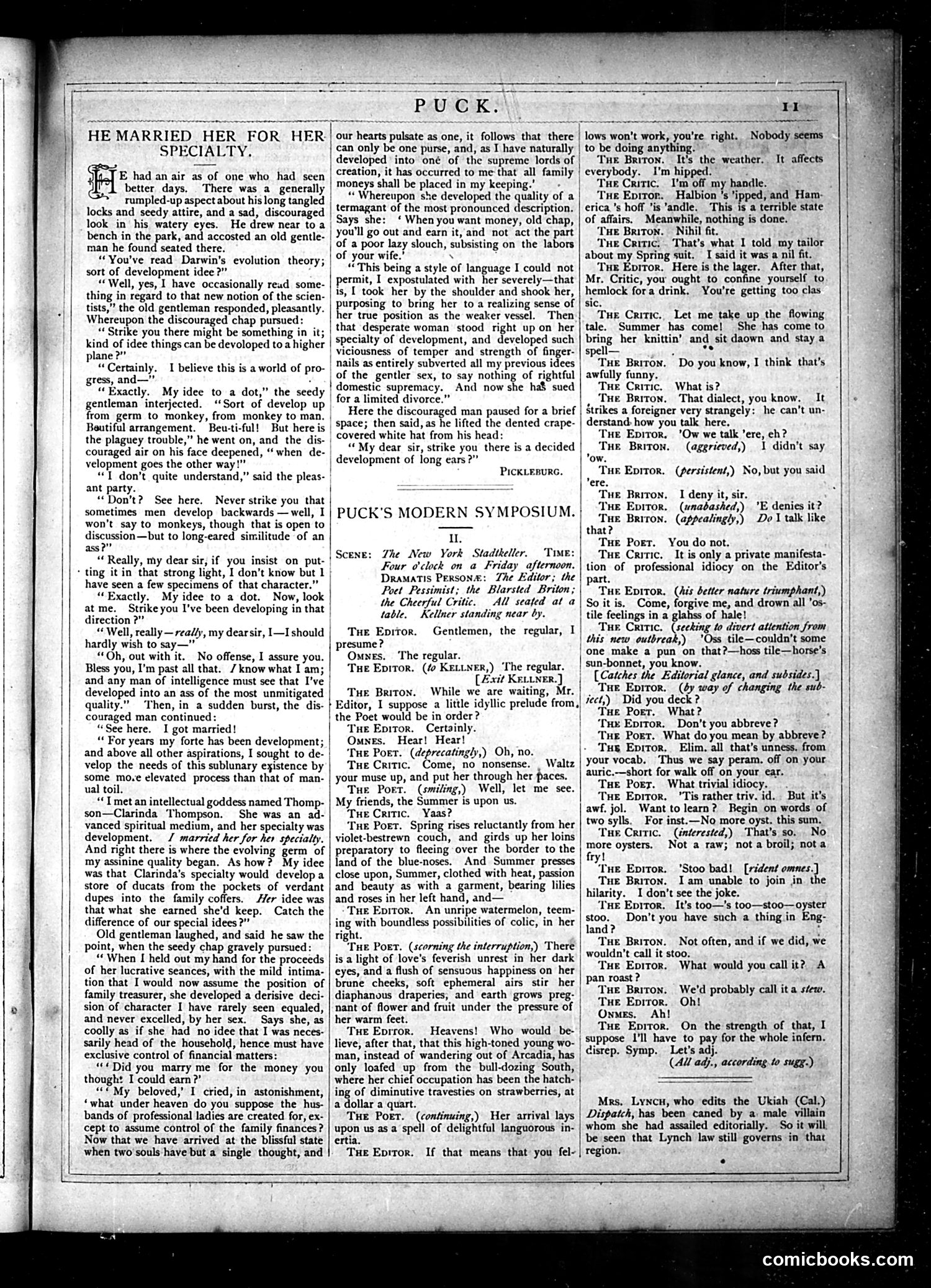
This page presents a dialogue-based satirical piece rather than a cartoon. The debate centers on marriage and women's roles, with characters including "The Editor," "The Barton" (likely a misspelling), "The Critic," and "The Port." The satire mocks intellectualized discussion of gender dynamics—specifically, arguments that wives should be "weaker vessels" developing strength through hardship, contrasted with calls for equality. A character recounts marrying a woman named Clarinda Thompson for her "intellectual goddessness," only to discover domestic reality differs from romantic ideals. The piece satirizes both sentimental Victorian marriage ideology and pretentious intellectual posturing about women's development and equality. Modern readers would recognize it as commentary on late-19th/early-20th century debates about women's education, marriage, and social roles.
📄 Transcribed text from this page (OCR, searchable)
Machine-transcribed from the original scan — historical spelling and the odd misread are preserved.
HE MARRIED HER FOR HER |x hearts pulsate as one, it follows that there | lows won't work, you're right. Nobody seems SPECIALTY, ee had an air as of one who had seen better days. There was a generally rumpled-up aspect about his long tangled locks and seedy attire, and a sad, discouraged look in his watery eyes. He drew near to a bench in the park, and accosted an old gentle- man he found seated there. “You've read Darwin's evolution theory; sort of development idee ?” “Well, yes, I have occasionally read some- thing in regard to that new notion of the scien- tists,” the old gentleman responded, pleasantly. Whereupon the discouraged chap pursued: “Strike you there might be something in it; kind of idee things can be devoloped toa higher plane?” “ Certainly gress, and— , “Exactly, My idee to a dot,” the seedy gentleman interjected. ‘Sort of develop up I believe this is a world of pro- from germ to monkey, from monkey to man. | Beutiful arrangement. Beu-ti-ful! But here is the plaguey trouble,” he went on, and the dis- couraged air on his face deepened, ‘when de- velopment goes the other way!” “T don’t quite understand,” said the pleas- ant party. “Don't? See here. Never strike you that sometimes men develop backwards —well, I won't say to monkeys, though that is open to discussion—but to long-eared similitude of an ass?” “Really, my dear sir, if you insist on put- + ting it in that strong light, I don’t know but 1 have seen a few specimens of that character.” “Exactly. My idee to a dot. atme. Strike you I’ve been developing in that direction ?” “Well, really —readly, my dearsir, 1—I should hardly wish to say—” “Oh, out with it. No offense, I assure you. Bless you, I’m past all that. / know what I am; and any man of intelligence must see that I’ve developed into an ass of the most unmitigated quality.” Then, in a sudden burst, the dis- couraged man continued: “See here. I got married! “For years my forte has been development; and above all other aspirations, I sought to de- | velop the needs of this sublunary eyistence by some move elevated process than that of man- ual toil. “I met an intellectual goddess named Thomp- son—Clarinda ‘Thompson. She was an ad- vanced spiritual medium, and her specialty was development. / married her for her specialty. And right there is where the evolving germ of my assinine quality began. As how? My idee was that Clarinda’s specialty would develop a store of ducats from the pockets of verdant dupes into the family coffers. Her idee was that what she earned she'd keep. Catch the difference of our special idees ?” Old gentleman laughed, and said he saw the | point, when the seedy chap gravely pursued: “When I held out my hand for the proceeds of her lucrative seances, with the mild intima- tion that I would now assume the position of family treasurer, she developed a derisive deci- sion of character I have rarely seen equaled, and never excelled, by her sex. Says she, as coolly as if she had no idee that I was neces- sarily head of the household, hence must have exclusive control of financial matters: “«*Did you marry me for the money you thought I could earn?’ “My beloved,’ I cried, in astonishment, ‘what under heaven do you suppose the hus- bands of professional ladies are created for, ex- cept to assume control of the family finances? Now that we have arrived at the blissful state when two'souls ‘have but a single thought, and Now, look | can only be one purse, and, as I have naturally | | developed’ into oné of the supreme lords of | creation, it has occurred to me that all family | | moneys shall be placed in my keeping.’ | | ‘Whereupon she developed the quality of a | termagant of the most pronounced description. Says she: ‘When you want money, old chap, | you'll go out and earn it, and not act the part of a poor lazy slouch, subsisting on the labors of your wife.’ . “This being a style of language I could not permit, 1 expostulated with her severely—that is, | took her by the shoulder and shook her, purposing to bring her to a realizing sense of er true position as the weaker vessel. Then that desperate woman stood right up on her specialty of development, and developed such | viciousness of temper and strength of finger- nails as entirely subverted all my previous idees of the gentler sex, to say nothing of rightful | domestic supremacy. And now she ha8 sued for a limited divorce.” Here the discouraged man paused for a brief | space; then said, as he lifted the dented crape- covered white hat from his head: | “My dear sir, strike you there is a decided | | development of long ears?” PICKLEBURG. PUCK’S MODERN SYMPOSIUM. } UL. The New York Stadtkeller. Time: Four o'clock on a Friday afternoon. The Editor; the : the Blarsted Briton; the Cheerful Critic. All seafed at a table. Kellner standing near by. | Tue Epitor. presume? Ones. ‘The regular. SCENE: Gentlemen, the regular, I | | this new outbreak,) Tue Epitor. (fo Kettner,) ‘The regular. (4ait Keciner.] | While we are waiting, Mr. | Tue Briton. Editor, I suppose a little idyllic prelude from, the Poet would be in order? Tue Epitor. Certainly. Omnes. Hear! Hear! ‘Tue Poet. (deprecatingly,) Oh, no. Tue Critic. Come, no nonsense. _ Waltz your muse up, and put her through her paces. Tue Poet. (smiling,) Well, let me see. My friends, the Summer is upon us. Tue Critic. Yaas? ‘Tue Poet. Spring rises reluctantly from her violet-bestrewn couch, and girds up her loins preparatory to fleeing over the border to the land of the blue-noses. And Summer presses close upon, Summer, clothed with heat, passion and beauty as with a garment, bearing lilies and roses in her left hand, and— ‘Tue Epiror. An unripe watermelon, teem- ing with boundless possibilities of colic, in her right. a Tae Poet. (scorning the interruption,) There is a light of love's feverish unrest in her dark eyes, and a flush of sensuous happiness on her brune cheeks, soft ephemeral airs stir her | diaphanous draperies, and earth grows preg- | nant of flower and fruit under the pressure of | her warm feet. | ‘Tue Eprror. Heavens! Who would be- lieve, after that, that this high-toned young wo- man, instead of wandering out of Arcadia, has | only loafed up from the bull-dozing South, | where her chief occupation has been the hatch- | ing of diminutive travesties on strawberries, at | a dollar a quart. Tue Poet. (continuing,) Her arrival lays upon us asa spell of delightful languorous in- ertia. Tue Eprror. If that means that you fel- to be doing anything. 4 { Tne Briton. It's the weather. It affects everybody. I'm hipped. : ‘Tue Critic, I'm off my handle. 7 : ‘Tue Eprtor. Halbion ’s ipped, and Ham- erica.'s hoff ‘is ’andle. This is a terrible state of affairs, Meanwhile, nothing is done. Tue Briton. Nihil fit. ‘Tue Critic, That's what I told my tailor about my Spring suit. I said it was a nil fit. ‘Tue Eprtor. Here is the lager. After that, Mr. Critic, you: ought to confine yourself to hemlock fora drink, You're getting too clas sic, Tue Critic.. Let me take up the flowing tale. Summer has come! She has come to bring her knittin’ and sit daown and stay a spell— 5 sor Tue Briton, awfully funny. Tue Critic. What is? , Tue Briton. That dialect, you know. It Strikes a foreigner very strangely: he can’t un- derstand: how you talk here. Tue Epitor. 'Ow we talk ’ere, eh? Tue Briton. (aggrieved,) 1 didn’t say tow. Tur Eprror. (fersistent,) No, but you said ‘ere. Tue Barron, I deny it, sir. Tue Evitor. (unadashed,) 'E denies it? Tue Briron. (appealingly,) Do I talk like that? Tue Poet. You do not. Tue Critic. It is only a private manifesta- tion of professional idiocy on the Editor's part. Tue Eprtor. (Ais better nature triumphant,) So it is, Come, forgive me, and drown all ’os- tile feelings in a glahss of hale! Tue Critic. (seeking to divert attention from "Oss _tile—couldn’t some one make a pun on that?—hoss tile—horse’s sun-bonnet, you know. (‘Catches the Editorial glance, and subsides.) Tue Eprror. (y way of changing the sub- iect,) Did you deck? Tue Poet. What? ‘THe Epitor. Don't you abbreve? THE Poet. What do you mean by abbreve? Tus Eprtor. Elim. all that’s unness. from your vocab. Thus we say peram. off on your auric.—short for walk off on your ear. f Tue Poer. What trivial idiocy. Tue Eprtor. ‘Tis rather triv. id. But it's awf. jol. Want to learn? Begin on words of two sylls. For inst.—No more oyst. this sum. ‘Tur Critic, (interested,) ‘That's so. No mre oysters. Not a raw; nota broil; nota ry! ‘Tue Eprtor. 'Stoo bad! [rident erect Tue Briton. Iam unable to join in the hilarity. I don’t see the joke. ‘Tue Eprtor. It’s too—’s too—stoo—oyster stoo. Don’t you have such a thingin Eng- land? q Tue Briton. Not often, and if we did, we wouldn't call it stoo. Tue Epitor. What would you call it? A pan roast ? Tue Briton. Tue Eprror. Onmes, Ah! Tue Epitor. On the strength of that, I suppose I'll have to pay for the whole infern. isrep. Symp. Let's adj. (AU adj., according to sugg.) Do you know, I think that’s We'd probably call it a séew. Oh! Mrs. Lyncu, who edits the Ukiah (Cal.) Dispatch, has been caned by a: male villain whom she had assailed editorially. So it will be seen that Lynch law still’ governs in that region, comicbooks.com