
Puck, 1877-06 · page 3 of 16
Puck — June 1877 — page 3: what you’re looking at
What you’re looking at
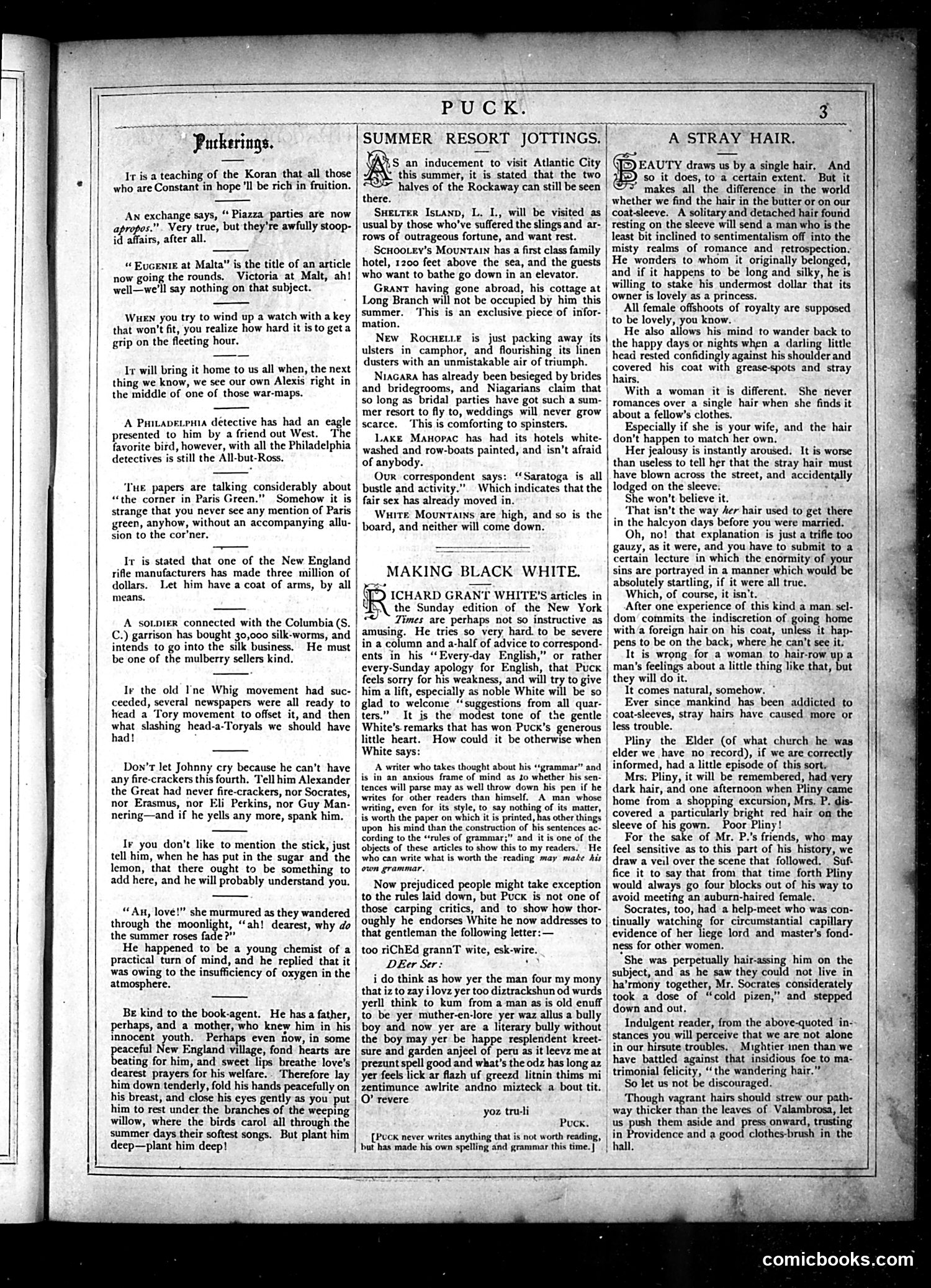
This page contains three distinct sections of satirical content: 1. **"Puckerings"** - A humor column with brief jokes and observations about contemporary society, including references to Koran teachings, watch-winding, Philadelphia detectives, and New England politicians. 2. **"Summer Resort Jottings"** - Social commentary on wealthy vacationers at Atlantic City and Shelter Island, satirizing their pretensions and behaviors. 3. **"A Stray Hair"** and **"Making Black White"** - Two longer articles. The first discusses a woman finding a stray hair and obsessing over its origin. The second critiques Richard Grant White's newspaper columns, suggesting his writing is overly pedantic and that he gives unsound advice about grammar and proper behavior. The satire targets social affectation, class pretension, and intellectual pomposity among the urban elite.
📄 Transcribed text from this page (OCR, searchable)
Machine-transcribed from the original scan — historical spelling and the odd misread are preserved.
Puckerings. Ir is a teaching of the Koran that all those who are Constant in hope 'll be rich in fruition. An exchange says, “* Piazza fies are now apropos.” Very true, but they're awfully stoop- id affairs, after all. « EuGEniE at Malta” is the title of an article now going the rounds. Victoria at Malt, ah! well—we'll say nothing on that subject. Wuen you try to wind up a watch with a key that won't fit, you realize how hard it isto geta grip on the fleeting hour. Ir will bring it home to us all when, the next thing we know, we sce our own Alexis right in the middle of one of those war-maps. A Pritapetrnia detective has had an eagle presented to him by a friend out West. The favorite bird, however, with all the Philadelphia detectives is still the All-but-Ross. ‘Tue papers are talking considerably about “the corner in Paris Green.” Somehow it is strange that you never see any mention of Paris green, anyhow, without an accompanying allu- sion to the cor’ner, Ir is stated that one of the New England rifle manufacturers has made three million of dollars. Let him have a coat of arms, by all means. A soLpieR connected with the Columbia (S. C.) garrison has bought 30,000 silk-worms, and intends to go into the silk business. He must be one of the mulberry sellers kind. Ir the old Ine Whig movement had suc- ceeded, several newspapers were all ready to head a Tory movement to offset it, and then what slashing head-a-Toryals we should have had! Don’t let Johnny cry because he can’t have any fire-crackers this fourth. Tell him Alexander the Great had never fire-crackers, nor Socrates, nor Erasmus, nor Eli Perkins, nor Guy Man- nering—and if he yells any more, spank him. Ir you don’t like to mention the stick, just tell him, when he has put in the sugar and the lemon, that there ought to be something to add here, and he will probably understand you. “Au, love!” she murmured as they wandered through the moonlight, “ah! dearest, why do the summer roses fade?” He happened to be a young chemist of a practical turn of mind, and he replied that it was owing to the insufficiency of oxygen in the atmosphere. Be kind to the book-agent. He has a father, perhaps, and a mother, who knew him in his innocent youth. Perhaps even now, in some -aceful New England village, fond hearts are eating for him, and sweet lips breathe love's dearest prayers for his welfare... ‘Therefore lay him down tenderly, fold his hands peacefully on his breast, and close his eyes gently as you put him to rest under the branches of the weeping willow, where the birds carol all through the summer days their softest songs. But plant him deep—plant him deep! PUCK. SUMMER RESORT JOTTINGS. NY an inducement to visit Atlantic City this summer, it is stated that the two halves of the Rockaway can still be seen there. SHELTER Istanp, L. L., will be visited as usual by those who've suffered the slings and ar- rows of outrageous fortune, and want rest. ScHOOLEY’s MounTAIN has a first class family hotel, 1200 feet above the sea, and the guests who want to bathe go down in an elevator. Grant having gone abroad, his cottage at | Long Branch will not be occupied by him this summer. This is an exclusive piece of infor- | mation. | New Rocnetre is just packing away its ulsters in camphor, and flourishing its linen | dusters with an unmistakable air of triumph. Niacara has already been besieged by brides and bridegrooms, and Niagarians claim that so long as bridal parties have got such a sum- | mer resort to fly to, weddings will never grow scarce. ‘This is comforting to spinsters. Lake Manopac has had its hotels white- washed and row-boats painted, and isn’t afraid of anybody. Our correspondent says: ‘Saratoga is all bustle and activity.” Which indicates that the fair sex has already moved in. Wuite Mountains are high, and so is the board, and neither will come down. MAKING BLACK WHITE. ICHARD GRANT WHITE'S articles in y IS\ the Sunday edition of the New York . Times are perhaps not so instructive as amusing. He tries so very hard. to be severe in a column and a-half of advice to correspond- | ents in his “Every-day English,” or rather every-Sunday apology for English, that Puck feels sorry for his weakness, and will try to give him a lift, especially as noble White will be so glad to welcome “suggestions from all quar- ters.” It is the modest tone of the gentle White's. remarks that has won Puck's generous little heart. How could it be otherwise when | White says: | A writer who takes thought about his ¢¢grammar” and is in an anxious frame of mind as to whether his sen- tences will parse may as well throw down his pen if he writes for other readers than himself. A man whose writing, even for its style, to say nothing of its matter, is worth the paper on which it is printed, has other things upon his mind than the construction of his sentences ac- cording to the “rules of grammar;” and it is one of the objects of these articles to show this to my readers. He who can write what is worth the reading may make his own grammar. Now prejudiced people might take exception to the rules laid down, but Puck is not one of those carping critics, and to show how thor- oughly he endorses White he now addresses to that gentleman the following letter: — too riChEd grannT wite, esk-wi DEer Ser: by i do think as how yer the man four my mony, that iz to zay i lovz yer too diztrackshun od wurds yerll think to kum from a man as is old enuff | to be yer muther-en-lore yer waz allus a bully | boy and now yer are a literary bully without | the boy may yer be happe resplendent kreet- sure and garden anjeel of peru as it leevz me at prezunt spell good and what's the odz has long az | yer feels lick ar flazh uf greezd litnin thims mi zentimunce awlrite andno mizteck a bout tit. O’ revere you tru-li Puck. | to be lovely, [Peck never writes anything that is not worth reading, but has made his own spelling and grammar this time. J A STRAY HAIR. EAUTY draws us by a single hair, And so it does, to a certain extent. But it makes all the difference in the world | whether we find the hair in the butter or on our coat-sleeve. A solitary and detached hair found resting on the sleeve will send a man who is the least bit inclined to sentimentalism off into the misty realms of romance and retrospection. He wonders to whom it originally belonged, and if it happens to be long and silky, he is willing to stake his undermost dollar that its owner is lovely as a princess. All female offshoots of royalty are supposed ou know. He also allows his mind to wander back to the happy days or nights when a darling little head rested confidingly against his shoulder and covered his coat with grease-spots and stray hairs. With a woman it is different. She never romances over a single hair when she finds it about a fellow’s clothes. Especially if she is your wife, and the hair don’t happen to match her own, Her jealousy is instantly aroused. It is worse than useless to tell her that the stray hair must have blown across the street, and accidentally lodged on the sleeve: : She won't believe it. ‘That isn’t the way Aer hair used to get there in the halcyon days before you were married. Oh, no! that explanation is just a trifle too gauzy, as it were, and you have to submit to a certain lecture in which the enormity of your sins are portrayed in a manner which would be absolutely startling, if it were all true. Which, of course, it isn't. After one experience of this kind a man. sel- dom commits the indiscretion of going home with/a foreign hair on his coat, unless it hap- pens to be on the back, where he can’t see it. It is wrong for a woman to hair-row up a man’s feelings about a little thing like that, but they will do it. It comes natural, somehow. * Ever since mankind has been addicted to coat-sleeves, stray hairs have caused more or less trouble. Pliny the Elder (of what church he was elder we have no record), if we are correctly informed, had a little episode of this sort. Mrs: Pliny, it will be remembered, had very dark hair, and one afternoon when Pliny came home from a shopping excursion, Mrs. P. dis- covered a particularly bright red hair on the sleeve of his gown. Poor Pliny! For the sake of Mr. P.'s friends, who may feel sensitive as to this part of his history, we draw a veil over the scene that followed. Suf- fice it to say that from that time forth Pliny would always go four blocks out of his way to avoid meeting an auburn-haired female, Socrates, too, had a help-meet who was con- tinually watching for circumstantial capillary evidence of her liege lord and master’s fond- ness for other women. She was perpetually hair-assing him on the subject, and as he saw they could not live in ha’rmony together, Mr. Socrates considerately took a dose of “cold pizen,” and stepped down and out. Indulgent reader, from the aboye-quoted in- stances you will perceive that we are not alone in our hirsute troubles. Mightier nen than we have battled against that insidious foe to ma- trimonial felicity, “the wandering hair.”” So let us not be discouraged. ‘Though vagrant hairs should strew our path- way thinker than the leaves Of? Valamnbroee) let us push them aside and press onward, trustii in Providence and a good clothes-brush in the | hall. comicbooks.com