
A complete issue · 16 pages · 1877
Puck — May 1877
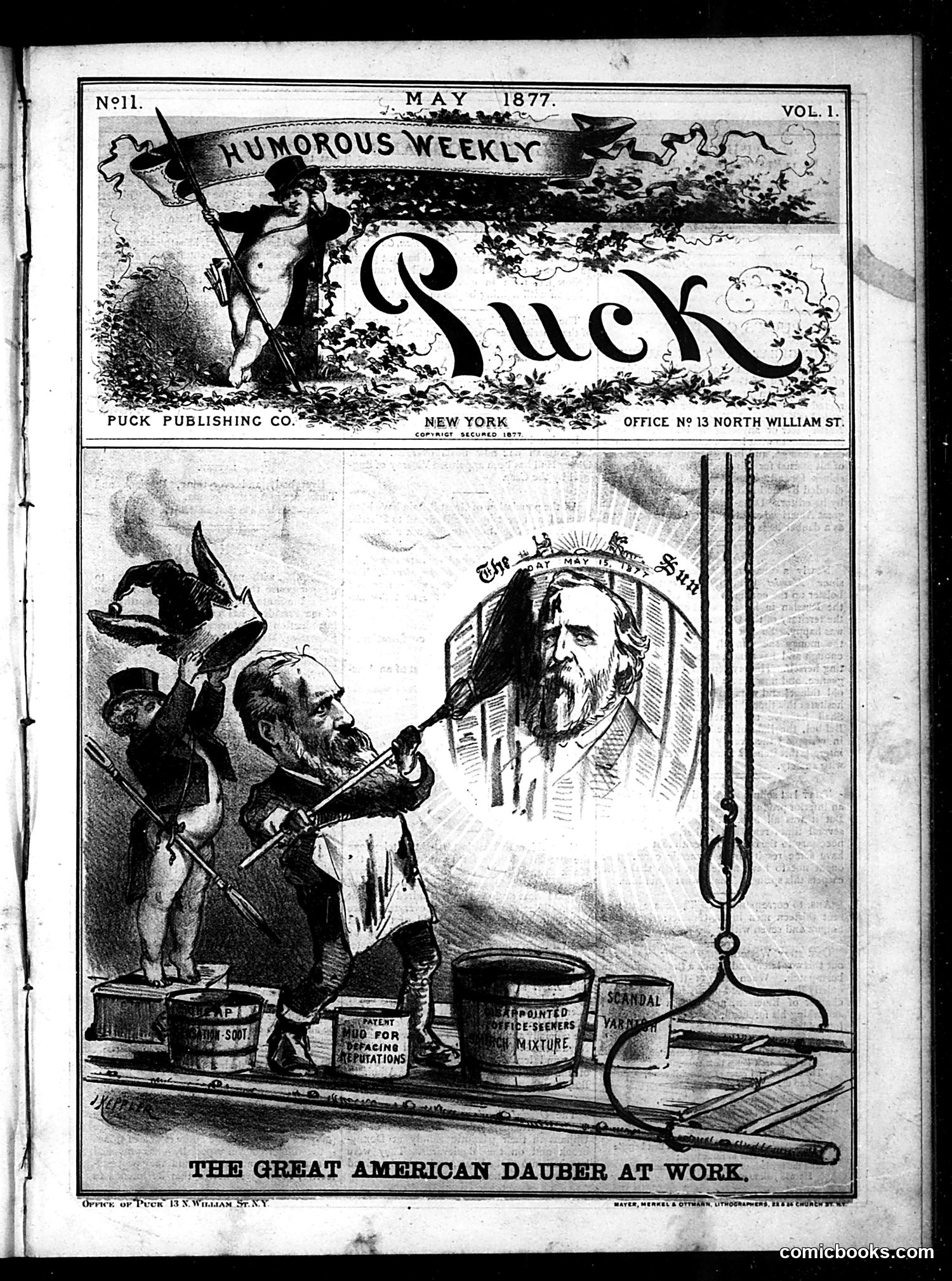
This May 1877 *Puck* cartoon satirizes what appears to be a political figure engaged in whitewashing or covering up scandals. The caricatured man, depicted with exaggerated facial features and a long beard, is literally painting over jars labeled "Scandal," "Appointed Office-Seekers," and "Mixture"—suggesting he's concealing corrupt practices or patronage appointments. The portrait on the wall labeled "The Saint" likely represents an idealized or falsely righteous image the figure wants projected publicly. The overall metaphor is transparent: the cartoon mocks someone using deception or manipulation to hide political misconduct from public view. Without additional context identifying the specific figure, the satire targets corruption and hypocrisy in American politics more broadly.
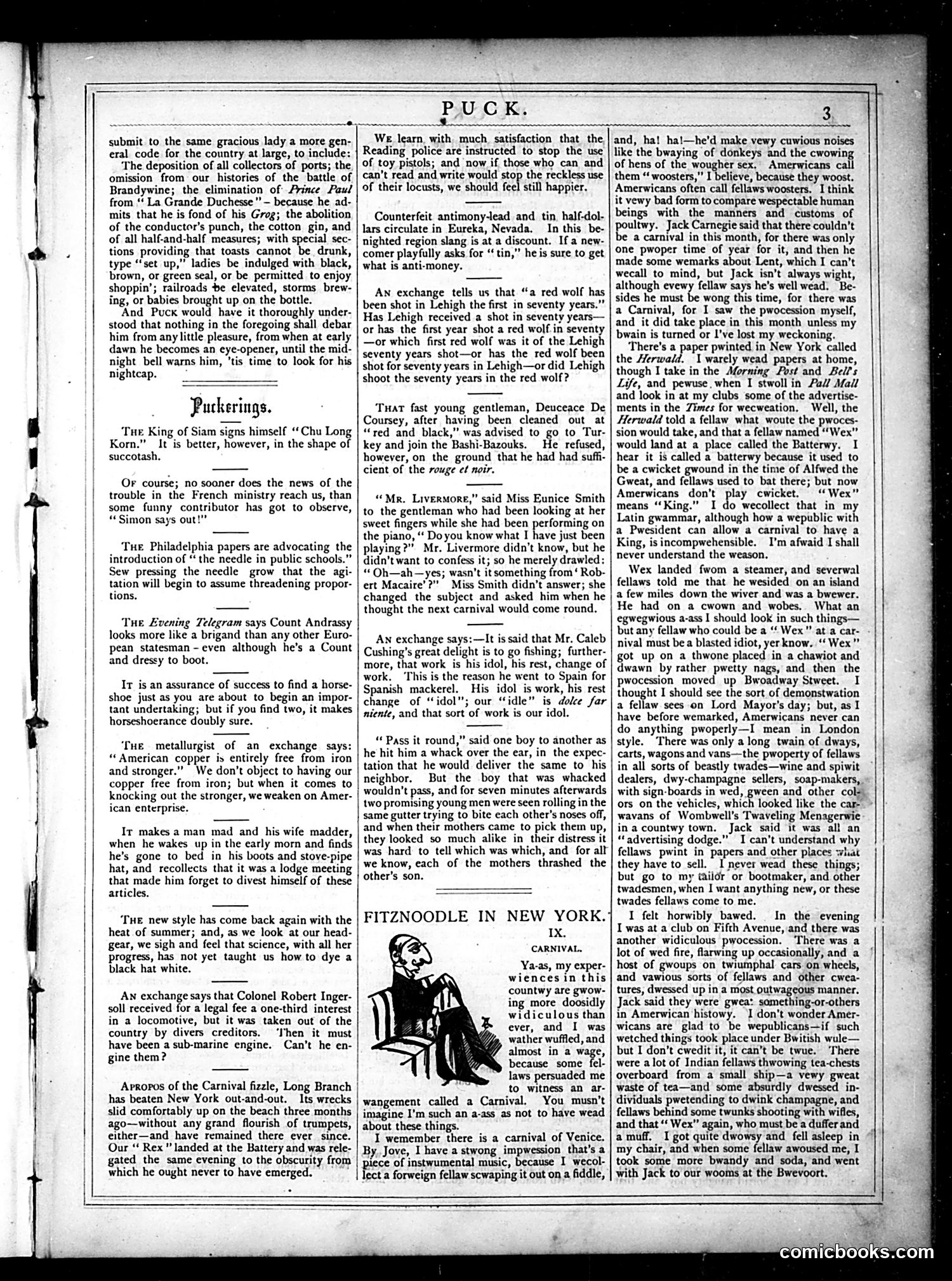
This page contains primarily **text content rather than political cartoons**—it's a humor/gossip column called "Puckerings" discussing various social observations and an article titled "Fitznoodle in New York" featuring a small illustration of a seated man. The content satirizes Victorian-era social absurdities: a King of Siam's self-aggrandizing signature, newspaper editors commenting on trivial matters, and elaborate descriptions of New York carnival festivities and social etiquette. The "Fitznoodle" illustration and accompanying text mock American social pretensions, particularly regarding imported European customs and the city's obsession with fashionable entertainment. The tone is lighthearted mockery of upper-class behavior rather than sharp political commentary. **Without clearer identification of specific figures or major political events referenced, detailed interpretation remains limited.**
This page contains three separate pieces of satirical content: 1. **"Ginger"** (left column): A poem by H.C. Bunner critiquing sentimental Victorian poetry about childhood innocence, mocking its excessive romanticism. 2. **"No Trouble to Show Goods"** (center): A story satirizing a dry goods merchant named Mr. Smoothleigh who uses aggressive advertising ("No trouble to show goods") to manipulate customers, particularly a young woman, into purchasing items she doesn't want. The satire targets deceptive retail practices and the vulnerability of female shoppers. 3. **"Little Tommy's Talks III"** and **"Puck's Personal Intelligence"** (right): Brief humorous anecdotes and gossip items, typical of the magazine's miscellaneous satirical commentary. The page primarily targets commercialism and advertising excess rather than explicit politics.
This page contains **"Puck's Modern Symposium,"** a satirical dialogue between various editorial personas (The Editor, The Poet, The Critic, The Barton, etc.) rather than a traditional political cartoon. The humor targets **literary pretension and journalistic self-importance**. The participants debate poetry quality, editorial dignity, and creative standards while making contradictory arguments. References include Greek poetry, religious papers, and contemporary publication debates. The satire mocks both **would-be serious critics** (who take themselves too seriously) and **hack writers** (who lack genuine talent). The dialogue format allows Puck to ridicule multiple literary and editorial types simultaneously—particularly their pompousness and inconsistent reasoning about what constitutes good writing or legitimate humor. The page primarily **ridicules intellectual vanity** rather than addressing specific political events.
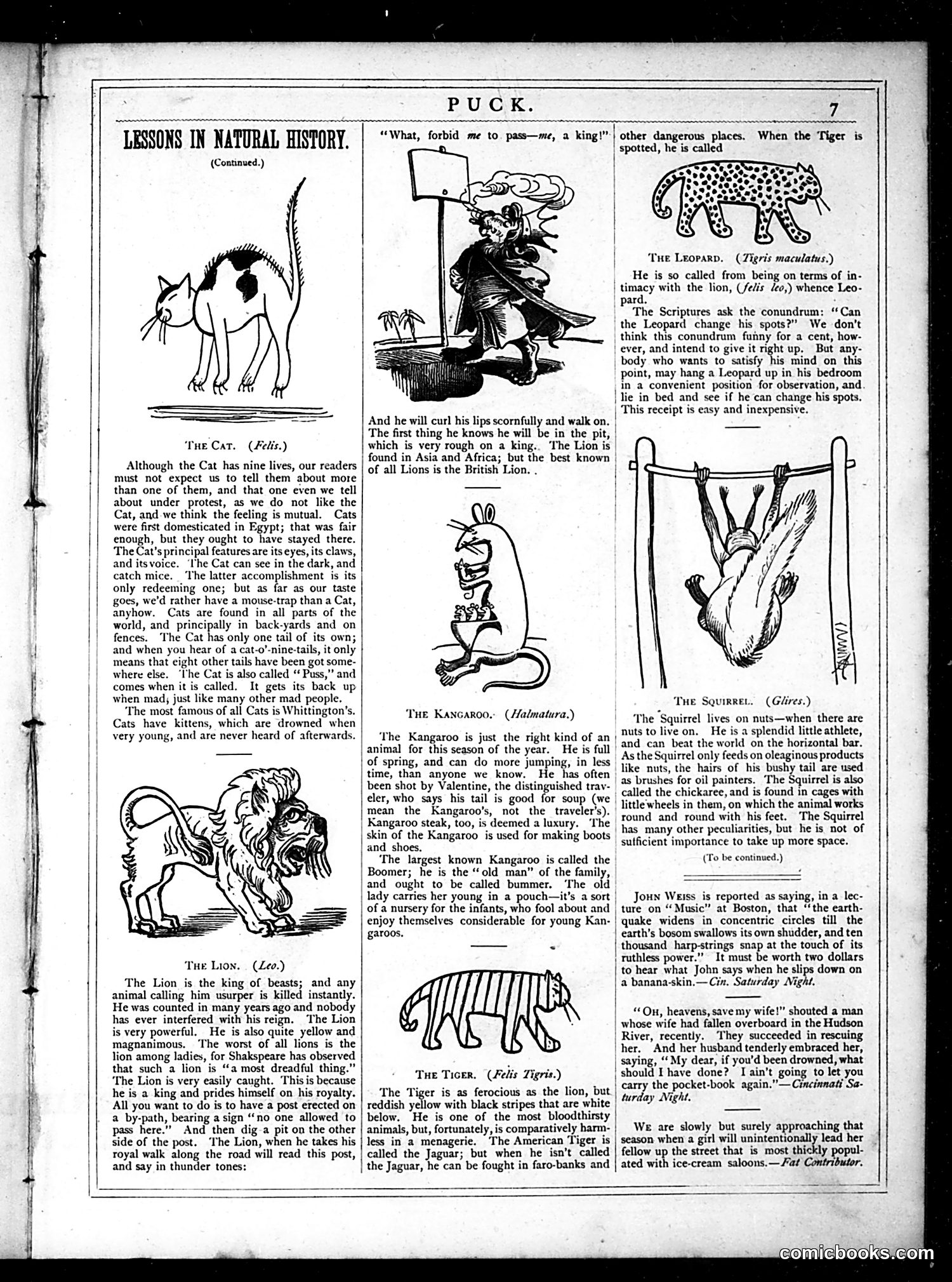
This is an educational feature rather than political satire. The page presents illustrated lessons about animals with humorous commentary. The content includes entries on: - **The Cat** (Felis): Notes cats' hunting abilities and nine lives - **The Lion** (Leo): Describes lions as "king of beasts" - **The Kangaroo** (Halmaturus): Discusses its jumping ability and culinary value - **The Leopard** (Tigris maculatus): References the biblical question "Can the Leopard change his spots?" - **The Tiger** (Felis Tigris): Describes its ferocity - **The Squirrel** (Sciurus): Notes its acrobatic abilities The tone is gently satirical, using animal characteristics to make oblique commentary on human nature and behavior. The page mixes genuine natural history information with whimsical observations and period-appropriate humor.
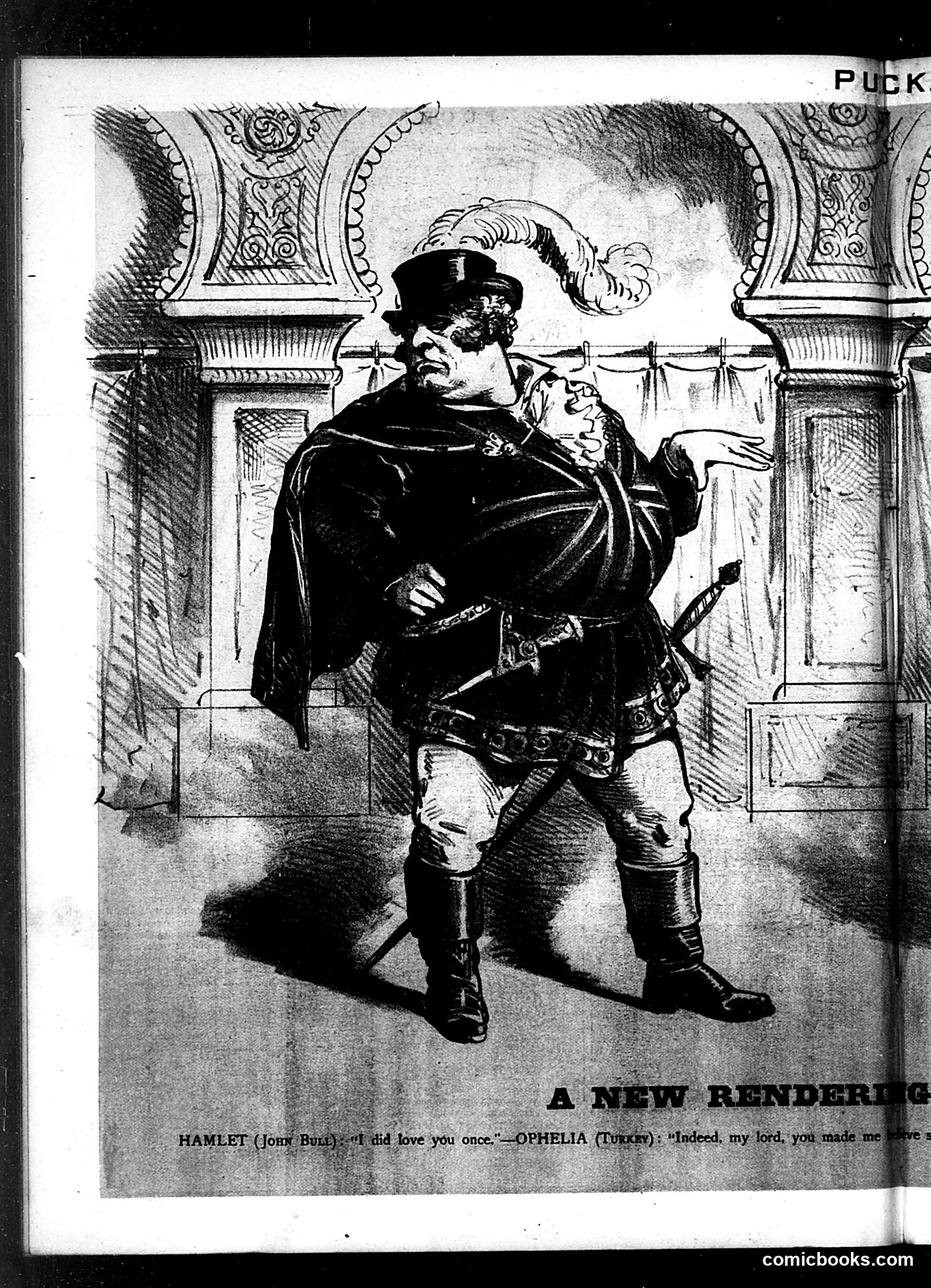
This illustration appears to be a theatrical caricature titled "A New Rendering" from Puck magazine. It depicts an actor in costume as Hamlet, wearing period military dress with boots and cape, in what seems to be an ornate palace setting with decorative columns. The caption quotes a famous exchange from Shakespeare's *Hamlet*—Hamlet tells Ophelia "I did love you once," to which Ophelia responds "Indeed, my lord, you made me believe so." The satire likely mocks a particular contemporary production or actor's interpretation of this classic scene, possibly criticizing an overly theatrical or unconventional staging choice. Without clearer attribution to the specific actor or production, the exact target of ridicule remains unclear, though the exaggerated physical posturing suggests criticism of hammy or excessive performance style.
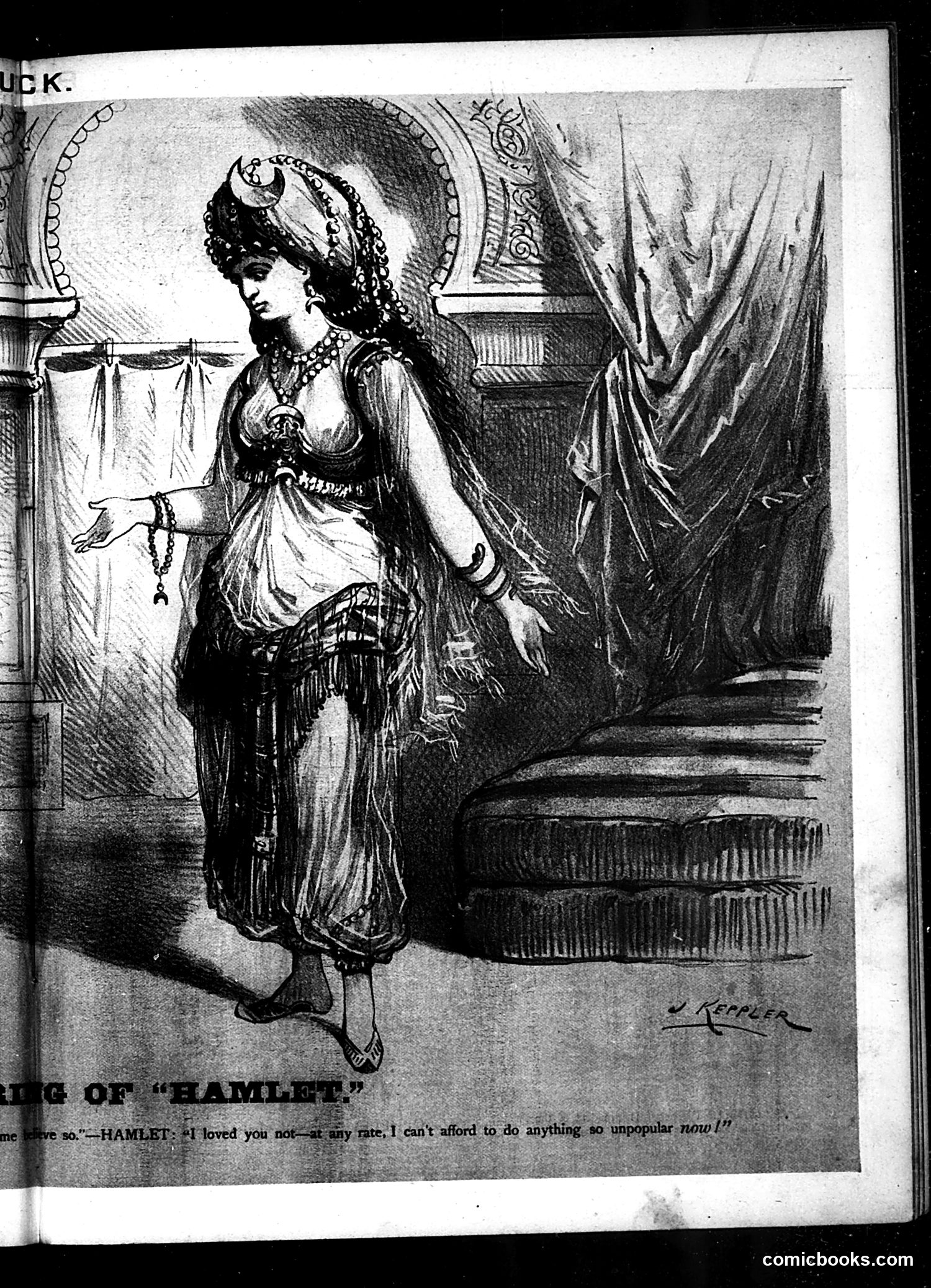
This appears to be an illustration from Shakespeare's *Hamlet*, showing a woman in elaborate classical/Eastern costume with a crescent moon headdress, multiple necklaces, and draped fabric standing in an ornate interior. The partial text below quotes Hamlet's famous rejection line: "I loved you not—at any rate, I can't afford to do anything so unpopular *now*!" The satire seems to comment on contemporary theatrical production choices. By dressing this character (likely Ophelia) in exotic, expensive costume and staging, the illustration mocks either overwrought Shakespearean productions of the era or, possibly, an actress's vanity in costume selection. The addition of "now" to the original text suggests commentary on current social or political pressures influencing artistic choices—actors or producers unwilling to make unpopular decisions regardless of artistic merit.
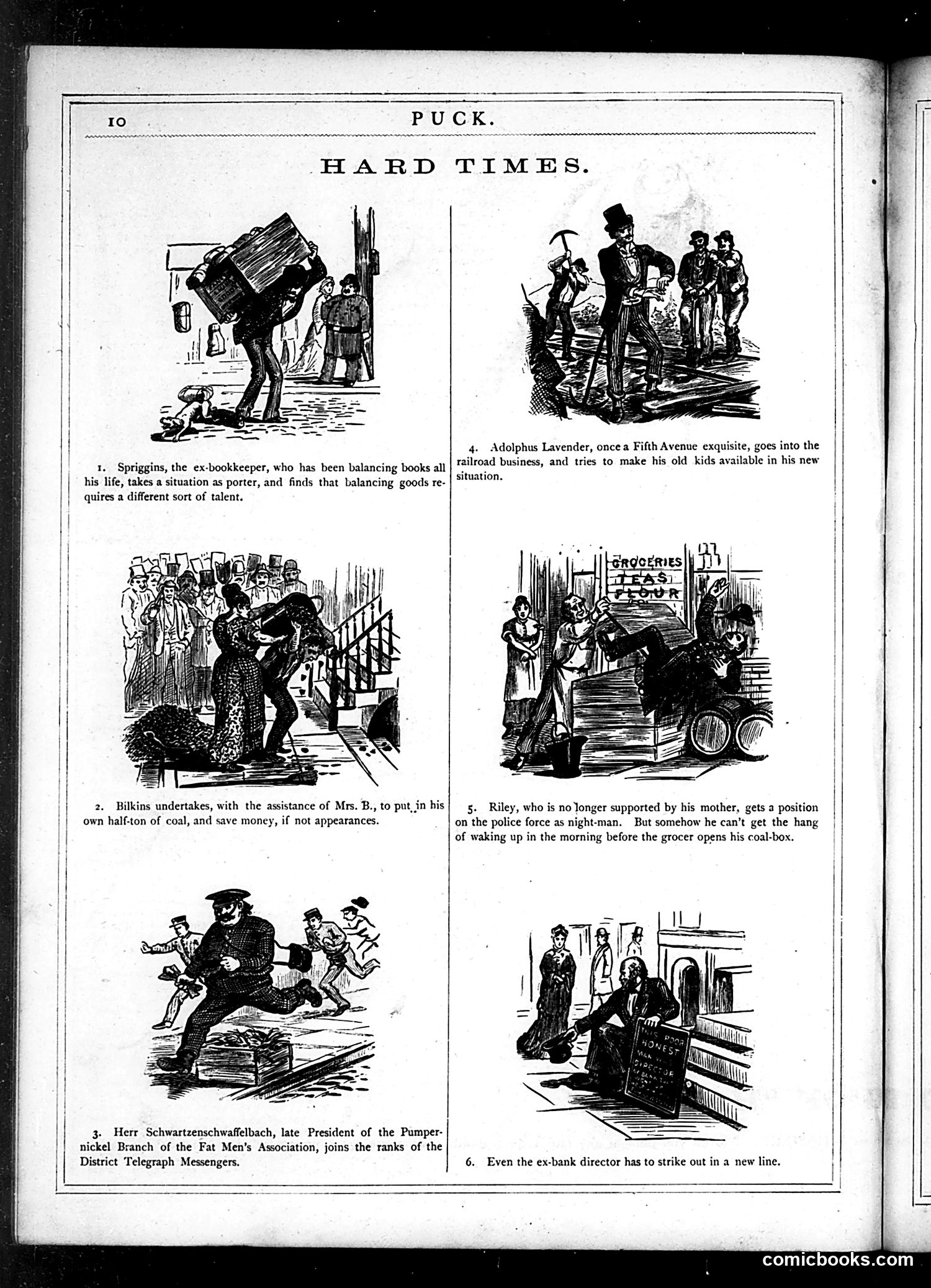
This page satirizes the economic hardships of the period through six vignettes showing people struggling to adapt to financial crisis: 1. **Spriggins** (an ex-bookkeeper) must become a porter, showing white-collar workers forced into manual labor. 2. **Bilkins** and Mrs. B. attempt to economize by sharing a coat, mocking desperate penny-pinching. 3. **Herr Schwartzenschwaffelbach**, a former Fat Men's Association president, joins the telegram messengers—suggesting even established figures lost status. 4. **Adolphus Lavender** attempts to profit from his children via the railroad business. 5. **Riley**, a policeman, struggles with the timing of his night shift and grocer's business hours. 6. An ex-bank director enters a new line of work. The cartoon depicts widespread unemployment and class displacement during economic hardship, likely referencing a Gilded Age financial panic.
This page contains a theater review disguised as a humorous first-person narrative. The author attended a production of "Rosedale" (a play by Lester Wallack) and describes the chaos of getting there—a carriage mishap, missing his hat, a pocket-book theft, and various theatrical annoyances. The satire targets both theatergoers' misadventures and performers' pretensions. The review praises Lester Wallack's acting while gently mocking the melodramatic conventions of the era. The cartoon (featuring "Silas") appears to illustrate the author's mishaps before the show. The piece satirizes the gap between anticipating an elegant evening at the theater versus the actual complicated reality of attending one in the period.
This page from *Puck* magazine contains primarily **serialized fiction** rather than political satire or cartoon content. The text shows "Two Knaves and a Queen: An English Story" (continued from an earlier installment), a narrative about romantic entanglements involving characters named René, Sir Humphrey Clinker, George, and Mattie. The story focuses on domestic drama—a woman's choices between suitors, complications involving horses and social gatherings, and swimming incidents. There appears to be **no political cartoon or satire** on this particular page. The page also includes practical correspondence from readers ("Detectfully yours, Silas Drift") and editorial responses, typical of *Puck*'s miscellaneous content sections, though these lack clear political or satirical targets visible in the provided text.
This page appears to be **text only—a serialized short story** rather than political satire or comics. The narrative concerns romantic complications among characters named Miss Biron, Sir Humphrey, Gregory, Radcliffe, and René. The story involves a horse-riding accident, injury recovery, and marriage proposal negotiations. Characters debate romantic ideals, class considerations, and gender relations typical of Victorian-era fiction. **No political cartoon or satirical content is visible.** This represents the literary fiction Puck sometimes published alongside its famous satirical illustrations. Without illustrations or contemporary political references, the page's relevance to modern readers lies primarily in period attitudes toward courtship, social hierarchy, and romantic conduct—not satire or social commentary.
This page contains primarily **text content** rather than political cartoons. The visible cartoon illustration shows "Puck's Arthuages" featuring what appears to be a figure in period dress, though details are unclear at this resolution. The page consists of several humorous short stories and anecdotes with satirical commentary on contemporary life, including pieces titled "Isaac, the Inkist" and "Oysters and Truth." These mock various social types and situations—including clerks, house-painters, and romantic mishaps—typical of Puck's satirical approach. The content targets everyday American foibles rather than specific political figures or events. Without clearer illustration details or dated references in the legible text, the exact satirical targets remain general social commentary rather than specific historical references.
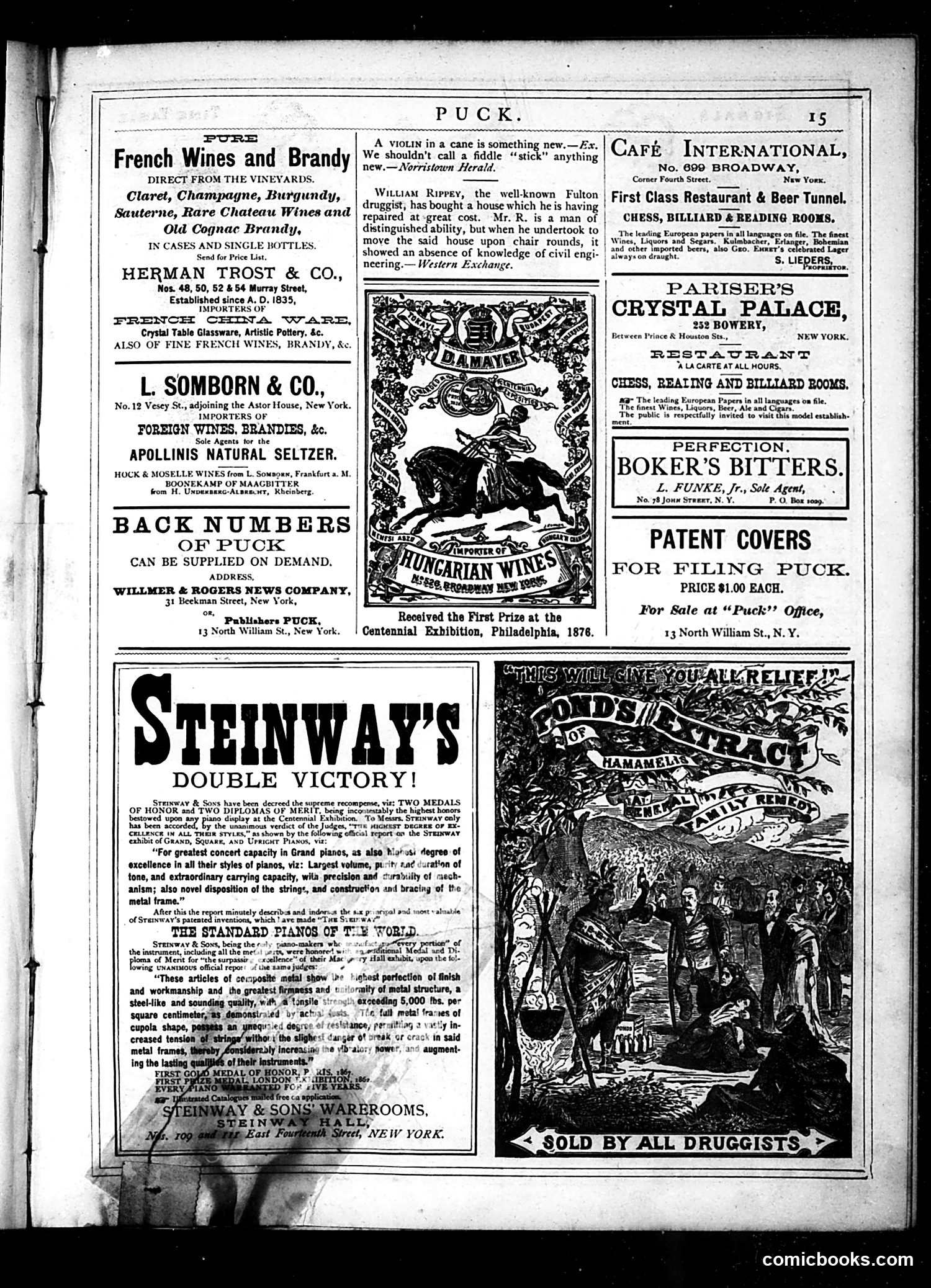
This page is primarily **advertising**, not satirical content. It features commercial advertisements for: - **French wines and brandy** (Herman & Trost Co.) - **Foreign wines and seltzers** (I. Somborn & Co.) - **Steinway pianos** — prominently advertised with claims about their awards and superior construction - **Hungarian wines** (with an ornate label illustration) - **Patent covers for filing Puck** magazine - **Boker's Bitters** (medicinal/patent remedy) - **Pond's Extract** (another patent medicine, sold by all druggists) The Hungarian wines label depicts a horseman, likely referencing Hungarian national imagery. The Pond's Extract advertisement uses dramatic illustrated packaging typical of 19th-century patent medicines. There is **no political satire** on this page — it's a straightforward advertisement section from the magazine.
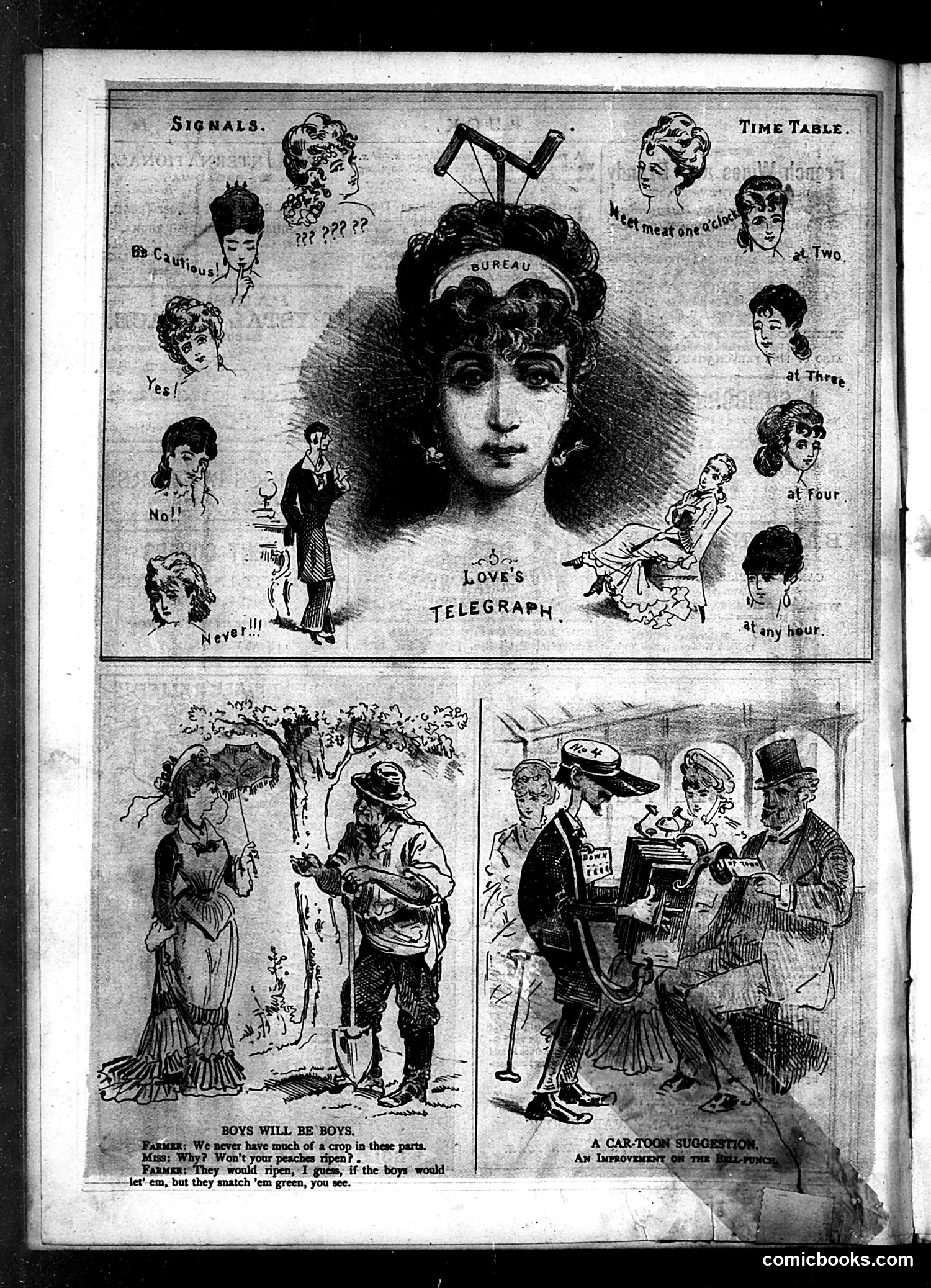
The top illustration, titled "Love's Telegraph," presents a woman's face surrounded by small vignettes labeled as romantic "signals" and a "time table." These depict various flirting gestures—"Be Cautious!," "Yes!," "No!," "Never!!"—and meeting times ("at Two," "at Three," "at Four," "at any hour"). This satirizes the elaborate coded language women supposedly used to communicate romantic interest to suitors. The bottom cartoons address gender and class themes. "Boys Will Be Boys" shows a woman scolding a soldier about damaging plants, sarcastically suggesting boys need punishment. "A Cartoon Suggestion" depicts what appears to be a street scene involving a woman and multiple men, likely critiquing urban social dynamics or public behavior. The humor relies on period-specific courtship conventions and social anxieties about gender relations.