
Puck, 1877-05 · page 4 of 16
Puck — May 1877 — page 4: what you’re looking at
What you’re looking at
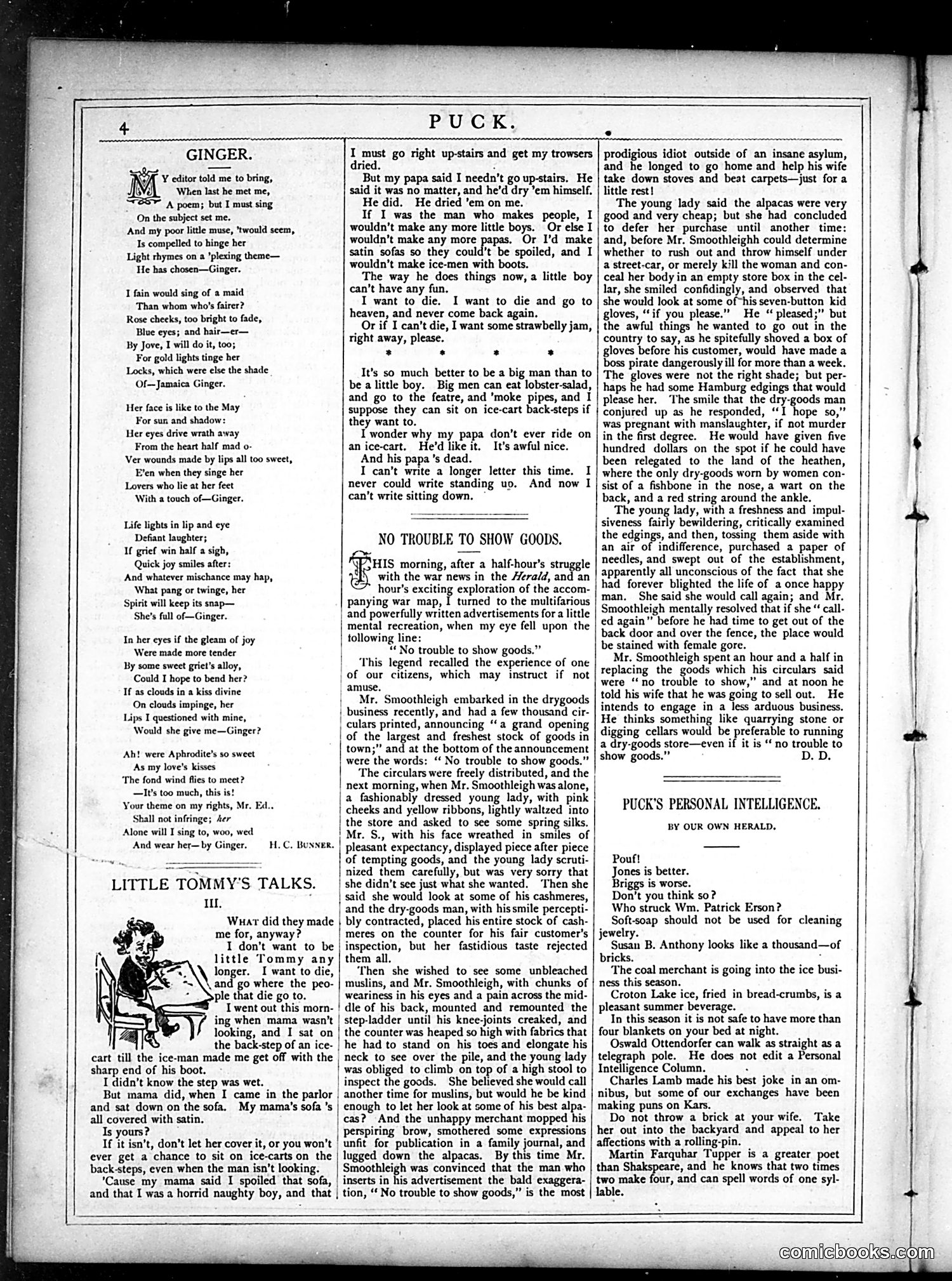
This page contains three separate pieces of satirical content: 1. **"Ginger"** (left column): A poem by H.C. Bunner critiquing sentimental Victorian poetry about childhood innocence, mocking its excessive romanticism. 2. **"No Trouble to Show Goods"** (center): A story satirizing a dry goods merchant named Mr. Smoothleigh who uses aggressive advertising ("No trouble to show goods") to manipulate customers, particularly a young woman, into purchasing items she doesn't want. The satire targets deceptive retail practices and the vulnerability of female shoppers. 3. **"Little Tommy's Talks III"** and **"Puck's Personal Intelligence"** (right): Brief humorous anecdotes and gossip items, typical of the magazine's miscellaneous satirical commentary. The page primarily targets commercialism and advertising excess rather than explicit politics.
📄 Transcribed text from this page (OCR, searchable)
Machine-transcribed from the original scan — historical spelling and the odd misread are preserved.
4 PUCK. GINGER. M f ¥ editor told me to bring, When last he met me, A poem; but I must sing On the subject set me. ‘And my poor little muse, ‘twould seem, Is compelled to hinge her Light rhymes on a 'plexing theme— He has chosen—Ginger. I fain would sing of a maid ‘Than whom who's fairer? Rose cheeks, too bright to fade, Blue eyes; and hair—er— By Jove, I will do it, too; For gold lights tinge her Locks, which were else the shade Of—Jamaica Ginger. Her face is like to the May For sun and shadow: Her eyes drive wrath away From the heart half mad o- Ver wounds made by lips all too sweet, E’en when they singe her Lovers who lie at her feet With a touch of—Ginger. Life lights in lip and eye Defiant laughter; If grief win half a sigh, Quick joy smiles after: ‘And whatever mischance may hap, ‘What pang or twinge, her Spirit will keep its snap— She's full of Ginger. In her eyes if the gleam of joy Were made more tender By some sweet griet’s alloy, Could I hope to bend her? If as clouds in a kiss divine On clouds impinge, her Lips I questioned with mine, Would she give me—Ginger? Ah! were Aphrodite’s so sweet As my love's kisses ‘The fond wind flies to meet? —It’s too much, this is! Your theme on my rights, Mr. Ed.. Shall not infringe; her Alone will I sing to, woo, wed And wear her—by Ginger. H.C, BUNNER. LITTLE TOMMY'S TALKS. Ill. Wuar did they made me for, anyway? I don’t want to be little Tommy any longer. I want to die, go where the peo- ple that die go to. I went out this morn- ! ing when mama wasn’t looking, and I sat on q the back-step of an ice- | cart till the ice-man made me get off with the sharp end of his boot. I didn’t know the step was wet. But mama did, when I came in the parlor | and sat down on the sofa. My mama's sofa ’s all covered with satin. Is yours? If it isn’t, don’t let her cover it, or you won't ever get a chance to sit on ice-carts on the back-steps, even when the man isn’t looking. Cause my mama said I spoiled that sofa, and that I was a horrid naughty boy, and that | nenerny iG must go right up-stairs and 3 my trowsers ied. But my papa said I needn't go up-stairs. He said it was no matter, and he'd dry ’em himself. He did. He dried ‘em on me. If I was the man who makes people, I wouldn’t make any more little boys. Or else I wouldn't make any more papas. Or I'd make satin sofas so they could’ be spoiled, and I wouldn’t make ice-men with boots. The way he does things now, a little boy can’t have any fun. I want to die. I want to die and go to heaven, and never come back again. Or if I can’t die, I want some strawbelly jam, right away, please. * . * * It’s so much better to be a big man than to be a little boy. Big men can eat lobster-salad, and go to the featre, and 'moke pipes, and I suppose they can sit on ice-cart back-steps if they want to. T wonder why my papa don’t ever ride on an ice-cart. He’d like it. It’s awful nice. And his papa ’s dead. I can’t write a longer letter this time. I never could write standing uo. And now I can’t write sitting down. NO TROUBLE TO SHOW GOODS. Kas morning, after a half-hour’s struggle with the war news in the Hera/d, and an hour's exciting exploration of the accom- panying war map, I turned to the multifarious and powerfully written advertisements for a little | mental recreation, when my eye fell upon the | tollowing line: “No trouble to show gaods.”” ‘This legend recalled the experience of one of our citizens, which may instruct if not amuse. | Mr. Smoothleigh embarked in the drygoods | business recently, and had a few thousand cir- culars printed, announcing “a grand opening | of the largest and freshest stock of goods in town;” and at the bottom of the announcement were ‘he words: ‘ No trouble to show goods."”” | fashionably dressed young lady, with pink | cheeks and yellow ribbons, lightly waltzed into | the store and asked to see some spring silks. j Mr. S., with his face wreathed in smiles of pleasant expectancy, displayed piece after piece of tempting goods, and the young lady scruti- nized them carefully, but was very sorry that | she didn’t sce just what she wanted. ‘hen she | said she would look at some of his cashmeres, | and the dry-goods man, with his smile percepti- | bly contracted, placed his entire stock of cash- | meres on the counter for his fair customer's | inspection, but her fastidious taste rejected them all. ‘Then she wished to see some unbleached muslins, and Mr. Smoothleigh, with chunks of weariness in his eyes and a pain across the mid- dle of his back, mounted and remounted the | step-ladder until his knee- joints creaked, and | the counter was heaped so high with fabrics that he had to stand on his toes and elongate his | neck to see over the pile, and the young lady | was obliged to climb on top of a high stool to | inspect the goods. She believed she would call another time for muslins, but would he be kind enough to let her look at some of his best alpa- | cas? And the unhappy merchant mopped his | perspiring brow, smothered some expressions unfit for publication in a family journal, and lugged down the alpacas. By this time Mr. Smoothleigh was convinced that the man who inserts in his advertisement the bald exaggera- | | tion, “ No trouble to show goods,” is the most The circulars were freely distributed, and the | next morning, when Mr. Smoothleigh was alone, | prodigious idiot outside of an insane asylum, and he longed to go home and help his wife take down stoves and beat carpets—just for a little rest! The young lady said the alpacas were very good and very cheap; but she had concluded to defer her purchase until another time: and, before Mr. Smoothleighh could determine whether to rush out and throw himself under a street-car, or merely kill the woman and con- ceal her body in an empty store box in the cel- lar, she smiled confidingly, and observed that she would look at some of-his seven-button kid gloves, ‘if you please.” He “ pleased;” but the awful things he wanted to go out in the country to say, as he spitefully shoved a box of gloves before his customer, would have made a boss pirate dangerously ill for more than a week. The gloves were not the right shade; but per- haps he had some Hamburg edgings that would please her. ‘The smile that the dry-goods man conjured up as he responded, ‘I hope so,” was pregnant with manslaughter, if not murder in the first degree. He would have given five hundred dollars on the spot if he could have been relegated to the land of the heathen, where the only dry-goods worn by women con- sist of a fishbone in the nose, a wart on the back, and a red string around the ankle. ‘The young lady, with a freshness and impul- siveness fairly bewildering, critically examined the edgings, and then, p tossing then aside with an air of indifference, purchased a paper of needles, and swept out of the establishment, apparently all unconscious of the fact that she had forever blighted the life of a once happy man. She said she would call again; and Mr. Smoothleigh mentally resolved that if she “ call- ed again” before he had time to get out of the back door and over the fence, the place would be stained with female gore. Mr. Smoothleigh spent an hour and a half in replacing the goods which his circulars said were ‘no trouble to show,” and at noon he told his wife that he was going to sell out. He intends to engage in a less arduous business. He thinks something like quarrying stone or digging cellars would be preferable to running a dry-goods store—even if it is “no trouble to show goods.” D. D. PUCK'S PERSONAL INTELLIGENCE. BY OUR OWN HERALD, Pouf! sone is better. riggs is worse. Dat ye think so? Who struck Wm. Patrick Erson? Soft-soap should not be used for cleaning jewelry. Susan B. Anthony looks like a thousand—of bricks. The coal merchant is going into the ice busi- ness this season. Croton Lake ice, fried in bread-crumbs, is a pleasant summer beverage. In this season it is not safe to have more than four blankets on your bed at night. Oswald Ottendorfer can walk as straight as a telegraph pole. He does not edit a Personal Intelligence Column. Charles Lamb made his best joke in an om- nibus, but some of our exchanges have been making puns on Do not throw a brick at your wife. Take her out into the backyard and appeal to her affections with a rolling-pin. Martin Farquhar Tupper is a greater poet than han Sea and he knows that two times four, ani d can spell words of one syl- ible. comicbooks.coun