
Puck, 1877-05 · page 5 of 16
Puck — May 1877 — page 5: what you’re looking at
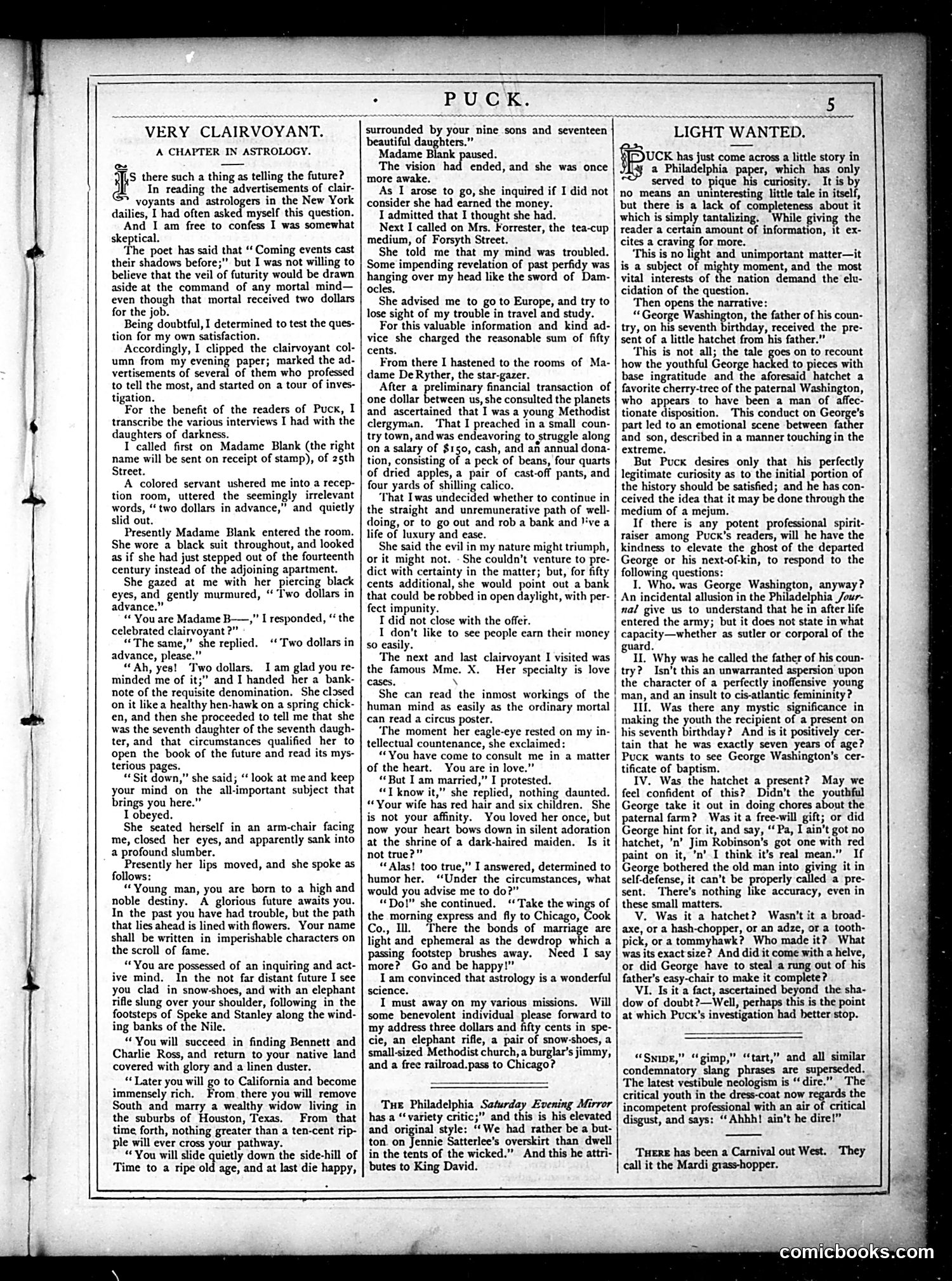
A restored page from Puck, 1877-05. Page through the whole issue in the reader above.
📄 Transcribed text from this page (OCR, searchable)
Machine-transcribed from the original scan — historical spelling and the odd misread are preserved.
VERY CLAIRVOYANT. A CHAPTER IN ASTROLOGY. ost era Ks there such a thing as telling the future? In reading the advertisements of clair- voyants and astrologers in the New York dailies, I had often asked myself this question. And I am free to confess I was somewhat skeptical. The poet has said that ‘ Coming events cast their shadows before;” but I was not willing to believe that the veil of futurity would be drawn aside at the command of any mortal mind— even though that mortal received two dollars for the job. Being doubtful, 1 determined to test the ques- tion for my own satisfaction. Accordingly, I clipped the clairvoyant col- umn from my evening paper; marked the ad- vertisements of several of them who professed to tell the most, and started on a tour of inves- tigation. For the benefit of the readers of Puck, I transcribe the various interviews I had with the daughters of darkness. I called first on Madame Blank (the right name will be sent on receipt of stamp), of 25th Street. A colored servant ushered me into a recep- tion room, uttered the seemingly irrelevant words, “two dollars in advance,” and quietly slid out. Presently Madame Blank entered the room. She wore a black suit throughout, and looked as if she had just stepped out of the fourteenth century instead of the adjoining apartment. She gazed at me with her piercing black eyes, and gently murmured, ‘Two dollars in advance.” “You are Madame B-—,” I responded, “ the celebrated clairvoyant ?” “The same,” she replied. ‘‘ Two dollars in advance, please.” “Ah, yes! ‘Two dollars. I am glad you re- minded me of it;” and I handed her a bank- note of the requisite denomination. She closed on it likea healthy hen-hawk on a spring chick- en, and then she proceeded to tell me that she was the seventh daughter of the seventh daugh- ter, and that circumstances qualified her to open the book of the future and read its mys- terious pages. “Sit down,” she said; “look at me and keep your mind on the all-important subject that brings you here.” I obeyed. She seated herself in an arm-chair facing me, closed her eyes, and apparently sank into a profound slumber. Presently her lips moved, and she spoke as follows: “Young man, you are born to a high and noble destiny. ‘A glorious future awaits you. In the past you have had trouble, but the path that lies ahead is lined with flowers. Your name shall be written in imperishable characters on the scroll of fame. “You are possessed of an inquiring and act- ive mind. In the not far distant future I see you clad in snow-shoes, and with an elephant rifle slung over your shoulder, following in the footsteps of Speke and Stanley along the wind- ing banks of the Nile. “You will succeed in finding Bennett and Charlie Ross, and return to your native land covered with glory and a linen duster. “Later you will go to California and become immensely rich. From there you will remove South and marry a wealthy widow living in the suburbs of Houston, Texas. From that time forth, nothing greater than a ten-cent rip- ple will ever cross your pathway. “You will slide quietly down the side-hill of Time to a ripe old age, and at last die happy, surrounded by your nine sons and seventeen beautiful daughters.” Madame Blank paused. The vision had ended, and she was once more awake. As I arose to go, she inquired if I did not consider she had earned the money. I admitted that I thought she had. Next I called on Mrs. Forrester, the tea-cup medium, of Forsyth Street. She told me that my mind was troubled. Some impending revelation of past Berfdy. was hanging over my head like the sword of Dam- ocles. She advised me to go to Europe, and try to lose sight of my trouble in travel and study. For this valuable information and kind ad- vice she charged the reasonable sum of fifty cents. From there I hastened to the rooms of Ma- dame De Ryther, the star-gazer. After a preliminary financial transaction of one dollar between us, she consulted the planets and ascertained that I was a young Methodist clergyman. ‘That I preached ina small coun- try town, and was endeavoring to struggle along on a salary of $150, cash, and af annual dona- tion, consisting of a peck of beans, four quarts of dried apples, a pair of cast-off pants, and four yards of shilling calico. ‘That Iwas undecided whether to continue in the straight and unremunerative path of well- doing, or to go out and rob a bank and l've a life of luxury and ease. She said the evil in my nature might triumph, or it might not. - She couldn’t venture to pre- dict with certainty in the matter; but, for fifty cents additional, she would point out a bank that could be robbed in open daylight, with per- fect impunity. T did not close with the offer. I don’t like to see people earn their money so easily. The next and last clairvoyant I visited was the famous Mme. X. Her specialty is love cases. \ She can read the inmost workings of the human mind as easily as the ordinary mortal can read a circus poster. ‘The moment her eagle-eye rested on my in- tellectual countenance, she exclaimed: “You have come to consult me in a matter of the heart. You are in love.” “But I am married,” I protested. “T know it,” she replied, nothing daunted. “Your wife has red hair and six children. She is not your affinity. You loved her once, but now your heart bows down in silent adoration at the shrine of a dark-haired maiden. Is it not true?” “Alas! too true,” I answered, determined to humor her. ‘Under the circumstances, what would you advise me to do?” “Dol” she continued. ‘Take the wings of the morning express and fly to Chicago, Cook Co., Il. There the bonds of marriage are light and ephemeral as the dewdrop which a passing footstep brushes away. Need I say more? Go and be happy!” 1 am convinced that astrology is a wonderful science. I must away on my various missions. Will some benevolent individual please forward to my address three dollars and fifty cents in spe- cie, an elephant rifle, a pair of snow-shoes, a small-sized Methodist church, a burglar’s jimmy, and a free railroad.pass to Chicago? Tue Philadelphia Saturday Evening Mirror has a “‘ variety critic;” and this is his elevated and original style: ‘‘We had rather be a but- ton. on Jennie Satterlee’s overskirt than dwell in the tents of the wicked.” And this he attri- butes to King David. LIGHT WANTED. iP UCK has just come across a little story in [ya Philadelphia paper, which has only served to pique his curiosity. It is by no means an uninteresting little tale in itself, but there is a lack of completeness about it which is simply tantalizing, While giving the reader a certain amount of information, it ex- cites a craving for more. ‘This is no ght and unimportant matter—it is a subject of mighty moment, and the most vital interests of the nation demand the elu- cidation of the question. Then opens the narrative: “George Washington, the father of his coun- try, on his seventh birthday, received the pre- sent of a little hatchet from his father.” This is not all; the tale goes on to recount how the youthful George hacked to pieces with base ingratitude and the aforesaid hatchet a favorite cherry-trec of the paternal Washington, who appears to have been a man of affec- tionate disposition. This conduct on George’s part led to an emotional scene between father and son, described in a manner touching in the extreme. But Puck desires only that his perfectly legitimate curiosity as to the initial portion of the history should be satisfied; and he has con- ceived the idea that it may be done through the medium of a mejum. If there is any potent professional spirit- raiser among Pucx’s readers, will he have the kindness to elevate the ghost of the departed George or his next-of-kin, to respond to the following questions: I. Who. was George Washington, anyway? An incidental allusion in the Philadelphia Jour- nal give us to understand that he in after life entered the army; but it does not state in what capacity—whether as sutler or corporal of the guard. II. Why was he called the father of his coun- try? Isn't this an unwarranted aspersion upon the character of a perfectly inoffensive young man, and an insult to cis-atlantic femininity ? II. Was there any mystic. significance in | making the youth the recipient of a present on his seventh birthday? And is it positively cer- tain that he was exactly seven years of age? Puck wants to see George Washington's cer- tificate of baptism. IV. Was the hatchet a present? May we feel confident of this? Didn’t the youthful George take it out in doing chores about the paternal farm? Was it a free-will gift; or did George hint for it, and say, ‘‘ Pa, I ain't got no hatchet, ’n’ Jim Robinson’s got one with red paint on it, ’n’ I think it’s real mean.” If George bothered the old man into giving it in self-defense, it can’t be properly called a pre- sent. ‘There’s nothing like accuracy, even in these small matters. V. Was it a hatchet? Wasn't it a broad- axe, or a hash-chopper, or an adze, or a tooth- pick, or a tommyhawk? Who made it? What was its exact size? And did it come with a helve, or did George have to steal a rung out of his father’s easy-chair to make it complete? VIL. Is it a fact, ascertained beyond the sha- dow of doubt ?—Well, perhaps this is the point at which Puck's investigation had better stop. “Swipe,” “gimp,” “tart,” and all similar condemnatory slang phrases are superseded. The latest vestibule neologism is “dire.” The critical youth in the dress-coat now the incompetent professional with an air of ical disgust, and says: “Ahhh! ain’t he dire ‘Tuere has been a Carnival out West. They call it the Mardi grass-hopper. "“comicbooks.com