
Puck, 1877-05 · page 11 of 16
Puck — May 1877 — page 11: what you’re looking at
What you’re looking at
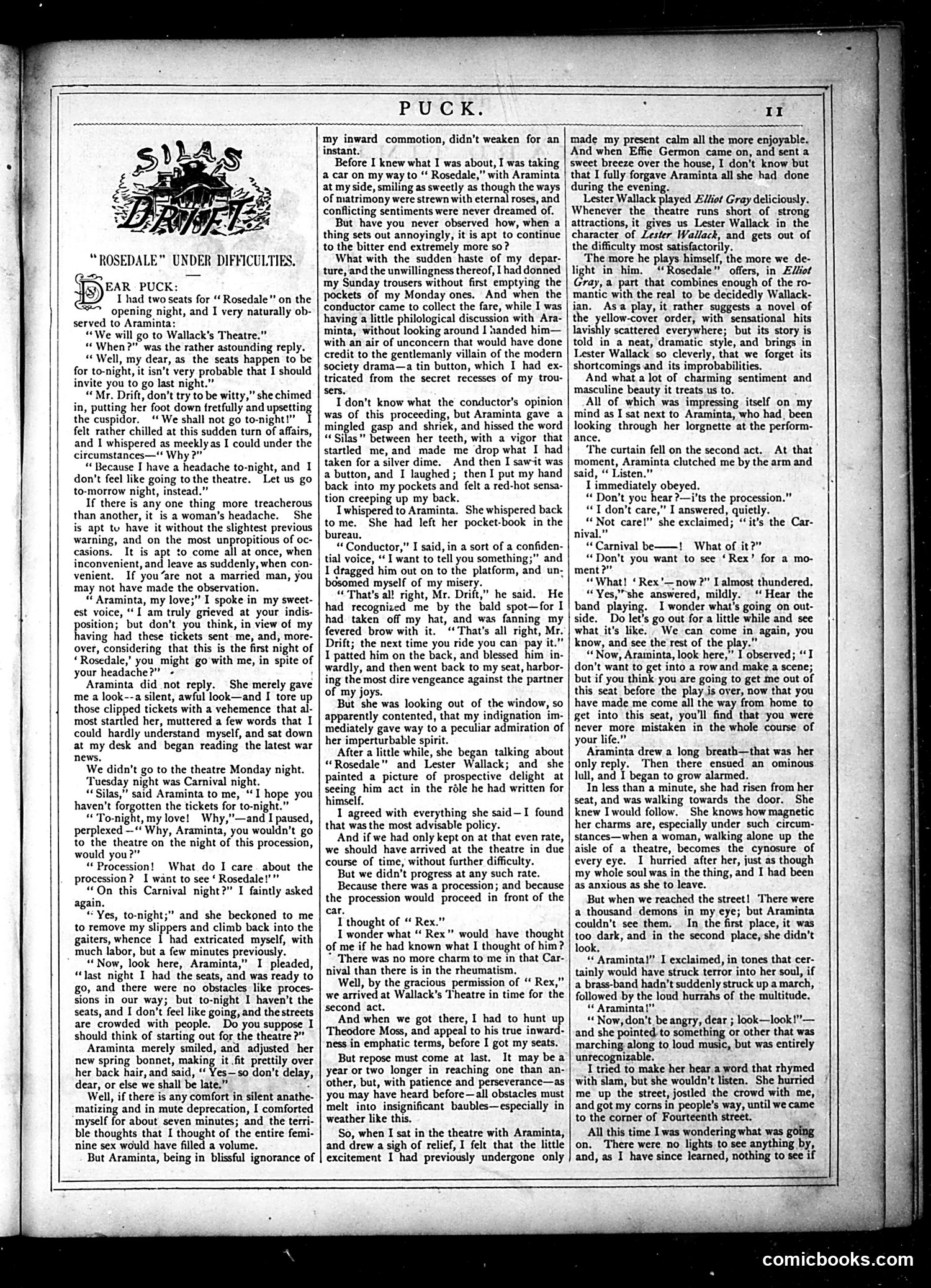
This page contains a theater review disguised as a humorous first-person narrative. The author attended a production of "Rosedale" (a play by Lester Wallack) and describes the chaos of getting there—a carriage mishap, missing his hat, a pocket-book theft, and various theatrical annoyances. The satire targets both theatergoers' misadventures and performers' pretensions. The review praises Lester Wallack's acting while gently mocking the melodramatic conventions of the era. The cartoon (featuring "Silas") appears to illustrate the author's mishaps before the show. The piece satirizes the gap between anticipating an elegant evening at the theater versus the actual complicated reality of attending one in the period.
📄 Transcribed text from this page (OCR, searchable)
Machine-transcribed from the original scan — historical spelling and the odd misread are preserved.
PUCK. “ROSEDALE” UNDER DIFFICULTIES. G EAR PUCK: I had two seats for ‘‘ Rosedale" on the “*~ opening night, and I very naturally ob- served to Araminta: “We will go to Wallack's Theatre.” “« When?” was the rather astounding reply. “Well, my dear, as the seats happen to be for to-night, it isn’t very probable that I should invite you to go last night.” “Mr. Drift, don’t try to be witty,” she chimed in, putting her foot down fretfully and upsetting the cuspidor. “We shall not go to-night!” felt rather chilled at this sudden turn of affairs, and I whispered as meekly as I could under the circumstances—* Why ?” “ Because I have a headache to-night, and 1 don't feel like going tothe theatre. Let us go to-morrow night, instead.” If there is any one thing more treacherous than another, it is a woman’s headache. She is apt tu have it without the slightest previous warning, and on the most unpropitious of oc- casions. It is apt to come all at once, when inconvenient, and leave as suddenly, when con- venient. If you“are not a married man, you may not have made the observation. “ Araminta, my love; I spoke in my sweet- est voice, “fam truly grieved at your indis- positions but don’t you think, in view of my aving had these tickets sent me, and, more- over, considering that this is the first night of ‘Rosedale,’ you might go with me, in spite of your headache?” + Araminta did not reply. She merely gave me a look--a silent, awful look—and I tore up those clipped tickets with a vehemence that al- most startled her, muttered a few words that I could hardly understand myself, and sat down at my desk and began reading the latest war news. We didn’t go to the theatre Monday night. ‘Tuesday night was Carnival night. “Silas,” said Araminta to me, ‘“‘I hope you haven't forgotten the tickets for to-night.” “ To-night, my love! Why,”—and I paused, perplexed — Why, Araminta, you wouldn't go to the theatre on the night of this procession, would you?” “Procession! What do I care procession? I want to see ‘ Rosedale “On this Carnival night?” I faintly asked again. “Yes, to-night;” and she beckoned to me to remove my slippers and climb back into the gaiters, whence 1 had extricated myself, with much labor, but a few minutes previously. ‘Now, look here, Araminta,” I pleaded, “last night I had the seats, and was ready to go, and there were no obstacles like proces- sions in our way; but to-night I haven’t the seats, and I don’t feel like going, and the streets are crowded with people. Do you suppose I should think of starting out for the theatre ?” Araminta merely smiled, and adjusted her new spring bonnet, making it .fit prettily over her back hair, and said, ‘‘ Yes—so don’t delay, dear, or else we shall be late.” é Well, if there is any comfort in silent anathe- matizing and in mute deprecation, I comforted myself for about seven minutes; and the terri- ble thoughts that I thought of the entire femi- nine sex would have filled a volume. But Araminta, being in blissful ignorance of bout the my inward commotion, didn’t weaken for an instant. Before I knew what I was about, I was taking a car on my way to “ Rosedale,” with Araminta at my side, smiling as sweetly as though the ways of matrimony were strewn with eternal roses, and conflicting sentiments were never dreamed of. But have you never observed how, when a thing sets out annoyingly, it is apt to continue | to the bitter end extremely more so? What with the sudden haste of my depar- ture, and the unwillingness thereof, I had donned my Sunday trousers without first emptying the pockets of my Monday ones. And when the conductor came to collect the fare, while I was having a little philological discussion with Ara- minta, without looking around | handed him— with an air of unconcern that would have done credit to the gentlemanly villain of the modern society drama—a tin button, which I had ex- tricated from the secret recesses of my trou- sers. I don’t know what the conductor's opinion was of this proceeding, but Araminta gave a mingled gasp and shriek, and hissed the word “Silas” between her teeth, with a vigor that startled me, and made me drop what I had taken for a silver dime. And then I sawiit was a button, and I laughed; then I put my hand back into my pockets and felt a red-hot sensa- tion creeping up my back. I whispered to Araminta. She whispered back tome. She had left her pocket-book in the bureau, “Conductor,” I said, in a sort of a confiden- tial voice, “I want to tell you something;” and I dragged him out on to the platform, and un- bosomed myself of my misery. “That's al! right, Mr. Drift,” he said. He had recognized me by the bald spot—for I had taken off my hat, and was fanning my fevered brow with it. ‘That's all right, Mr. Drift; the next time you ride you can pay i I patted him on the back, and blessed him in- wardly, and then went back to my seat, harbor- ing the most dire vengeance against the partner of my joys. But she was looking out of the window, so apparently contented, that my indignation im- mediately gave way to a peculiar admiration of her imperturbable spirit. After a little while, she began talking about “Rosedale” and Lester Wallack; and she painted a picture of prospective delight at seeing him act in the réle he had written for himself, I agreed with everything she said—I found that was the most advisable policy. ‘And if we had only kept on at that even rate, we should have arrived at the theatre in due course of time, without further difficulty. But we didn’t progress at any such rate. Because there was a procession; and because the procession would proceed in front of the car. I thought of “ Rex.” I wonder what “‘ Rex" would have thought of me if he had known what I thought of him? * There was no more charm to me in that Car- nival than there is in the rheumatism. Well, by the gracious permission of “ Rex,” we arrived at Wallack’s Theatre in time for the second act. And when we got there, I had to hunt up Theodore Moss, and appeal to his true inward- in emphatic terms, before I got my seats. But repose must come at last. It may bea year or two longer in reaching one than an- other, but, with patience and perseverance—as you may have heard before—all obstacles must melt into insignificant baubles—especially in weather like this. So, when I sat in the theatre with Araminta, and drew a sigh of relief, I felt that the little excitement I had previously undergone only made my present calm all the more enjoyable. And when Effie Germon came on, and sent a sweet breeze over the house, I don’t know but that I fully forgave Araminta all she had done during the evening. Lester Wallack played Evliot Gray deliciously. Whenever the theatre runs short of strong attractions, it gives us Lester Wallack in the character of Lester Wallack, and gets out of the difficulty most satisfactorily. The more he plays himself, the more we de- light in him. ‘Rosedale” offers, in Eliot Gray, a part that combines enough of the ro- mantic with the real to be decidedly Wallack- ian. Asa play, it rather suggests a novel of the foloncores order, with sensational hits lavishly scattered everywhere; but its story is told in a neat, dramatic style, and brings in Lester Wallack so cleverly, that we forget its shortcomings and its improbabilities. And what a lot of charming sentiment and masculine beauty it treats us to. All of which was impressing itself on my mind as I sat next to Araminta, who had, been looking through her lorgnette at the perform- ance, ‘The curtain fell on the second act. At that moment, Araminta clutched me by the arm and said, “ Listen.” I immediately obeyed. “ Don’t you hear ?—i’ts the procession.” “1 don’t care,” I answered, quietly. ‘Not care!” she exclaimed; ‘it’s the Car- nival.” “Carnival be——! What of it?” “Don’t you want to see ‘Rex’ for a mo- ment?” “What! ‘Rex’—now ?” Lalmost thundered. “Yes,’"she answered, mildly. ‘‘ Hear the band playing. I wonder what's going on out- side. Do let’s go out for a little while and see what it’s like. We can come in again, you know, and see the rest of the play.” “Now, Aramninta, look here,” I observed; “I don’t want to get into a rowand make.a scene; but if you think you are going to get me out of this seat before the play is over, now that you have made me come all the way from home to get into this seat, you'll find that you were never more mistaken in the whole course of your life.” Araminta drew a long breath—that was her only reply. Then there ensued an ominous lull, and I began to grow alarmed. In less than a minute, she had risen from her seat, and was walking towards the door. She knew Iwould follow. She knows how magnetic her charms are, especially under such circum- stances—when a woman, walking alone up the aisle of a theatre, becomes the cynosure of every eye. I hurried after her, just as though my whole soul was in the thing, and I had been as anxious as she to leave. But when we reached the street! There were a thousand demons in my eye; but Araminta couldn't see them. In the first place, it was too dark, and in the second place, she didn’t look. ‘“ Araminta!”” I exclaimed, in tones that cer- tainly would have struck terror into her soul, if a brass-band hadn’t suddenly struck up a march, followed by the loud hurrahs of the multitude. “ Aramintal” “‘ Now, don’t be angry, dear ; look—look!”— and she pointed to something or other that was marching along to loud music, but was entirely unrecognizable. I tried to make her hear.a word that rhymed with slam, but she wouldn't listen. She hurried me up the street, jostled the crowd with me, and got my corns in people’s way, until we came to the corner of Fourteenth street. oath All this time Iwas wondering what was going on, There were no lights to see anything by, and, as I have since learned, nothing to see if comicbooks.com