
Puck, 1877-05 · page 6 of 16
Puck — May 1877 — page 6: what you’re looking at
What you’re looking at
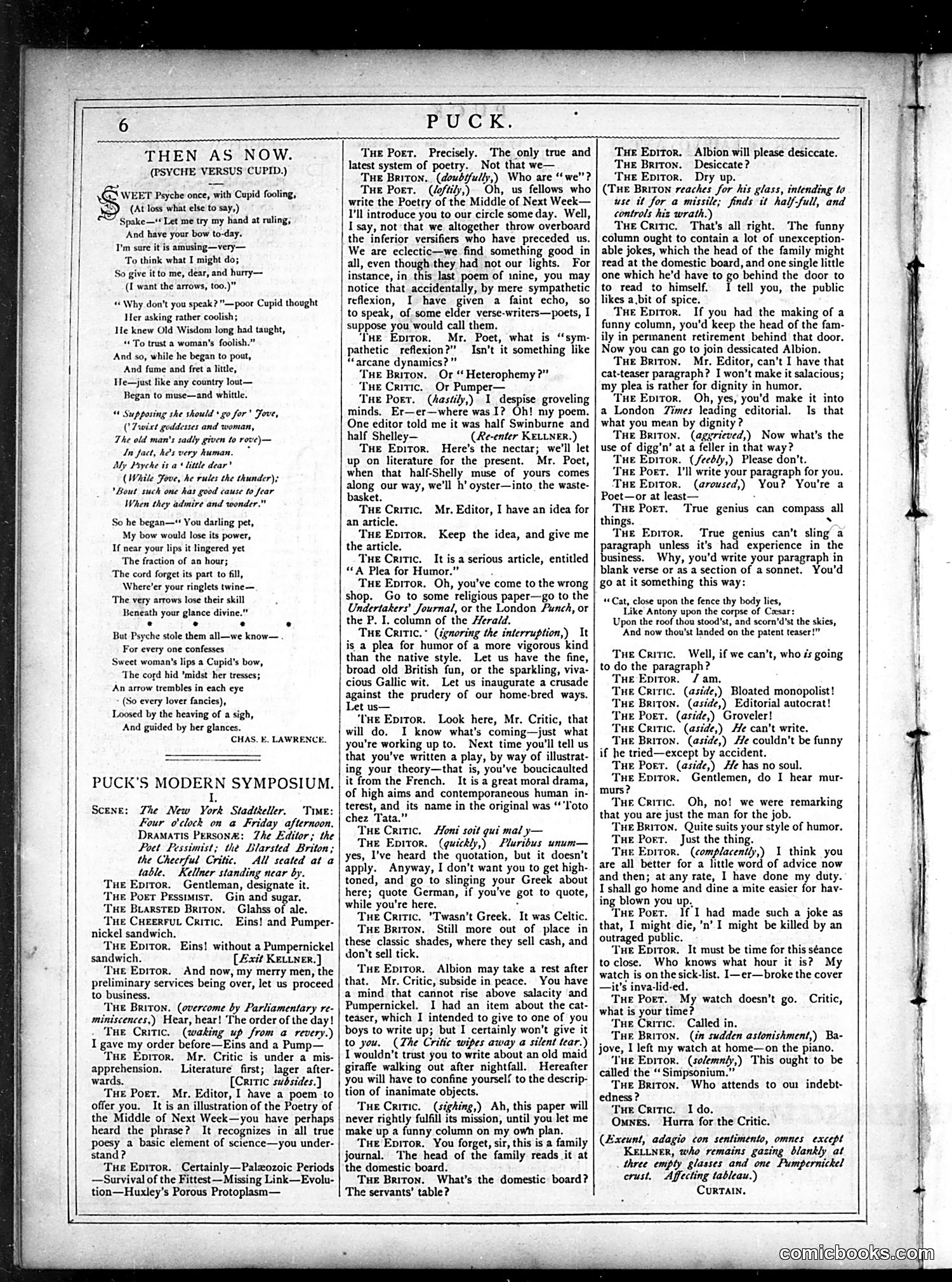
This page contains **"Puck's Modern Symposium,"** a satirical dialogue between various editorial personas (The Editor, The Poet, The Critic, The Barton, etc.) rather than a traditional political cartoon. The humor targets **literary pretension and journalistic self-importance**. The participants debate poetry quality, editorial dignity, and creative standards while making contradictory arguments. References include Greek poetry, religious papers, and contemporary publication debates. The satire mocks both **would-be serious critics** (who take themselves too seriously) and **hack writers** (who lack genuine talent). The dialogue format allows Puck to ridicule multiple literary and editorial types simultaneously—particularly their pompousness and inconsistent reasoning about what constitutes good writing or legitimate humor. The page primarily **ridicules intellectual vanity** rather than addressing specific political events.
📄 Transcribed text from this page (OCR, searchable)
Machine-transcribed from the original scan — historical spelling and the odd misread are preserved.
PUCK. THEN AS NOW. (PSYCHE VERSUS CUPID.) ET Psyche once, with Cupid fooling, (At loss what else to say,) Spake—'“ Let me try my hand at ruling, ‘And have your bow to-day. I'm sure it is amusing—very— To think what I might do; So give it to me, dear, and hurry— (I want the arrows, too.)” “« Why don’t you speak? "—poor Cupid thought Her asking rather coolish; He knew Old Wisdom long had taught, “To trust a woman's foolish.” And so, while he began to pout, ‘And fume and fret a little, He—just like any country lout— Began to muse—and whittle. “« Supposing she should * go for’ Jove, (’Ziwiet goddesses and woman, The old man's sadly given to rove)— In fact, he's very human. * My Pryche isa little dear? (While Jove, he rules the thunder); "Bout such one has good cause to fear When they admire and wonder.” So he began—* You darling pet, My bow would lose its power, If near your lips it lingered yet ‘The fraction of an hours ‘The cord forget its part to fill, Where’er your ringlets twine — The very arrows lose their Beneath your glance divine. . . . . But Psyche stole them all—we know— For every one confesses Sweet woman's lips a Cupid's bow, ‘The cord hid 'midst her tresses; ‘An arrow trembles in each eye (So every lover fancies), Loosed by the heaving of a sigh, ‘And guided by her glances. CHAS. E. LAWRENCE. PUCK'S MODERN SYMPOSIUM. I. The New York Stadtkeller. Four o'clock on a@ Friday afternoon, Dramatis Persone: Zhe Editor; the Scene: Time: Poet Pessimist; the Blarsted Briton; the Cheerful Critic. All seated at a table, Kellner standing near by. Tue Eprtor. Gentleman, designate it. ‘Tue Poer Pessimist. Gin and sugar, ‘Tue Buarstep Briton. Glahss of ale. Tue Cueerrut Critic, Eins! and Pumper- nickel sandwich, ‘Tue Eprtor. Eins! without a Pumpernickel sandwich. (2xit Kettner.) ‘Tue Epitor. And now, my merry men, the preliminary services being over, let us proceed to business. ‘THe Briton. (overcome by Parliamentary re- miniscences,) Hear, hear! The order of the day! Tue Critic. (waking up from a revery.) I gave my order before—Eins and a Pump— Tue Epiror. Mr. Critic is under a mis- apprehension. Literature first; lager after- wards. [Critic subsides.] Tue Poer. Mr. Editor, I have a poem to offer you. It is an illustration of the Poetry of the Middle of Next Week—you have perhaps heard the phrase? It recognizes in all true poesy a basic element of science—you under- stand? Tue Epitor. Certainly—Palxozoic Periods —Survival of the Fittest —Missing Link—Evolu- tion—Huxley’s Porous Protoplasm— Tue Port. Precisely. The only true and latest system of poetry. Not that we— ‘Tue Briton, (doubifully,) Who are we"? Tue Poet. (loftily,) Oh, us fellows who write the Poetry of the Middle of Next Week— I'll introduce you to our circle some day. Well, I say, not that we altogether throw overboard the inferior versifiers who have preceded us. We are eclectic—we find something good in all, even though they had not our lights. For instance, in this last poem of inine, you may notice that accidentally, by mere sympathetic reflexion, I have given a faint echo, so to speak, of some elder verse-writers—poets, I suppose you would call them. ‘Tne Eprtor. Mr. Poet, what is ‘sym- pathetic reflexion?” Isn't it something like “arcane dynamics?” ‘Tue Briton. Or ‘‘ Heterophemy ?” ‘Tue Critic. Or Pumper— Tue Poet. (hastily,) 1 desplee groveling minds. Er—er—where was 1? Oh! my poem. One editor told me it was half Swinburne and half Shelley— (Re-enter KELLNER.) Tue Epitor. Here's the nectar; we'll let up on literature for the present. Mr. Poet, when that half-Shelly muse of yours comes along our way, we'll h’ oyster—into_ the waste- basket. Tue Critic, an article. ‘Tue Epitor. the article. Tue Critic. It is a serious article, entitled “A Plea for Humor.” Tue Eprtor. Oh, you’ve come to the wrong shop. Go to some religious paper—go to the Undertakers’ Journal, or the London Punch, or the P. I. column of the Hera/d. Tue Critic.’ (ignoring the interruption,) It is a plea for humor of a more vigorous kind than the native style. Let us have the fine, broad old British fun, or the sparkling, viva- cious Gallic wit. Let us inaugurate a crusade against the prudery of our home-bred ways. Let us— ‘Tue Eprtor. Look here, Mr. Critic, that will do. I know what's coming—just what you're working up to. Next time you'll tell us that you've written a play, by way of illustrat- ing your theory—that is, you've boucicaulted it from the French. It is a great moral drama, of high aims and contemporaneous human in- terest, and its name in the original was ‘‘‘loto chez Tata.” Tue Critic. Hont soit gui mal y— Tue Epitor. (quickly) Pluribus unum— yes, I’ve heard the quotation, but it doesn’t apply. Anyway, I don’t want you to get high- toned, and go to slinging your Greek about here; quote German, if you've got to quote, while you're here. Tue Critic. *Twasn’t Greek. It was Celtic. Tue Briton. Still more out of place in these classic shades, where they sell cash, and don't sell tick. ‘Tue Epitor. Albion may take a rest after that. Mr. Critic, subside in peace. You have a mind that cannot rise above salacity and Pumpernickel. I had an item about the cat- teaser, which I intended to give to one of you boys to write up; but I certainly won't give it to you. (Zhe Critic wipes away a silent tear.) I wouldn’t trust you to write about an old maid giraffe walking out after nightfall. Hereafter you will have to confine yourself to the descrip- tion of inanimate objects. Tue Critic. (sighing,) Ah, this paper will never rightly fulfill its mission, until you let me make up a funny column on my own plan. Tue Epitor. You forget, sir, this is a family journal. The head of the family reads it at the domestic board. Tue Briton. What's the domestic board? The servants’ table? Mr. Editor, I have an idea for Keep the idea, and give me Tue Eprtor. Tue Briton. Desiccate? ‘Tue Epitor. Dry up. (Tue Briton reaches for his glass, intending to use it for a missile; finds it half-full, and controls his wrath.) Tue Critic. That's all right. The funny column ought to contain a lot of unexception- able jokes, which the head of the family might read at the domestic board, and one single little one which he’d have to go behind the door to to read to himself. I tell you, the public likes a.bit of spice. Tue Eprtor. If you had the making of a funny column, you'd keep the head of the fam- ily in permanent retirement behind that door. Now you can go to join dessicated Albion. Tue Briton. Mr. Editor, can’t I have that cat-teaser paragraph? I won’t make it salacious; my plea is rather for dignity in humor. Tue Epitor. Oh, yes, you'd make it into a London Zimes leading editorial. Is that what you mean by dignity ? Tue Briton. (aggrieved,) Now what's the use of digg’n’ at a feller in that way? Tue Epitor. (feebly,) Please don’t. ‘THE Poet. I'll write your paragraph for you. Tue Epitor. (aroused,) You? You're a Poet—or at least— Tue Port. ‘True genius can compass all things. s Tue Epiror. ‘True genius can’t sling’ a paragraph unless it's had experience in the usiness. Why, you'd write your paragraph in blank verse or as a section of a sonnet. You'd go at it something this way: Albion will please desiccate. “Cat, close upon the fence thy body lies, Tike’ Antony upon the corpse of Caesar: Upon the roof thou stood’st, and scorn’d’st the skies, ‘And now thou’st landed on the patent teaser!” Tue Critic, Well, if we can’t, who és going to do the paragraph? Tue Epitor. / am, Tue Critic. (aside,) Bloated monopolist! Tue Briton. (aside,) Editorial autocrat! Tue Poet. (aside,) Groveler! Tre Critic. (aside,) He can’t write. Tue Briton. (aside,) He couldn't be funny if he tried—except by accident. Tue Port. (aside,) He has no soul. Tue Epitor. Gentlemen, do I hear mur- murs? Tue Critic. Oh, no! we were remarking that you are just the man for the job. THE Briton. Quite suits your style of humor. Tue Port. Just the thing. Tue Epitor. (complacently,) 1 think you are all better for a little word of advice now and then; at any rate, I have done my duty. I shall go ) home and dine a mite easier for hav- ing blown you up, Tue Poet. If I had made such a joke as that, I might die, ’n’ I might be killed by an outraged public. Tue Epitor. It must be time for this séance to close. Who knows what hour it is? watch is on the sick-list. I—er—broke the cover —it’s inva-lid-ed. Tue Poet. My watch doesn’t go. what is your time? Tne Critic. Called in. Tue Briton. (in sudden astonishment) Ba- jove, I left my watch at home—on the piano. ‘THe Eprtor. (solemnly,) This ought to be called the “ Simpsonium.” Tue Briton. Who attends to our indebt- edness ? Tue Critic. Ido. Ones. Hurra for the Critic. (Exeunt, adagio con sentimento, omnes except KELLNER, who remains gazing blankly at three empty glasses and one Pumpernickel crust, Affecting tableau.) Curtain. Critic, |) SS a a | comichooks.