
Puck, 1877-05 · page 14 of 16
Puck — May 1877 — page 14: what you’re looking at
What you’re looking at
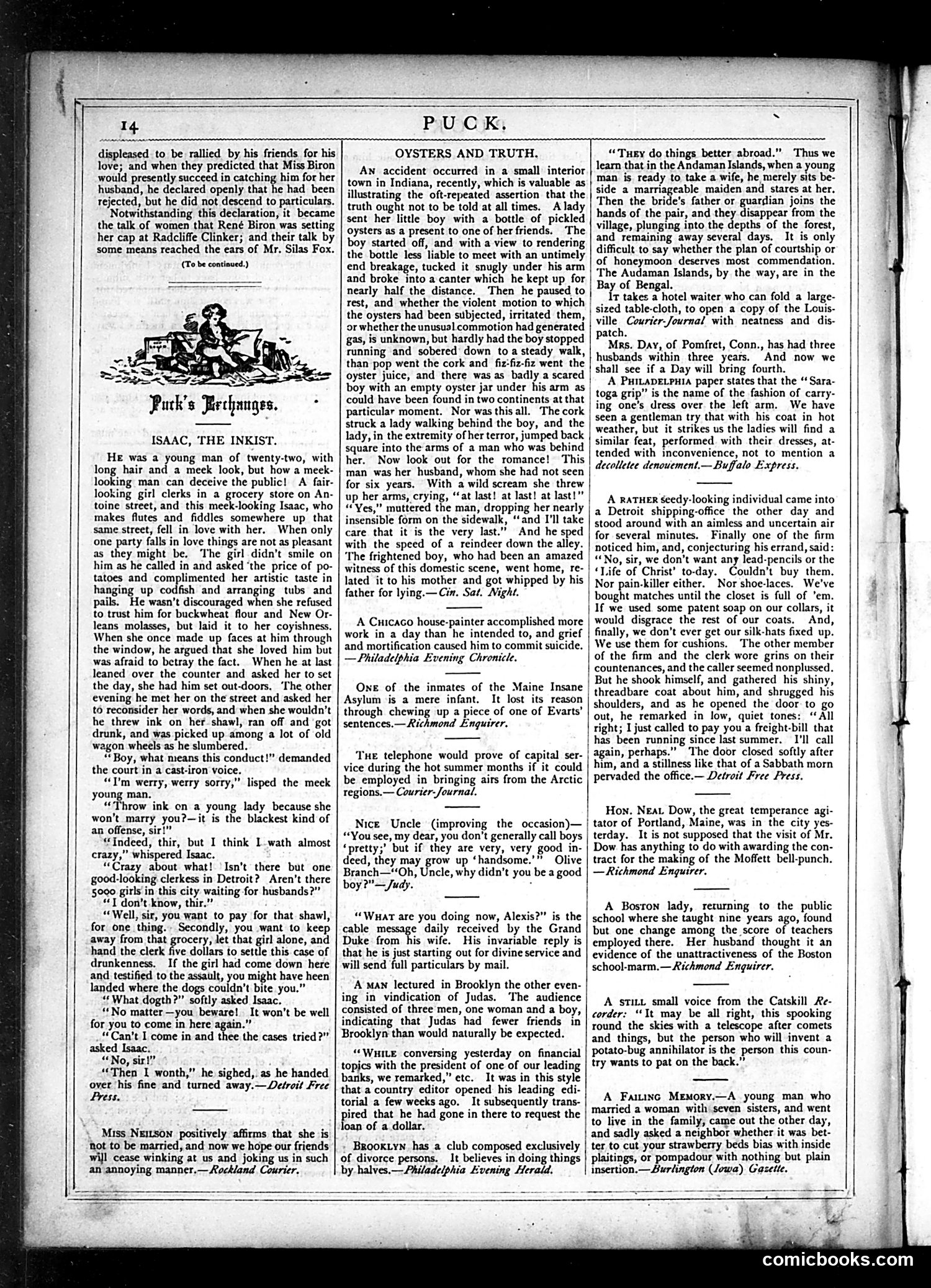
This page contains primarily **text content** rather than political cartoons. The visible cartoon illustration shows "Puck's Arthuages" featuring what appears to be a figure in period dress, though details are unclear at this resolution. The page consists of several humorous short stories and anecdotes with satirical commentary on contemporary life, including pieces titled "Isaac, the Inkist" and "Oysters and Truth." These mock various social types and situations—including clerks, house-painters, and romantic mishaps—typical of Puck's satirical approach. The content targets everyday American foibles rather than specific political figures or events. Without clearer illustration details or dated references in the legible text, the exact satirical targets remain general social commentary rather than specific historical references.
📄 Transcribed text from this page (OCR, searchable)
Machine-transcribed from the original scan — historical spelling and the odd misread are preserved.
14 PUCK. displeased to be rallied by his friends for his love; and when they predicted that Miss Biron would presently succeed in catching. him for her husband, he declared openly that he had been rejected, but he did not descend to particulars. Notwithstanding this declaration, it became the talk of women that René Biron was setting her cap at Radcliffe Clinker; and their talk by some means reached the ears of Mr. Silas Fox. (To be continued.) Puck's Kechanges, — * ISAAC, THE INKIST. HE was a young man of twenty-two, with long hair and a meek look, but how a meek- looking man can deceive the public! A fair- looking girl clerks in a grocery store on An- toine street, and this meek-looking Isaac, who makes flutes and fiddles somewhere up that same street, fell in love with her. When only one party falls in love things are not as pleasant as they might be. The girl didn’t smile on him as he called in and asked ‘the price of po- tatoes and complimented her artistic taste in hanging up codfish and arranging tubs and pails. He wasn’t discouraged when she refused to trust him for buckwheat flour and New Or- leans molasses, but laid it to her coyishness. When she once made up faces at him through the window, he argued that she loved him but was afraid to betray the fact. When he at last leaned over the counter and asked her to set the day, she had him set out-doors. ‘Ihe other evening he met her on the street and asked her to reconsider her words, and when she wouldn’t he threw ink on her shawl, ran off and ‘got drunk, and was picked up among a lot of old wagon wheels as he slumbered. “Boy, what means this conduct!” demanded the court in a cast-iron voice. “Y'm werry, werry sorry,” lisped the meck young man. “Throw ink on a young lady because she won't marry you?—it is the blackest kind of an offense, sir!” “indeed, thir, but I think I-wath almost crazy,” whispered Isaac. “Crazy about what! ‘Isn't there but one good-looking clerkess in Detroit? Aren't there 5000 girls in this city waiting for husbands?” “1 don’t-know, thir.” “Well, sir, you want to pay for that shawl, for one thing.» Secondly, you want to keep away from that grocery, let that girl alone, and hand the clerk ive dollars to settle this case of drunkenness. If the girl had come down here and testified to the assault, you might have heen landed where the dogs couldn’t bite you.” “What dogth?” softly asked Isaac. “No matter—you beware! It won't be well for you to come in here again.” “Can't I come in and thee the cases tried?” asked Isaac. “No, sir!” “‘Then I wonth,” he sighed,. as he handed over his fine and turned away.—Detroit Free Press. Miss NEILsoN positively affirms that she ‘is not to be married, and now we hope our friends will cease winking at us and joking us in such an annoying manner.—Xockland Courier. OYSTERS AND TRUTH. Aw accident occurred in a small interior town in Indiana, recently, which is valuable as illustrating the oft-repeated assertion that the truth ought not to be told at all times. A lady sent her little boy with a bottle of pickled oysters as a present to one of her friends. The boy started off, and with a view to rendering the bottle less liable to meet with an untimely end breakage, tucked it snugly under his arm and broke into a canter which he kept up for nearly half the distance. Then he paused to rest, and whether the violent motion to which the oysters had been subjected, irritated them, or whether the unusual. commotion had generated gas, is unknown, but hardly had the boy stopped running and sobered down to a steady walk, than pop went the cork and fiz-fiz-fiz went the oyster juice, and there was as badly a scared | boy with an empty oyster jar under his arm as could have been found in two continents at that | particular moment. Nor was this all. The cork struck a lady walking behind the boy, and the lady, in the extremity of her terror, jumped back square into the arms of a man who was behind her. Now look out for the romance! This man was her husband, whom she had not seen for six years. With a wild scream she threw up her arms, crying, “at last! at last! at last!” “Yes,” muttered the man, dropping her nearly insensible form on the sidewalk, ‘and I'll take care that it is the very last.” And he sped with the speed of a reindeer down the alley. ‘The frightened boy, who had been an amazed witness of this domestic scene, went home, re- | lated it to his mother and got whipped by his | father for lying.—Cin. Sat. Night. | } A Cnicaco house-painter accomplished more work in a day than he intended to, and grief and mortification caused him to commit suicide. —Philadelphia Evening Chronicle. One of the inmates of the Maine Insane Asylum is a mere infant. It lost its reason | through chewing up a piece of one of Evarts’ sentences.—Richmond Enquirer, ‘Tue telephone would prove of capital ser- vice during the hot summer months if it could be employed in bringing airs from the Arctic regions.— Courier-Journal. Nice Uncle (improving the occasion)— “You see, my dear, you don’t generally call boys ‘pretty;’ but if they are very, very good in- deed, they may from 8 ‘handsome.’” Olive Branch—“Oh, Uncle, why didn’t you be a good boy?"— Judy. a “Wuat are you doing now, Alexis?” is the cable poresge daily received by the Grand Duke from his wife. His invariable reply is that he is just starting out for divine service and will send full particulars by mail. A Man lectured in Brooklyn the other even- ing in vindication of Judas. The audience consisted of three men, one woman and a boy, indicating that Judas had fewer friends in Brooklyn than would naturally be expected. “Wntte conversing yesterday on financial topics with the president of one of our leading banks, we remarked,” etc. It was in this style that a country editor opened his leading edi- torial a few weeks ago. It subsequently trans- ired that he had gone in there to request the loan of a dollar. Brooktyn_ has a club composed exclusively of divorce persons. It believes in doing things by halves.—Philadelphia Evening Herald, “Tuy do things better abroad.” Thus we learn that in the Andaman Islands, when a young man is ready to take a wife, he merely sits be- side a marriageable maiden and stares at her. Then the bride's father or guardian joins the hands of the pair, and they disappear from the village, plunging into the depths of the forest, and remaining away several days, It is only difficult to say whether the plan of courtship or of honeymoon deserves most commendation. ‘The Audaman Islands, by the way, are in the Bay of Bengal. 't takes a hotel waiter who can fold a large- sized table-cloth, to open a copy of the Louis- ville Courier-Journal with neatness and dis- patch. Mrs. Day, of Pomfret, Conn., has had three husbands within three years. And now we shall see if a Day will bring fourth. A PHILADELPHIA paper states that the “ Sara- toga grip” is the name of the fashion of carry- ing one’s dress over the left arm. We have seen a gentleman try that with his coat in hot weather, but it strikes us the ladies will find a similar feat, performed. with their dresses, at- tended with inconvenience, not to mention a decollelee denowement.— Buffalo Express. A RATHER Seedy-looking individual came into a Detroit shipping-office the other day and stood around with an aimless and uncertain air for several minutes. Finally one of the firm noticed him, and, conjecturing his errand, said: “No, sir, we don’t want any lead-pencils or the “Life of Christ’ to-day. Couldn't buy them. Nor pain-killer either. Nor shoe-laces. We've bought matches until the closet is full of em. If we used some patent soap on our collars, it would disgrace the rest of our coats. And, finally, we don’t ever get our silk-hats fixed up. We use them for cushions. The other member of the firm and the clerk wore grins on their countenances, and the caller seemed nonplussed. But he shook himself, and gathered his shiny, threadbare coat about him, and shrugged his shoulders, and as he opened the door to go out, he remarked in low, quiet tones: ‘All right; I just called to pay you a freight-bill that | has been running since last summer. I'll call | again, perhaps.” ‘The door closed softly after him, and a stillness like that of a Sabbath morn pervaded the office.— Detroit Free Press. Hon. Neat Dow, the great temperance agi- tator of Portland, Maine, was in the city yes- terday. It is not supposed that the visit of Mr. Dow has anything to do with awarding the con- tract for the making of the Moffett bell-punch. —Richmond Enquirer. A Boston lady, returning to the public school where she taught nine years ago, found but one change among the score of teachers employed there. Her husband thought it an evidence of the unattractiveness of the Boston school-marm.— Richmond Enquirer. A sit small voice from the Catskill Re- corder: ‘It may be all right, this spooking round the skies with a telescope after comets and things, but the person who will invent a potato-bug annihilator is the person this coun- try wants to pat on the back.” A Fawinc Memory.—A young man who married a woman with seven sisters, and went to live in the family, came out the other day, and sadly asked a neighbor whether it was bet- ter to cut your strawberry beds bias with inside plaitings, or pompadour with nothing but plain insertion.— Burlington (Jowa) Gasette. nade comicbooks.com