
Puck, 1877-05 · page 12 of 16
Puck — May 1877 — page 12: what you’re looking at
What you’re looking at
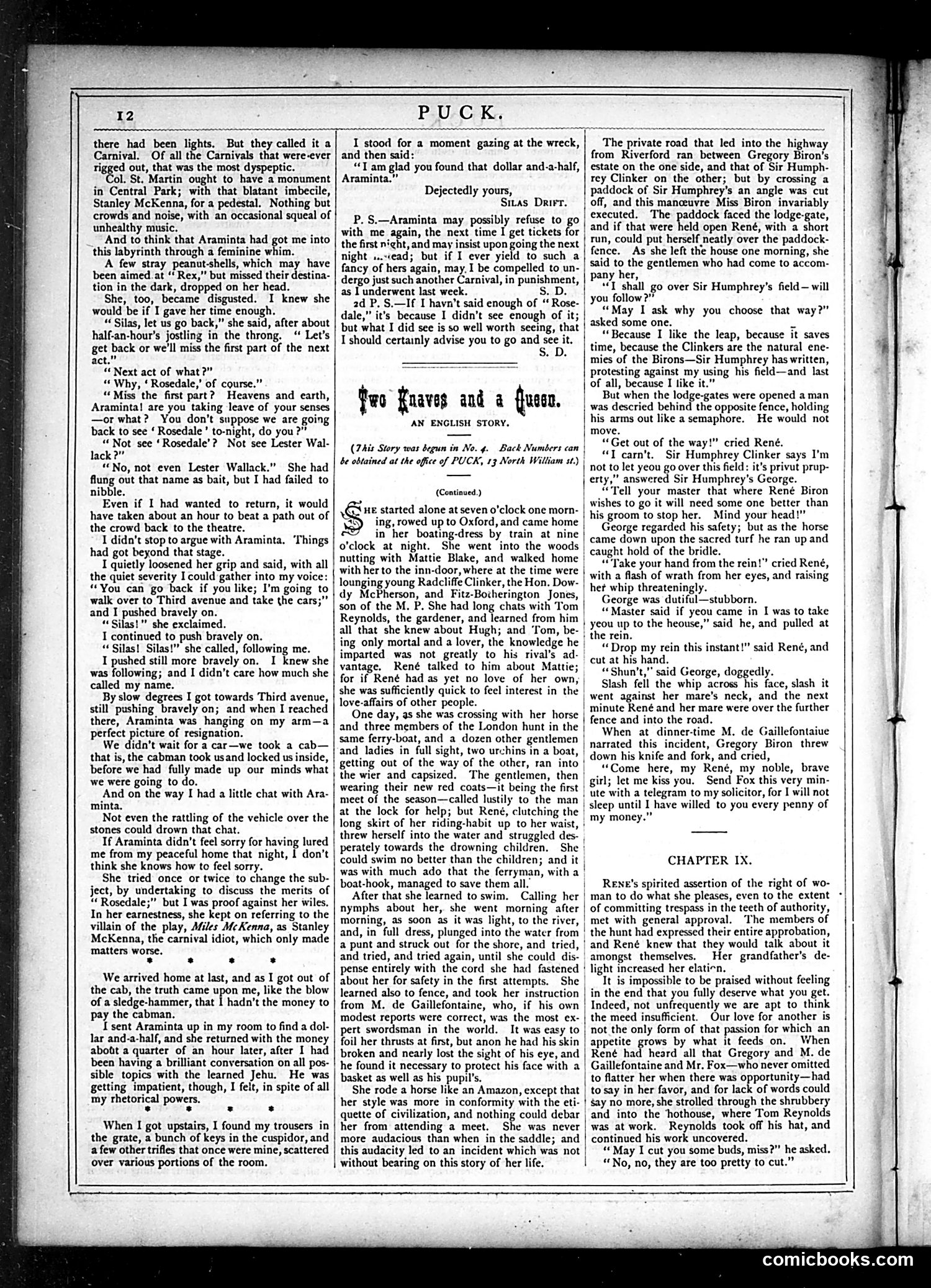
This page from *Puck* magazine contains primarily **serialized fiction** rather than political satire or cartoon content. The text shows "Two Knaves and a Queen: An English Story" (continued from an earlier installment), a narrative about romantic entanglements involving characters named René, Sir Humphrey Clinker, George, and Mattie. The story focuses on domestic drama—a woman's choices between suitors, complications involving horses and social gatherings, and swimming incidents. There appears to be **no political cartoon or satire** on this particular page. The page also includes practical correspondence from readers ("Detectfully yours, Silas Drift") and editorial responses, typical of *Puck*'s miscellaneous content sections, though these lack clear political or satirical targets visible in the provided text.
📄 Transcribed text from this page (OCR, searchable)
Machine-transcribed from the original scan — historical spelling and the odd misread are preserved.
12 PUCK. there had been lights. But they called it a Carnival. Of all the Carnivals that were-ever rigged out, that was the most dyspeptic. ol. St. Martin ought to have a monument in Central Park; with that blatant imbecile, Stanley McKenna, for a pedestal. Nothing but crowds and noise, with an occasional squeal of unhealthy music. And to think that Araminta had got me into this labyrinth through a feminine whim. A few stray peanut-shells, which may have been aimed.at ‘‘ Rex,” but missed their destina- tion in the dark, dropped on her head. She, too, became disgusted. I knew she would be if I gave her time enough. “ Silas, let us go back,” she said, after about half-an-hour’s jostling in the throng. “ Let’s get back or we'll miss the first part of the next act. “Next act of what?” “ Why, ‘ Rosedale,’ of course.” “Miss the first part? Heavens and earth, Araminta! are you taking leave of your senses —or what? You don’t suppose we are going back to see ‘ Rosedale ’ to-night, do you ?” “Not see ‘Rosedale’? Not see Lester Wal- lack?” ‘No, not even Lester Wallack.” She had flung out that name as bait, but I had failed to nibble. Even if I had wanted to return, it would have taken about an hour to beat a path out of the crowd back to the theatre. I didn’t stop to argue with Araminta. ‘Things had got beyond that stage. I quietly loosened her grip and said, with all the quiet severity I could gather into my voice: “You can go back if you like; I'm going to walk over to Third avenue and take the cars;”" and I pushed bravely on. “Silas!” she exclaimed. I continued to push bravely on. “Silas! Silas!” she called, following me. I pushed still more bravely on. I knew she was following; and I didn’t care how much she called my name. By slow degrees I got towards Third avenue, still pushing bravely on; and when I reached there, Araminta was hanging on my arm—a perfect picture of resignation. We didn’t wait for a car—we took a cab— that is, the cabman took usand locked us inside, before we had fully made up our minds what we were going to do. And on the way I had a little chat with Ara- minta, Not even the rattling of the vehicle over the stones could drown that chat. If Araminta didn’t feel sorry for having lured me from my peaceful home that night, 1 don’t think she knows how to feel sorry. She tried once or twice to change the sub- ject, by undertaking to discuss the merits of “ Rosedale; but I was proof against her wiles. In her earnestness, she kept on referring to the villain of the play, Miles McKenna, as Stanley McKenna, the carnival idiot, which only made matters worse. ry We arrived home at last, and as I got out of the cab, the truth came upon me, like the blow of a sledge-hammer, that | hadn’t the money to pay the cabman. {sent Araminta up in my room to find a dol- lar and-a-half, and she returned with the money abott a quarter of an hour later, after I had been having a brilliant conversation on all pos- sible topics with the learned Jehu. He was getting impatient, though, I felt, in spite of all my thetorical powers. When I got upstairs, I found my trousers in the grate, a bunch of keys in the cuspidor, and a few other trifles that once were mine, scattered over various portions of the room. I stood for a moment gazing at the wreck, and then said: “T am glad you found that dollar and-a-half, Araminta.” Dejectedly yours, Stas Drirr. P. S.—Araminta may possibly refuse to Fs with me again, the next time I get tickets for | the first night, and may insist upon going the next night ...«ead; but if I ever yield to such a fancy of hers again, may. 1 be compelled to un- dergo just such another Carnival, in punishment, as l underwent last week. Ss. D. 2d P. S.—If I havn’t said enough of “ Rose- | dale,” it's because I didn’t see enough of it; but what I did see is so well worth seeing, that I should certainly advise you to go and see it. feo fuaves and a queen. AN ENGLISH STORY. (This Story was begun in No. ¢. Back Numbers can be obtained at the office of PUCK, 13 North William st.) ww (Continued.) HE started alone at seven o'clock one morn- ing, rowed up to Oxford, and came home in her boating-dress by train at nine o'clock at night. She went into the woods | nutting with Mattie Blake, and walked home | with her to the inn-door, where at the time were | lounging young Radcliffe Clinker, the Hon. Dow- dy McPherson, and Fitz-Botherington Jones, son of the M. P. She had long chats with Tom Reynolds, the gardener, and learned from him all that she knew about Hugh; and Tom, be- ing only mortal and a lover, the knowledge he imparted was not greatly to his rival's ad- vantage. René talked to him about Mattie; for if René had as yet no love of her own, she was sufficiently quick to feel interest in the love-affairs of other people. One day, as she was crossing with her horse and three members of the London hunt in the same ferry-boat, and a dozen other gentlemen and ladies in full sight, two urchins in a boat, | getting out of the way of the other, ran into | | the wier and capsized. The gentlemen, then | wearing their new red coats—it being the first | meet of the season—called lustily to the man at the lock for help; but René, clutching the long skirt of her riding-habit up to her waist, | threw herself into the water and struggled des- , perately towards the drowning children, She | could swim no better than the children; and it was with much ado that the ferryman, with a boat-hook, managed to save them all. \ After that she learned to swim. Calling her nymphs about her, she went morning after morning, as soon as it was light, to the river, and, in full dress, plunged into the water from a punt and struck out for the shore, and tried, | and tried, and tried again, until she could dis- pense entirely with the cord she had fastened about her for safety in the first attempts. She learned also to fence, and took her instruction from M. de Gaillefontaine, who, if his own modest reports were correct, was the most ex- pert swordsman in the world. It was easy to foil her thrusts at first, but anon he had his skin broken and nearly lost the sight of his eye, and he found it necessary to protect his face with a basket as well as his pupil's. She rode a horse like an Amazon, except that her style was more in conformity with the eti- quette of civilization, and nothing could debar her from attending a meet. She was never more audacious than when in the saddle; and this audacity led to an incident which was not | | without bearing on this story of her life, The private road that led into the highway from Riverford ran between Gregory Biron’s estate on the one side, and that of Sir Humph- rey Clinker on the other; but by crossing a paddock of Sir Humphrey’s an angle was cut off, and this manceuvre Miss Biron invariably executed. The paidock faced the lodge-gate, and if that were held open René, with a short | run, could put herself neatly over the paddock- fence. As she left the house one morning, she said to the gentlemen who had come to accom- pany her, “I shall you follow ? “May I ask why you choose that way?” asked some one. fe “Because I like the leap, because it saves time, because the Clinkers are the natural ene- mies of the Birons—Sir Humphrey has written, protesting against my using his field—and last of all, because I like it.” But when the lodge-gates were opened aman was descried behind the opposite fence, holding his arms out like a semaphore. He would not move. “Get out of the way!” cried René. “TI carn't.. Sir Humphrey Clinker says I'm not to let yeou go over this field: it’s privut prup- erty,” answered Sir Humphrey's George. “Tell your master that where René Biron go over Sir Humphrey's field — will | wishes to go it will need some one better than his groom to stop her. Mind your head!” George regarded his safety; but as the horse came down upon the sacred turf he ran up and caught hold of the bridle. “Take your hand from the rein!” cried René, with a flash of wrath from her eyes, and raising het whip threateningly. George was dutiful—stubborn. “Master said if yeou came in I was to take yeou up to the heouse,” said he, and pulled at | the rein. “Drop my rein this instant!” said René, and cut at his hand. “Shun't,” said George, doggedly. Slash fell the whip across his face, slash it went against her mare's neck, and the next minute René and her mare were over the further fence and into the road. When at dinner-time M. de Gaillefontaiue | narrated this incident, Gregory Biron threw down his knife and fork, and cried, “Come here, my René, my noble, brave girl; let me kiss you. Send Fox this very min- ute with a telegram to my solicitor, for I will not | sleep until I have willed to you every penny of my money.” CHAPTER IX, Rene’s spirited assertion of the right of wo- man to do what she pleases, even to the extent of committing trespass in the teeth of authority, met with general approval. ‘The members of the hunt had expressed their entire approbation, and René knew that they would talk about it amongst themselves. Her grandfather's de- light increased her elatien. It is impossible to be praised without feeling in the end that you fully deserve what you get. Indeed, not unfrequently we are apt to think the meed insufficient. Our love for another is not the only form of that passion for which an appetite grows by what it feeds on. When René had heard all that Gregory and M. de Gaillefontaine and Mr. Fox—who never omitted to flatter her when there was Spportunity had to say in her favor, and for lack of words could gay no more, she strolled through the shrubbery and into the ‘hothouse, where Tom Reynolds was at work. Reynolds took off his hat, and continued his work uncovered. “May I cut you some buds, miss?” he asked. “No, no, they are too pretty to cut.” comicbooks.com